Bilbilis: An Ancient Celtiberian and Roman City in Spain
Table of Contents




Visitor Information
Google Rating: 4
Popularity: Low
Google Maps: View on Google Maps
Official Website: yacimientoarqueologicobilbilis.wordpress.com
Country: Spain
Civilization: Roman
Remains: City

Context
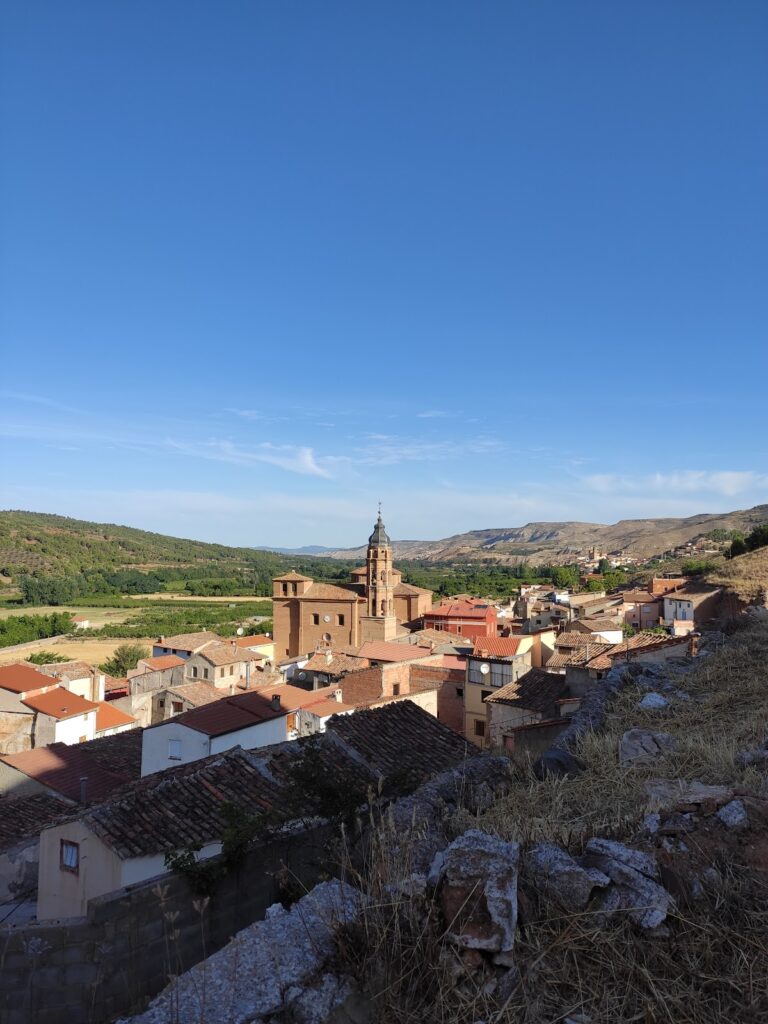
Bilbilis is an archaeological site situated near the modern city of Calatayud in Zaragoza province, within the autonomous community of Aragon, Spain. It occupies a prominent rocky hill overlooking the Jalón valley, part of the larger Ebro river basin. This elevated position provided natural defensive advantages and proximity to watercourses, factors that influenced its initial settlement and sustained occupation.
Archaeological investigations have documented continuous human presence at Bilbilis from the late Iron Age through the Roman period. Initially established as a Celtiberian fortified settlement, the site later underwent significant transformation under Roman rule, as evidenced by inscriptions and material culture reflecting municipal institutions and Romanization processes. Literary sources identify Bilbilis as the birthplace of the Latin poet Martial, underscoring its cultural relevance. Stratigraphic data and artifact distributions indicate a decline and eventual abandonment during Late Antiquity.
Systematic archaeological research, primarily conducted by Spanish scholars since the twentieth century, has revealed extensive architectural remains and a rich corpus of inscriptions. The preservation of stone structures and in situ deposits allows ongoing scholarly study and controlled public access. Numerous artifacts recovered from Bilbilis are curated in local and regional museums, contributing to the understanding of its historical trajectory.
History
Bilbilis exemplifies the evolution of a Celtiberian tribal center into a Roman municipium, reflecting broader political, cultural, and administrative developments in the Iberian Peninsula. Its strategic location near important communication routes and water resources shaped its role from the late Iron Age through the Roman imperial era. The city experienced significant urban growth and architectural transformation under Roman rule, achieving prominence in the early imperial period before entering a phase of decline in Late Antiquity. Following abandonment, the site’s ruins were repurposed by neighboring communities and later rediscovered through archaeological inquiry.
Celtiberian Period (2nd–1st century BCE)
During the late Iron Age, Bilbilis functioned as a principal settlement of the Lusones, a Celtiberian tribe inhabiting the Ebro basin. The community was established on the Bámbola and San Paterno hills, where it operated as a fortified castro serving as a tribal capital. Archaeological evidence confirms the minting of local coinage inscribed with Iberian script, indicating organized political authority and economic activity. The settlement’s strategic position near a Roman military road connecting Caesaraugusta (modern Zaragoza) and Emerita Augusta (Mérida) facilitated interaction between Celtiberian territories and Mediterranean trade networks. Ancient authors, notably Strabo, mention Bilbilis in the context of the Sertorian Wars, underscoring its regional significance during this period.
Roman Conquest and Augustan Urbanization (1st century BCE – 1st century CE)
Following the Roman conquest of the Iberian Peninsula, Bilbilis was incorporated into the province of Tarraconensis. The indigenous population underwent gradual Romanization, adopting Latin language, Roman customs, and municipal governance structures. Under Emperor Augustus, the settlement was elevated to the status of municipium Romanum and renamed Augusta Bilbilis, formally integrating it into the Roman provincial administration within the conventus Caesaraugustanus. This period witnessed extensive urban development, including the construction of monumental public buildings such as a forum complex comprising a porticoed plaza, a hexastyle Corinthian temple, a two-nave basilica, a curia, and cryptoporticoes. Additionally, a theater and public baths were erected, reflecting Roman civic and social practices.
The city’s urban plan adapted to the challenging topography of three hills—Bámbola, Santa Bárbara, and San Paterno—through terraced streets, ramps, and stairways. Defensive walls with multiple watchtowers and two principal gates enclosed the approximately 30-hectare urban area. A sophisticated hydraulic system was developed, consisting of at least 62 stone cisterns sealed with cement and interconnected by lead or ceramic pipes. This system, lacking evidence of an aqueduct, likely sourced water from rainwater collection, river transport, and deep wells, supporting both public amenities and private households. These infrastructural improvements primarily date to Augustan reforms and were expanded during the 1st and 2nd centuries CE, particularly under the Flavian dynasty.
Imperial Roman Period (1st–3rd century CE)
Augusta Bilbilis reached its demographic and cultural apex during the early Roman Empire, especially under the reigns of Augustus through Trajan. The city’s population is estimated at 3,000 to 3,500 inhabitants, comprising Roman citizens, local elites, veterans, and artisans. The city continued to mint coins inscribed with “Augusta Bilbilis” during the reigns of Augustus, Tiberius, and Caligula, reflecting sustained municipal identity and economic activity. Modifications to the forum during Trajan’s rule indicate ongoing civic investment.
The theater, modeled after the Theatre of Pompey in Rome, served as a venue for public performances and imperial cult worship. A small sacellum located above the upper seating rows housed sculptural portraits of the Julio-Claudian dynasty, including a rare marble head of Emperor Augustus with a veiled head (“capite velato”) discovered beneath the theater stage in 2009. The city was also the birthplace of the Latin poet Marcus Valerius Martialis (Martial), who celebrated and critiqued his hometown in his epigrams, providing valuable literary insight into local society. The urban fabric included well-appointed private residences featuring amenities such as private baths and decorative flooring, illustrating the Romanization of local elites and the adoption of Mediterranean domestic culture.
Decline and Abandonment (3rd–5th century CE)
From the 3rd century CE onward, Augusta Bilbilis experienced a gradual decline amid broader regional transformations affecting Roman Hispania. Many inhabitants relocated to rural villas or the provincial capital Caesaraugusta, leading to depopulation and contraction of urban life. Archaeological evidence indicates that public buildings fell into disuse and domestic life became more modest. Economic activities diminished, and social stratification likely weakened as elite families departed or lost influence. The abandonment of communal amenities such as baths and theaters reflects a reduction in public social practices.
By the 4th and 5th centuries CE, Bilbilis was effectively deserted as a functioning city. No substantial evidence exists for early medieval reoccupation, although a small necropolis dating to the 12th or 13th century suggests limited sporadic use of the site. The loss of municipal institutions and civic structures marked the end of Bilbilis’s role within the Roman provincial framework.
Post-Roman Period and Early Modern Reuse (11th–19th century)
Following the foundation of nearby Calatayud in the 11th century by Arab settlers, the ruins of Bilbilis remained a prominent but uninhabited landmark. Over subsequent centuries, the site’s stone and marble materials were extensively quarried and repurposed for construction in Calatayud and surrounding villages. Elements from Bilbilis were incorporated into churches, theaters, and other public buildings, reflecting practical reuse rather than continuous occupation. No evidence indicates permanent settlement or economic activity at Bilbilis during this period, which functioned primarily as a source of building materials and a historical reference point linked to the region’s Roman heritage.
Archaeological Research and Modern Preservation (18th century–present)
Interest in Bilbilis’s antiquities began in the 18th century with excavations conducted by Jesuit monks, who collected inscriptions and coins; however, this early collection was lost following the order’s expulsion. Sporadic archaeological investigations occurred in the early 20th century, including work by Prince de Samitier, Narciso Sentenach, Adolfo Schulten, and General Lammerer. Systematic scientific excavations resumed in 1971 under Manuel Martín-Bueno and have continued annually, uncovering the city’s urban layout, monumental architecture, hydraulic infrastructure, and rich epigraphic and material remains.
The 2009 discovery of the marble head of Augustus beneath the theater stage underscored the site’s imperial connections. Bilbilis was declared a protected historic monument in 1931 and is currently managed as a state archaeological reserve with controlled public access. Many artifacts from the site are exhibited in the Museum of Calatayud. Since 2007, digital reconstruction projects have enhanced understanding of the city’s historical appearance and significance, supporting both scholarly research and heritage education.
Daily Life and Importance by Period
Celtiberian Period (2nd–1st century BCE)
During the Celtiberian period, Bilbilis was a fortified tribal center inhabited by the Lusones. The social structure likely included warrior elites and local chieftains governing through kinship ties. The minting of coins with Iberian inscriptions indicates organized political authority and economic control. Subsistence activities centered on agriculture, animal husbandry, and local crafts, supporting a self-sufficient community. The settlement’s location near a Roman military road facilitated trade and communication with neighboring tribes and Mediterranean markets. Domestic architecture was adapted to the rocky hilltop terrain, though detailed remains are limited. Religious practices probably involved indigenous deities, but no specific sanctuaries have been identified.
Roman Conquest and Augustan Urbanization (1st century BCE – 1st century CE)
Following Roman conquest, Bilbilis transformed into a Roman municipium, Augusta Bilbilis, with a diversified population including Roman veterans and Italian colonists alongside indigenous Celtiberians. Inscriptions attest to municipal magistracies such as duumviri and aediles, reflecting Roman administrative organization. Economic activities expanded to include specialized crafts and local manufacturing, supported by workshops. Imported materials like Italian marble and pigments were used in domestic decoration, indicating elevated living standards. Private houses featured mosaic floors, painted walls, and private baths. The forum served as a commercial and social hub, while religious life incorporated Roman deities and the imperial cult, evidenced by temples and shrines within the forum and theater. The city functioned as a provincial administrative center within Tarraconensis.
Imperial Roman Period (1st–3rd century CE)
At its height, Augusta Bilbilis housed a population of 3,000 to 3,500, including Roman citizens, veterans, local elites, and artisans. Civic inscriptions document magistrates and priests involved in governance and religious rites. Public institutions such as the theater, forum, and baths were focal points for entertainment, political assembly, and social interaction. The poet Martial’s writings provide literary insight into local customs and social dynamics. Agriculture remained the economic foundation, supplemented by crafts and coin minting. The city’s continued coinage issuance under successive emperors reflects economic vitality. Religious observance included imperial cult worship, with the theater sacellum housing portraits of the Julio-Claudian family. The municipium maintained administrative, judicial, and religious functions within the province.
Decline and Abandonment (3rd–5th century CE)
From the 3rd century onward, Augusta Bilbilis underwent demographic decline as inhabitants migrated to rural estates or Caesaraugusta. Public buildings fell into disuse, and domestic life contracted to smaller, less elaborate households. Economic activities became localized and subsistence-oriented, with diminished craft production and trade. Communal social practices declined, as evidenced by the abandonment of baths and theaters. Religious activities likely persisted in reduced forms, but no new cult centers emerged. By the 4th and 5th centuries, the city was effectively deserted, marking the end of its municipal role.
Post-Roman Period and Early Modern Reuse (11th–19th century)
During this period, Bilbilis was uninhabited but served as a quarry for building materials used in Calatayud and nearby villages. Stone blocks, marble cladding, and architectural fragments were incorporated into churches and public buildings. No evidence indicates permanent settlement or economic activity at the site. The ruins retained cultural significance as a historical landmark linked to the Roman past.
Archaeological Research and Modern Preservation (18th century–present)
Modern archaeological investigations have revealed the complexity of Bilbilis’s urban organization, social structure, and cultural practices. Excavations have uncovered public buildings, domestic spaces, inscriptions, and artifacts illuminating municipal governance, economic roles, and religious life. The discovery of the marble head of Augustus and richly decorated interiors has enhanced understanding of the city’s integration into Roman imperial culture. Preservation efforts have safeguarded the site’s remains, ensuring its continued contribution to regional heritage and scholarly research.
Remains
Architectural Features
Bilbilis is situated on a steep rocky hill approximately 1500 by 800 meters at its base, rising about 200 meters above the river level. The city was enclosed by defensive walls constructed in the 1st century CE, featuring numerous watch and supporting towers. Two principal gates controlled access: one near the river plain and another oriented toward the theater complex. The enclosed urban area covers roughly 30 hectares. The settlement’s layout adapted to the uneven terrain through terraced construction on the slopes of the Bámbola, Santa Bárbara, and San Paterno hills, connected by inclined streets, ramps, and stairways. Building techniques include ashlar masonry and stone foundations, with some use of Roman concrete. The architectural ensemble reflects a primarily civic and residential character, with public buildings concentrated in the forum and entertainment zones, and domestic quarters occupying the hillsides.
Over time, Bilbilis evolved from a fortified Celtiberian castro into a Roman municipium with significant urban development during the 1st century CE. The city’s infrastructure expanded notably under Augustus and later emperors, including the Flavian dynasty and Trajan. From the 3rd century CE onward, many buildings fell into disuse, and extensive quarrying from the 16th to 19th centuries removed substantial architectural elements. Despite this, considerable remains survive, enabling detailed study of the city’s layout and construction methods.
Key Buildings and Structures
Forum Complex
The forum was constructed in the early 1st century CE during Emperor Tiberius’s reign, funded by Emilus, a local citizen. It occupies several natural terraces reshaped by extensive earthworks. The complex centers on a large rectangular plaza measuring approximately 48.6 by 44.9 meters, surrounded by a portico. A prominent feature is a 12-meter-high hexastyle peripteral temple of Corinthian order, accessed by a monumental staircase about 6 meters high. The forum also includes a two-nave basilica and a curia (council chamber), as well as a cryptoporticus (covered corridor) completing the ensemble. Side terraces contained tabernae (shops) and possibly residential rooms. Modifications to the forum occurred during Emperor Trajan’s reign in the early 2nd century CE. The forum served as the administrative and cultural center of Bilbilis and was architecturally integrated with the adjacent theater.
Theater
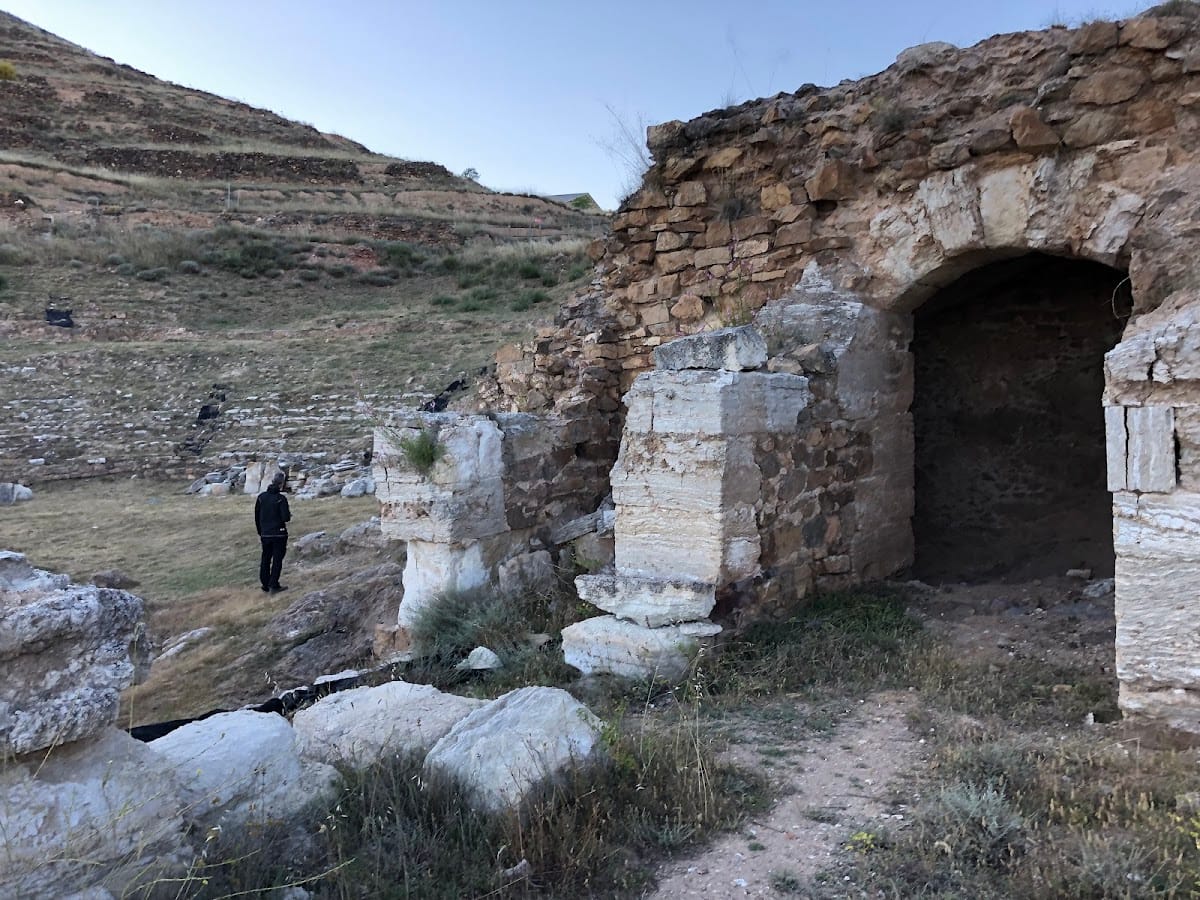
The theater was built in the 1st century CE as part of a unified architectural complex with the forum, modeled after the Theatre of Pompey in Rome. The stage measured approximately 20 meters in width. Seating was arranged semicircularly on the slopes between the Bámbola and Santa Bárbara hills, comprising 30 rows of seats with a capacity of up to 4,600 spectators. The theater accommodated city residents, nearby rural populations, and soldiers. Above the uppermost seating rows stood a small sacellum (shrine) dedicated to the imperial cult, housing sculptural portraits of the Julio-Claudian family. Notably, a 43-centimeter-tall marble head of Emperor Augustus, carved from Spanish marble and depicting him with a veiled head (“capite velato”), was discovered beneath the theater stage in 2009. The theater’s seating area (cavea) underwent restoration and detailed study in 2005.
Water Supply System
Bilbilis featured an advanced Roman hydraulic system developed primarily during Augustan urban reforms and expanded in the 1st to late 2nd centuries CE, especially under the Flavian dynasty. The system comprises 62 known stone cisterns of various sizes and types, sealed with cement and interconnected by lead or ceramic pipes. No aqueduct supplied the city; water sources likely included rainwater collection, river water transported by carts, and deep wells. Some cisterns remained in use for potable water supply into the 20th century. This infrastructure supported public amenities and private households, demonstrating complex urban water management.
Bath Complexes (Thermae)
At least two public bath complexes existed, with the western baths on the Bámbola hill slope fully excavated. These baths date to the 1st century CE and are modest in size compared to those in larger cities such as Caesaraugusta or Rome. The bath layout includes the essential functional rooms: apodyterium (changing room with storage lockers), frigidarium (cold room), tepidarium (warm room), and caldarium (hot room). The caldarium contained a labrum (basin) comparable in size to that found in the Old Baths of Pompeii. The baths employed a hypocaust heating system to warm the floors of the hot rooms. Wall paintings and ceramic tile floors with decorative motifs were uncovered. Water was supplied from nearby cisterns, and wastewater drained through a cloaca (sewer) system.
Residential Buildings (Houses and Insulae)
Residential quarters were arranged on terraces along the slopes of the Santa Bárbara, San Paterno, and Bámbola hills. Excavations conducted between 1996 and 2004 revealed several insula-type houses near the baths, including the “Casa de la Fortuna” and “Casa de los Signina.” These dwellings illustrate the domestic architecture and elevated living standards of Bilbilis’s inhabitants. Some houses contained private bathing rooms (balneum). Buildings were connected by inclined streets, ramps, and stairways, adapting to the uneven terrain. Construction materials included stone foundations and walls, with interior decoration such as mosaics and painted plaster in some cases.
City Walls and Gates
The city was enclosed by defensive walls constructed in the 1st century CE, featuring numerous watch and supporting towers. The walls followed the contours of the hill, enclosing an area of about 30 hectares. Two main gates provided controlled access: one near the river plain and another leading toward the theater complex. The walls were built using ashlar masonry and local stone. Although partially preserved, many sections have collapsed or were dismantled over time, with stones repurposed in later constructions.
Temple within the Forum Complex
The hexastyle peripteral temple of Corinthian order, built in the early 1st century CE, stands on the forum plaza. It rises approximately 12 meters high and is accessed by a monumental staircase about 6 meters tall. The temple forms part of the forum’s monumental ensemble and is constructed of finely cut stone blocks. Architectural features include Corinthian capitals and a classical entablature. The remains comprise foundations, staircases, and column fragments. The temple symbolized Roman religious and civic identity within the city.
Basilica and Curia within the Forum Complex
The basilica, constructed in the 1st century CE, features two naves and is integrated into the forum complex. It served administrative and judicial functions. Adjacent to the basilica is the curia, a council or assembly building, also dating to the 1st century CE. Both structures are built of stone masonry and include vaulted rooms. Their remains consist of foundations, wall segments, and floor surfaces, reflecting the city’s political organization.
Sacellum (Theater Shrine)
A small sacellum dedicated to the imperial cult is located above the upper seating rows of the theater. Built in the 1st century CE, it housed sculptural portraits of the Julio-Claudian dynasty. The marble head of Emperor Augustus discovered beneath the theater stage in 2009 is associated with this shrine. The sacellum’s remains include foundation stones and sculptural fragments, underscoring the city’s participation in imperial religious practices.
Other Public Structures
Bilbilis contained monumental fountains known as nymphaea, although details about their precise locations and architectural features remain limited. The city also possessed a complex sewer system with drainage pipes for wastewater removal, integrated into the urban infrastructure. These features date primarily to the 1st and 2nd centuries CE and were constructed using stone and ceramic materials.
Other Remains
Archaeological evidence includes tabernae (shops) located on terraces adjacent to the forum plaza, some of which may have included residential rooms. Surface traces and architectural fragments across the site have helped identify various structures, including domestic and economic buildings. Extensive quarrying from the 16th to 19th centuries removed many architectural elements, significantly reducing the visible remains of the ancient city.
Archaeological Discoveries
Excavations at Bilbilis have uncovered numerous inscriptions, including dedicatory texts and municipal records primarily dating from the 1st to 3rd centuries CE. These inscriptions provide evidence of local administrative institutions and Romanization processes. Coins minted by the city, bearing the name Augusta Bilbilis, span the Augustan through Trajanic periods, reflecting economic activity and municipal identity.
Pottery finds include a variety of tableware, storage jars, and amphorae, some locally produced and others imported, dating mainly from the 1st to 3rd centuries CE. Wall paintings and ceramic tile floors with decorative motifs were recovered from bath complexes and private houses. Domestic objects such as lamps, cooking vessels, and furniture fragments have been found in residential areas. Religious artifacts include statuettes and altars associated with the imperial cult, particularly from the sacellum in the theater.
Tools related to agriculture and craft activities have been discovered in peripheral areas, though these are less numerous. Collectively, these finds illustrate aspects of daily life, economic production, and religious practices within Bilbilis during its Roman occupation.
Preservation and Current Status
The ruins of Bilbilis are partially preserved, with substantial remains of the forum complex, theater, baths, and some residential buildings visible. The theater’s seating area was restored and studied in 2005, with conservation efforts focusing on stabilizing the cavea. The marble head of Augustus discovered in 2009 remains a significant find associated with the site. Many stone structures survive as foundations, walls, and architectural fragments, though some have collapsed or been dismantled over time.
Conservation and restoration efforts have been ongoing since systematic excavations resumed in 1971. Some areas are stabilized but not fully restored, preserving original materials in situ. The site is protected as a historic monument, and archaeological work continues annually. No significant environmental threats or human damage have been reported in recent studies.
Unexcavated Areas
Although major public and residential sectors have been excavated, portions of the city remain unexcavated or only partially explored. Surface surveys and architectural fragments suggest additional buried structures, particularly in peripheral zones beyond the forum and theater complexes. No detailed geophysical surveys or future excavation plans have been publicly reported. Conservation policies prioritize preserving exposed remains, limiting intrusive excavation in some areas to protect the site’s integrity.
Nearby sites