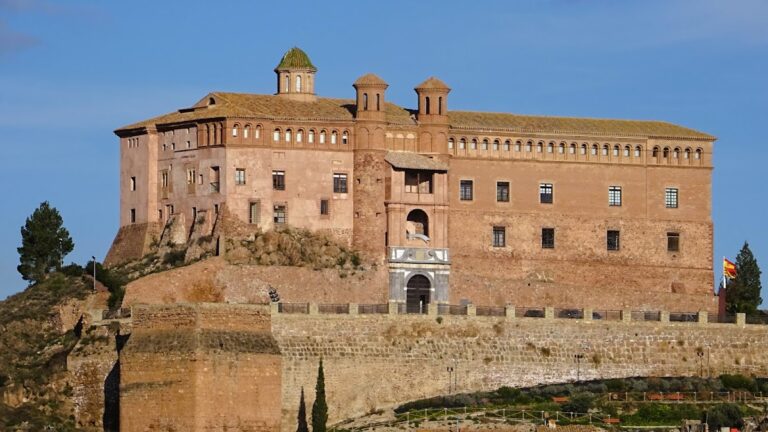
Clock Castle: A Muslim Fortress in Calatayud, Spain


Site at a Glance
- Rating
- 4.1
- Popularity
- Very Low
- Country
- Spain
- Primary era
- Medieval
- Eras represented
- Medieval
- Civilizations
- Crown of Aragon
- Site type
- Military
- Remains
- Castle
On this page7 sections
History
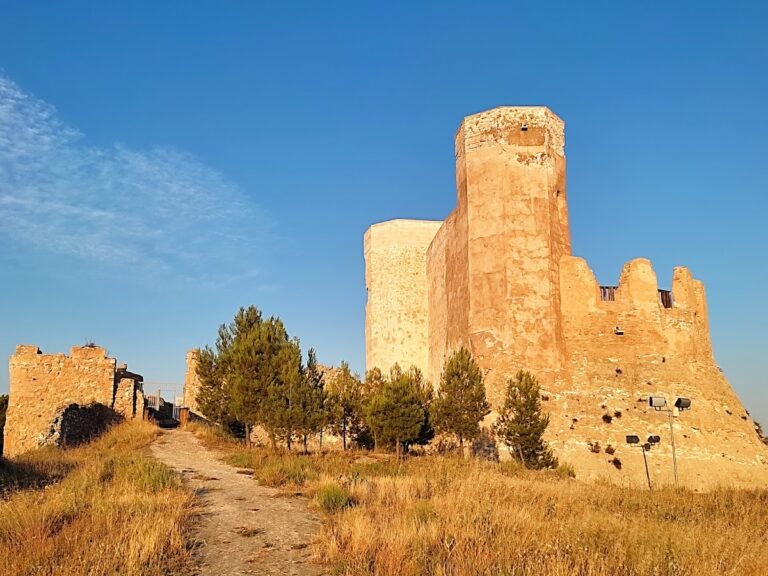
Clock Castle, also known as Royal Castle, is a Muslim fortress in Calatayud, Spain, associated with the city’s medieval fortified complex. It originated in the eleventh century, while the surviving remains are attributed to the fourteenth century. The castle forms one of five fortifications surrounding Calatayud’s upper city, whose hilltop defenses are connected by nearly four kilometres of walls.
Calatayud under Muslim rule
Calatayud was traditionally founded in 716 by Ayyub ibn Habib al-Lakhmi, an early Muslim military and political leader, at the site now identified with Doña Martina Castle. In 862, Muhammad I, Emir of Córdoba, ordered Abd al-Rahman ibn Abd al-Aziz al-Tujibi, a member of the Tujibid ruling family, to expand the city’s fortifications. The work was intended to defend Calatayud against the Banu Qasi, a powerful Muslim ruling family that controlled territory in the Ebro valley.
During the Emirate of Córdoba, Calatayud belonged to the Upper March, the northern frontier zone of the emirate and later caliphate, facing Christian territories and other contested regions. The city served as the administrative centre of a district that included Daroca. In 937, Abd al-Rahman III, the Umayyad emir and later caliph of Córdoba, captured Calatayud after its involvement in the Tujibid revolt against the caliphate.
The Taifa of Zaragoza and the Christian conquest
By 1031, Calatayud was one of the principal cities of the Taifa of Zaragoza. A taifa was an independent or semi-independent Muslim kingdom in Iberia, particularly during the period after the fragmentation of the Caliphate of Córdoba. The city entered a period of economic and cultural prosperity that lasted approximately until 1110. Around 1050, during a brief period of semi-independence under Muhammad ibn Hud of the Hudid dynasty, Calatayud declared itself an independent taifa and minted its own currency.
The Almoravids, a North African Muslim dynasty that ruled much of the western Islamic lands in Iberia during the eleventh and twelfth centuries, took control of the region in 1110 while attempting to contain the Christian reconquest. In 1120, Alfonso I of Aragon besieged Calatayud. The city surrendered after the Almoravid defeat at the Battle of Cutanda.
Later descriptions and military reuse
João Baptista Lavanha, a Portuguese mathematician, cartographer, and royal cosmographer, described Clock Castle as a palace in his Itinerary of the Kingdom of Aragon for 1610 to 1611. In the nineteenth century, Pascual Madoz recorded that the castle was still well preserved. It was altered for military use in 1876 and was later abandoned.
The castle became a Bien de Interés Cultural, a protected cultural heritage property, through a resolution of 17 April 2006 that was published on 22 May 2006.
Remains
Fortified structure and underground chambers
Clock Castle occupies lower ground south of Ayyub Castle and east of Doña Martina Castle. A section of wall descends from Ayyub Castle toward it, helping close the fortified enclosure between the two elevations. The surviving castle is a rectangular mass of rammed earth, a method in which compacted earth is formed into solid walls. The structure was formerly faced with brick, extends approximately 80 metres in length, and covers the rock beneath it.
Within the enclosure, circular underground chambers were excavated directly into the rock. These chambers form part of the castle’s surviving physical fabric and show how the fortress incorporated the underlying stone into its construction. Numerous medieval artillery stone balls, known as bolaños, are also preserved within the enclosure. These rounded projectiles were used by medieval stone-throwing siege engines.
The bell and the castle’s present name
At the upper part of the castle, a bell hangs between two pillars that form a belfry-like structure. Pedro IV, king of Aragon, gave the bell to Calatayud in 1366 in recognition of the city’s heroism during the War of the Two Peters, the fourteenth-century conflict between Peter I of Castile and Peter IV of Aragon.
The bell now in place is a recasting of the original and is called the “Foolish Clock.” It gave Clock Castle its current name. The bell had previously been installed in a tower described by Pascual Madoz, but that tower no longer survives.