Aspendos: An Ancient City in Pamphylia, Türkiye
Table of Contents


Visitor Information
Google Rating: 4.8
Popularity: High
Google Maps: View on Google Maps
Country: Turkey
Civilization: Byzantine, Roman
Remains: City

Context
Aspendos is located near the modern village of Belkıs, along Aspendos Yolu in the Serik district of Antalya Province, Türkiye. The site occupies a prominent terrace overlooking the Köprüçay River valley, situated approximately 16 kilometers inland from the Mediterranean coast. This elevated position commands views over the fertile Pamphylian plain and provides access to routes leading into the Taurus Mountains, facilitating connections between coastal and inland regions.
Archaeological investigations have established continuous occupation at Aspendos from at least the Late Bronze Age onward. The material culture reflects an initial Pamphylian presence, followed by significant Hellenistic urban development and extensive Roman-period construction. Inscriptions and architectural remains attest to the city’s civic and economic vitality during these eras. The site also shows evidence of Byzantine occupation and later medieval phases under Seljuk and Ottoman control. Aspendos has attracted scholarly attention since the nineteenth century, with systematic archaeological surveys and excavations conducted in the twentieth and twenty-first centuries. Its well-preserved monuments, particularly the Roman theatre and aqueduct, remain protected under Turkish heritage legislation and continue to be subjects of ongoing research.
History
Aspendos, situated in the ancient region of Pamphylia in southern Anatolia, represents a significant urban center with a history extending from the Late Bronze Age through the Ottoman period. Its strategic location near the Mediterranean coast and along inland routes shaped its political, economic, and military roles over time. The city experienced successive phases of control by indigenous Anatolian groups, Greek settlers, Persian rulers, Hellenistic kingdoms, and the Roman Empire. Throughout these transitions, Aspendos maintained a notable degree of autonomy and regional prominence, particularly during the Classical and Roman periods, before entering a period of decline during the Byzantine and medieval eras.
Early Iron Age and Greek Foundation (circa 1000 BCE – 5th century BCE)
The origins of Aspendos likely date to around 1000 BCE, with ancient traditions attributing its foundation to Greek colonists from Argos. However, epigraphic and onomastic evidence suggests earlier Anatolian connections, possibly linked to Azatiwada, a ruler of the Syro-Hittite kingdom of Quwê. The city occupied a hill on the western bank of the Eurymedon River, approximately 16 kilometers from the Mediterranean, benefiting from the river’s navigability which facilitated trade and communication.
By the 5th century BCE, Aspendos had emerged as the dominant city in Pamphylia, surpassing rivals such as Side. Its wealth derived from extensive salt production in large salt pans, olive oil, wool, horse breeding, cereals, fruit, and wine, with Strabo specifically noting salt and wine as key economic products. The population spoke a Pamphylian dialect reflecting a cultural synthesis of Greek and indigenous Anatolian elements, as funerary inscriptions attest through the presence of Anatolian personal names. The city’s coinage circulated widely, indicating its economic reach and political significance in the region.
Persian Achaemenid Rule and Classical Conflicts (6th–4th century BCE)
In the mid-6th century BCE, Aspendos came under the control of the Lydian king Croesus before incorporation into the Achaemenid Persian Empire around 540 BCE. Despite Persian sovereignty, the city retained considerable self-governance, as evidenced by its continued minting of coinage. Aspendos contributed horses and soldiers to the Persian military, reflecting its strategic importance.
In 469 BCE, the city hosted a Persian naval base on the Eurymedon River, which was defeated by the Athenian admiral Cimon. Subsequently, Aspendos joined the Delian League, paying tribute to Athens. During the Peloponnesian War, Aspendos served as a diplomatic venue where the Athenian general Alcibiades negotiated with the Persian satrap in 411 BCE, disrupting Spartan alliances. Control of the city fluctuated between Persian, Athenian, and Spartan forces throughout the 4th century BCE, with episodes such as the assassination of the Athenian general Thrasybulus in 388 BCE following his destructive campaign. Spartan governance proved ineffective, and Persian authority was reasserted by 366 BCE, underscoring the city’s contested status amid regional power struggles.
Hellenistic Period (4th–2nd century BCE)
Following Alexander the Great’s conquest of Asia Minor in 333 BCE, Aspendos initially negotiated to avoid occupation by agreeing to pay tribute and supply horses. However, after reneging on this agreement, the city was besieged and compelled to accept a Macedonian garrison, paying an increased annual tribute and providing thousands of horses, highlighting its considerable wealth. After Alexander’s death in 323 BCE, Aspendos passed between Seleucid and Ptolemaic control before becoming part of the Kingdom of Pergamon.
Military records from 220 BCE indicate that Aspendos contributed 4,000 hoplites under Seleucid command, reflecting a substantial population and organized military capacity. The city surrendered peacefully to Rome in 190 BCE during the Roman expansion into Asia Minor, marking the end of its Hellenistic independence and the beginning of integration into the Roman provincial system.
Roman Republican and Imperial Period (2nd century BCE – 3rd century CE)
Incorporated into the Roman province of Asia after 133 BCE, Aspendos experienced its zenith during the 2nd and 3rd centuries CE. The city’s prosperity was supported by fertile agricultural lands, a navigable river port, and access to nearby forests. Economic activities included salt production, viticulture, tapestry weaving, furniture making, limewood statuette carving, and renowned horse breeding. Roman administration was generally indirect, with local governance exercised through democratic assemblies (ekklesia) and magistrates such as the demiurgos. Despite this, the city suffered plundering by corrupt officials, notably Gaius Verres in the 1st century BCE, who looted artistic treasures including a celebrated harpist statue.
Aspendos was famed for its military units, particularly slingers, a reputation immortalized on its coinage which featured a slinger on the obverse and a triskelion on the reverse. The sophist Philostratus ranked Aspendos as the third most important city in Pamphylia. Prominent citizens included philosophers such as Diodorus and Demetrius, and military commanders like Andromachus, who served as governor of Phoenicia and Syria. The construction of the Roman theatre around 155 CE by the local architect Zenon under Emperor Marcus Aurelius exemplifies the city’s urban and cultural development during this period.
Byzantine Period and Christianization (4th–8th century CE)
During the Byzantine era, Aspendos was known as Primopolis and functioned as a Christian bishopric subordinate to the metropolitan see of Side within the province of Pamphylia Prima. Several bishops from Aspendos participated in major ecclesiastical councils, including Domnus at Nicaea (325 CE), Tribonianus at Ephesus (431 CE), Timotheus at the synod of 448 CE and the Second Council of Ephesus, and Leo at the Second Council of Nicaea (787 CE). The city’s population declined in this period, mirroring the broader regional downturn, but it remained inhabited and retained some local influence into the early medieval period. Architectural modifications and inscriptions from this era attest to continued occupation and Christian institutional presence.
Seljuk and Ottoman Periods (12th–18th century CE)
In the 12th or early 13th century, Aspendos became part of the Seljuk Sultanate of Rum. The Seljuks restored the Roman theatre, adorning it with characteristic tile decoration and repurposing it as a palace during the reign of Sultan Alaeddin Keykubad I (r. 1220–1237). The city’s population likely included Turkish settlers alongside residual local inhabitants, with social and administrative structures reflecting Seljuk governance. Economic activity was reduced compared to earlier periods, focusing on local agriculture and limited crafts. Following Seljuk rule, Aspendos came under Ottoman control but gradually lost importance and was abandoned by the 18th century. Despite this decline, the site’s monumental remains, especially the theatre, survived relatively intact, preserving its historical legacy.
Daily Life and Importance by Period
Early Iron Age and Greek Foundation (circa 1000 BCE – 5th century BCE)
During its formative centuries, Aspendos was inhabited by a population of mixed Greek and indigenous Anatolian descent, speaking a Pamphylian dialect as evidenced by funerary inscriptions. The economy centered on salt extraction from extensive salt pans, olive cultivation, cereal farming, and horse breeding, activities likely controlled by an elite class. Artisans and merchants supported local and regional trade, facilitated by the navigable Eurymedon River. Domestic architecture probably consisted of modest stone or mudbrick houses, possibly decorated with painted plaster, though direct archaeological evidence is limited. The diet included staples such as bread, olives, wine, and locally raised livestock. Religious practices combined Greek deities like Artemis and Athena with Anatolian traditions. Civic life featured assemblies and magistrates, indicating early forms of local governance.
Persian Achaemenid Rule and Classical Conflicts (6th–4th century BCE)
Under Persian rule, Aspendos maintained significant autonomy, continuing to mint its own coinage and manage local affairs. The city’s economy remained based on agriculture, salt production, and horse breeding, supporting both civilian needs and Persian military requirements. Military service, especially as skilled slingers, was a prominent social role, reflected in coin iconography. Political instability due to shifting control among Persian, Athenian, and Spartan forces affected daily life, with markets offering a mixture of local and imported goods. Homes likely incorporated Hellenic architectural elements, serving as centers for family and social activities. Religious life persisted with traditional Greek cults, possibly under Persian oversight. Civic governance included assemblies and magistrates, though political power fluctuated with external influences. The city’s strategic location as a naval base and diplomatic center influenced social and economic dynamics.
Hellenistic Period (4th–2nd century BCE)
Following Alexander’s conquest, Aspendos experienced increased militarization and political shifts, including the imposition of a Macedonian garrison and tribute obligations. The population remained substantial, supporting organized defense and contributing thousands of hoplites under Seleucid command. Economic activities expanded to include more structured agriculture, horse breeding, and artisanal production at household and workshop levels. Domestic architecture likely adopted Hellenistic styles, with more elaborate decoration such as mosaics and painted walls. The diet continued to rely on cereals, olives, and wine, with possible introduction of new crops and culinary influences. Marketplaces facilitated trade in local and luxury goods, supported by river and overland transport. Religious life continued traditional Greek cults, possibly augmented by Hellenistic syncretism. Civic institutions evolved under changing rulers but maintained assemblies and magistracies, reflecting local self-government despite external control.
Roman Republican and Imperial Period (2nd century BCE – 3rd century CE)
Roman incorporation brought significant urban development and economic prosperity. Aspendos functioned as a municipium within the province of Asia, governed by local councils and magistrates, with evidence of democratic assemblies and officials such as the demiurgos. The population included Roman settlers alongside indigenous inhabitants, with social stratification encompassing landowners, artisans, soldiers, and slaves. Economic life flourished through diversified agriculture—olive oil, cereals, vineyards—and specialized crafts including tapestry weaving, furniture making, and limewood statuette production. Salt extraction and horse breeding remained important. Archaeological remains reveal a well-planned urban center with a large agora, basilica, market, and public baths. The city was supplied by an advanced aqueduct system facilitating daily life and sanitation.
Homes featured mosaic floors and painted walls, indicating wealth and aesthetic values. Diet included bread, olives, fish, and wine, though wine was not used in religious rituals. Markets offered local produce and imported luxury items, supported by river port trade and overland routes. Transportation involved boats on the Eurymedon and animal-drawn carts. Religious practices centered on Greek and Roman deities such as Artemis Kastnietis, Athena, Zeus, Hera, and Hermes, with sanctuaries and festivals. The Roman theatre, a monumental cultural venue, hosted performances and social gatherings, underscoring civic life. Military service, especially as slingers, remained a civic hallmark, symbolized on coinage. Notable citizens included philosophers and military governors, reflecting the city’s regional importance.
Byzantine Period and Christianization (4th–8th century CE)
Transitioning from pagan traditions, Aspendos became a Christian bishopric known as Primopolis, integrated into the ecclesiastical hierarchy under the metropolitan see of Side. The population gradually declined but maintained a Christian community led by bishops who participated in major councils. Social life centered increasingly on the church, which influenced education, charity, and local governance. Economic activities contracted but continued at subsistence or small-scale levels, with agriculture sustaining the population. Urban structures were adapted for Christian use, and some pagan temples were repurposed or abandoned. Domestic life reflected modest means, with simpler household decoration. Markets likely focused on local necessities, with diminished long-distance trade. Transportation remained reliant on river and road networks. Religious practices shifted to Christian liturgy, festivals, and episcopal administration. Civic authority transitioned from classical magistracies to ecclesiastical leadership, with bishops playing prominent roles. Despite decline, Aspendos retained regional significance as a religious center until the early medieval period.
Remains
Architectural Features
Aspendos is situated on a raised terrace overlooking the Köprüçay River valley, with its urban core organized around a central agora located on the acropolis hill. The city’s layout integrates civic, commercial, and entertainment structures arranged concentrically around this public square. Construction predominantly employs ashlar masonry with finely cut stone blocks, characteristic of Roman engineering techniques. The most prominent surviving monuments are the Roman theatre and aqueduct, which exemplify advanced architectural design and durable materials. The city expanded significantly during the 2nd century CE, as reflected in the scale and quality of its public buildings. Later Byzantine and medieval periods saw modifications and partial repurposing of structures. Preservation varies from well-maintained to fragmentary, allowing identification of original functions and subsequent adaptations.
Key Buildings and Structures
Theatre of Aspendos
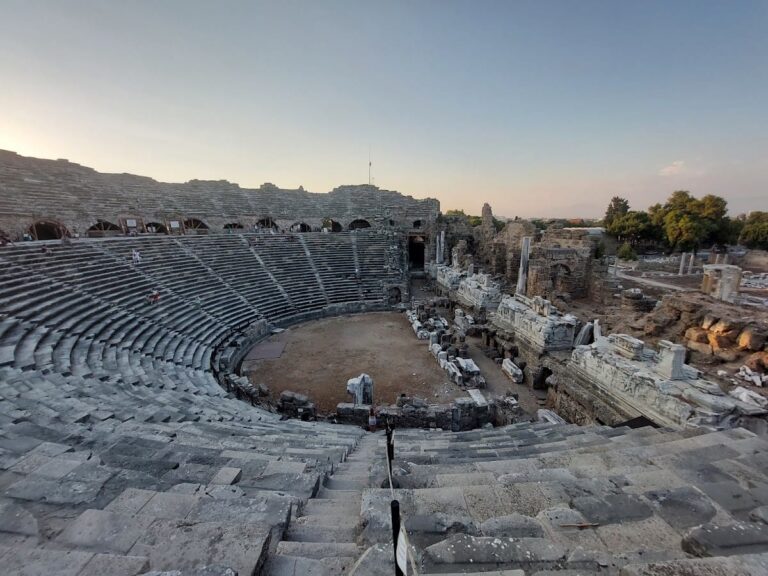
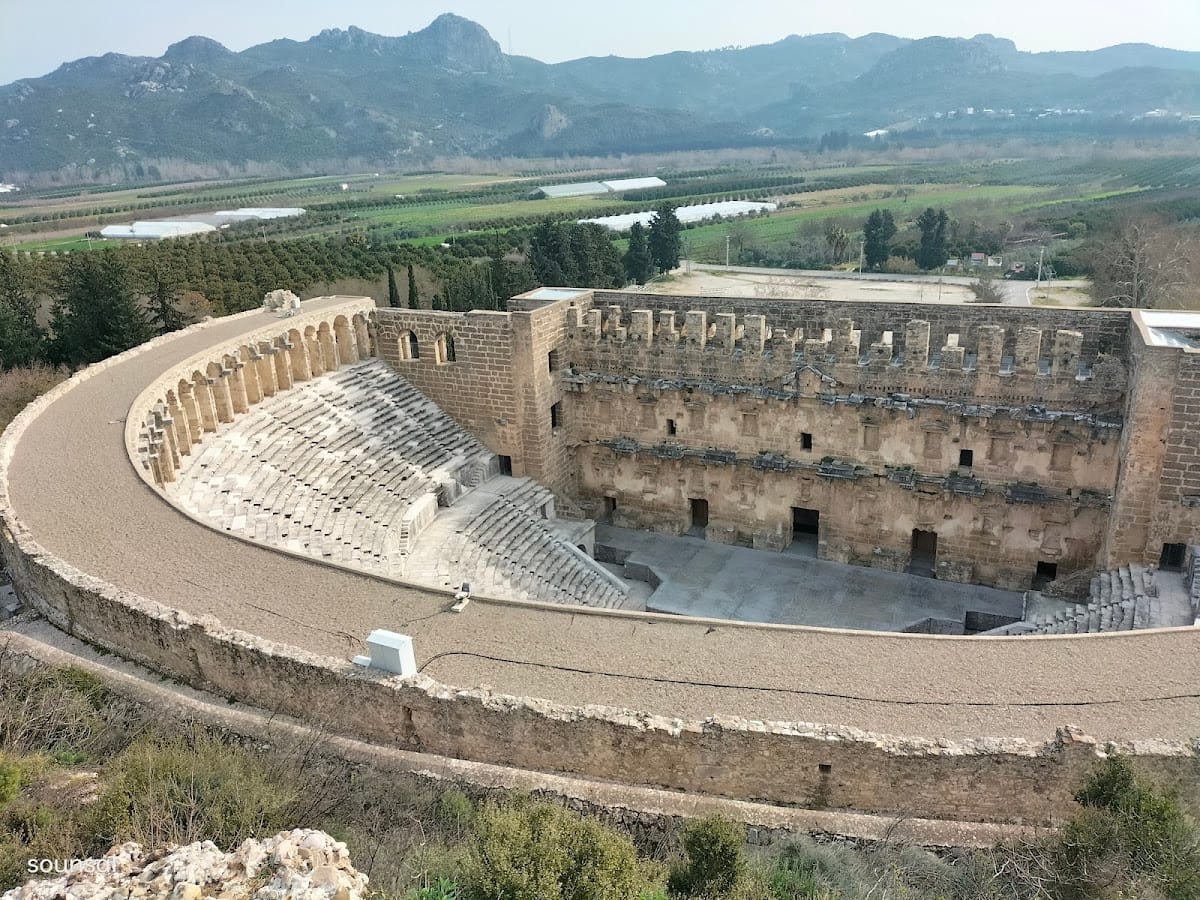
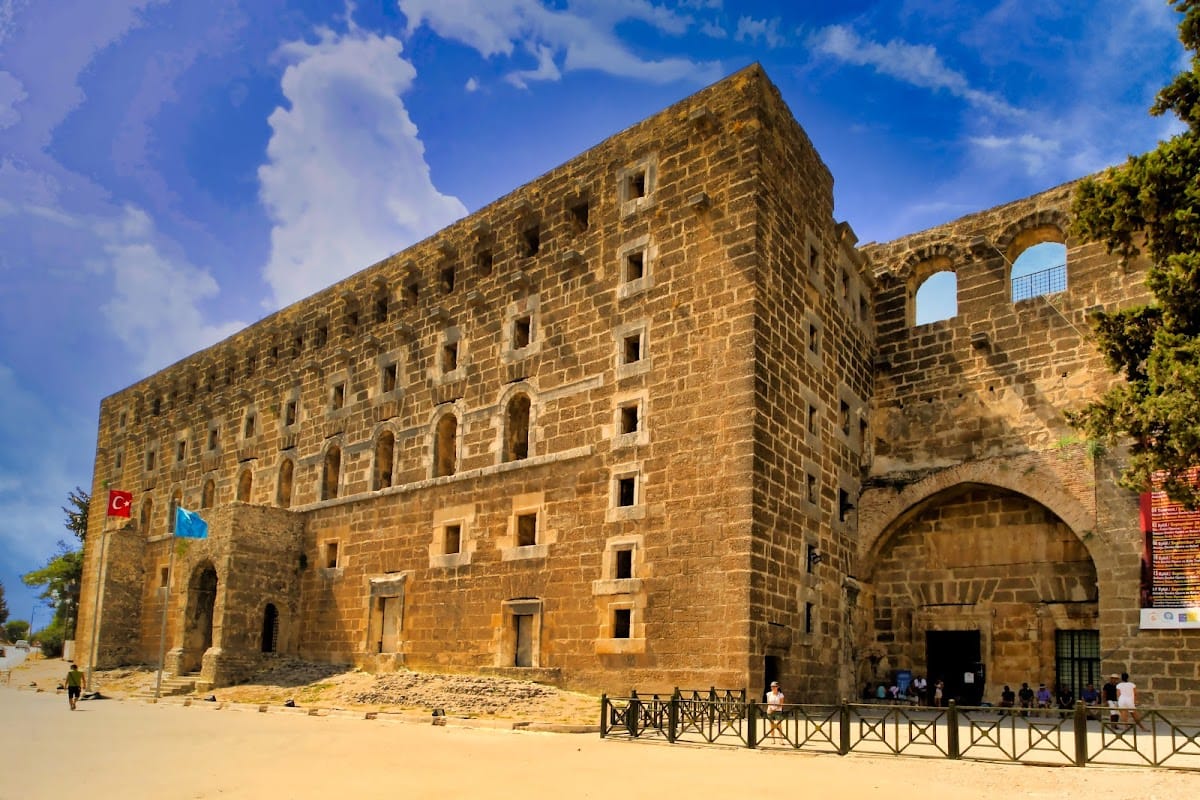
Constructed in 155 CE during the reign of Emperor Marcus Aurelius, the theatre was designed by Zenon, a native Greek architect of Aspendos. It measures approximately 96 meters in diameter and originally accommodated between 10,000 and 15,000 spectators, with recent events demonstrating capacity exceeding 20,000. The design follows Hellenistic architectural traditions, with a small portion built against the acropolis hill and the majority supported on vaulted arches. The high stage building (scaenae frons) remains largely intact, visually isolating the audience from the external environment. The original wooden inclined roof over the stage has not survived. Archaeological evidence includes 58 mast holes in the upper tiers, which supported a retractable awning (velarium) to provide shade. The theatre underwent multiple restorations under the Seljuk Sultanate of Rum, who used it as a caravanserai and converted the stage building into a palace in the 13th century. It is considered one of the best-preserved ancient theatres worldwide and remains a key monument of Roman architecture in Asia Minor.
Basilica near the Agora
Located on the eastern side of the agora atop the acropolis hill, the basilica dates to the 3rd century CE. It measures approximately 27 by 105 meters and comprises a large central hall surrounded by smaller chambers. The central hall is delineated from the side rooms by columns and features a higher ceiling. Within the basilica’s interior, a courtroom has been identified, indicating its administrative function. The building underwent significant modifications during the Byzantine period, which altered many original architectural elements. The surviving walls reach a considerable height, allowing reconstruction of its general layout and function as a civic and judicial center.
Nymphaeum near the Agora
The nymphaeum stands on the northern side of the agora, with only its front façade preserved. This façade extends 32.5 meters in length and rises to 16 meters in height. It features two levels, each with five niches; the central niche on the lower level is larger and likely served as an entrance. Marble bases at the base indicate the original presence of columns. Although its precise function remains uncertain, the building’s connection to the aqueduct and its monumental façade suggest it may have served as a nymphaeum—a monument dedicated to water nymphs—or as a decorative boundary for the agora. No water features survive to confirm its hydraulic function.
Market Building near the Agora
On the western side of the agora lies a market building containing twelve uniformly sized shops arranged behind a now-destroyed colonnaded walkway (stoa). The stoa’s location is marked by a row of steps. The shops’ layout and arrangement remain clearly identifiable, providing insight into the city’s commercial infrastructure and retail organization during the Roman period.
Buleuterion (Possible Covered Theatre or Council Building)
At the northwest corner of the agora is a large rectangular building measuring approximately 48 by 27 meters, with a rounded eastern end. Its precise function is uncertain; it may have served as a council house (buleuterion) or a covered odeon (small theatre). The structure’s substantial size and form suggest a public or administrative use, possibly for assemblies or performances.
Stadium
The stadium is situated north of the theatre on flat terrain, oriented roughly north-south. It has a rounded northern end and an open southern end, resembling the stadium at nearby Perge. Below the seating area is a vaulted corridor providing spectator access. On the eastern side, a row of shops with small windows opens onto this corridor. The starting line beam has not survived, but the overall layout indicates its use for athletic contests and public gatherings.
Aqueduct
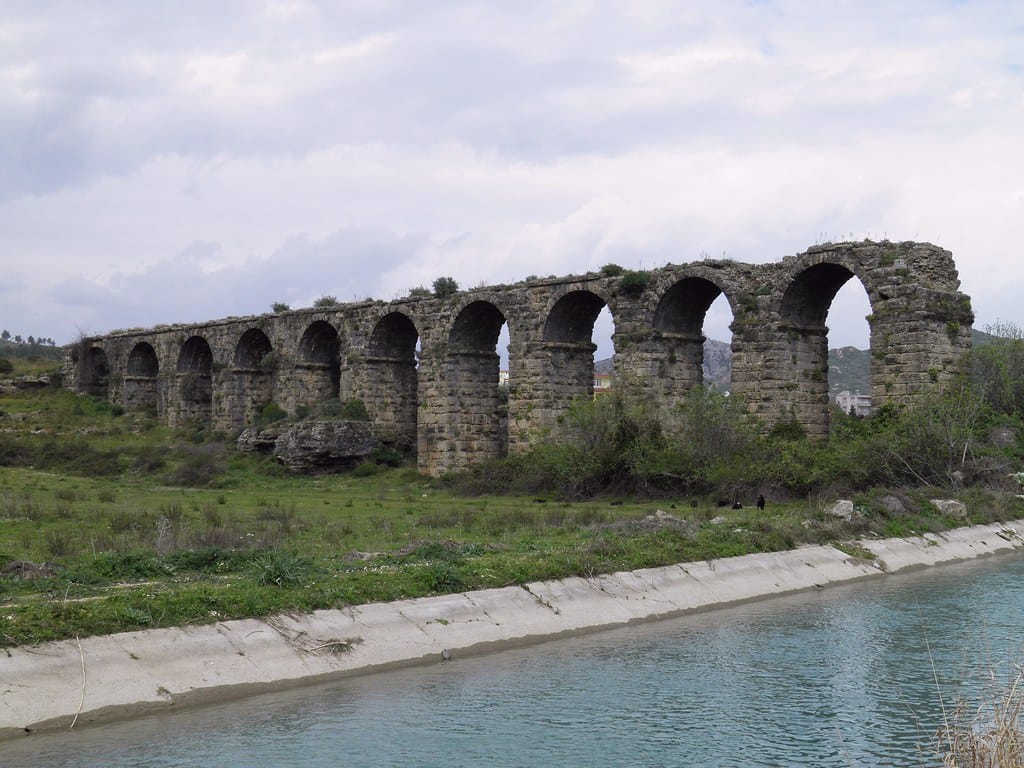
The aqueduct, constructed in the mid-2nd century CE by Tiberius Claudius Italicus, supplied water to Aspendos from marshy areas and hills approximately 19 kilometers north of the city. Originally about 15 kilometers in length, the surviving final section near the acropolis extends 850 meters. It features an advanced siphon system to cross a plain lower than the city and includes a well-preserved arched bridge (viaduct) with pillars reaching up to 30 meters in height. Each pillar top contained an open basin connected to a pipe system designed to release air and improve water flow. The aqueduct entered the acropolis from the north and is among the best-preserved Roman aqueducts known, demonstrating sophisticated hydraulic engineering.
Other Remains
Additional structures include the ruins of an exedra south of the basilica and a covered theatre or buleuterion located north of the nymphaeum. An arch stands northward from this buleuterion, with a square situated northeast of the arch. A Doric temple is located northeast of the square, though its dedication remains uncertain. Parts of a peristyle and sections of the main street survive, along with a well-preserved drainage system within the city. Several Phrygian-style tombs are found near the site. The necropolis lies along the road east of the acropolis, containing multiple tomb buildings, a rock-cut tomb, and numerous funerary stelae with pediments and acroteria dating to the Hellenistic period, providing valuable insight into local funerary customs and onomastics.
Archaeological Discoveries
Excavations at Aspendos have uncovered numerous inscriptions, including dedicatory texts on the aqueduct identifying its builder, Tiberius Claudius Italicus, and inscriptions naming the theatre’s architect, Zenon. Funerary stelae from the necropolis bear local names in the Pamphylian dialect, reflecting the city’s cultural composition. Coinage from Aspendos spans from circa 500 BCE through the late Roman Empire, featuring motifs such as a slinger on the obverse and a triskelion on the reverse, with legends in the local language.
Preservation and Current Status
The theatre of Aspendos is exceptionally well preserved, with its stone seating, stage building, and vaulted supports largely intact. Restoration efforts by the Seljuks in the 13th century included tile decoration and conversion of the stage into a palace. The basilica’s walls survive to a considerable height, though many original features were lost during Byzantine modifications. The aqueduct’s final section and viaduct remain well preserved, showcasing Roman engineering prowess. Other structures, such as the nymphaeum façade and market shops, survive in fragmentary but identifiable condition. Conservation and archaeological research have been ongoing under Turkish heritage authorities. Some damage to the theatre has occurred due to modern stage equipment, prompting the construction of a nearby open-air venue for performances. The site is protected under national heritage law and continues to be a focus of study and preservation efforts, with proposals for UNESCO World Heritage status recognizing its outstanding cultural value.
Nearby sites