Myra: An Ancient Lycian City in Türkiye
Site at a Glance
- Rating
- 4.7
- Popularity
- Medium
- Country
- Turkey
- Primary era
- Classical
- Eras represented
- Classical, Medieval
- Civilizations
- Ancient Greek, Byzantine, Lycian, Roman
- Site type
- City
On this page18 sections
History
Myra was an ancient Lycian city in Türkiye, located near modern Demre, founded by the Lycians on the river Myros and later shaped by Hellenistic, Roman, and Christian traditions. By the 3rd century BC, the city had become culturally Hellenized. It later served as the capital of the Roman province of Lycia and as an important Christian episcopal center.
Lycian and Hellenistic Myra
Myra has no substantiated written reference before its membership in the Lycian League, a federation of Lycian cities, between 168 BC and AD 43. Strabo described it as one of the league’s largest cities. Its population during the early Roman Empire may have been about 5,000, although Myra was regarded as a metropolis. Some scholars have identified it with Mira in Arzawa, but that proposed connection remains uncertain.
After Alexander the Great conquered Lycia, the region passed under the control of Antigonus following Alexander’s death. Around 250 BC, the Ptolemies, one of the dynasties that emerged from the wars among Alexander’s successors, took control. The Seleucids later ruled the region before Lycia came under Roman authority in AD 43, while retaining a degree of autonomy.
The ancient Lycians worshiped Artemis Eleutheria, a local form of Artemis associated with protection and liberation, as Myra’s protective goddess. Zeus, Athena, and Tyche, the personification of fortune and civic prosperity, were also venerated. Pliny the Elder described a spring of Apollo called Curium, where fish were summoned three times by a pipe to provide answers through an oracle.
Roman and Christian Myra
During the Roman period, Myra belonged to the Greek-speaking world and adopted Christianity rapidly. The Acta Pauli probably indicate that a Christian community existed there in the 2nd century. Around AD 60, during the journey from Caesarea to Rome, Paul the Apostle and the author of the Acts of the Apostles, probably Luke the Evangelist, are associated with changing ships at Myra’s harbor of Andriake.
The earliest bishop in Le Quien’s list is Saint Nicander. According to the Greek Menologion, Saint Titus ordained him, and he was martyred under the emperor Domitian in AD 95. In AD 325, Lycia became a Roman province separate from Pamphylia, with Myra as its capital. The city then became the province’s metropolitan see, the principal bishopric of an ecclesiastical province. Its bishop at that time was Saint Nicholas.
A sixth-century index attributed to Theodorus Lector is the first document to list Saint Nicholas among the fathers of the First Council of Nicaea, the major Christian council held in AD 325. Other bishops of Myra included Petrus, who defended the Council of Chalcedon, and Theodorus and Nicolaus, who attended the Second Council of Nicaea in AD 787, a council that addressed the veneration of religious images. Lists compiled around AD 640 and in the early 10th century name 36 and 33 subordinate bishoprics respectively.
Saint Nicholas promoted Christianity in the early 4th century and is associated with the foundation of a Christian church at Andriake. He was buried outside Myra’s walls, where a church dedicated to him was later built. Saint Themistocles, a Christian martyr, was another religious figure connected with the city. Myra was also associated with Dioskorios, a grammarian and city prefect, and Nicolaus of Myra, a rhetorician and sophist who wrote an Art of Rhetoric and declamations.
Late Roman, Byzantine, and Medieval Transformations
Myra was besieged and sacked by Abbasid troops in AD 809, after which it returned to Roman control. During the early reign of Emperor Alexius I Comnenus, who ruled from 1081 to 1118, Seljuk Turks captured the city. In the disturbances that followed, sailors from Bari seized the relics of Saint Nicholas. They reached Bari on 20 May 1087, and the relics were later transferred to the newly built Basilica of Saint Nicholas there.
Myra returned to Roman control during the Komnenian restoration but was ultimately lost sometime after the Fourth Crusade. Its Greek inhabitants were compelled to leave for Greece during the 1923 population exchange between Greece and Turkey. The church of Saint Nicholas was finally abandoned after this population movement.
Archaeology and Religious Status
The ancient city was first detected archaeologically in 2009 through ground-penetrating radar, which uses pulses sent into the ground to identify buried structures. Excavations during the following two years uncovered a well-preserved 13th-century chapel. In February 2021, researchers from Akdeniz University led by Nevzat Çevik announced the discovery of dozens of approximately 2,200-year-old inscribed terracotta sculptures and other Hellenistic material from the theater.
Excavations at Andriake have continued since 2009. The former granary was converted into the Museum of Lycian Civilizations, while the harbor-market buildings, agora, synagogue, and a large cistern were restored. The Catholic Church recognizes Myra as a titular see, an ecclesiastical title without ordinary territorial administration, in both the Latin Church and the Melkite Greek Catholic Church. Latin bishops are no longer appointed to the see, while Melkite bishops continue to be appointed.
Remains
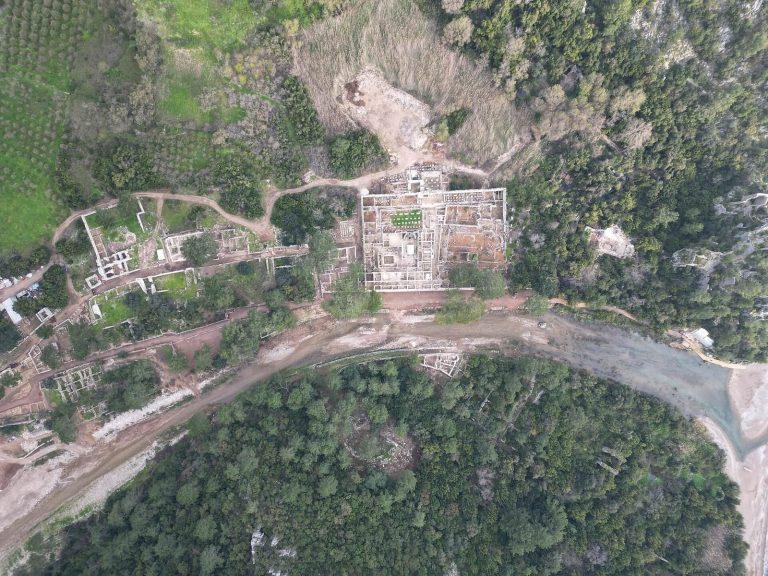
Myra stood on the Myros, now called the Demre Çay, in a fertile alluvial plain between the Massikytos mountain range and the Aegean Sea. Accumulated alluvial silt covers much of the ancient Lycian and Roman city. The acropolis on the Demre plateau, the Roman theater, and the Roman baths, also known as the Eski Hamam, have been partly excavated.
City Center and Necropoleis
Roman Theater
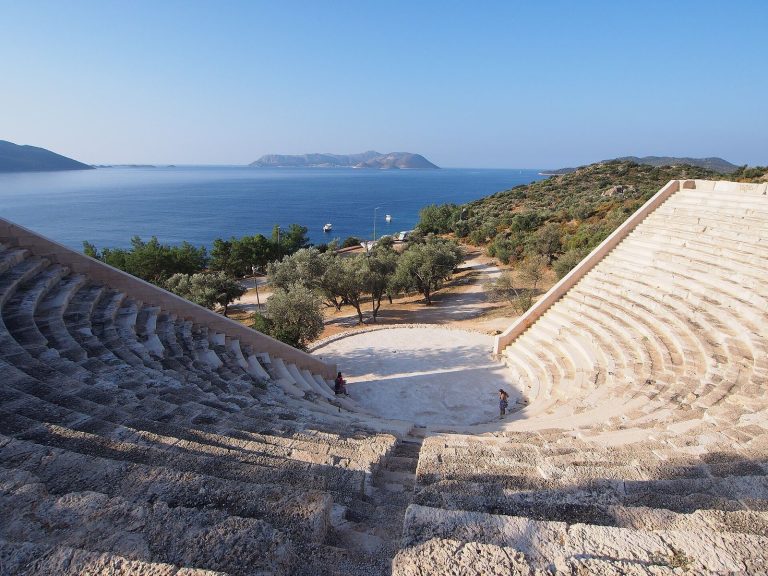
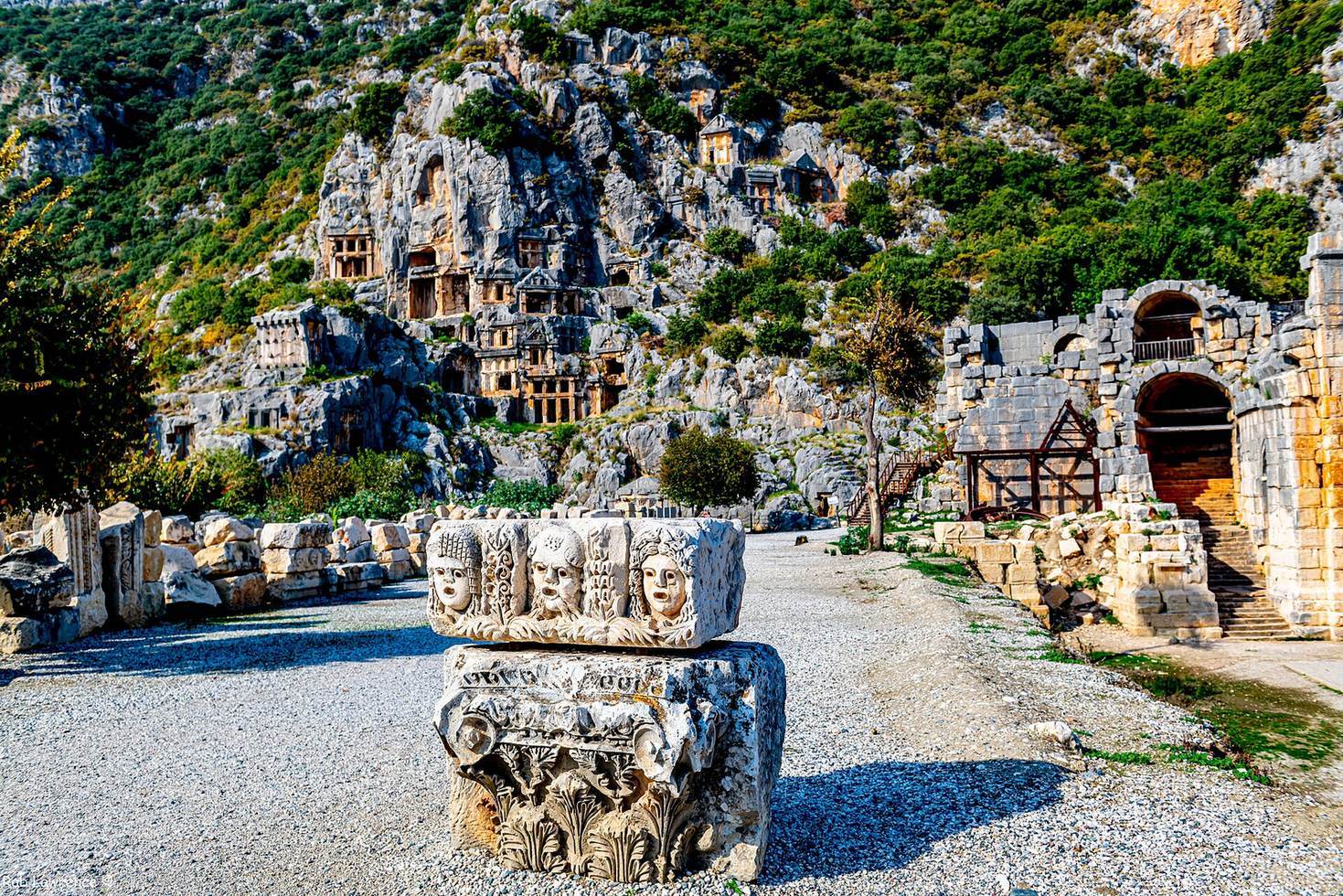
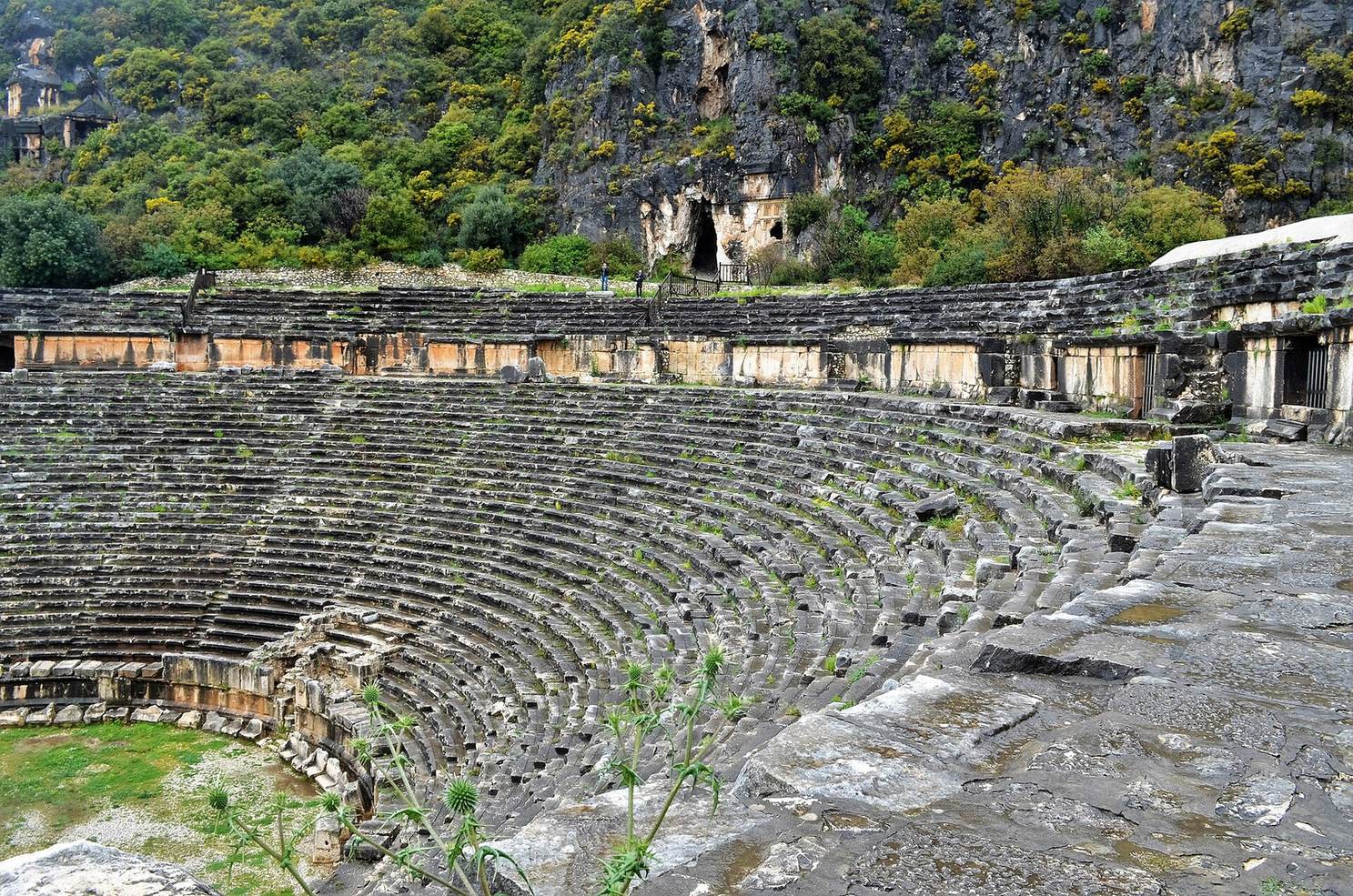
The semicircular Roman theater was destroyed by an earthquake in AD 141 and subsequently rebuilt. Finds from the building include theatrical masks made for actors and names carved in different places to reserve seats. An inscription identifies the seat of Gelasius, a vendor who supplied spectators with food and drink. Another inscription on the orchestra floor states that Myra was required to pay the Lycian League 7,000 denarii each year from customs revenue.
Rock-Cut Tombs
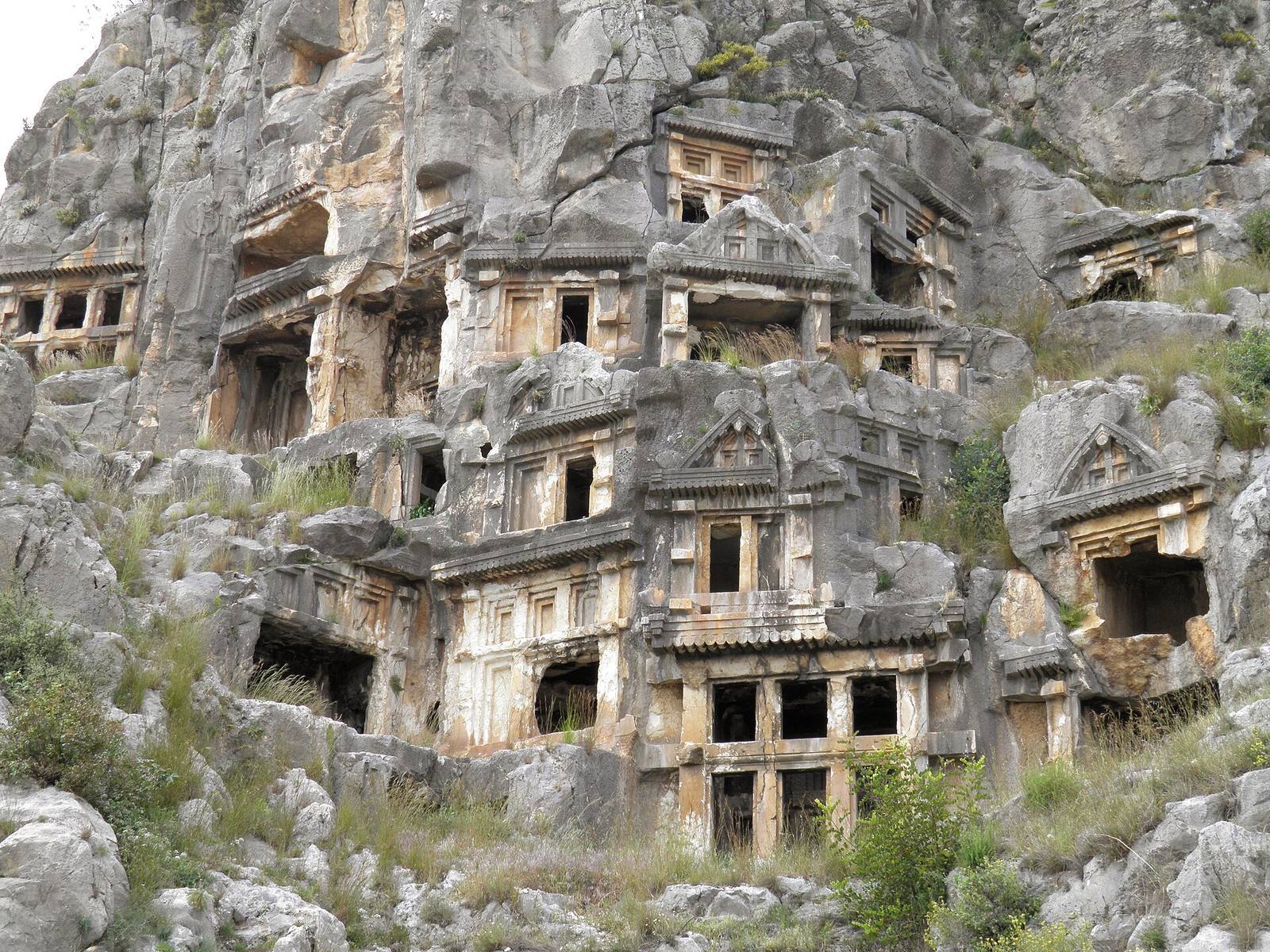
Two Lycian rock-cut necropoleis survive at Myra, the River Necropolis and the Ocean Necropolis. Their tombs were carved into vertical cliff faces as temple façades. The Ocean Necropolis lies directly northwest of the theater. The best-known tomb in the River Necropolis is the Lion’s Tomb, also called the Painted Tomb, about 1.5 kilometers upriver from the theater along the Demre Çay. When Charles Fellows visited in 1840, the tombs remained vividly painted in red, yellow, and blue.
Andriake Harbor
Granary
Andriake, about 5 kilometers southwest of Myra, was the city’s ancient harbor before becoming silted up. Its principal surviving structure is a granary, or horrea, built during the reign of the Roman emperor Hadrian, from AD 117 to 138. The building has seven rooms and measures 56 meters long by 32 meters wide. A large heap of Murex shells beside it points to a local operation producing purple dye.
Harbor Buildings and Cistern
The restored harbor area includes port-market buildings, the agora, a synagogue, and a large cistern. The cistern is 6 meters deep, 24 meters long, and 12 meters wide. A 16-meter-long Roman-period boat, a crane, and a cargo vehicle stand in front of the museum established in the former granary.
Saint Nicholas Church
Early Church and Tomb
The earliest church of Saint Nicholas was built near the saint’s tomb in the Eastern Roman, or Byzantine, period during the 5th or 6th century. Remains survive in the church’s northwestern and southeastern areas, including the place where the sarcophagus containing his relics stood. An ancient Greek marble sarcophagus was reused for his burial. His bones were removed in 1087 and are now held in the Basilica of Saint Nicholas in Bari.
Present Basilica
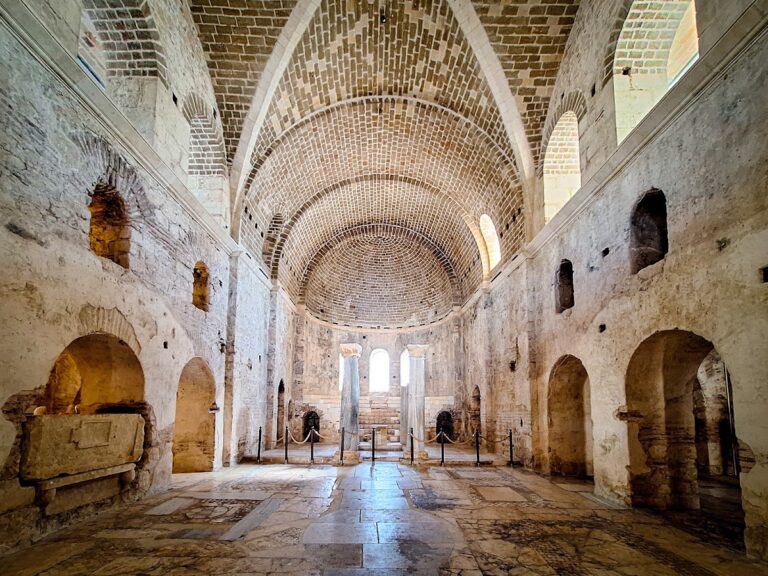
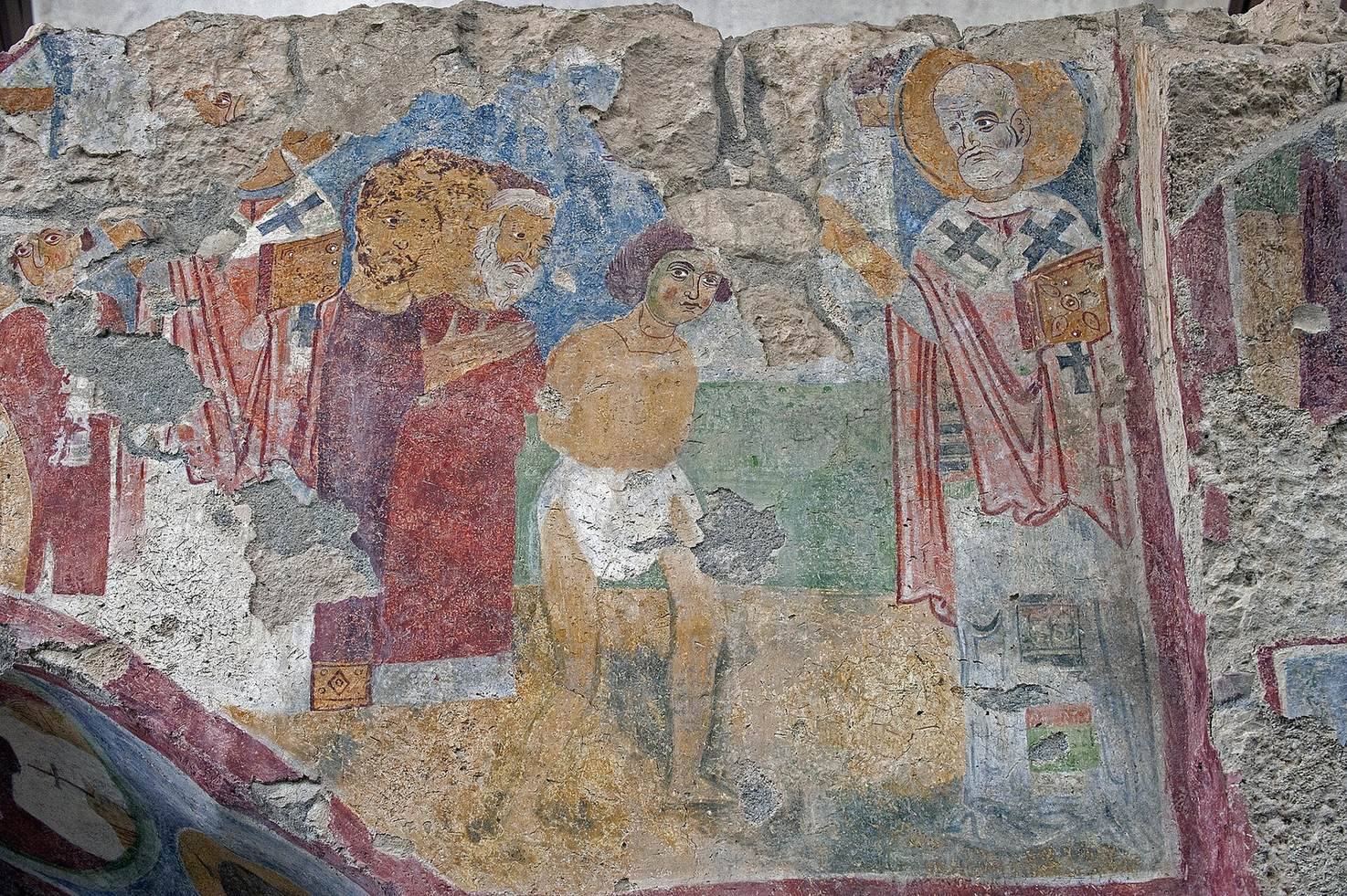
The present church is a domed, three-aisled basilica built mainly from the 8th century onward for Myra’s Byzantine Greek inhabitants. An Eastern Orthodox monastery was added in the second half of the 11th century. The floor uses opus sectile, a technique in which colored marble pieces are cut and fitted into patterned surfaces. Fragments of wall frescoes survive, including scenes from the miraculous life of Saint Nicholas.
Several ancillary buildings remain around the church. These include a baptistery directly connected with the inner narthex, the entrance vestibule of the church, and two chapels south of the basilica. In 1863, Emperor Alexander II of Russia purchased the church and began restoration, but the work was not completed. The eastern and southern sides were excavated in 1963, and the former tomb, or confessio, of Saint Nicholas was roofed over in 1968. Conservation and restoration have continued since work initiated by Turkey’s Ministry of Culture in 1989.
Buried Structures and Hellenistic Finds
Thirteenth-Century Chapel
Ground-penetrating radar revealed buried walls and buildings beneath the ancient city. Excavation then uncovered a 13th-century chapel in an unusually well-preserved, sealed condition. A cross carved into one wall projects its shape onto the altar when illuminated by sunlight.
Terracotta Sculptures
The terracotta figurines announced in 2021 are approximately 2,200 years old. They retain traces of paint and depict men, women, cavalry, animals, and some Greek deities. Inscriptions on the figures include the names of artists. Other material from the Hellenistic theater was made of ceramic, bronze, lead, and silver.