Perge Ancient City: A Pamphylian Urban Center in Türkiye


Site at a Glance
- Rating
- 4.7
- Popularity
- Medium
- Country
- Turkey
- Primary era
- Classical
- External website
- Open
- Eras represented
- Classical, Medieval
- Civilizations
- Ancient Greek, Byzantine, Roman
- Site type
- City
On this page33 sections
History
Perge Ancient City in Türkiye, near modern Aksu in Antalya Province, was an ancient city of Pamphylia that developed from a prehistoric settlement into one of the region’s principal urban centers. Its history extends from the Chalcolithic and Early Bronze Ages through the Hellenistic, Roman, Byzantine, and early medieval periods. At different times, Perge served as a leading city and metropolis of Pamphylia, a region of southern Anatolia shaped by local communities and Greek-speaking settlers.
Prehistoric and Late Bronze Age Perge
The earliest settlement was on the flat-topped acropolis, a hill rising about 50 metres above the Pamphylian plain. Archaeological evidence indicates activity there from approximately 4000 or 3000 BC. Obsidian, flint, pottery, and a prehistoric burial point to occupation during the Chalcolithic and Early Bronze Ages.
Perge may be identified with Parha, a city mentioned on a bronze treaty tablet found at Hattusa in 1986 and dated shortly before 1235 BC. The treaty refers to Parha and the Kastaraya River, implying that the city and its territory lay along the river. It also suggests that Parha retained its independence after a conflict between the Hittite king and the ruler of Tarhuntassa, although Perge’s precise political position within the Hittite world remains uncertain.
During the Late Hittite period, Perge was probably a small settlement on the acropolis. Later Pamphylian linguistic evidence indicates that local traditions continued alongside growing Greek influence. Greek foundation traditions instead connected the city’s establishment after the Trojan War with heroes such as Mopsus and Kalkhas and other Achaean founders. The possible relationship between Mopsus and the Late Hittite figure Muksus or Muksa remains an interpretation rather than a settled identification.
Greek and Persian Rule
From approximately the sixth century BC, Perge became increasingly Hellenized, possibly through settlers and cultural influences arriving from Rhodes. The city nevertheless retained a strong Pamphylian character, and its inhabitants spoke the Pamphylian dialect of Ancient Greek. Founder traditions later became part of the city’s public identity through statues and inscriptions placed at the city gate.
Perge was captured by the Achaemenid Empire around 540 BC. The Achaemenids were the Persian imperial dynasty that ruled much of western Asia from the sixth to the fourth century BC. Later traditions describe successive Persian, Athenian, and Persian control, while Perge appears in the tribute lists of the Delian League, the alliance led by Athens, for 425/424 BC. The city may also have taken part in the Great Satraps’ Revolt of 360 BC, an uprising by several Persian provincial governors against the Achaemenid king.
Alexander and the Hellenistic Kingdoms
When Alexander the Great entered Pamphylia after capturing Phaselis in 334 BC, Perge welcomed him and supplied guides for his army. No battle between the city and the Macedonian forces is recorded. Perge subsequently served as a base for Alexander’s operations in Pamphylia, while Nearchus was appointed satrap of Lycia and Pamphylia in the same year.
After Alexander’s death, the city passed under Antigonid and then Seleucid control. The Seleucids were one of the Hellenistic dynasties that competed for parts of Alexander’s former empire. Perge belonged to the Seleucid kingdom from 223 BC until the Seleucid defeat by Rome at Magnesia in 190/189 BC. A Seleucid garrison remained in the city in 188 BC, until the Roman consul Gnaeus Manlius Vulso expelled it.
After the settlement at Apamea, Perge came under the Attalid kingdom. The Attalids were the dynasty that ruled Pergamon in western Anatolia, and the boundaries between Attalid and Seleucid territories changed during this period. In 133 BC, Attalus III bequeathed the kingdom of Pergamon, including Perge, to Rome.
Roman Administration and Prosperity
Perge became part of several Roman provincial arrangements. It was associated successively with Cilicia, Asia, Galatia, and Lycia et Pamphylia. In AD 43, Emperor Claudius established the province of Lycia et Pamphylia, although later reforms altered the region’s administrative status repeatedly.
The city’s sanctuary of Artemis Pergaia was already wealthy and influential during the late Republic. In 79 BC, Verres, quaestor to the governor of Cilicia, plundered the treasury of the Temple of Artemis Pergaia. Cicero states that the Pergian Artemidorus assisted him. The episode reveals the value attached to the sanctuary and its treasury during a period when Roman officials exploited provincial communities.
During the Pax Romana, the period of relative stability under the Roman Empire, Perge entered a major phase of prosperity and monumental development. The southern part of the Hellenistic fortifications was removed, and public construction expanded. Wealthy local families financed large projects, including a gymnasium and palaestra built by Gaius Julius Cornutus during the reign of Nero. The Plancii family became especially influential under the Flavian and Hadrianic emperors.
Plancia Magna, daughter of the senator and provincial governor Plancius Varus, was a priestess of Artemis and a major civic benefactor. During the reign of Hadrian, she promoted the rebuilding and embellishment of Perge and transformed the area behind the Hellenistic gate into a monumental presentation of the city’s Greek and Roman founders. Perge’s founder mythology also helped it gain admission to the Panhellenia, a Greek cultural festival established by Hadrian. Through statues and inscriptions, the city presented itself as an ancient Greek colony while also emphasizing its imperial connections and the cult of Artemis.
Perge prospered through the second and early third centuries AD. Political stability and local wealth supported extensive construction, while rivalry with nearby Side encouraged the city to emphasize its monuments, imperial associations, and religious traditions. Vespasian granted Perge the title of neokorate, an imperial privilege connecting a city with the official cult of a Roman emperor. Domitian granted the Temple of Artemis Pergaia the right of asylum, which gave a sanctuary recognized protection for certain people seeking refuge. Under Tacitus, around AD 274–275, Perge was proclaimed the metropolis of Pamphylia. It was also treated as the region’s leading city for a short period under Probus.
Christianity, Insecurity, and Abandonment
Perge was visited twice by the apostle Paul during his first missionary journey. On the first visit he was accompanied by Barnabas, his missionary companion. They travelled through the city between the coast and Pisidian Antioch, and Paul later preached at Perge on the return journey.
During the third century, Persian and Isaurian attacks disrupted routes through the Taurus and weakened trade connections. Perge still enjoyed prosperity during parts of the century and received imperial attention, including a statue erected in honour of Gordian III. Isaurian attacks intensified in the fourth century, especially in 368–377 and again in 399 and 405–406. Destruction across Pamphylia encouraged the construction or repair of defensive systems. The devastation was halted under the Isaurian ruler Zeno, after which Pamphylia experienced renewed prosperity in the fifth century.
Administrative changes continued during Late Antiquity. Lycia and Pamphylia were temporarily separated and reunited, while Lycia et Pamphylia probably continued until about AD 313. By 333–337, Aurelius Fabius is attested as governor of Lycia, after the two provinces had been definitively separated.
In Late Antiquity and the Byzantine period, Perge became an important Christian center and the second episcopal see of Pamphylia after Side. Its bishops participated in major church councils, including Callinicus at the First Council of Nicaea in 325. Ecclesiastical records describe Perge as the metropolis of Pamphylia Secunda into the thirteenth century, although the precedence of Perge and Side remained contested. During the Byzantine period, Perge and Sillyon were generally placed under the same metropolitan authority until that role was transferred to Attaleia.
Arab raids began in Pamphylia during the seventh century, and information about Perge becomes scarce in the later Byzantine period. The population gradually abandoned the city, although the settlement remained inhabited until approximately the foundation of the Seljuk state around 1100. Perge was probably abandoned sometime after the Byzantine period. A seventeenth-century reference by Evliya Celebi to a settlement called Tekke Hisari has been proposed as a possible reference to Perge, but the identification is uncertain.
Excavation and Heritage
Excavations began in 1946 under Istanbul University, led by A. M. Mansel, and later involved cooperation with Justus Liebig University Giessen. The work revealed public buildings, sculpture, mosaics, inscriptions, and other evidence for the city’s long development. The archaeological area has been on Türkiye’s tentative list for UNESCO World Heritage since 2009.
Remains
Perge developed between the Catarrhactes and Cestrus rivers, about 11 kilometres from the mouth of the Cestrus and the Mediterranean coast. The first settlement occupied the acropolis at the edge of the Pamphylian plain, while the urban area later spread southward across the level ground. At its greatest Roman extent, the city covered approximately 61 hectares. Its territory has been estimated at more than 500 square kilometres, extending at least eastward to the Cestrus River.
Acropolis, Streets, and Fortifications
The acropolis is the earliest settlement area, although relatively few early structures survive there. Most visible remains on the hill date from the Byzantine period. The lower city expanded southward during the Hellenistic period and was enclosed by substantial walls. A further outer wall was probably built around the fourth century AD. During the Byzantine period, settlement appears to have shifted back toward the acropolis.
Colonnaded Streets
Two principal colonnaded streets divided the lower city into four irregular quarters. The north-south street ran from the acropolis to the southern, or Hadrianic, gate and continued for approximately 800 metres beyond the city. Within the city it extended about 480 metres and measured approximately 22 metres wide. Its western and eastern colonnades were about 6.5 and 5.5 metres wide. Attic-Ionic columns supported the porticoes, whose floors carried mosaics, while shops stood behind them.
The second major street ran east-west. The two streets crossed in the northern part of the lower city and were probably constructed or substantially developed under Hadrian. Neither followed a completely straight line because earlier streets and public buildings influenced their routes. A water channel ran along the centre of each street, divided by transverse partitions at intervals of approximately 6–8 metres.
City Walls and Gates
The walls were built from large blocks and included numerous towers and four principal gates, two on the southern side and one each on the east and west sides, together with smaller entrances. The eastern fortifications are particularly well preserved, and many towers survive nearly intact.
Southern Gates and Civic Identity
Hellenistic Gate
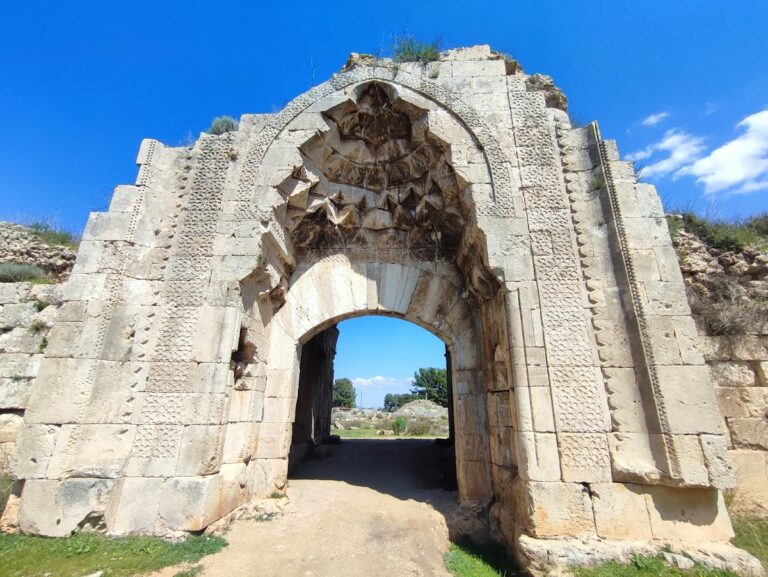
The Hellenistic southern gate is a monumental courtyard entrance protected by two circular towers. Built from large limestone blocks, it forms a horseshoe-shaped court approximately 30 metres long and up to 23 metres wide. Two levels of niches held 28 statues representing the city’s mythological founders and later Roman founders. The statues have not survived, but inscriptions on their bases preserve their identities.
Hadrian’s Arch
During Hadrian’s reign, a two-storey structure with three arches was inserted on the northern side of the Hellenistic gate’s courtyard. Commissioned by Plancia Magna, it carried statues of Artemis Pergaia, Tyche, deified Augustus, deified Nero, deified Trajan, deified Matidia, Plotina, Hadrian, and Sabina. Only the lower part of the arch survives.
Roman Southern Gate
A later Roman southern gate was built outside the Hellenistic entrance. On its eastern side stood a square with a stoa, a covered colonnade, dating to the reign of Septimius Severus. The gate was about 24 metres wide and survives to nearly 10 metres high. Its northern face contained five arched niches, with the central opening forming the entrance. A Syrian-style pediment was added during the second century, and the gate was incorporated into the outer wall during the third century.
Waterworks and Bath Complexes
Acropolis Nymphaeum
The Acropolis Nymphaeum, also called the Hadrianic Nymphaeum, stood at the northern end of the main street where water first entered the city. A nymphaeum was a monumental fountain building, often decorated with architectural sculpture. This two-storey, U-shaped structure contained a basin, niches, projecting wings, a podium, and Corinthian columns. Sculptures of Artemis, Zeus, an emperor, and the river god Cestrus decorated it. Water flowed from the basin into the channel running along the street.
Caracalla Nymphaeum
The Caracalla Nymphaeum stood beside the western gate and the North Baths. Its front was about 15 metres wide and the building itself about 18 metres wide, with a water basin 2.5 metres deep. Sculptural decoration included Aphrodite, Apollo, Asclepius, the Dioscuri, Helios, Nemesis, Selene, Telesphorus, and Tyche. A statue of Caracalla found in the ruins dates the building to approximately AD 217.
South Nymphaeum and Aqueducts
The South Nymphaeum stood beside the square near the Roman southern gate. Its two-storey facade rose in front of a basin and connected with the hydraulic system of the South Baths. At least six nymphaea supplied or displayed water in the Roman city. Roman aqueducts also brought water to Perge. One aqueduct associated with Kursunlu was approximately 11 kilometres long and probably carried water to the baths from near the Kursunlu waterfall. A later aqueduct, about 21 kilometres long, drew a greater flow from the Duden River near Dudenbasi waterfall.
South Baths
The South Baths are among the best-preserved buildings at Perge. Constructed during the first or second century AD, the complex underwent several later alterations and additions. It included an apodyterium, or changing room, a frigidarium, or cold room, a tepidarium, or warm room, a caldarium, or hot room, and a palaestra, an exercise and training court. Hypocausts, underfloor heating systems, remain visible beneath some floors. Sculptures of Aphrodite, Asclepius, Athena, the Genius, Hygieia, and Nemesis decorated the complex, whose floors were covered with mosaics.
North Baths
The North Baths stood west of the palaestra beside the western gate. Dating from the second century AD, the complex contained five principal rooms and a courtyard.
Gymnasium and Market
Palaestra
The palaestra in the northwestern quarter measured approximately 76 by 76 metres. It consisted of a square court surrounded by rooms. Its southern wall, facing the east-west street, survives well and contains several windows. Gaius Julius Cornutus dedicated the building to Emperor Claudius.
Macellum
The market, more precisely a macellum, stood immediately east of the Hellenistic southern gate. A macellum was a Roman-style market, especially associated with the sale of food and meat. Dating mainly from the second half of the second century AD, it formed a square approximately 75.9 metres on each side and was surrounded by colonnades and shops. The portico floors had mosaics, the southern buildings were two storeys high, and entrances opened onto all four sides.
A circular building called a tholos stood at the centre of the market. A tholos is a round building whose function can vary, and the purpose of this structure is unknown. Some shops opened toward the market, while others faced the surrounding streets. The southern shops were built on two levels because of the slope of the ground.
Churches and Religious Buildings
North Basilica
The North Basilica was a three-aisled church built during the fourth or fifth century west of the main north-south street.
South Basilica
The South Basilica stood east of the Roman southern gate. Built in the fifth century, it was a three-aisled church with a narthex, or entrance hall, and a western entrance. Its eastern wall and apse, the rounded end of the sanctuary, survive.
Temple of Artemis Pergaia
A large Temple of Artemis Pergaia stood on a hill outside the city and was one of Perge’s defining religious monuments. It was described as a large Ionic-style temple, but its ruins have not been securely located. The cult of Artemis Pergaia, the local form of the Greek goddess Artemis, existed at Perge by at least the fourth or third century BC. Coins from the city depict the goddess and, in some cases, her sanctuary. Artemis Pergaia was honoured throughout Pamphylia, with annual celebrations held in her name.
Hellenistic Temple
About 800 metres south of the city are the remains of a separate Hellenistic temple. It was a prostyle tetrastyle building, meaning that a row of four columns stood across its front, with a pronaos and cella behind them. Its stylobate measured approximately 23 by 14 metres. The deity is unknown, and the building is considered unlikely to be the missing Temple of Artemis Pergaia.
Stadium and Theatre
Stadium
The stadium lay southwest of the city walls and measured approximately 234 metres in length, including a 42-metre enclosed section at the north end. It had a rounded northern end and a decorated entrance at the south. About twelve rows of seating were arranged with broad and narrow circulation passages.
Built mainly from local conglomerate blocks, the stadium rested on 70 vaulted substructures, with 30 along each long side and 10 at the short side. The vaulted spaces below the eastern seating were divided into 30 rooms. Some were shops, and inscriptions identified the occupations of shopkeepers and sometimes their names. The exceptionally well-preserved stadium could hold approximately 12,000 spectators.
Theatre
The theatre stood outside the walls southwest of the stadium and was largely built into a slope. Its slightly more than semicircular seating area was divided by 13 stairways into 12 sections. Above the transverse passage, the number of sections was doubled, and the theatre accommodated approximately 13,000–14,000 spectators.
The two-storey stage building had five doors opening toward the backstage area and survives to considerable height. Its panel frieze carried reliefs showing episodes from the life of Dionysus, the Greek god associated with wine, performance, and theatrical culture. Many reliefs were damaged when the building collapsed, although the Dionysian scenes remain understandable. The eastern exterior wall was later converted into a nymphaeum with five niches, and the theatre has undergone restoration.
Necropolises and Archaeological Finds
Necropolises extended along the roads east, west, and south of the city. The western necropolis produced at least 30 sculpted sarcophagi. The tomb of Plancia Magna, outside the later southern gate beside the road, is now almost completely destroyed.
Numerous funerary finds and other objects from Perge are preserved in the Antalya Museum. Archaeologists found Greek mosaics depicting Oceanus and Medusa in 2003 and a mosaic showing the sacrifice of Iphigenia in 2017. In 2020, archaeological work led by Sedef Cokay Kepce recovered a full-length statue of a dressed woman, probably from the Roman imperial period, for display at the Antalya Museum. Coins depicting Artemis Pergaia and her sanctuary, together with inscriptions, statue bases, founder imagery, imperial portraits, and civic dedications, illuminate Perge’s religious institutions, political identity, and traditions of monumental patronage.