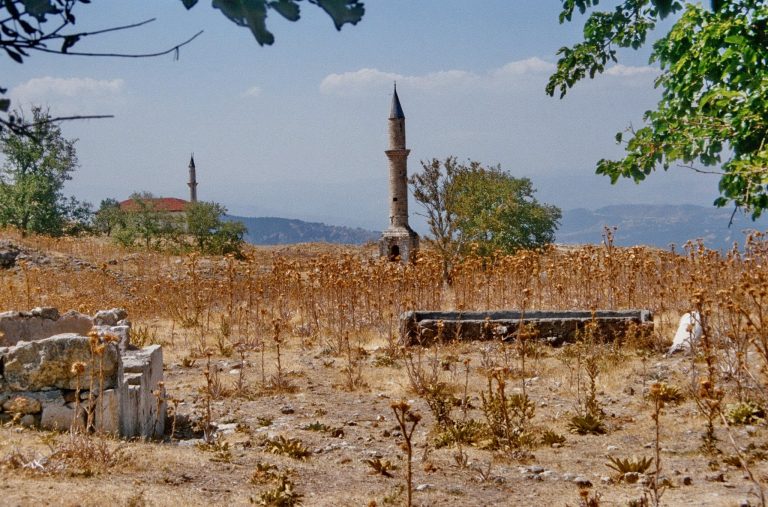
Laodicea Ancient City: A Hellenistic and Roman Centre in Türkiye


Site at a Glance
- Rating
- 4.8
- Popularity
- Medium
- Country
- Turkey
- Primary era
- Classical
- External website
- Open
- Eras represented
- Classical, Medieval
- Civilizations
- Byzantine, Roman, Seleucid
- Site type
- City
On this page21 sections
History
Laodicea Ancient City in Türkiye, near Denizli, was a Hellenistic city founded by the Seleucid king Antiochus II Theos between 261 and 253 BC. Built on the site of an earlier settlement, it became a prosperous centre of commerce, administration, medicine, and Christianity before repeated medieval invasions brought its urban life to an end.
Earlier Settlement and Hellenistic Foundation
The site was inhabited by an indigenous population before the Hellenistic period, the era that followed Alexander the Great’s conquests and spread Greek language and culture across the eastern Mediterranean and Near East. Earlier names for the settlement included Diospolis, meaning “City of Zeus,” and Rhoas.
Antiochus II Theos, ruler of the Seleucid Empire, founded the Hellenistic city between 261 and 253 BC and named it after his wife, Laodice. Its position on a major trade route helped it become wealthy soon after its foundation. In 213 BC, Antiochus the Great defeated the regional ruler Achaeus and transferred 2,000 Jewish families from Babylonia to Phrygia. Laodicea later possessed a large Jewish community, from which approximately nine kilograms of gold was sent annually to the Temple in Jerusalem until the Roman governor L. Valerius Flaccus confiscated it.
Roman Prosperity and Civic Importance
After Rome defeated the Seleucids, the Treaty of Apamea placed Laodicea within the Kingdom of Pergamon. Pergamene territory passed to Rome in 133 BC, and Laodicea received the status of a free city. The city suffered during the Mithridatic Wars, the first-century BC conflicts between Rome and Mithridates VI of Pontus, but recovered rapidly under Roman rule.
During the late Roman Republic and the early imperial period, Laodicea became one of the most prosperous commercial cities of Asia Minor. Its economy included major financial transactions, trade in black wool, linen and wool textiles, medicinal ointments, and other medicines. Wealthy inhabitants financed public monuments, while the city minted coins bearing references to Zeus, Asclepius, Apollo, and the Roman emperors.
Laodicea served as the chief city of a Roman conventus, an administrative and judicial district where a governor or magistrate held legal sessions. The district included 24 other cities. Cicero held judicial sessions at Laodicea for approximately ten weeks around 50 BC and recommended the city for money exchange.
Strabo linked Laodicea’s prominence to the fertility of its soil and the wealth of its citizens. Hiero of Laodicea was credited with adorning the city with many buildings and leaving more than 2,000 talents at his death. The city also had a major medical school and associations with the philosophers Antiochus and Theiodas, successors of Aenesidemus. Another prominent citizen, Polemon, later became king of Armenian Pontus and of the coastal territory around Trebizond.
Earthquake and Early Christianity
A major earthquake during the reign of Nero, approximately between AD 60 and 66, completely destroyed Laodicea. The inhabitants declined imperial assistance and rebuilt the city using their own resources, allowing its recovery to proceed rapidly.
Christianity spread early in Laodicea, reportedly through Epaphras, a disciple of Paul who worked among the city’s large Jewish community. Laodicea became a bishopric, a Christian territory administered by a bishop, and was one of the Seven Churches of Asia addressed in the Book of Revelation. Paul’s Letter to the Colossians refers to the Laodicean Christian community and asks that the letter be read publicly there.
The martyrdoms of Lulianos and Paphos were traditionally associated with Laodicea. Some Greek manuscripts of the First Epistle to Timothy end by stating that the letter was written at Laodicea, described there as the metropolis of Phrygia Pacatiana. The earliest bishops associated with the city are uncertainly identified as Archippus, Nymphas or Nympha, and Diotrephes. Later figures connected with the see include Sagaris, a martyr dated to approximately AD 166, Sisinnius, Nunechius, Eugenius, and the Arian bishop Cecropius.
Nunechius attended the Council of Nicaea in 325, while Eugenius was probably his successor. Constantius later transferred Cecropius to the see of Nicomedia. When Phrygia was divided into two provinces, Laodicea became the metropolitan see of Phrygia Pacatiana, a late Roman and Byzantine province in western Asia Minor.
Ecclesiastical and Medieval History
Sixty Greek canons attributed to a Council of Laodicea survive. The council’s date remains disputed, although a date after the Council of Constantinople in 381 is considered safer. The canons appear to condense an older text derived from two collections and remain important for the history of Christian discipline and liturgy.
In 1384, Laodicea temporarily assumed the metropolitanates of Chonae, Kotyaion, and Kolis, as well as patriarchal possessions at Koula. These ecclesiastical territories had declined under pressure from Anatolian beyliks, medieval Turkish principalities that emerged as Seljuk authority weakened. Laodicea retained Chonae until 1394. The last bishop occupied the see in 1450, after which its name continued as a titular see, meaning a historical bishopric without a resident bishop, of the Ecumenical Patriarchate and the Catholic Church. The Catholic Church appointed no further titular bishop after transferring its last incumbent in 1968.
Laodicea also endured repeated military changes in the medieval period. In 1119, Emperor John II Komnenos and his principal commander, John Axouch, captured the city from the Seljuk Turks. Emperor Manuel I Komnenos fortified it in 1160, but the Seljuks sacked it in 1161 and enslaved much of its population. They raided the city again several years later.
Manuel Maurozomes ruled Laodicea from 1206 to 1230. Around 1257, the Empire of Nicaea received Laodicea and several neighboring strongholds from Sultan Kaykaus II in exchange for assistance in recovering Iconium. The city was soon captured again by Turkomans, and repeated Turkish and Mongol invasions ultimately destroyed its urban life.
Excavation and Conservation
Excavations have continued since 2002 under Pamukkale University, accompanied by intensive restoration. These activities have recovered and conserved parts of the city’s civic, religious, hydraulic, and residential landscape. In 2013, Laodicea was placed on Türkiye’s Tentative List for World Heritage Sites.
Remains
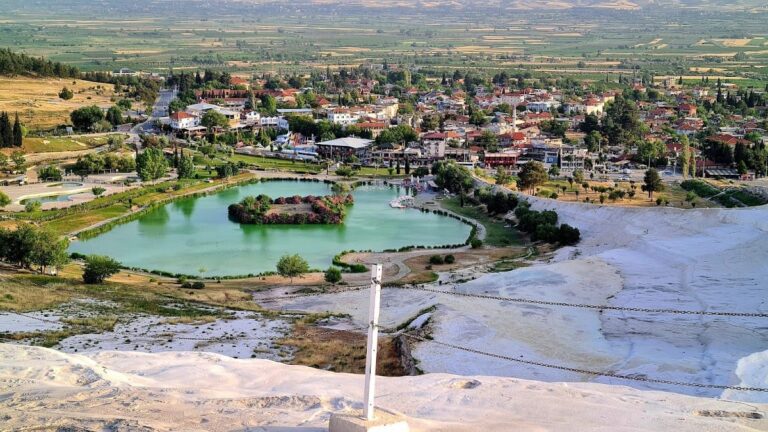
Laodicea stood on a long hill or spur between the narrow valleys of the Asopus and Caprus rivers, whose waters flowed into the Lycus within the Lycus-Maeander river system. The ruins lie near modern Eskihisar, close to Denizli, approximately 17 kilometres west of Colossae, 10 to 15 kilometres south of Hierapolis, and 160 kilometres east of Ephesus. The surviving urban remains include theatres, baths, temples, a gymnasium, a stadium, a civic council house, colonnaded streets, public squares, and numerous pedestals.
Civic Centre and Performance Buildings
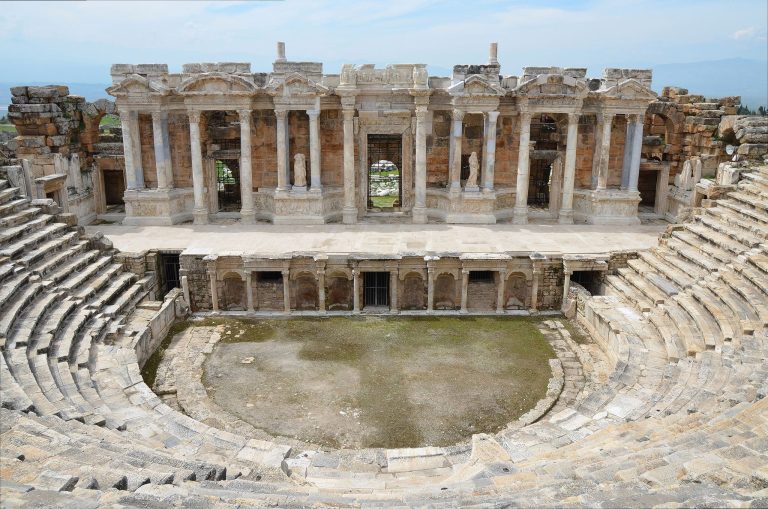
West Theatre
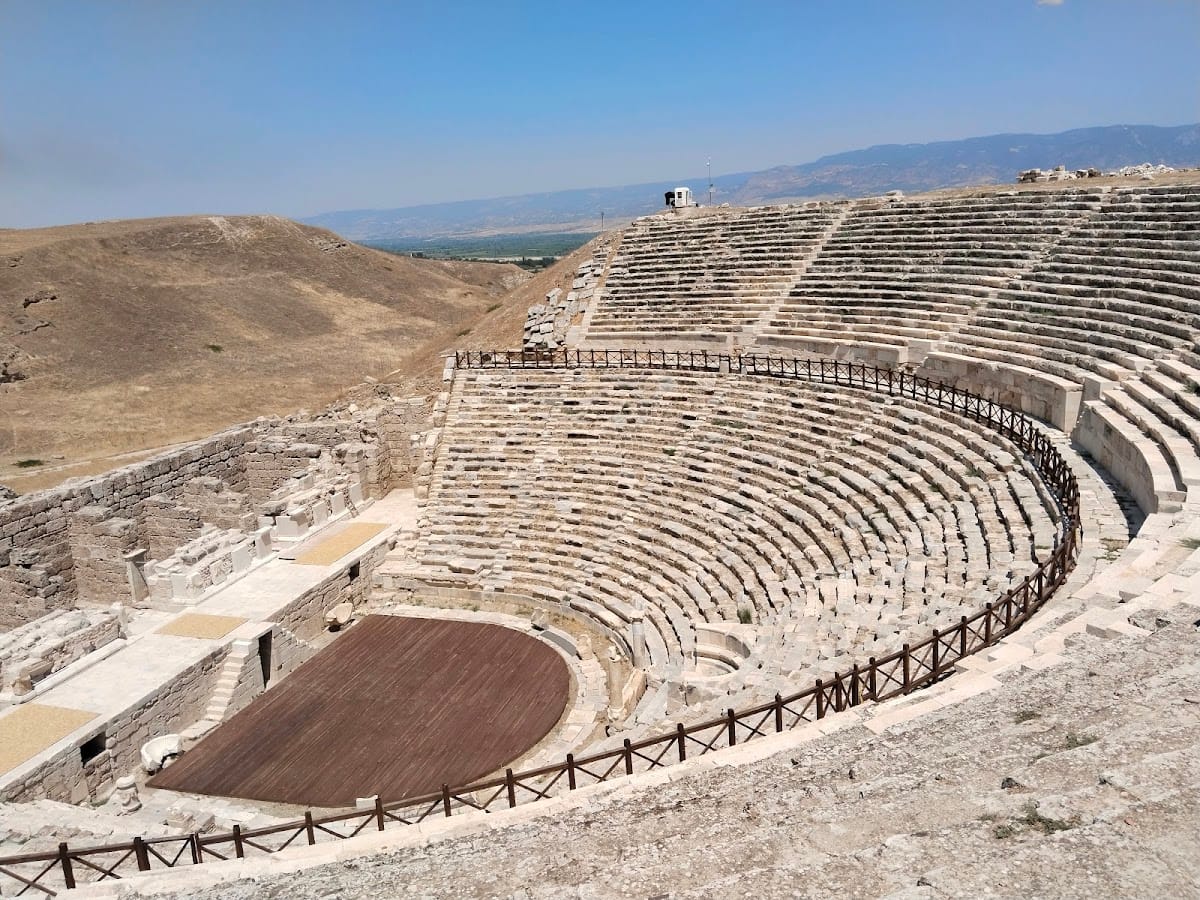
The West Theatre was first built during the Hellenistic period and held approximately 8,000 spectators. It continued in use until the seventh century AD. Its stone seating banks were restored in 2022 under the supervision of Celal Simsek of Pamukkale University, with work involving academics, an architect, archaeologists, monument-restoration specialists, and laborers.
West Agora
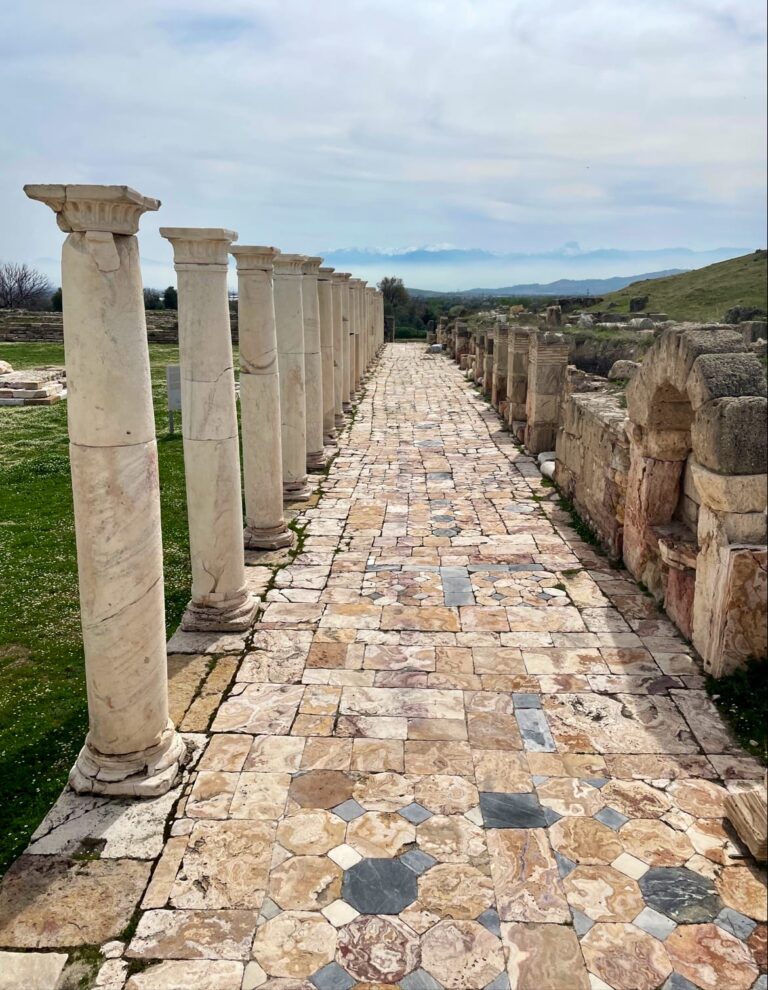
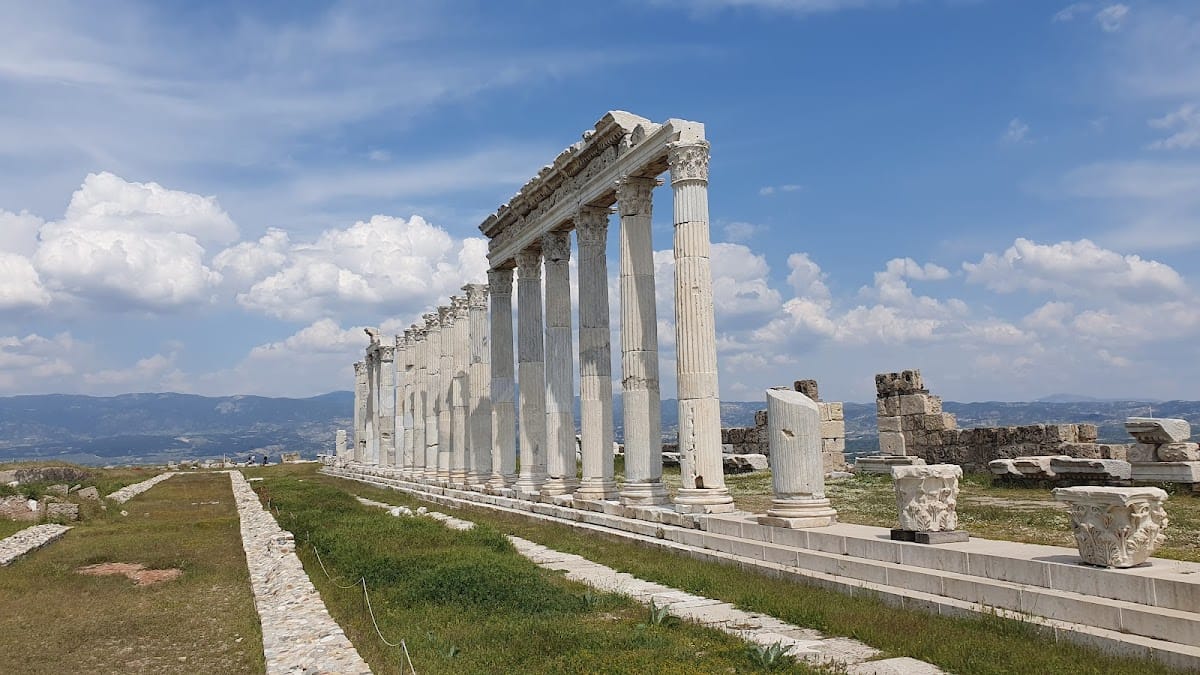
Much of the enormous West, or Central, Agora has been restored. This public civic and commercial space covers approximately 35,000 square metres. Its columns rise to about 10.8 metres, while the rear wall extends for approximately 100 metres and reaches 11 metres in height. Frescoes cover the rear wall.
Stadium
The stadium lies near the southern edge of the city and is relatively well preserved. Its seating occupies both sides of a narrow valley adapted for the arena, which was closed at both ends. A substantial underground passage on the western side allowed chariots and horses to enter, and a long inscription stood above the entrance.
Nicostratus, a wealthy citizen, dedicated the stadium to Emperor Vespasian in AD 79. Athletic contests, gladiatorial combat, and animal hunts took place there. Immediately north of the stadium, a gymnasium and twin baths formed a regional type of complex connected on its northern side with the South Agora and a bouleuterion, a civic council house. An inscription indicates that this ensemble was built for Emperor Hadrian’s visit in AD 135.
Water Supply and Fountains
Aqueduct and Distribution Tanks
Laodicea’s aqueduct began several kilometres away at the Baspinar spring in Denizli and may also have drawn water from a more distant source. To cross the valley south of the city, it used an inverted siphon, a pressurized conduit that descends into a valley and rises again on the opposite side, instead of relying solely on elevated open channels carried by high Roman arches.
The system used a pressurized double pipeline. Low arches supported the siphon from a southern hill, where a header tank stood, to the first terminal distribution tank at the edge of the city hill. This castellum aquae, a tank that directed water into smaller conduits, lies east of the stadium and the South Baths complex. Large carved stone pipes formed the siphon, while clay pipes of different diameters distributed water toward the northern, eastern, and southern parts of the city.
Calcareous deposits accumulated in the water system. Thick encrustations formed around leaks, and some pipes became heavily coated or blocked. A small fountain stood west of the terminal tank beside a vaulted gate. Earthquake damage is indicated by the surviving arches, which lean to one side without being extensively shattered.
Secondary Water Installation
A second distribution terminal and sedimentation tank lie approximately 400 metres north of the first installation. Another siphon made from travertine blocks connected the two structures. This larger installation supplied most of the city.
Water Law
A rare marble block found in 2015 bears a water law issued in AD 114. It regulated water brought from the mountains to Laodicea and imposed fines ranging from 5,000 to 12,500 denarii, Roman monetary units, for polluting the supply, destroying channels, or opening water pipes.
Nymphaeum
A third-century AD nymphaeum, a monumental fountain associated with water supply and decoration, stood at the centre of the city and was excavated during the 1950s. It consisted of a square basin with an Ionic colonnade and two semicircular fountains. Two underground storage tanks supplied the structure, while water reached it through a water tank and an arched aqueduct from the Denizli valley.
Defences, Tombs, and Finds
City Wall and Ephesus Gate
The eastern line of the ancient defensive wall remains traceable, together with the remains of the Ephesus Gate. These features formed part of the city’s boundary and provide evidence for its organized urban enclosure.
Sarcophagi
Numerous sarcophagi lie north of the city toward the Lycus. Their covers remain nearby, and many of the stone coffins are partly embedded in the ground. The group forms a funerary area associated with the northern side of Laodicea.
Trajan Statue
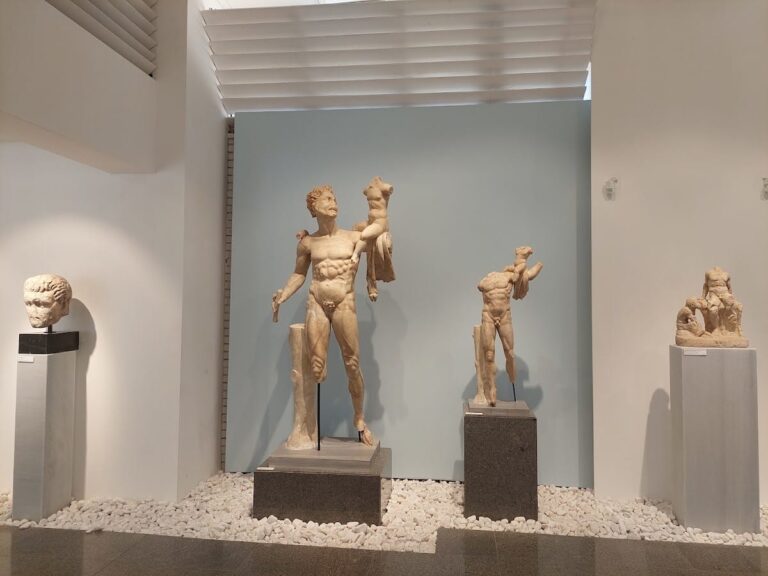
A statue of the Roman emperor Trajan was unearthed at the site in 2019, adding a surviving imperial image to the city’s recovered sculpture.
Hellenistic Sundial
A marble sundial from the Hellenistic period was discovered in 2020. It indicated seasons, months, and hours, and its surface was decorated with foliage and the names of the seasons in Greek. The projecting pin that cast the shadow used to read the time, called a gnomon, is missing.