Alcázar of Seville: A Historic Royal Palace in Spain


Visitor Information
Google Rating: 4.7
Popularity: Very High
Google Maps: View on Google Maps
Official Website: www.alcazarsevilla.org
Country: Spain
Civilization: Medieval Islamic
Remains: Military

History
The Alcázar of Seville is located in the historic center of Seville, Spain. Its origins trace back to a site occupied since at least the 8th century BCE, with evidence of Phoenician, Roman, and Visigothic presence. The earliest palace enclosure preserved today dates from the late 11th century, likely constructed by the taifa king Al-Mutamid or the Almoravids. This early structure incorporated materials from Roman walls and earlier buildings, marking the beginning of the complex’s long history.
In the 12th century, the Almohad dynasty expanded and fortified the Alcázar, linking it to the city’s defenses and adding new constructions, including a major mosque. This period reinforced the Alcázar’s role as a fortified palace within the Islamic city. The name Puerta de la Montería, the original name of the main entrance, reflects hunting traditions, later replaced by Puerta del León, referencing a lion motif added in the 19th century.
Following the Christian conquest of Seville in 1248 by King Ferdinand III, the Alcázar became a royal residence. Alfonso X built a Gothic palace between 1252 and 1260, introducing Christian architectural elements. After a significant earthquake in 1356, King Pedro I commissioned the construction of the Mudéjar palace, blending Islamic and Christian styles. This palace featured extensive Arabic inscriptions praising the king and became a symbol of the Mudéjar artistic tradition.
Throughout the late Middle Ages and Renaissance, the Alcázar remained a royal residence and administrative center. It hosted important events such as diplomatic meetings in the 14th century, the birth of Prince Juan in 1478, and the wedding of Charles I and Isabel of Portugal in 1526. The Casa de Contratación, established in 1503 within the complex, regulated trade with the Americas, highlighting the Alcázar’s role in Spain’s expanding empire.
In the 19th century, the Alcázar was used by the Spanish royal family during the French intervention of 1823. The Second Spanish Republic ceded the site to the city of Seville in 1931. In the 20th and 21st centuries, the Alcázar hosted significant political meetings, including sessions of the Spanish Council of Ministers in 1976 and 2010, maintaining its importance in national affairs.
Remains
The Alcázar of Seville is a complex of palaces and gardens showcasing a variety of architectural styles, including Islamic, Mudéjar, Gothic, Renaissance, Manierist, and Baroque. Its layout includes multiple courtyards, halls, and extensive gardens, reflecting centuries of construction and renovation.
Archaeological excavations have revealed Roman and Phoenician remains beneath the palace, including a Roman building from the 2nd or 1st century BCE and a possible temple dedicated to the goddess Isis. These ancient structures lie beneath the current complex, indicating continuous occupation of the site.
The Patio del Yeso, dating from the late 12th-century Almohad period, is a nearly square courtyard with a central pool and porticoed arches. It features sebka plasterwork and caliphal columns, typical of Islamic decoration. The Patio del Crucero, originally Almohad and reformed in the 13th century, is a rectangular garden courtyard divided by myrtle hedges, containing Mediterranean plants. Its original lower garden with a large fountain was buried after the 1755 Lisbon earthquake.
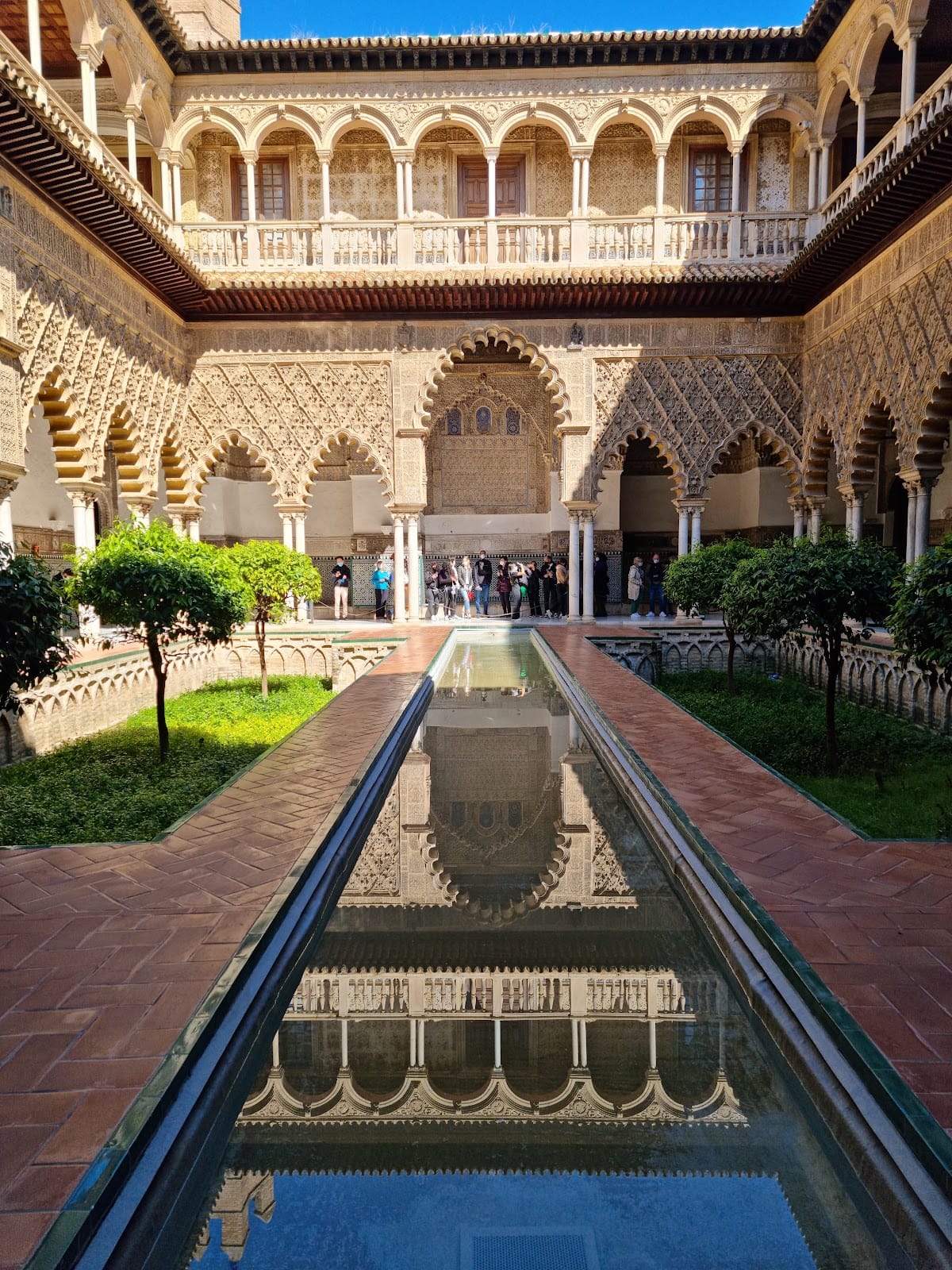
The Mudéjar Palace of Pedro I, built between 1356 and 1366, includes the Patio de las Muñecas, a rectangular courtyard surrounded by four galleries of lobed arches decorated with sebka and plaster reliefs. The palace’s Salón de Embajadores (Hall of Ambassadors) features a golden hemispherical dome built in 1427, with walls adorned by azulejos (glazed tiles) and intricate plasterwork. Arabic inscriptions praising King Pedro I decorate the palace extensively.
The Gothic Palace, constructed by Alfonso X in the 13th century, retains its original ground floor structure. It includes 16th-century azulejo zócalos (decorative tile panels) and a chapel likely dedicated to San Clemente. The Sala de Justicia, built under Alfonso XI around 1340-1350, is a square Mudéjar hall with a wooden artesonado ceiling and originally housed a tribunal with brick tiers and a stone throne.
The Alcoba Real, or Royal Chamber, accessed from the Patio de las Doncellas, consists of two rooms separated by horseshoe arches. It features 15th-century wooden ceilings, stucco friezes, and doors decorated with six-armed circular lacerías (geometric patterns). Windows display star and eight-armed wheel motifs. Nearby, the Salón del Techo de Carlos V contains a ceiling with 75 octagonal coffers made in the mid-16th century.
The gardens form a fundamental part of the complex, evolving from Islamic garden design to Renaissance and Baroque styles. Notable features include the Estanque de Mercurio (Mercury Pond) with a 1576 bronze statue, the Galería de Grutesco, and the Jardín de la Danza, which provides access to the 12th-century vaulted Baños de María Padilla. Other gardens, such as Jardín de Troya, Jardín de la Galera, and Jardín de las Flores, contain fountains, marble columns, and grottos dating from the 16th to 18th centuries.
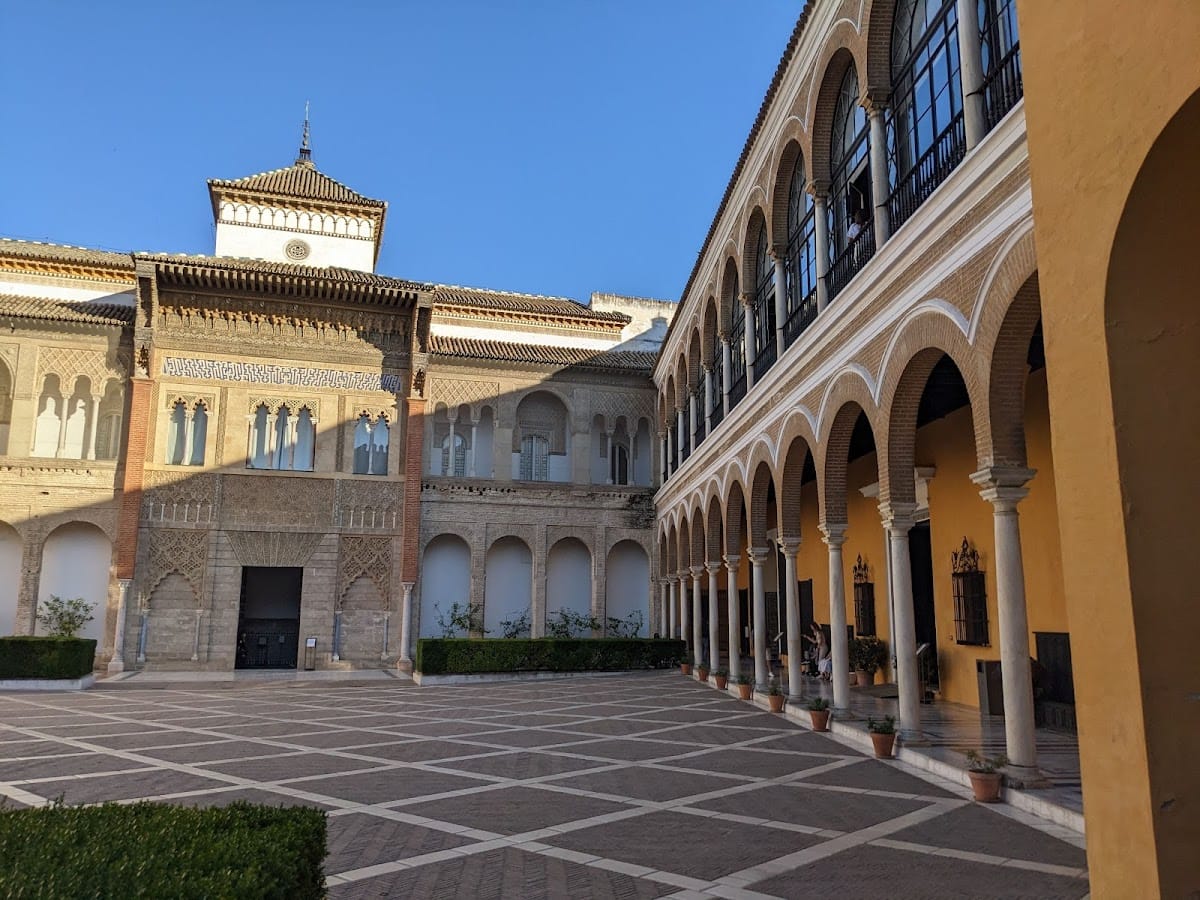
The Casa de Contratación occupied buildings extending from the Patio de la Montería to the Plaza de la Contratación. Surviving rooms include the Salón del Almirante, decorated with notable paintings, and the Sala de Audiencias, converted into a chapel with a 16th-century altarpiece by Alejo Fernández.
Restoration efforts have uncovered and preserved many original features, including the Mudéjar garden beneath the Patio de las Doncellas. The site contains numerous inscriptions in Arabic and Latin, including dedicatory texts praising King Pedro I and religious inscriptions on doors. These elements contribute to the Alcázar’s rich historical and cultural heritage.
Nearby sites