Augusta Raurica: A Roman Colony and Archaeological Site in Switzerland
Table of Contents

Visitor Information
Google Rating: 4.6
Popularity: Medium
Google Maps: View on Google Maps
Official Website: www.augustaraurica.ch
Country: Switzerland
Civilization: Roman
Remains: City

Context
Augusta Raurica is situated near the present-day municipality of Augst in the canton of Basel-Landschaft, Switzerland, positioned on the left bank of the Rhine River close to the German border. The site occupies a gently sloping terrace between the Rhine and the Jura Mountains, providing advantageous access to fresh water from nearby streams such as the Ergolz and Violenbach, as well as fertile soils conducive to agriculture. The surrounding landscape features low hills and the Jura range to the west, which influenced local climatic conditions and resource availability. Its location along the Rhine established Augusta Raurica as a natural corridor for movement, trade, and communication within the transalpine region.
Founded in the late Republican period around 44 BCE, Augusta Raurica developed into a significant Roman colony and urban center during the early Imperial era. Archaeological evidence documents continuous occupation through the 1st and 2nd centuries CE, with gradual decline beginning in the late 3rd century. The site’s abandonment was a protracted process rather than a sudden event, reflecting broader regional transformations. Extensive excavations since the 19th century have revealed well-preserved remains of public, residential, and infrastructural elements, making Augusta Raurica one of the most comprehensively studied Roman sites in Switzerland and a key reference for understanding Roman urbanism in the Upper Rhine region.
History
Augusta Raurica was established as a Roman colony in the late Republican period and evolved into a prominent urban center within the province of Germania Superior. Its strategic position near the Rhine River placed it at the intersection of major north-south and east-west routes connecting northern Italy, Gaul, and the Danube provinces. Over several centuries, the site experienced phases of growth, military occupation, crisis, and transformation, mirroring wider imperial developments and regional conflicts. By the early medieval period, Augusta Raurica’s importance diminished as political and military focus shifted to nearby Basel and the Rhine frontier.
Foundation and Early Roman Period (1st century BCE – 1st century CE)
Founded circa 44 BCE as Colonia Augusta Rauricorum, the settlement was established primarily as a veteran colony under the auspices of Emperor Augustus. The colony’s name reflects the indigenous Celtic tribe of the Raurici, indicating a deliberate Romanization of the local population and territory. The site was selected for its favorable topography—a terrace between the Rhine and the Jura Mountains—offering natural protection, access to water sources, and fertile land. Initial urban development included a wooden forum constructed shortly after foundation and a military camp in the lower town near the Rhine, measuring approximately 90 by 140 meters. This camp housed auxiliary troops linked to the legionary base at Vindonissa, located about 40 kilometers away. By the mid-1st century CE, as the Roman frontier advanced northward, the military camp was abandoned, and Augusta Raurica transitioned into a civilian urban center.
Imperial Prosperity and Urban Development (1st–2nd centuries CE)
During the 1st and 2nd centuries CE, Augusta Raurica expanded rapidly, becoming a prosperous municipium within Germania Superior. The city’s layout followed a planned orthogonal grid adapted to the local terrain, with insulae (city blocks) measuring approximately 56 by 66 meters. Major construction projects under the Flavian dynasty included a large scenic theater, a monumental podium temple on Schönbühl hill, a secondary forum (South Forum), and extensive bath complexes such as the Frauenthermen and Central Baths. The military presence diminished significantly, and the population is estimated to have reached around 10,000 inhabitants by circa 200 CE. The economy was diversified, with specialized crafts including pottery production near clay sources, glassmaking workshops along the Rhine, metalworking, textile manufacture, and woodworking. Residential architecture ranged from modest houses to richly decorated town villas, some occupying entire insulae and extending over public streets with official sanction. The forum remained the civic, judicial, and religious heart of the city, featuring porticoes, shops, offices, and sacred precincts.
Crisis and Decline in the 3rd Century CE
The 3rd century CE was marked by political instability and external pressures across the Roman Empire, which profoundly affected Augusta Raurica. Archaeological evidence reveals widespread abandonment of buildings, accumulation of refuse in streets, and multiple fire layers with uncollected debris, indicating social and economic decline. Around 260 CE, the city suffered extensive destruction, likely connected to the upheavals of the Gallic Empire and the withdrawal of Roman forces from the upper Germanic-Rhaetian Limes. Finds of weapons and human remains in the upper town streets attest to violent confrontations within the urban area. The surviving population retreated to a naturally defensible spur on the town’s edge, where they erected a reduced fortified enclosure (enceinte réduite) using salvaged materials from public and private structures.
Late Antiquity and Military Reorganization (Late 3rd – 5th centuries CE)
In response to renewed threats along the Rhine frontier, the Castrum Rauracense was constructed near the river around 290 CE as part of Emperor Diocletian’s military reforms. This fortress featured massive enclosure walls 8 to 10 meters high, multiple towers, and four gates, surrounded by a V-shaped defensive ditch. It housed troops of Legio I Martia and included both military personnel and civilians within its walls. The fort was integrated into a broader defensive system reinforced by Emperor Valentinian I, which included watchtowers along the Rhine. In 351/352 CE, the fort was attacked and heavily damaged by Alamanni tribes during Roman civil wars, as evidenced by a buried hoard of 58 kilograms of silver objects, likely belonging to high-ranking imperial officials. The fort was subsequently rebuilt and remained in use into the early 5th century. Defensive ditches were modified or filled in during this period, possibly reflecting troop withdrawals amid Gothic incursions. The adjacent cemetery continued in use until the 7th century, indicating some continuity of occupation beyond the Roman military presence.
Early Medieval Period (6th–7th centuries CE)
Following the collapse of Roman authority in the region, Augusta Raurica underwent a gradual transformation into a smaller, rural settlement during the early medieval period. Stone buildings within the former fort were partially abandoned or repurposed, with timber and wattle-and-daub structures replacing some earlier masonry constructions. The population likely comprised descendants of the Roman garrison alongside emerging Frankish elites. Economic activities centered on agriculture and fishing, with limited craft production. By the 7th century, Augusta Raurica had lost its regional prominence to the rising city of Basel and was reduced to a modest village. Archaeological evidence for this period is sparse but suggests a gradual decline rather than abrupt abandonment.
Daily Life and Importance by Period
Foundation and Early Roman Period (1st century BCE – 1st century CE)
During its initial phase as a veteran colony, Augusta Raurica’s population consisted of Roman military veterans and local Celtic inhabitants of the Raurici tribe. Social organization likely followed Roman patriarchal family structures, with households comprising nuclear families supported by slaves or freedpersons, though direct evidence remains limited. Civic governance was probably conducted by magistrates such as duumviri, as indicated by inscriptions typical of Roman municipia. Economic activities combined small-scale agriculture exploiting fertile lands near the Rhine with artisanal crafts including pottery and metalworking. The military camp in the lower town provided logistical support to troops stationed at Vindonissa. Early residential buildings were primarily wooden with open courtyards, gradually transitioning to stone foundations. Dietary remains and amphora fragments suggest consumption of cereals, locally caught fish, olives, and imported wine. Religious practices integrated Roman imperial cult worship with local Celtic traditions, centered on temples and shrines within the forum precinct. The settlement’s urban plan adhered to Roman orthogonal principles adapted to the terrain, with water supplied by nearby streams and early aqueducts supporting public fountains and baths. Trade goods arrived via the Rhine corridor and intersecting roads, facilitating connections to northern Italy and Gaul.
Imperial Prosperity and Urban Development (1st–2nd centuries CE)
By the 1st and 2nd centuries CE, Augusta Raurica had matured into a thriving civilian city with an estimated population of approximately 10,000. The social hierarchy became more pronounced, with wealthy elites residing in multi-room stone houses (domus) featuring interior courtyards, private baths, and elaborate wall paintings. Inscriptions attest to the presence of magistrates, priests, and guild members who organized civic and religious life, while slaves and freedpersons formed the labor base. The economy was characterized by diversified crafts, including pottery workshops near clay sources, glassmaking facilities along the Rhine, and metalworking and textile production. These industries operated at household and workshop scales, supplying local and regional markets via established trade routes.
Agriculture remained vital, with grain, olives, and vineyards cultivated in the surrounding countryside. Public amenities such as multiple bath complexes, theaters, and temples facilitated social interaction and cultural activities. Dietary evidence indicates a varied menu including bread, olives, fish, and imported delicacies like wine and spices. Clothing typically consisted of woolen tunics and cloaks, with leather sandals common across social strata. Domestic interiors were richly decorated with mosaics and frescoes, and furniture included wooden tables, stools, and storage chests.
Markets within the forum offered a range of goods, and transportation relied on carts and river vessels navigating the Rhine. Religious life centered on imperial cult temples, Gallo-Roman shrines, and festivals reinforcing civic identity. Public readings, legal proceedings in the basilica, and theatrical performances contributed to the city’s cultural fabric. Augusta Raurica functioned as a municipium within Germania Superior, governed by local councils and integrated into imperial administrative networks, serving as a regional hub for commerce, crafts, and ritual.
Crisis and Decline in the 3rd Century CE
The 3rd century CE witnessed significant demographic and economic contraction at Augusta Raurica amid broader imperial instability. Population decline is evidenced by abandoned residences and diminished craft production, with survivors retreating to a fortified enclave on a defensible spur. Social structures likely became more insular, with a reduced elite presence and increased militarization of the remaining community.
Economic activities contracted to subsistence agriculture and small-scale artisanal production, with many workshops abandoned or repurposed. Dietary patterns shifted toward locally available staples, reflecting disrupted trade networks. Clothing and domestic decoration became simpler, paralleling reduced wealth. Streets littered with refuse and signs of fire damage indicate episodes of violent conflict, consistent with historical accounts of Alamanni incursions and the Gallic Empire’s turmoil. Religious observances persisted but on a smaller scale, centered within the reduced urban core. Civic institutions weakened as administrative functions contracted. Transport and trade diminished due to insecurity along the Rhine corridor. The city’s role shifted from a thriving municipium to a beleaguered settlement struggling to maintain basic functions amid empire-wide crisis.
Late Antiquity and Military Reorganization (Late 3rd – 5th centuries CE)
With the construction of the Castrum Rauracense fortress near the Rhine around 290 CE, Augusta Raurica’s urban focus shifted to a militarized community comprising Roman soldiers of Legio I Martia, their families, and some civilian retainers. Hierarchical command structures governed the fort, which included barracks, workshops, and storage facilities. Economic life centered on military provisioning, brick and tile production stamped by the legion, and limited artisanal crafts supporting the garrison and adjacent civilian settlement. Agriculture in the hinterland sustained the fort’s population.
Diet remained basic but adequate, relying on stored grain, local fish, and limited imports. The fort’s water supply and sanitation systems ensured sustainability. Religious practice included traditional Roman cults and possibly early Christian worship, though direct evidence is limited. The fort secured a key Rhine crossing, integrating Augusta Raurica into the late Roman defensive network under Diocletian and Valentinian I. Despite Alamanni attacks in 351/352 CE, the fort was rebuilt and remained active into the early 5th century. Civic life outside the fort diminished, with the cemetery’s continued use indicating some population continuity. The site’s importance shifted from a civilian municipium to a military stronghold safeguarding the Rhine frontier.
Early Medieval Period (6th–7th centuries CE)
Following the collapse of Roman authority, Augusta Raurica transformed into a modest rural village inhabited by Romanized descendants and emerging Frankish elites. Household structures simplified, with timber and wattle-and-daub replacing stone buildings. Social organization reflected early medieval patterns, with local chieftains or landowners supplanting Roman magistrates. Economic activities focused on agriculture, fishing, and small-scale crafts sufficient for local needs. Trade was minimal, limited to regional exchange. Diet remained based on cereals, vegetables, and river fish. Clothing adapted to early medieval styles, with wool and linen garments predominating. Domestic interiors were modest, lacking the elaborate decoration of earlier periods. Religious life transitioned toward Christianity, likely centered on small rural churches or chapels, though archaeological evidence is limited. The site lost its former civic prominence to nearby Basel, which became the regional center. Augusta Raurica’s role was reduced to a peripheral agrarian settlement, maintaining continuity through gradual transformation rather than abrupt abandonment.
Remains
Architectural Features
Augusta Raurica exhibits a planned Roman urban layout characterized by a grid pattern adapted to the local topography. The city developed primarily as a civilian settlement from the late 1st century BCE through the 2nd century CE, with later military fortifications added in the 3rd and 4th centuries CE. Construction techniques include ashlar masonry, Roman concrete (opus caementicium) cores, and limestone blocks, with red Buntsandstein employed in structurally stressed or decorative elements. The city was partially enclosed by a stone wall begun around 80 CE but never completed, extending approximately 370 meters with semicircular towers and two main gates. The urban area comprises distinct civic, religious, residential, commercial, and military zones, with many structures preserved in situ or as visible ruins.
Following the 3rd-century crisis, the civilian settlement contracted, and military fortifications such as the Castrum Rauracense were constructed near the Rhine around 300 CE. This fort featured high enclosure walls with multiple towers and gates, surrounded by a V-shaped ditch. It remained in use into the early 5th century, with evidence of rebuilding after damage in the mid-4th century. The city’s decline led to partial abandonment of earlier buildings, some of which were repurposed during the early medieval period. Several areas remain only partially excavated, while others have been extensively studied and conserved.
Key Buildings and Structures
Main Forum
The main forum, initially constructed in the 1st century CE and subsequently rebuilt twice in stone, functioned as the civic center of Augusta Raurica. It comprises four components: a large rectangular public square (area publica) surrounded by tabernae (shops or offices), an adjacent sacred precinct (area sacra) with a podium temple, a basilica to the east, and a 3⁄4-circular curia (town hall) attached to the basilica. The cardo maximus (principal north-south street) intersects the forum, delineating public and sacred zones. The forum square was lined by porticoes and small chambers used as municipal offices and commercial spaces. Statues and inscriptions honoring notable citizens were displayed here. The basilica, rebuilt after a fire at the end of the 1st century CE, is a large three-aisled hall with thick retaining walls and served administrative and judicial functions.
Curia
The curia served as the meeting place for the town council (decuriones) and magistrates. Originally a two-story structure, it featured a large basement room likely used as a treasury or jail and an upper timber-built council hall accessible from the basilica. The basement was later filled, and the council hall was reconstructed in stone. Remains of the curia’s walls and foundations are extant near the forum complex.
Forum Temple
Situated within the forum’s sacred precinct, the temple was constructed on a raised podium surrounded by porticoes. Dating to the 1st century CE, it housed a cult statue, possibly of the goddess Roma or Jupiter, as suggested by inscriptions and iconography. Priests accessed the cella (inner chamber) via monumental steps. An altar at the temple’s base, dating to circa 50 CE, is clad in Carrara marble slabs decorated with reliefs depicting oak wreaths, eagles with thunderbolts, laurel wreaths, and sacrificial implements, underscoring its imperial cult function.
Temple on Schönbühl Hill
This temple complex on Schönbühl hill originated in the city’s early phase, with several small Gallo-Roman style temples present around 50 CE. Around 70 CE, the area was reorganized, and a large column-surrounded temple on a podium was erected, likely dedicated to the emperor and Roman state gods, symbolizing imperial authority. The podium’s core remains, with visible column recesses. Retaining walls and embankments expanded the hill to form a large rectangular terrace. The temple was partially dismantled for building materials in the late 3rd century CE.
Sanctuary in the Grienmatt Area
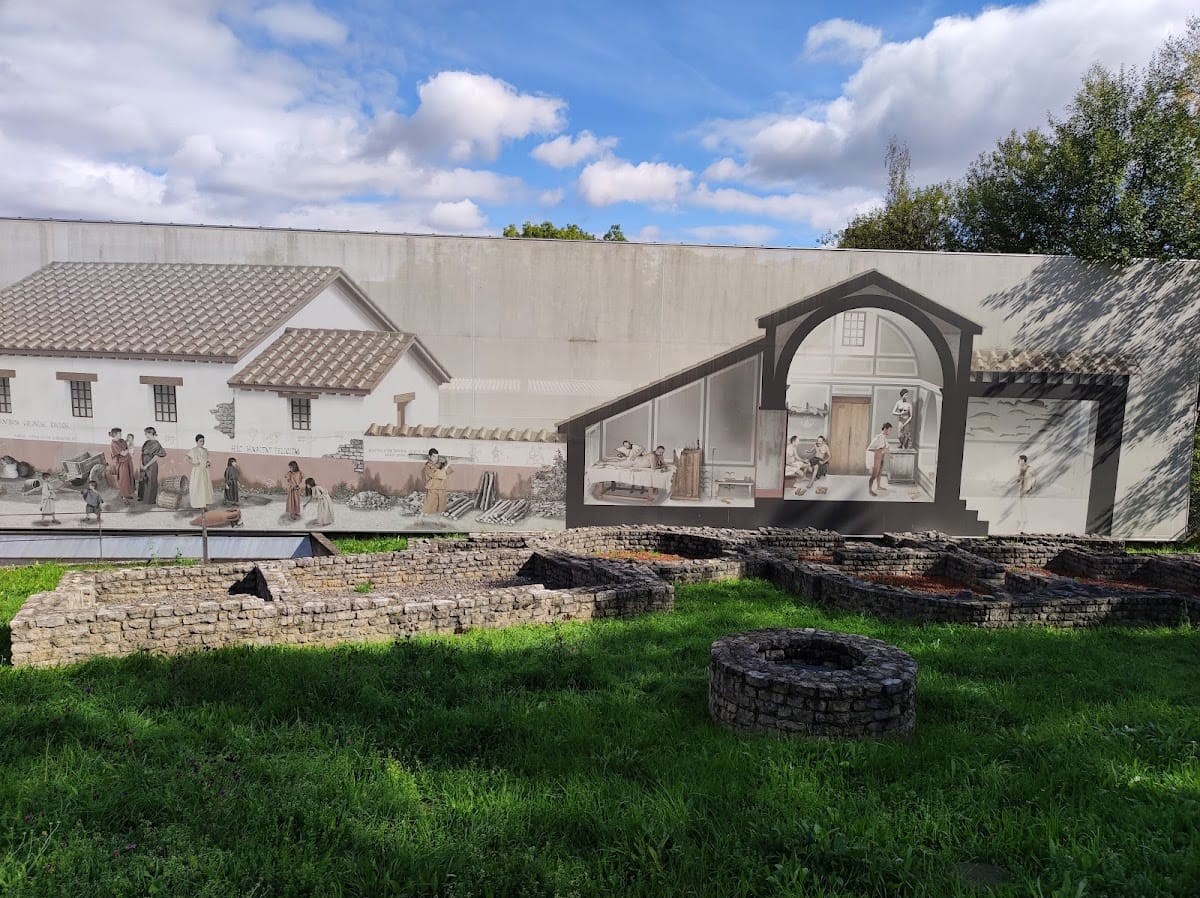
Located at the western edge of the town, this sanctuary comprises the lower portion of a large rectangular building surrounded by porticoes. Adjacent to it is a bath complex with two rooms containing multiple built-in bathtubs, interpreted as facilities for remedial spa treatments under priestly supervision. Dedications to Aesculapius Augustus and a personal votive altar indicate the site’s association with healing and health rituals.
Scenic Theater
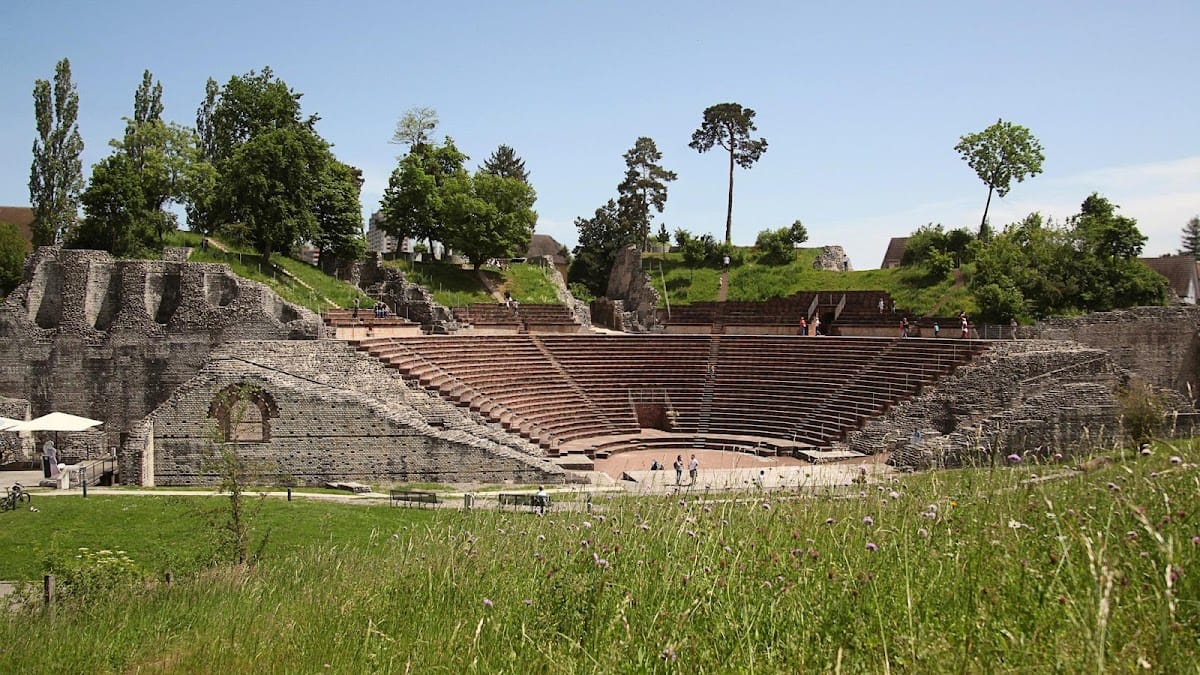
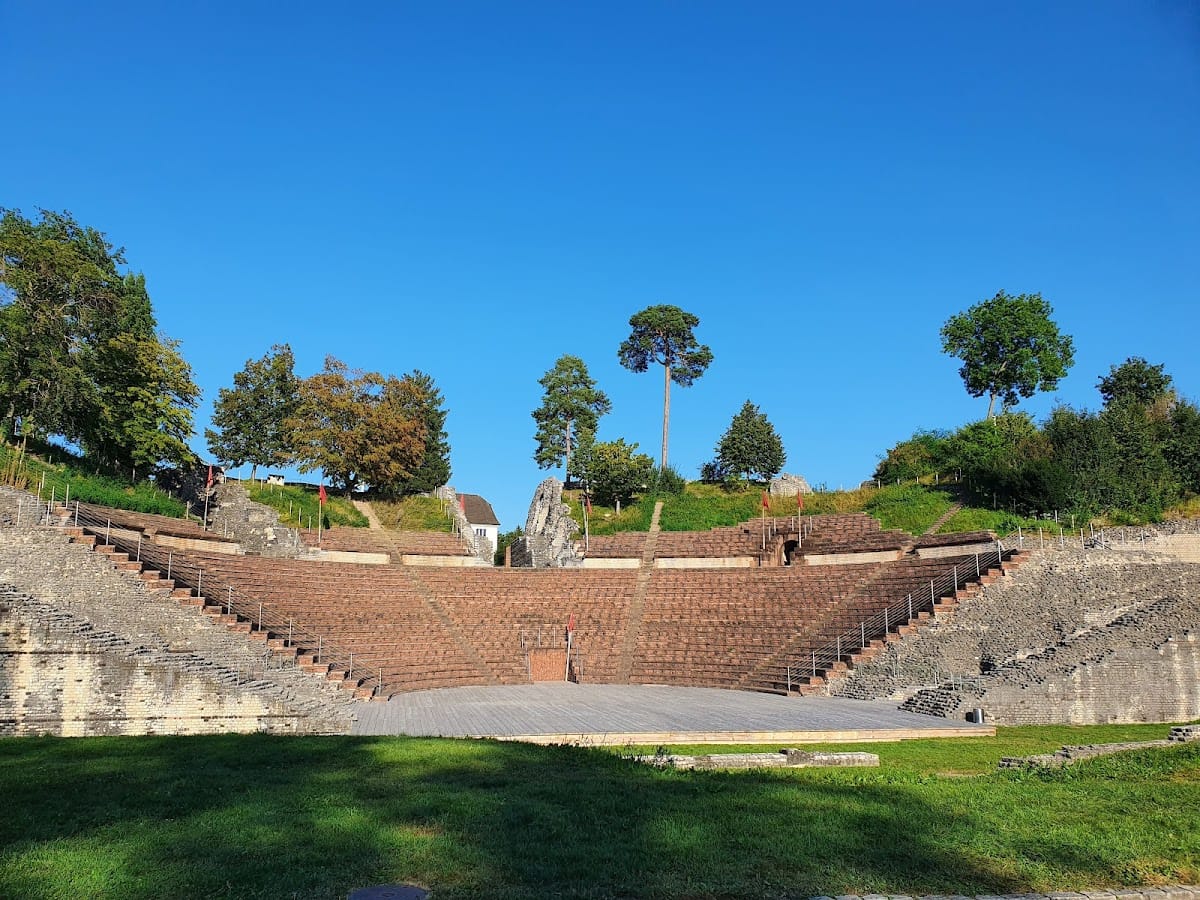
The scenic theater, situated in the city center, is the best-preserved ancient theater of its type north of the Alps. It underwent three construction phases: an initial arena-theater with a circular arena built circa 70–80 CE; a semi-amphitheater rebuilt around 110 CE with seating for 7,500–8,500 spectators; and a classic Gallo-Roman scenic theater constructed circa 180–190 CE, accommodating approximately 10,000–12,000 spectators. Constructed primarily of limestone with red Buntsandstein used in structural and decorative elements, the theater is axially aligned opposite the Schönbühl podium temple, indicating integration of theatrical and cult activities. The theater fell out of use in the mid-3rd century and was quarried for building materials. Excavations and restorations have been ongoing since the 16th century.
Amphitheater (Southwestern Edge)
Built around 170 CE on a natural terrain depression, the elliptical amphitheater measures approximately 50 by 34 meters and is enclosed by a roughly 4-meter-high wall. It contains two carceres (holding pens) on the long sides and two multi-entrance gates on the short sides for access. Designed for rapid ingress and egress, it hosted animal hunts, gladiatorial combats, and executions. The eastern entrance, known as the “gate of death,” was used to remove dead gladiators, while survivors exited via the “gate of the living” near a small sanctuary. The amphitheater is located on the town’s periphery.
Later Amphitheater (4th Century)
Discovered in 2021 near the Rhine riverbank west of the Castrum Rauracense, this later amphitheater measures approximately 50 by 40 meters. It represents the youngest known amphitheater in the Roman Empire and is associated with the military fortifications of the late Roman period.
Frauenthermen (Women’s Baths)
Located adjacent to the scenic theater in the city center, the Frauenthermen cover an entire insula and include tabernae facing the street. Constructed shortly after 100 CE and used for approximately 150 years, the complex features a sequence of cold, warm, and hot rooms plus a circular sweat room. Underfloor heating (hypocaust) was present in all rooms except the cold room. An outdoor area with a portico, swimming pool, and exercise space was part of the complex. The swimming pool was later replaced by a covered hall, likely also used for physical exercise. The baths were probably privately owned but may have been accessible to locals or travelers for a fee.
Central Baths (Zentralthermen)
Situated within the residential and craft quarters of the upper town along the cardo maximus, the central baths extend beyond a single insula into adjacent blocks to the north and south. Built around 100 CE, only small trenches have been excavated, limiting detailed knowledge. A large wastewater channel (cloaca) associated with the baths remains visible, indicating the complex’s considerable size and sophisticated sanitation system.
Heilbad in Grienmatt
Located outside the city near a temple complex, the Heilbad (healing bath) is identified by dedicatory inscriptions and numerous small basins. It likely served health and healing rituals, possibly connected to the adjacent sanctuary dedicated to Aesculapius Augustus.
Bath Complex in Violenried
Excavated between 1996 and 1998 west of Kastelen hill, this bath complex and well house date to the first half of the 2nd century CE. Its function as either a small public bath or a large private bath remains uncertain due to limited excavation.
Rheinthermen (Rhine Baths)
Constructed after the abandonment of the civilian settlement, the Rheinthermen form part of the Castrum Rauracense fortifications. This typical Roman bath complex includes bathing rooms and service facilities, featuring a large cold-water basin with seating steps and drainage, two warm baths, and a hot bath with an apse. Remains of colorful murals and a hypocaust (underfloor heating) system are preserved.
City Wall and Gates
The city wall, begun around 80 CE, was partially completed and included semicircular towers and two main gates on the southwest and southeast sides. The wall’s core consists of Roman concrete with ashlar facing. The east gate’s towers, with walls up to 2 meters thick and diameters around 8 meters, survive in part. The wall extends a maximum of 370 meters but was never fully enclosed. The east gate’s towers were originally planned larger but reduced in size during construction.
East Gate
Part of the incomplete city wall, the east gate’s remains show massive construction dating to around 80 CE. The gate features two large towers with thick walls and a central passage. The structure’s defensive elements are visible, though partially ruined.
Castrum Rauracense (Fort)
Built around 300 CE in the northern city area near the Rhine, the Castrum Rauracense is a large military fortification with enclosure walls 8 to 10 meters high, multiple towers, and four gates. A V-shaped ditch surrounds the fort. It housed Roman troops, including Legio I Martia, and civilians. The fort was heavily damaged during an Alamanni attack around 351/352 CE but was rebuilt and reinforced in the late 4th century under Emperor Valentinian I. Two defensive ditches have been identified; the older was filled in the late 4th century, while the younger may date to after the 5th century. Military presence continued into the early 5th century, and the fort retained regional importance into the 7th century.
Military Camp of the 1st Century
Located in the lower town on the Rhine plain, this camp was enclosed by a defensive ditch approximately 3.2 meters wide and 0.9 meters deep, covering an area of about 140 by 90 meters. Buildings were wooden, with little known about internal structures. The camp possibly housed cavalry units such as Ala Moesica and Ala Hispana. It was abandoned by the mid-1st century CE, after which the area was overbuilt with wooden residential and craft buildings.
Bridgehead Fortification
Constructed around 369 CE to secure the Rhine crossing opposite Castrum Rauracense, this fortification featured six to eight round towers about 8 meters in diameter with walls up to 2 meters thick. A protective ditch surrounded the structure. Remains of three towers on the landward side survive. It is unclear whether the river-facing side collapsed or was never completed.
Commercial Buildings
Along the main Roman road connecting Augst and Rheinfelden, archaeologists uncovered a building interpreted as an inn with lodging on the upper floor. The basement included a sausage and meat smokehouse and storage cupboards with supplies and crockery. A small rear courtyard was surrounded by living quarters with underfloor heating, possibly for the innkeeper’s family. An adjacent building contained a storage or workroom with a large stone trough and a heated drying room. Access to these buildings requires a free ticket from the museum.
Gewerbehaus Schmidmatt (Commercial Buildings)
Two adjacent multi-story buildings on an east-west road between the upper and lower towns have been excavated. The upper floors are accessible at street level, while the lower floors are reached via a ramp due to the hillside location. The western building’s lower floor contains heated living rooms, a large kitchen, and a storage room for food and dishes, suggesting a tavern above. The eastern building’s lower floor includes a large workshop hall with a masonry basin and wooden barrels, possibly for textile or food processing. Upper floor finds indicate guest hospitality.
Taberna (Shop/Workshop)
This shop or workshop features a large baking oven, almost fully preserved and restored, installed around 250 CE in an existing building. It has ground-level street access, likely serving passers-by such as theater visitors. Originally flanked by now-lost buildings, the upper floor contained cupboards with weapons and tools, possibly used as a repair workshop or storage for a craftsman or scrap dealer.
Tile Yard (Ziegelei)
Located in today’s Liebrüti district, the tile yard includes six large tile kilns dating to the 4th century CE. These kilns produced architectural ceramics for the town, probably operated by soldiers of Legio I Martia. Tiles and floor slabs stamped with the legion’s mark have been found throughout Augusta Raurica and surrounding areas. The production process involved shaping clay, air-drying, and firing in kilns. Imbrex tiles from the last firing remain visible. Products were shipped along the Rhine and Aar rivers to distant locations.
Pottery Workshops
Pottery workshops were concentrated mostly at the settlement edges in the upper town, especially along the southeastern road and near clay extraction sites east of the city wall. In the lower town, workshops were more dispersed within residential and craft quarters. These were organized as family businesses and small manufactories producing small batches, primarily marketed to the city and nearby surroundings.
Glass Workshops
Located in the lower town near the Rhine, glass workshops used three types of furnaces: melting furnaces for large quantities of recycled glass, forming furnaces for vessel production, and cooling furnaces. The workshops mainly produced square-shaped glass jugs.
Hypocaust System
Remains of an underfloor heating system (hypocaust) have been found beneath meadows in the former town center. This system heated a dining hall in a luxury residence owned by a wealthy family. The floor was supported by small clay tile pillars, with hot air entering from a stoke-hole and circulating beneath the floor and through wall flues. The hypocaust system is an early example of Roman heating technology.
Well House (Brunnenhaus)
Built around 80 CE and redesigned about 20 years later, the well house was discovered fully preserved in 1998, untouched for approximately 1800 years. The water has a slightly elevated sulfur content, which Pliny recommended for nervous disorders. After abandonment around 250 CE, the well house became a waste dump. Excavations revealed about 6,000 ceramic coin molds and skeletons of animals and humans, including adults and infants. The exact function of the well house remains unclear.
Funerary Monument
A monumental round funerary building about 15 meters in diameter, topped by an earthen mound, is located just outside the town gate on the road to Vindonissa. The burial dates to around 80 CE of a person aged 35–40. The deceased was cremated with amphorae containing wine, grain, and meat. Ashes were placed in a wooden box with two small perfume bottles. The structure consists of multiple relieving arches covered by the mound. The identity of the buried individual is unknown but likely a prominent person.
Early Church near St. Gallus Parish Church
Constructed between 360 and 400 CE on foundations of earlier Roman buildings, this early Christian church has a nave measuring 18 by 10 meters, large for its time. Preserved remains include a semicircular apse wall and an adjoining small bath complex. The church is accessed through a protective building integrated into the old fort wall.
Cloaca (Wastewater Channel) of Central Baths
A large wastewater channel associated with the central baths indicates the complex’s vast size, combining three town districts in its footprint. Built around 100 CE, only a slight ground elevation remains visible today. The baths served hygiene, social, and entertainment functions, with separate areas for men and women. Bathers used the facilities naked during their visits.
Other Remains
The lapidarium is a collection of important stone monuments found throughout Augusta Raurica. It includes statues and sculptures showing clothing, names, occupations, and lifespans of Roman inhabitants. The collection preserves information carved in stone that would otherwise be lost.
A subterranean masonry conduit brought fresh water from the River Ergolz near Liestal over 6.5 kilometers to Augusta Raurica. Outside the city wall, the conduit fed into an aqueduct leading to a water tower for storage. Water was distributed via wooden pipes beneath streets to public fountains, baths, latrines, and wealthy private homes.
Preservation and Current Status
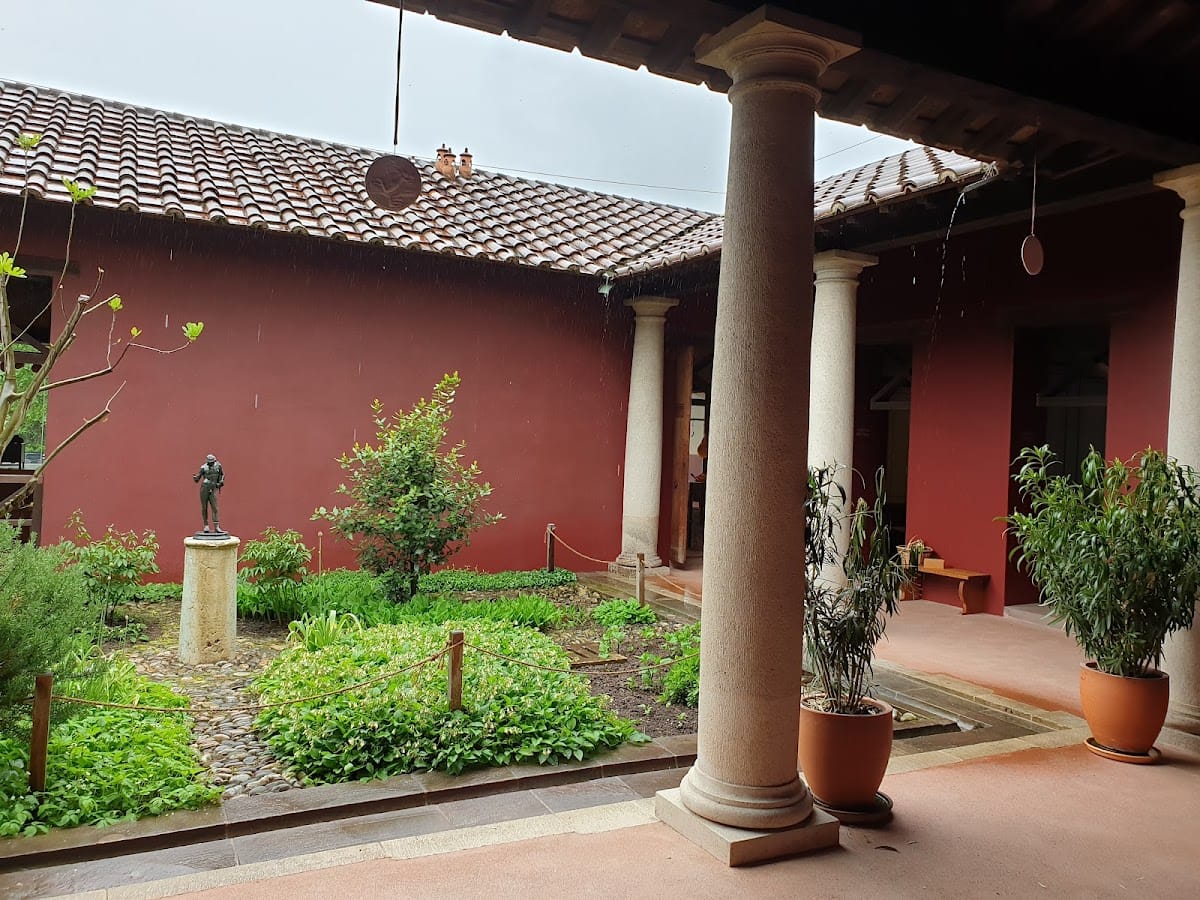
Many structures at Augusta Raurica are well-preserved, including the scenic theater, forum complex, and parts of the Castrum Rauracense fortifications. The theater’s limestone and Buntsandstein construction remains largely intact, with ongoing conservation efforts. The forum’s basilica, curia, and temple podiums survive as visible ruins, while the city wall and east gate remain fragmentary but substantial. The Castrum Rauracense fort walls and towers have been stabilized and partially restored, with visible defensive ditches. The Frauenthermen baths and other bath complexes retain architectural elements such as hypocaust systems and mural fragments. The Roman House is preserved with interior features including a kitchen, banquet hall, and craft workshops. Some commercial buildings and workshops have been conserved, though others survive only as foundations.
Environmental factors such as vegetation growth and riverbank erosion pose ongoing challenges. Excavation and conservation are managed by local heritage authorities, with two permanent teams conducting research year-round. Restoration projects have included fort walls, mosaics, and architectural elements. Digital technologies like geophysical surveys and 3D mapping support preservation and study. Some areas are stabilized but left unexcavated to preserve stratigraphy.
Unexcavated Areas
Several parts of Augusta Raurica remain unexcavated or only partially studied. The central baths are known to extend beyond current trenches, with limited detailed excavation. Residential and craft quarters in the upper and lower towns have areas identified by surface surveys and geophysical studies but remain unexplored. The southeastern road and clay extraction sites east of the city wall suggest further pottery workshop remains. Modern developments and conservation policies limit excavation in some zones. Future research plans include targeted excavations and non-invasive surveys to clarify the extent of buried remains. Historic maps and aerial photography indicate potential structures beneath agricultural land and urban areas. The full extent of the bridgehead fortification and later amphitheater near the Rhine also requires further investigation.
Nearby sites