Segesta Archaeological Park: An Elymian City and Its Ancient Monuments in Italy

Site at a Glance
- Rating
- 4.6
- Popularity
- Medium
- Country
- Italy
- Primary era
- Classical
- External website
- Open
- Eras represented
- Bronze Age, Iron Age, Classical, Medieval
- Civilizations
- Norman, Roman
- Site type
- City
On this page13 sections
History
Segesta Archaeological Park in Italy preserves the remains of Segesta, the principal city of the Elymians, an indigenous people of ancient Sicily. Occupation of Monte Barbaro reaches back to at least the eleventh century BC, although the city’s foundation date is unknown. Segesta was never a Greek colony, but sustained contact, trade, and conflict with the Greek cities of Sicily brought profound Hellenization to its culture and architecture.
Origins and Elymian identity
Ancient traditions gave Segesta a Trojan ancestry. Thucydides related its foundation to Trojan refugees who reached Sicily after the destruction of Troy. Other accounts treated the Elymians as an established Sicilian people, linked the city to the Greek hero Philoctetes, or described its foundation through Egestus, also called Aegestus, the son of the Trojan woman Segesta and the river god Crinisus. Later traditions connected the city with Trojan followers of Aeneas who remained in Sicily. These stories helped explain Segesta’s distinct identity and later claims of kinship with Rome.
Conflict with Selinus and Athens
Segesta’s earliest recorded conflict was with Selinus, a Greek city on Sicily’s southern coast, probably between 580 and 576 BC. The rivalry continued for centuries. Segesta alternated between alliances with Greek powers and with Carthage, the major North African state that controlled much of western Sicily during parts of the classical period, seeking to preserve its territory and autonomy.
In 426 BC Segesta allied with Athens during the Athenian expedition to Sicily. When Selinus, supported by Syracuse, renewed pressure by land and sea in 416 BC, Segesta appealed to Athens again. It provided 60 talents to help finance the expedition and a further 30 talents after the Athenian army arrived. Although the relief of Segesta was the expedition’s original purpose, the Athenians directed their principal attack against Syracuse. In 415 BC they captured Hyccara near Segesta and transferred the settlement to the Segestans.
Carthaginian alliance and destruction
After the Athenian defeat, Segesta appealed to Carthage for help against Selinus. A force of 5,000 Africans and 800 Campanian mercenaries assisted Segesta in defeating Selinus in 410 BC. The following year, Hannibal Mago’s Carthaginian army destroyed Selinus. Segesta then became a dependent ally of Carthage and remained loyal to it during Dionysius I of Syracuse’s western Sicilian campaign in 397 BC. Dionysius, the tyrant of Syracuse, besieged the city, but ended the attack when the Carthaginian commander Himilco arrived with an army.
In 307 BC Agathocles of Syracuse turned against Segesta after being received as a friend. He is said to have killed 10,000 male inhabitants, enslaved women and children, plundered the city, renamed it Dicaeopolis, and settled refugees and deserters there. Segesta soon recovered its former name and later regained independence, although the city probably never returned fully to its earlier strength.
Roman rule
Segesta joined Pyrrhus of Epirus during his Sicilian campaign in 276 BC, but soon returned to Carthaginian control and may have suffered plunder at that time. During the First Punic War, the Roman commander Appius Claudius Caudex attacked the city in 264 BC without success. The inhabitants then killed the Carthaginian garrison and allied themselves with Rome. A Carthaginian siege was lifted after the arrival of Gaius Duilius, a Roman consul and naval commander, in 260 BC.
Rome granted Segesta the privileged status of a free and tax-exempt city. The privilege was traditionally associated partly with the claimed common Trojan ancestry of Romans and Segestans. Rome also enlarged Segesta’s territory, incorporating part of the area around Eryx. After Carthage’s defeat, Scipio Africanus reportedly returned a statue of Diana that the Carthaginians had taken from Segesta.
Segesta’s territory was affected by the Second Servile War in 102 BC, a major uprising of enslaved people in Sicily. The city remained important during Cicero’s lifetime, although its port, or emporium, approximately 10 kilometres away later became more prominent than the hilltop settlement. Segesta gradually declined, while its continued existence and the Latin citizenship of its inhabitants are attested during the imperial period.
Late antiquity and the medieval settlement
At some point during the Roman period, the settlement may have shifted northward toward the coast, near modern Castellammare del Golfo. Vandals damaged or destroyed it in the fifth century AD, and Arab or Saracen incursions later affected the area. A Muslim community subsequently occupied the site, followed by a Norman-Swabian settlement. The medieval occupation appears to have ended by the second half of the thirteenth century.
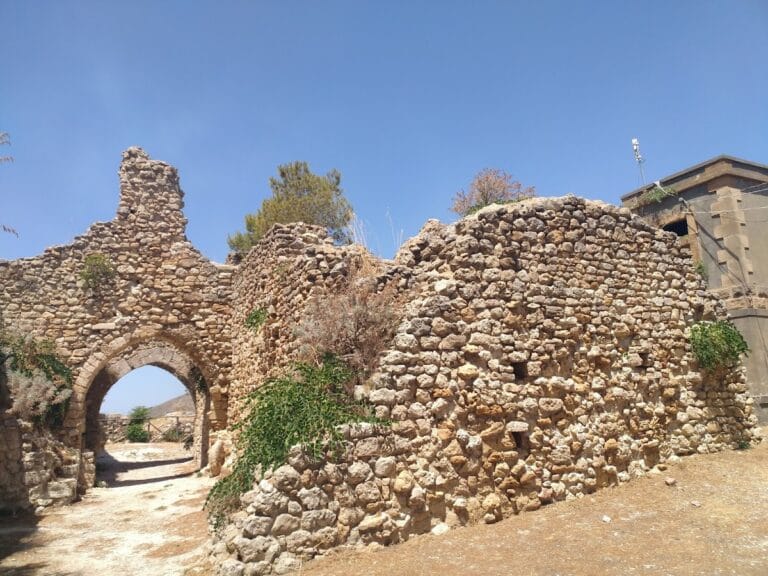
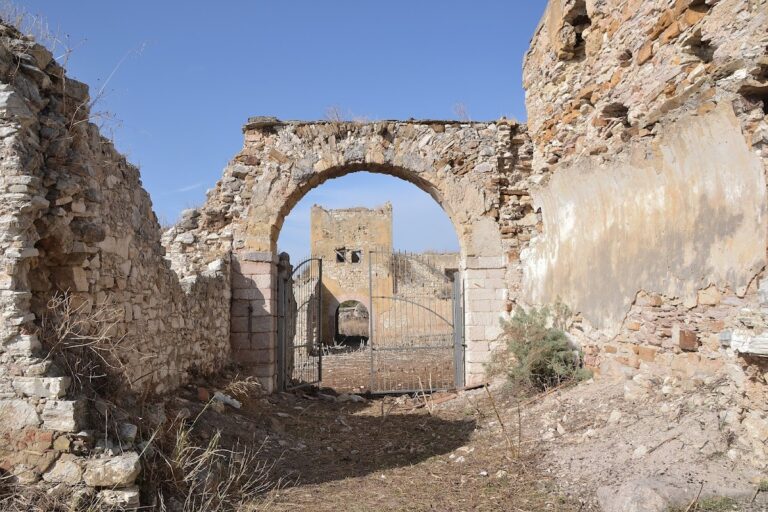
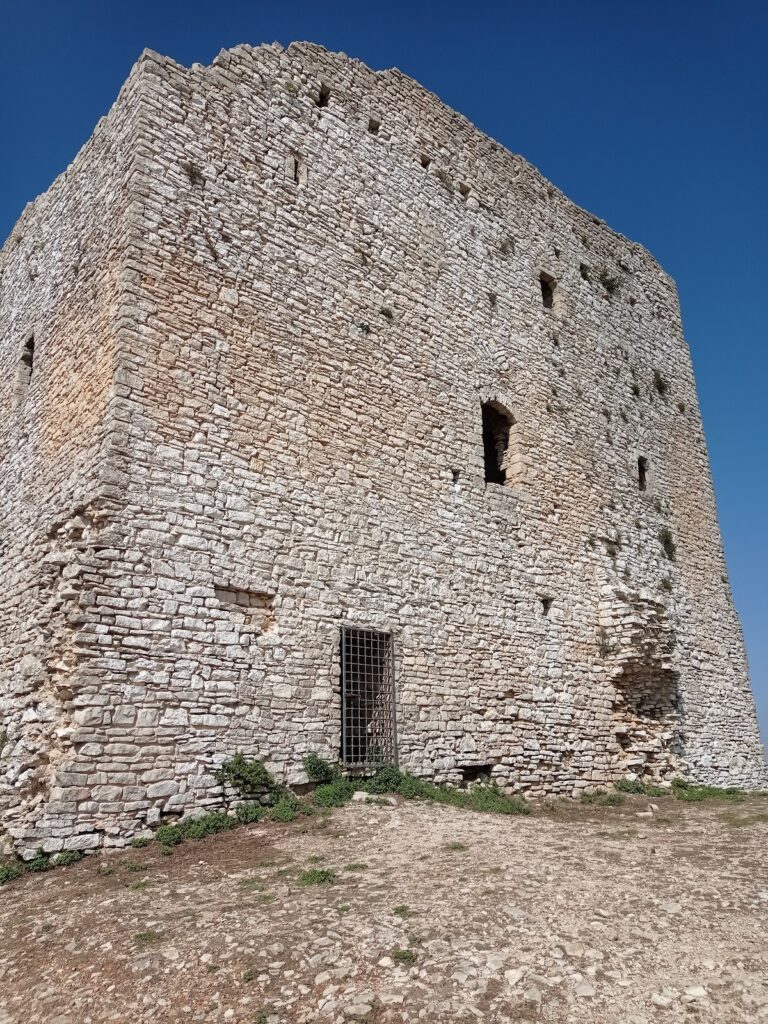
Later investigations have revealed a late-antique phase, a Muslim settlement, a Muslim necropolis, and a twelfth-century mosque beside a Norman castle. The mosque was probably destroyed after a new Christian overlord arrived in the early thirteenth century. Medieval occupation also included rebuilt defensive walls, a hilltop quarter, and churches of Norman and later periods.
Excavation and preservation
The theatre was partly excavated at the beginning of the twentieth century and later restored. The Doric temple underwent stone consolidation and restoration after erosion damaged its limestone. The archaeological park now preserves the principal visible remains of both ancient and medieval Segesta and is among Sicily’s principal archaeological parks.
Remains
Ancient Segesta occupied the summit and slopes of Monte Barbaro, between approximately 305 and 440 metres above sea level. The acropolis stood on the summit, while habitation extended down the hillsides and toward the mountain’s foot. Steep rock faces protected the eastern and southern sides, and fortifications defended the gentler approaches. The hill controlled routes between Sicily’s northern coast and inland districts and provided views across the valley toward the Gulf of Castellammare. A regular urban plan, partly arranged on terraces to accommodate the slope, is visible in the archaeological layout.
Fortifications and urban areas
The classical city had a fortified circuit with towers and monumental gates, including the articulated Porta di Valle. An additional wall line replaced or supplemented earlier defenses during the early imperial period. Sections of both wall systems and at least one gate survive, together with identifiable remains of an upper circuit. Some of the visible arrangement may belong to the rebuilding that followed Agathocles’ destruction.
Archaic habitation areas lie near the theatre. Houses in a southern sector were built of wood and mud brick during the late seventh century BC, while buildings to the southwest date from the sixth century BC. Later urban phases included the agora, a public civic space, and the House of the Navarch, a high-quality Hellenistic-Roman residence. Its elegant columned courtyard includes ship-prow decorations carved on the sides of the peristyle.
Doric temple
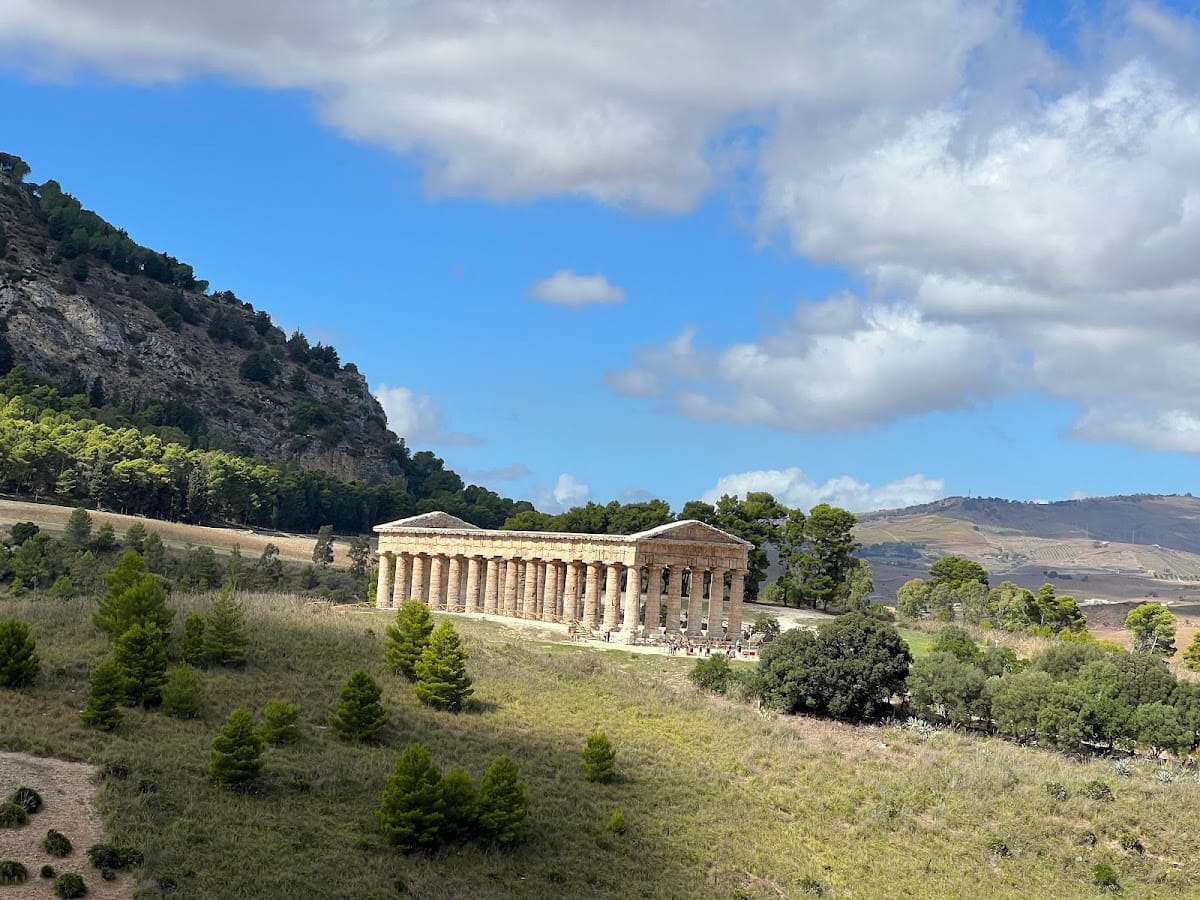
The Doric temple stands outside the city walls on a prominent hill to the west, beside an ancient approach route. Construction began in the late fifth century BC, probably around the 420s BC, on or near an earlier sacred place dating to the sixth century BC. Wars involving Segesta and Selinus may have interrupted the work. The building is a large peripteral, hexastyle temple, meaning that a single external colonnade surrounds it and that six columns stand across each short end. Built from local limestone, it measures approximately 23 by 58 metres at its base, and its columns rise about 10 metres.
The colonnade and entablature, the horizontal architectural structure above the columns, are exceptionally well preserved. The columns remain unfluted, and lifting bosses survive on some foundation blocks. These features, together with the unfinished state of other elements, indicate that the building was never fully completed. Traces of cella foundations, the enclosed central room normally associated with a temple’s cult image, and earlier construction lie within the colonnade. The building may instead have functioned as an open-air indigenous sanctuary whose exterior followed Greek architectural models.
Its proportions and construction techniques belong to the late Classical Greek tradition, while some features have been associated with Elymian religious practice. The colonnade has equal spacing between columns, adjustments near the corners known as terminal contraction, curved horizontal lines, and a frieze related in architectural and decorative form to late fifth-century Attic models.
The temple’s deity remains uncertain. A calcarenite statue base, a limestone object formed from consolidated carbonate sand, was found near the building and is now held in the municipal library at Calatafimi. A complete Greek inscription on the base, dated to the second century BC, records the dedication of a statue of Minyra, a priestess, to Aphrodite Urania. This has been interpreted as evidence for the worship of that aspect of Aphrodite at Segesta. The temple’s preserved Doric form was restored in the eighteenth century by the royal architect Carlo Chenchi and later attracted Grand Tour visitors, contributing to the European revival of interest in Greek and Doric architecture associated with Neoclassicism.
Theatre
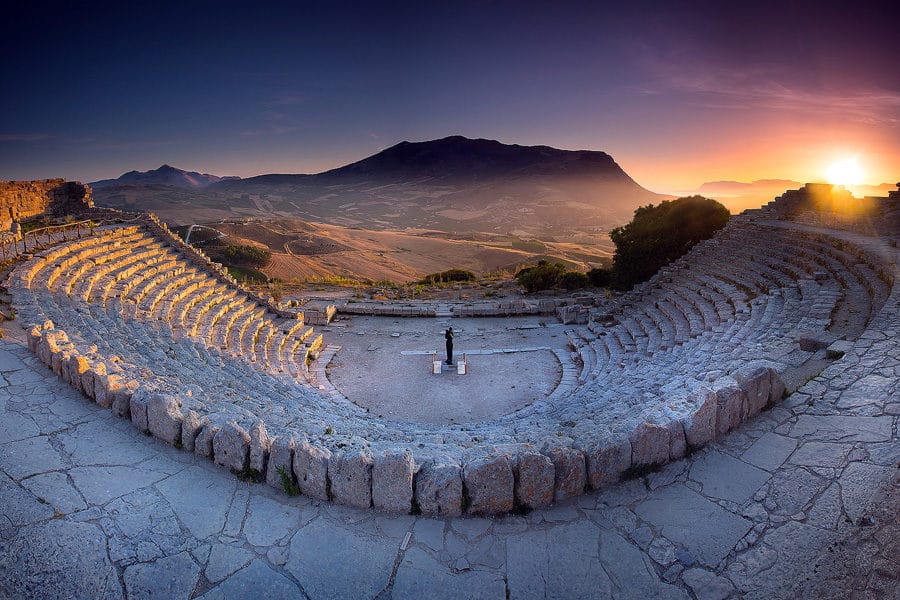
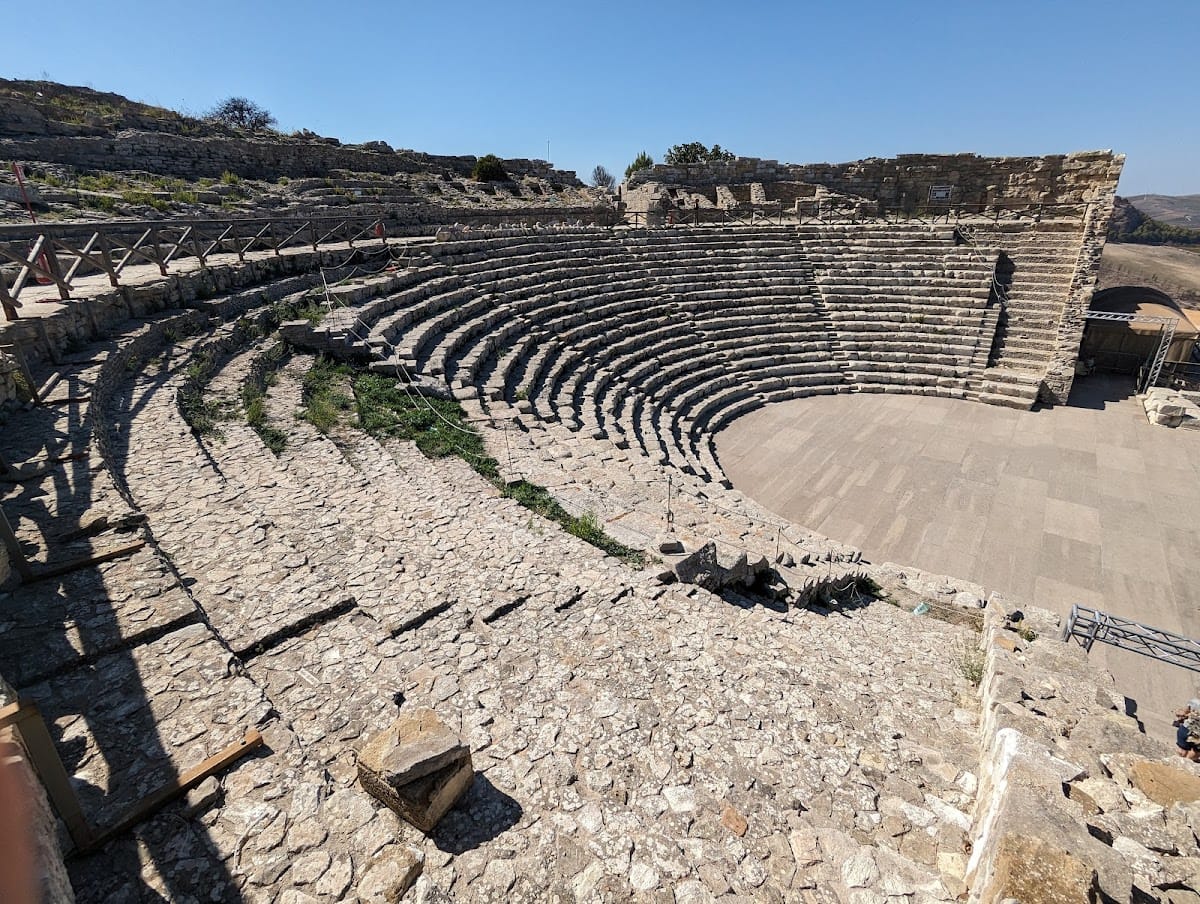
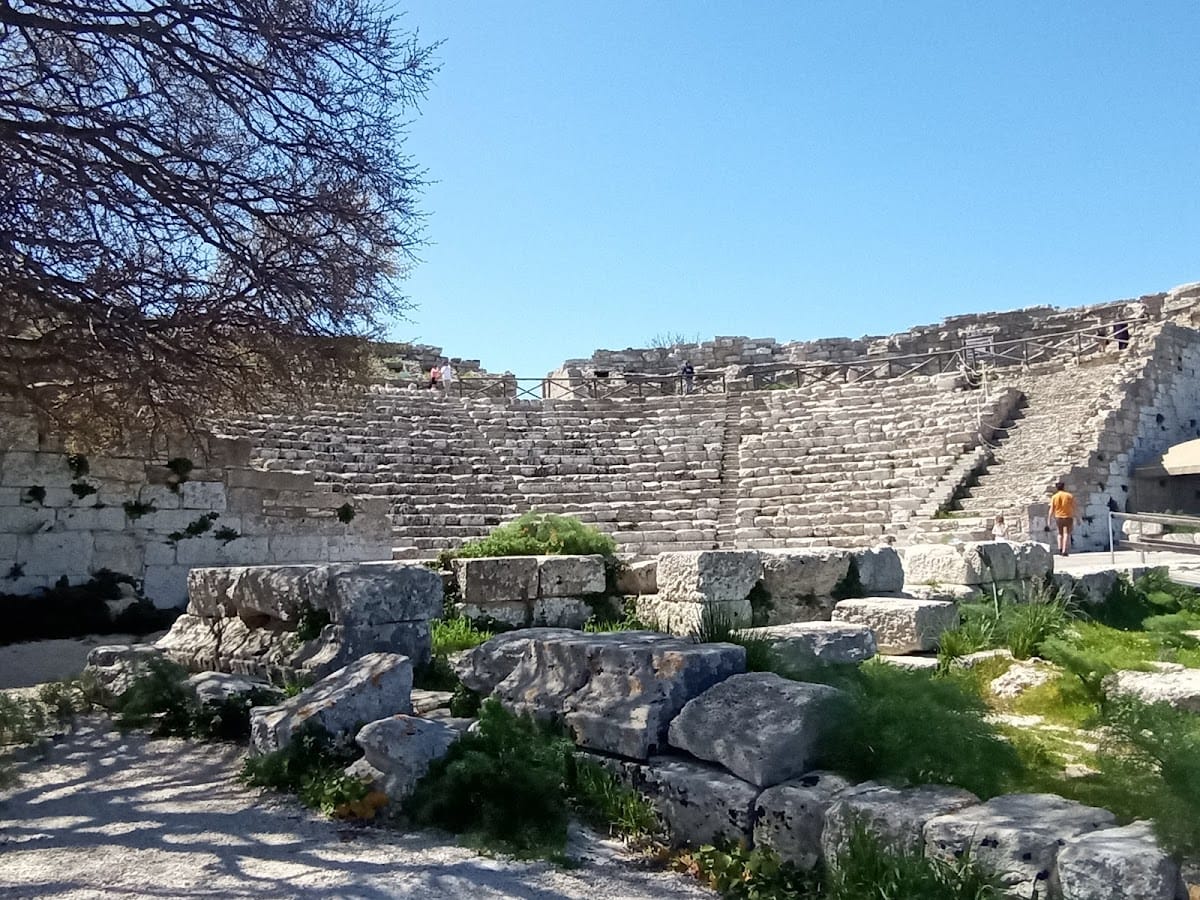
The theatre occupies the northeastern corner of the summit of Monte Barbaro. Its date remains disputed, with proposed dates ranging from the mid-fourth to the second century BC, although it is also commonly placed around the middle of the third century BC. A Bronze Age cave containing archaeological material occupied the location before the theatre was built. The semicircular Greek-style seating area, or cavea, is approximately 63 metres in diameter and faces north toward the sea and the Gulf of Castellammare. Its circular orchestra forms the central performance space.
Twenty-nine rows of seats are divided by radial stairways into seven sections. A transverse passage, called a diazoma, separates the lower and upper seating areas. The lower 21 rows survive, while the upper seating and stage building are poorly preserved. The theatre could hold approximately 4,000 spectators. Its cavea was partly cut into the rock and partly supported by a substantial retaining wall. Excavations indicate that the stage included colonnades and pilasters, with two projections flanking the raised acting platform, or logeion. The theatre is periodically used for theatrical performances.
Sanctuary of Contrada Mango
The Sanctuary of Contrada Mango lies south of Monte Barbaro, outside the city walls and beside an ancient access route. Discovered in 1952, it originated in the sixth century BC. Its sacred enclosure, or temenos, measures approximately 83 by 48 metres and is bounded by a substantial wall. Capitals, columns, and other architectural elements indicate that several buildings stood within the precinct. A Doric temple was erected there in the sixth century BC and remodelled in the fifth century BC.
The precise cult function of the sanctuary remains uncertain. The enclosing wall has been associated with the work of Greek craftsmen, while the character of its rituals has been interpreted as Elymian. Excavation has not yet revealed enough of the interior arrangement to reconstruct the sanctuary’s religious organization securely.
Rock-cut features, cemeteries, and archaeological finds
Rock-cut recesses on the northeastern slope of Monte Barbaro have been associated with a cult, although their exact function is uncertain. A group of Hellenistic tombs, probably dating to the second century BC, was found at the southwestern foot of the mountain. Pottery from the slopes includes locally made and imported Greek ceramics. Some fragments bear writing in Greek letters that probably represents the Elymian language.
Segesta’s mint was among the most important in Sicily, and many of its coins survive. Some depict a dog, probably recalling the tradition in which the river god Crinisus assumed canine form. Earlier issues carry the name Segesta, while later coins use the form Egestaiōn. These objects, together with the settlements, sanctuaries, fortifications, and burial remains, illuminate the city’s interaction with Greek, Carthaginian, Roman, Muslim, and Norman communities.