Gortyna Archaeological Site: A Cretan City from the Minoan Era to Late Antiquity




Site at a Glance
- Rating
- 4.1
- Popularity
- Medium
- Country
- Greece
- Primary era
- Classical
- Eras represented
- Bronze Age, Iron Age, Classical, Medieval
- Civilizations
- Ancient Greek, Byzantine, Minoan, Roman
- Site type
- City
On this page15 sections
History
Gortyna Archaeological Site is the remains of a long-lived city in Greece, near Metropolis and Agioi Deka in the Messara valley. Its history extends from the Neolithic period through the Minoan, Greek, Roman, and early Christian eras. Gortyna developed into one of Crete’s most powerful cities during the Hellenistic period and later became the administrative capital of Roman Crete.
Prehistoric and Archaic Gortyna
Gortyna was inhabited during the Neolithic period, part of Crete’s prehistoric past. It flourished again during the Late Minoan period, from 1600 to 1100 BC, when a villa and shrine were established at Kannia near Metropolis. The Minoan civilization was a Bronze Age culture centered on Crete, and this phase places Gortyna within the island’s wider network of settlements and religious communities.
An Archaic settlement occupied the Acropolis from the seventh century BC. The earlier settlement there, dated to about 1050 BC, had collapsed by the seventh century, after which the area was fortified. Gortyna continued to grow through the Hellenistic period, which followed the conquests of Alexander the Great and brought Greek culture across the eastern Mediterranean. During the third and second centuries BC, the city controlled territory extending from Messara to Levina.
Conflict and Regional Power
Gortyna became involved in the Lyttian War in 220 BC, a conflict between Cretan cities that included Lyttos and its opponents. Civil division split the Gortynians themselves. Older citizens supported their traditional ally Knossos, while younger citizens backed the Lyttians. The rival groups occupied the citadel and the port of Gortyn in successive stages.
After Phaistos was destroyed in the second century BC, Gortyna extended its power to Matala. Its favorable relationship with Ptolemy IV, the ruler of Ptolemaic Egypt, also contributed to its prosperity. These developments strengthened the city’s position within Crete before the island came under Roman control.
Roman Capital
Gortyna allied with Rome and avoided the destruction inflicted on many other Cretan cities during the invasion led by Quintus Caecilius Metellus Creticus in 68 BC. Under Roman rule, the city reached its greatest prosperity. It became the capital of the province of Creta et Cyrenaica, a Roman administrative territory that combined Crete with Cyrenaica in North Africa, and from the fourth century AD it served as the capital of a separate province of Crete.
The Praetorium, the official residence and administrative headquarters of a Roman provincial governor, formed the center of Roman administration at Gortyna. Built in the first century AD, it was altered substantially over the following eight centuries. The city also acquired public baths, theaters, religious buildings, and monuments that reflected its continuing political and civic importance.
Christian Gortyna and Destruction
Christianity was preached at Gortyna by the Apostle Titus, an early Christian missionary traditionally regarded as the first bishop of Crete. The Ten Saints, a group of Christian martyrs associated with Crete, were martyred there in AD 250. Gortyna later became the seat of an archbishop, and a cathedral dedicated to Saint Titus was built in the sixth century.
Arab invaders destroyed Gortyna around the ninth century, approximately between AD 824 and 828. The destruction ended the city’s long role as a major urban and ecclesiastical center. Archaeological investigations began in 1884 under the Italian archaeologist Federico Halbherr. Later work by the Italian Archaeological School and the 23rd Ephorate exposed further buildings, while some of the uncovered structures were consolidated.
Law, Myth, and Historical Memory
The Gortyn Law Code dates to the fifth century BC and consists of legal inscriptions in the Dorian dialect. It records civic and private laws and provides evidence for the organization of Gortynian society. The code was discovered in 1884 in the Odeion, where stones bearing inscriptions had been reused from an earlier Hellenistic structure and later incorporated into the Roman building. Its surviving slabs are widely known as the “Queen of the Inscriptions.”
Gortyna was also associated with the myth of Europa and Zeus. Zeus, the chief god of ancient Greek religion, was said to have united with Europa beneath a plane tree at Gortyn. Their children, Minos, Rhadamanthys, and Sarpedon, were connected by tradition with the Minoan palaces of Crete. Coins from the city honored Europa through her representation. The Odyssey further associates Gortyna with Menelaus, the legendary king of Sparta, whose fleet was driven onto the coastline while returning from the Trojan War. Storm waves wrecked many ships against a sharp reef while the crews survived.
Remains
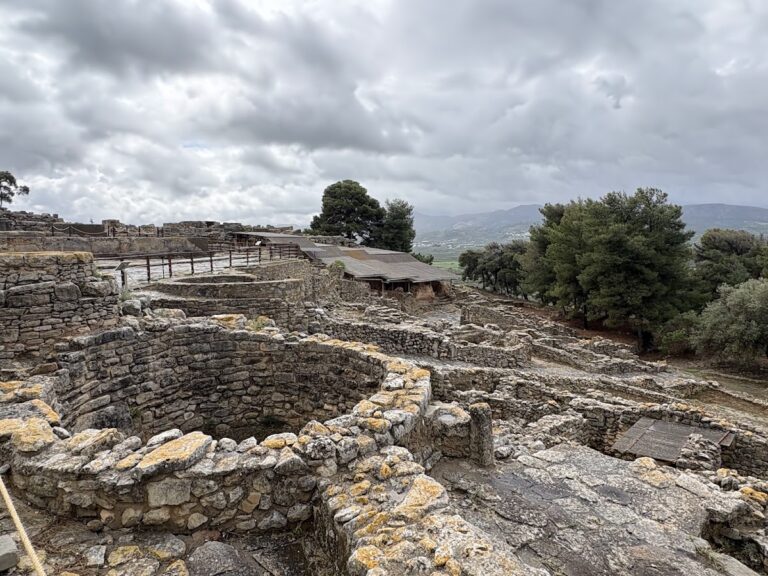
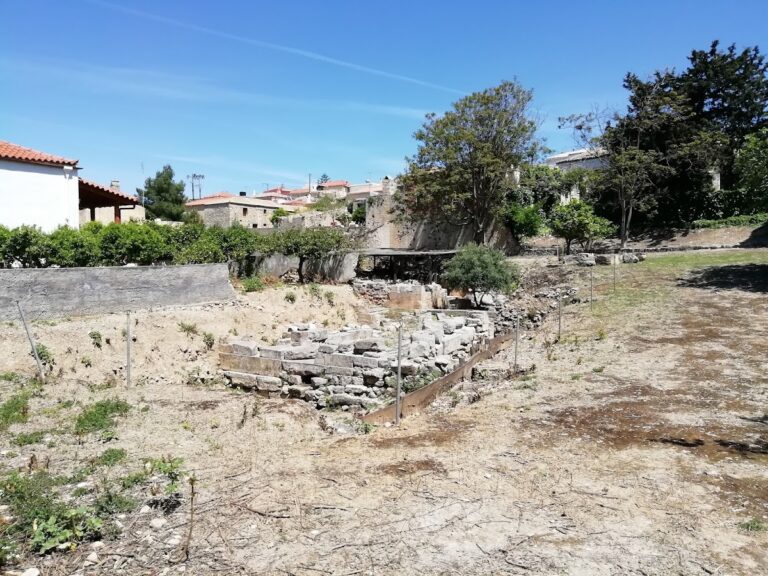
Gortyna lies in the Messara valley south of Mount Psiloritis, near Metropolis and Agioi Deka and close to the Libyan Sea. Its remains extend across an upper Acropolis and a lower city. The surviving buildings range from prehistoric and Archaic features to Hellenistic structures, Roman civic architecture, Egyptian religious monuments, and a sixth-century Christian cathedral.
Acropolis and Early Sanctuaries
The Acropolis contains the remains of a settlement dated to about 1050 BC. After its collapse in the seventh century BC, the area was fortified with a wall. A temple on the summit also dates to the seventh century BC. Excavations there produced embossed plates, sculptures, paintings, Daedalic-style clay figures, black-figure and red-figure pottery, and vessels known as kernoi. Daedalic art is an early Greek style recognized for rigid figures, frontal poses, and patterned hair. Geometric-period graves were found on the southern side of the Acropolis.
In the lower city, the Agora formed the market area. About 600 metres from it stood the Temple of Pythian Apollo, also called the Pythion. Pythian Apollo was an aspect of Apollo associated with the oracle at Delphi. Traces of a sanctuary of Demeter survive at the foot of Prophet Elias. Demeter was the Greek goddess of agriculture and grain.
Roman Civic Buildings
Praetorium
The Praetorium was the administrative center of Roman Gortyna and the seat of the governor of Crete. Its construction began in the first century AD, and the building was substantially modified over the next eight centuries. The surviving remains therefore reflect a long sequence of administrative use and alteration rather than a single building phase.
Public and Religious Monuments
The lower city includes the ruins of Roman baths, the Temple of Apollo, and an honorary arch. It also contains a temple dedicated to Egyptian deities. Statues associated with that temple represented Isis, Serapis, and Anubis, major figures in ancient Egyptian religion. Together, these structures show the variety of religious and public buildings within the Roman city.
Roman Theater
The Roman Theater dates to the second century AD. It had two entrances and a semicircular orchestra, whose outline remains visible. The theater formed part of the city’s Roman public architecture and survives as a distinct feature within the lower urban area.
Odeion and the Gortyn Law Code
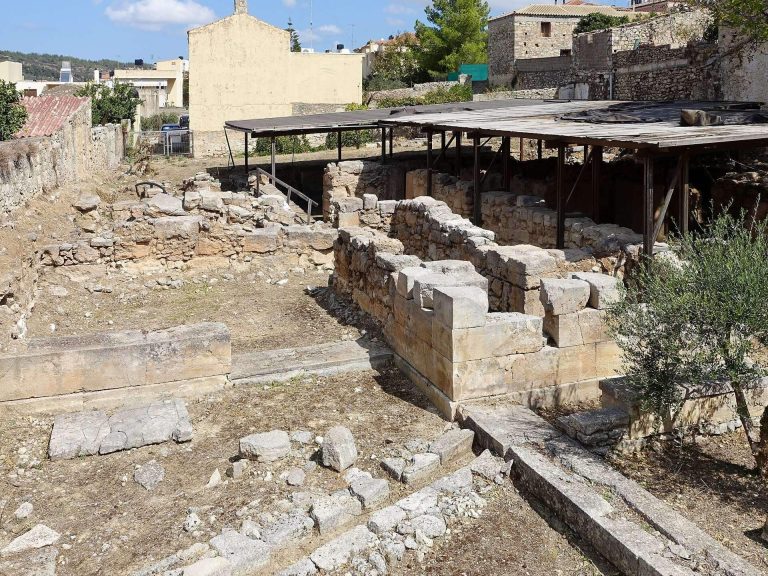
The Odeion was built under the Roman emperor Trajan as a roofed building for musical performances and other public gatherings. Its construction reused stones from an inscription-bearing wall that had earlier formed part of a Hellenistic structure. The surviving stones of the Gortyn Law Code are housed and sheltered in a small building incorporated into the Odeion’s northern circular wall. Other portions of the inscriptions are held in museums, including the Louvre.
Cathedral of Saint Titus
The sixth-century Cathedral of Saint Titus was built from large, regularly shaped stone blocks laid in even courses. It has a cruciform plan and a dome supported by four pillars. The building’s original height survives only in the Holy Bema, the sanctuary platform, and the pastophoria, the adjoining chambers of the church. These remains preserve the cathedral’s central Christian architectural form and its relationship to the late history of Gortyna.
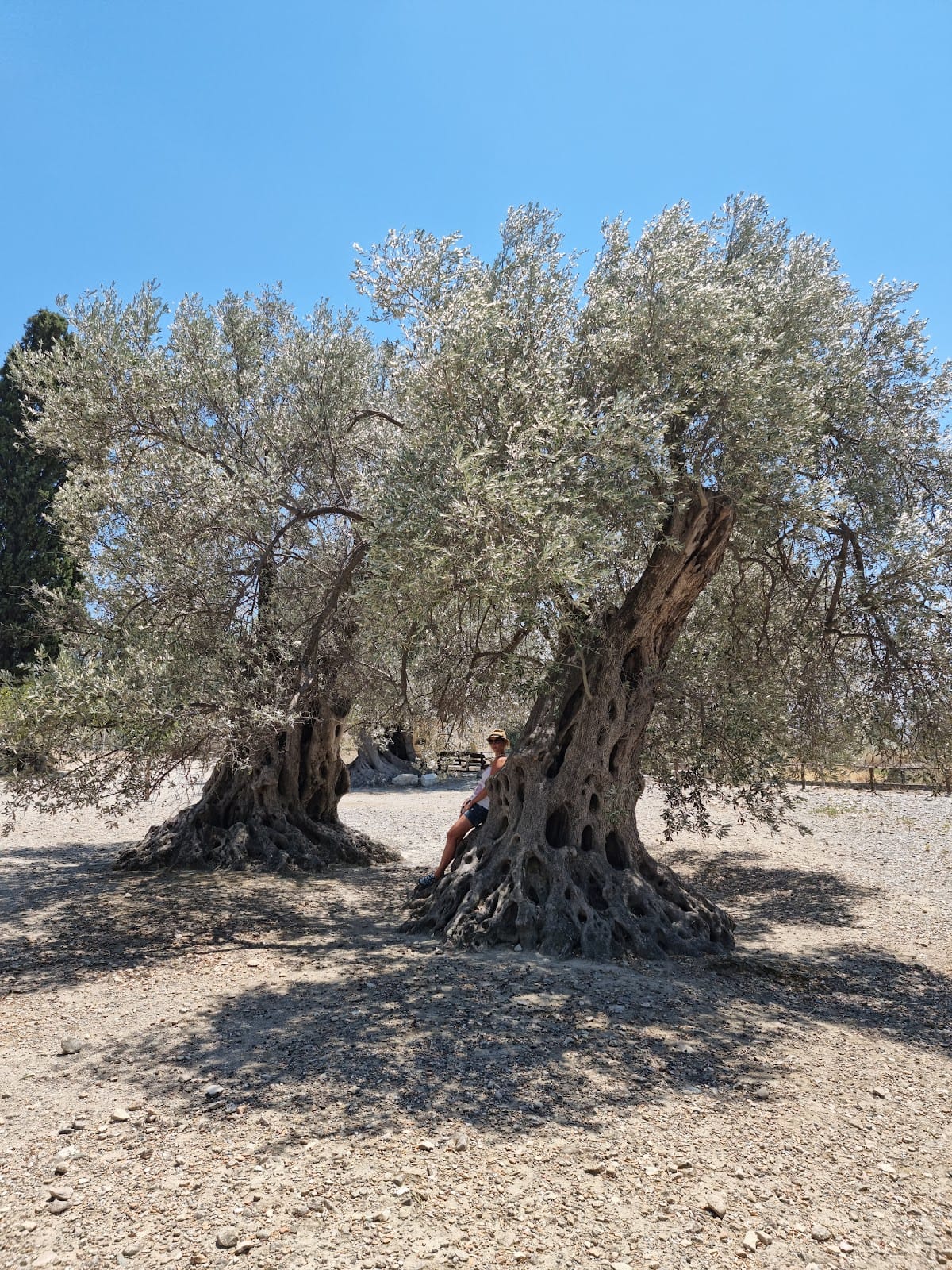
Europa and the Plane Tree
A plane tree associated with the tradition of Europa and Zeus remains visible at Gortyn. The city’s connection with the myth is also reflected in its material remains. A colossal statue of Europa seated on a bull was discovered at Gortyna in the nineteenth century and is now held by the British Museum, while coins found at the site depict Europa as well.