Neu-Schauenburg Castle: A Medieval Hill Castle in Switzerland


Site at a Glance
- Rating
- 4.1
- Popularity
- Very Low
- Country
- Switzerland
- Primary era
- Medieval
- External website
- Open
- Eras represented
- Medieval
- Civilizations
- Holy Roman Empire
- Site type
- Military
- Remains
- Castle
On this page9 sections
History
Neu-Schauenburg Castle is a medieval hill castle in Switzerland above Frenkendorf. Its surviving remains date from the thirteenth century, when a branch of the Truchsessen of Rheinfelden, a noble family whose name originated from the court office of steward, probably established the castle. It secured the family’s allodial clearing estate, meaning hereditary land held as its own property rather than as a feudal fief. Although Neu-Schauenburg is now the older of the two Schauenburg castles west of Frenkendorf, its name acquired the prefix “Neu” because it continued in use after Alt-Schauenburg was abandoned.
Early castle and the Schauenburg estate
A predecessor castle probably occupied the site in the twelfth century. The historian Werner Meyer proposed that settlement may have begun as early as the eleventh century, while pottery from the middle of the twelfth century, found during construction work, supports an earlier phase of occupation. The visible castle belongs to the later thirteenth-century rebuilding or foundation phase. The Lords of Schauenburg are securely known from the middle of that century, at least a hundred years after the castle’s probable foundation.
The castle protected the Schauenburg family’s hereditary clearing estate, which carried no associated jurisdictional rights. The family also held the village of Füllinsdorf as a fief from the Counts of Frohburg. As their hereditary property expanded toward the southwest, they built Alt-Schauenburg. This development helps explain the existence of two related castles and the later distinction between the older Neu-Schauenburg and its abandoned counterpart.
Earthquake damage and changing lordships
The Basel earthquake of 1356 damaged Neu-Schauenburg. The castle was repaired and remained in use, unlike Alt-Schauenburg, which was abandoned. By 1385 the Schauenburg family had died out, and the castle apparently passed by inheritance to the knightly Vitztum family. In the early fifteenth century it came to the Truchsessen of Rheinfelden, who sold it in 1418 to Konrad Sintz, a wealthy citizen of Basel.
Sintz later collapsed financially and fled after attempting fraud. In 1428, Henman Offenburg purchased the castle from the bankruptcy estate and received its judicial rights as a fief from Hans von Falkenstein, the landgrave of Sisgau. A landgrave was a territorial lord whose authority was comparable to that of a count. Munzach and Liestal soon showed that these judicial rights already belonged to them, and Offenburg consequently lost them.
Religious use and the later estate
After the middle of the fifteenth century, a religious brother house was established north of the castle. The property associated with it later became the Neu-Schauenburg farm estate. In 1502 the estate passed to the Beguines, communities of religious women who lived devotionally without taking permanent monastic vows. They operated a sister house there, but the castle itself was already uninhabited and deteriorating. The Beguine community remained until 1523.
In the following centuries, ownership changed repeatedly because of the value of the surrounding land. The estate first passed to the Dräss, or Drais, family. In 1700 that family sold it to Liestal town clerk Johann Friedrich Wettstein and his brother-in-law from Kleinbasel, Pastor Johann Heinrich Gernler. Their families sold it in 1748 to the Liestal gardener Johannes Gysin, whose family transferred it in 1792 to Daniel Iselin-Weiss. Iselin-Weiss left the estate to Achilles Forcaret-Iselin. Later owners included Marie Riggenbach-Burckhardt and H. L. Miescher-Riggenbach.
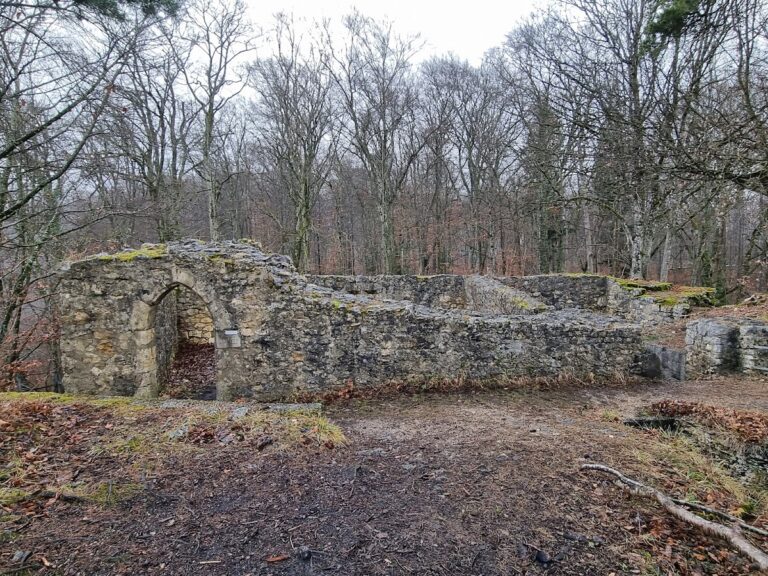
Mineral springs were discovered near the ruins in 1691, followed by the construction of a bathhouse. A small country estate with attached fields was established beside the ruins in 1792. Neu-Schauenburg is now preserved as a ruin with conserved wall remains and is included in Frenkendorf’s heritage inventory.
Remains
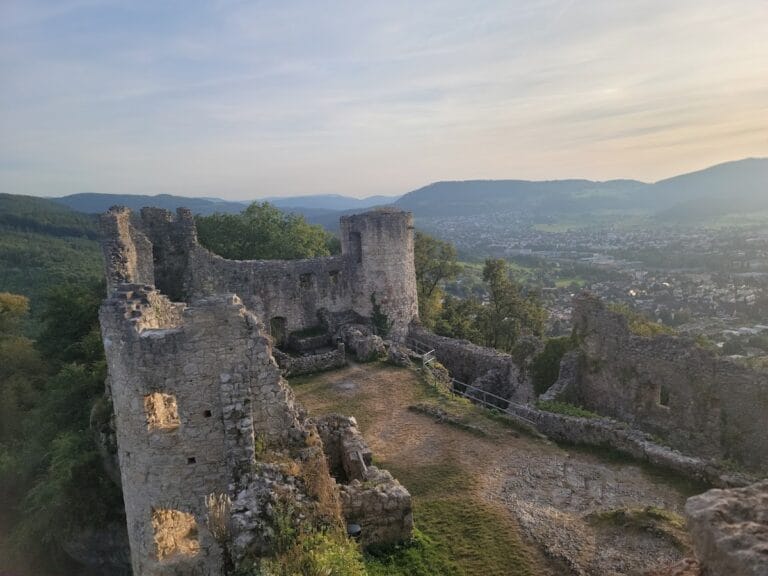
Neu-Schauenburg occupies a rocky promontory about 600 metres above sea level west of Frenkendorf, above the valley and beside the Schauenburgflue rock formation. The hill stands within a cleared highland plateau near the borders of France and Germany. Its stone walls follow the irregular edge of the outcrop. The enclosing circuit is about 2 metres thick and surrounds an irregular ground plan, of which only a small amount survives in conserved ruin form.
Fortifications and access
Approach to the castle was from the west along a ramp that curved around the northern corner toward the gate on the north-eastern side. Modern building work heavily altered the gate area. Slight wall remains in front of the entrance may have belonged to a zwinger, an outer defensive enclosure or passage between defensive lines, or to an outer gate. Their precise function cannot be determined. A faint ditch west of the promontory probably belongs to the earlier twelfth-century predecessor castle.
Terraces and internal buildings
Residential wing
A narrow band of rock divides the outcrop into a higher eastern terrace and a lower western terrace, creating a two-part internal arrangement. The lower western section was occupied largely by a residential wing built against the enclosing defensive wall. Its surviving context reflects the division of the castle between the lower living area and the higher defensive or representative zone.
Eastern keep
The higher eastern terrace probably carried a keep. Its remains were completely removed when a modern viewing pavilion was built on the terrace. The surviving castle fabric therefore consists chiefly of the conserved wall remains around the rocky promontory and the traces associated with its former access and earlier ditch.
Nearby sites