Amberley Castle: A Historic Bishop’s Residence and Fortress in the United Kingdom


Visitor Information
Google Rating: 4.7
Popularity: Low
Google Maps: View on Google Maps
Official Website: www.amberleycastle.co.uk
Country: United Kingdom
Civilization: Unclassified
Remains: Military

History
Amberley Castle is located in the village of Amberley in the United Kingdom. It was originally established by the medieval Christian civilization under the authority of the Bishops of Chichester.
The site began as a manor house around the year 1140, constructed by Bishop Seffrid I. This stone structure replaced an earlier timber lodge that had been built in 1103 by Bishop Ralph de Luffa. Throughout the 12th and 13th centuries, the castle saw gradual development linked closely to its function as both a residence and defensive stronghold for the bishops. In 1200, Bishop Seffrid II expanded the site with the addition of the East Wing, reflecting growing ecclesiastical influence and the need for improved domestic quarters.
Between 1305 and 1337, Bishop John Langton undertook further enhancements by constructing the Great Hall, leading the site to become known as the Bishop’s Summer Palace. This period marked Amberley’s emergence not only as a fortified home but also as a place for ecclesiastical leisure and administration.
The castle’s fortifications were significantly enhanced during the late 14th century amid concerns over French attacks during the Hundred Years’ War. In 1377, Bishop William Reade received permission to strengthen Amberley with high curtain walls, a gatehouse, and an oubliette—a type of dungeon designed for solitary confinement. These works, carried out until 1382, transformed the manor house into a more formidable fortress.
Ownership and occupancy changed notably during the 16th century. Bishop Robert Sherborne, who died in 1536, was the last bishop to reside at Amberley Castle. After his period, the castle ceased to function as a bishop’s residence and was instead leased to various tenants.
Amberley Castle’s military relevance resurfaced during the English Civil War in the mid-17th century. The tenant at the time supported the Royalist cause, prompting an assault by forces loyal to Parliament led by General William Waller under Oliver Cromwell’s command. This attack reduced the height of the castle’s walls by about 20 feet and destroyed the Great Hall. Following the conflict, the castle was sold but was returned to the Bishop of Chichester’s possession after the monarchy’s restoration in 1660.
In the centuries that followed, Amberley Castle passed through the hands of several private owners, including Robert Curzon in 1872 and Henry Fitzalan-Howard, the 15th Duke of Norfolk, from 1893. In the late 20th century, the castle was converted into a hotel, reflecting a new phase in its long history. Since 1955, it has held the status of a Grade I listed building, recognizing its historical and architectural importance.
Remains
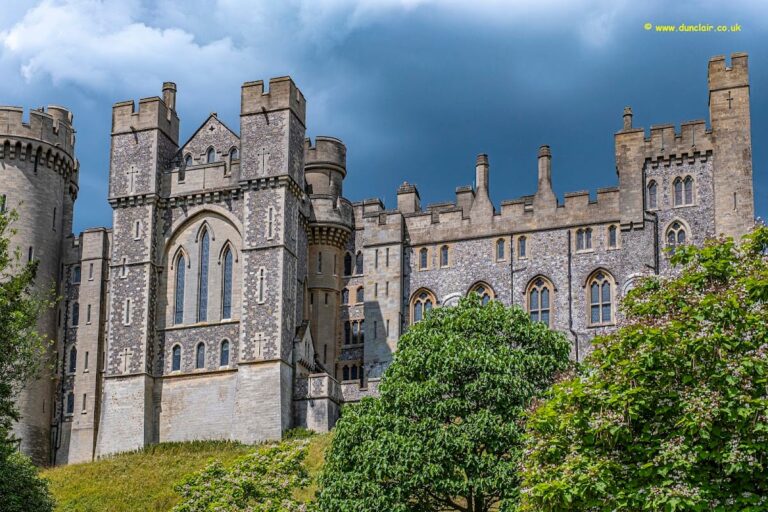
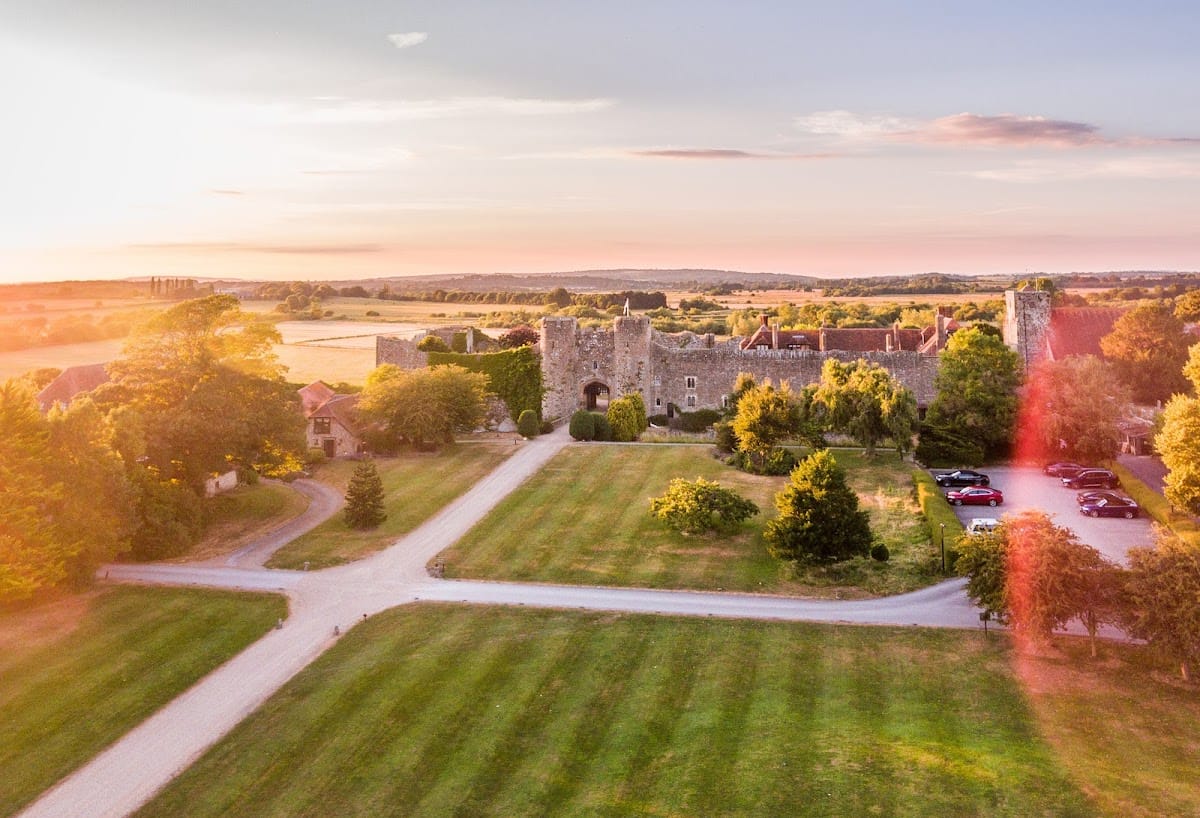
Amberley Castle is built on a roughly rhomboid quadrilateral plan, enclosed by robust stone curtain walls rising about 40 feet (approximately 12 meters). These walls form the fortress’s primary defense and include internal towers positioned at the corners, although only the northwest and southeast towers remain intact today. The walls are made of squared stone masonry, a technique where stones are cut into regular blocks to provide stability and strength.
The south wall is notable for featuring two semicircular towers that project outward and flank the main gatehouse. This gatehouse served as the principal entrance and defensive choke point, controlling access to the castle’s interior. Surrounding the enclosure is a dry moat, which was a defensive ditch without water and never equipped with a drawbridge, adding another barrier for potential attackers.
The castle’s fortifications are anchored by natural sandstone rock formations along the north and west walls. These sandstone outcrops, rising between 10 and 20 feet, offer a natural foundation that enhanced the defensive capabilities of the masonry above. The roofs throughout the castle are covered with traditional clay tiles, consistent with regional building practices.
Inside Amberley Castle, a small building marks the probable location of a private chapel, indicating the religious functions that accompanied the castle’s role as a bishop’s residence. Another interior highlight is the so-called “Queen’s Room,” which contains early 16th-century frescoes. These wall paintings are attributed to Lambert, or possibly Theodore Bernardi, an artist from Amsterdam active during Bishop Robert Sherborne’s time. The frescoes reflect the castle’s period of ecclesiastical prominence before its decline as a bishopric home.
The main staircase within the castle dates from the mid-1600s, constructed during restoration efforts that followed damage sustained in the English Civil War. This feature reflects a phase of repair and adaptation as the castle moved away from military use.
Positioned immediately west of the village church of St. Michael in Amberley, the castle lies in a valley with primarily flat land to the east and hills rising to the west, a setting that would have been significant for both defense and local estate management. These remaining structural and decorative elements provide a tangible connection to Amberley’s layered past as a religious residence, fortified manor, and noble home.
Nearby sites