Knepp Castle: A Medieval Motte Castle in West Sussex
Site at a Glance
- Rating
- 4.7
- Popularity
- Low
- Country
- United Kingdom
- Primary era
- Medieval
- Eras represented
- Medieval
- Civilizations
- English
- Site type
- Military
- Remains
- Castle
On this page8 sections
History
Knepp Castle is a medieval castle in the United Kingdom near Horsham, probably founded in the twelfth century by William de Braose, 1st Lord of Bramber, as a motte castle. A motte castle centred on a raised earth mound, usually with a defensive enclosure and ditch, it stood within the Rape of Bramber, a medieval Sussex territory combining administrative and military functions. The name Knepp probably comes from an Old English word meaning “mound,” referring to the raised ground on which the castle was built.
Royal castle and the First Barons’ War
King John confiscated Knepp and other Braose lands in 1208 after he came to regard William de Braose, 4th Lord of Bramber, as a threat. The castle then became a royal hunting lodge, and John visited it several times. The first surviving record of Knepp dates from 1210. Royal expenditure during the 1210s included general repairs, the construction of a chimney, and work on a pond or moat. John was at Knepp on 6 April 1211, while Queen Isabella stayed there for eleven days in either 1214 or 1215.
The castle became involved in the First Barons’ War, the conflict between King John and rebel barons that followed the crisis surrounding Magna Carta in 1215. On 18 May 1215, John ordered Knepp to be stripped and totally destroyed. A further order of 13 June 1216 instructed Roland Bloett to have it burned and destroyed. The first order may not have been carried out. In early 1217, Knepp surrendered to William Marshal during the campaign against supporters of Prince Louis of France, who had intervened in the baronial conflict as a claimant to the English throne.
Later medieval use and decline
The Braose lands were not restored after Giles de Braose, Bishop of Hereford, died before the transfer could be completed. Knepp nevertheless continued in use into the fourteenth century. Royal visitors included Henry III in 1218, Edward II in 1324, and Richard II in 1384. Simon de Montfort temporarily seized the castle from William de Braose and later returned it. After this period, the castle declined and eventually fell out of use.
A skirmish may have taken place near Knepp during the English Civil War. Early nineteenth-century oral history described the alleged engagement as the Battle of Knepp, placing a parliamentary victory over royalist forces on 19 July 1648. A cannonball was reportedly found near the castle, although its date and precise location were not recorded. The fighting may have caused considerable damage and contributed to the castle’s abandonment, but the date of its destruction remains uncertain.
Demolition, protection, and investigation
By the 1720s, most of the castle had been demolished. During the later eighteenth century, stone from the ruins was used to build nearby roads. In 1775, the antiquarian Francis Grose wrote that demolition had made the castle’s original form and extent impossible to determine. About 55 years later, Edmund Cartwright described further deterioration and the continued removal of stone.
Ownership of the castle was linked to the manor of Knepp. Sir Charles Raymond purchased the manor in 1788, and after his death that year it passed to his daughters Sophia and Julia. Sophia’s husband, the antiquarian Sir William Burrell, bought Julia’s share, after which the estate descended through the Burrell family. In the early nineteenth century, Sir Charles Burrell reinforced and fenced the surviving remains to limit further deterioration.
A separate building nearby also bears the name Knepp Castle. This early nineteenth-century castellated Gothic Revival mansion was designed by John Nash for Sir Charles Merrik Burrell. Gothic Revival architecture revived forms associated with medieval Gothic buildings, but the mansion is distinct from the medieval castle ruin.
Knepp Castle became a scheduled monument in 1951, giving the archaeological site national protection. The protected area includes the entire mound and part of the causeway extending west from it. The wall on top of the motte received additional protection as a Grade II listed building in 1959, and damage to the mound was reported to Worthing Museum in 1962.
Geophysical surveys carried out in 2021 and 2022 investigated the castle’s layout and sought evidence of burning connected with King John’s orders. They identified possible buried archaeology, but no burning attributable to those commands. The surrounding land forms part of Knepp Wildland, a large-scale rewilding project established from 1,400 hectares of former arable and dairy farmland owned by Sir Charles Burrell, 10th Baronet. The project has operated on the Knepp estate since 2001.
Remains
Mound, moat, and causeway
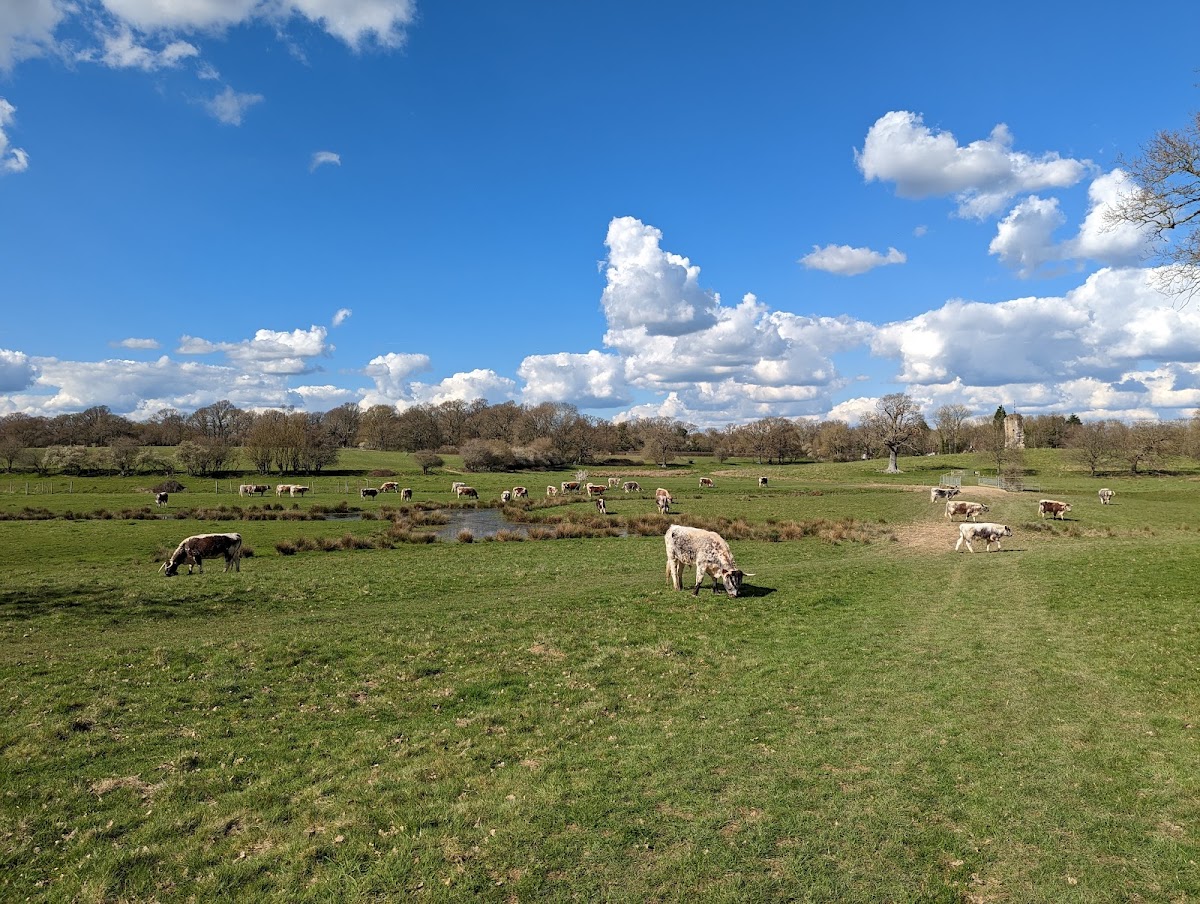
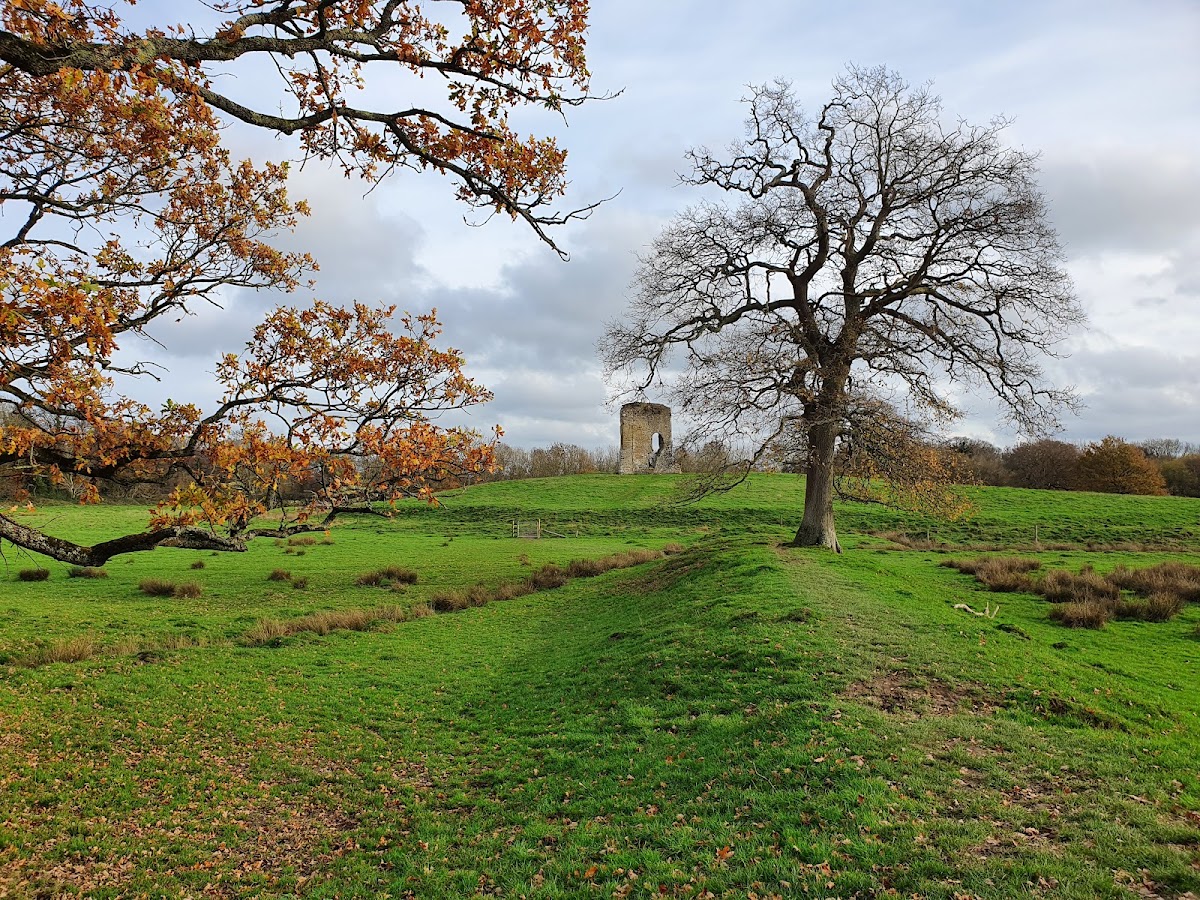
The castle occupies an oval mound created by modifying a natural feature. Raised ramparts and a ditch surround it, while a nearby pond fed the ditch and formed a moat. The moat still held water at the beginning of the eighteenth century. A causeway crosses the moat and continues west from the castle, surviving within the scheduled area.
Surviving wall and medieval buildings
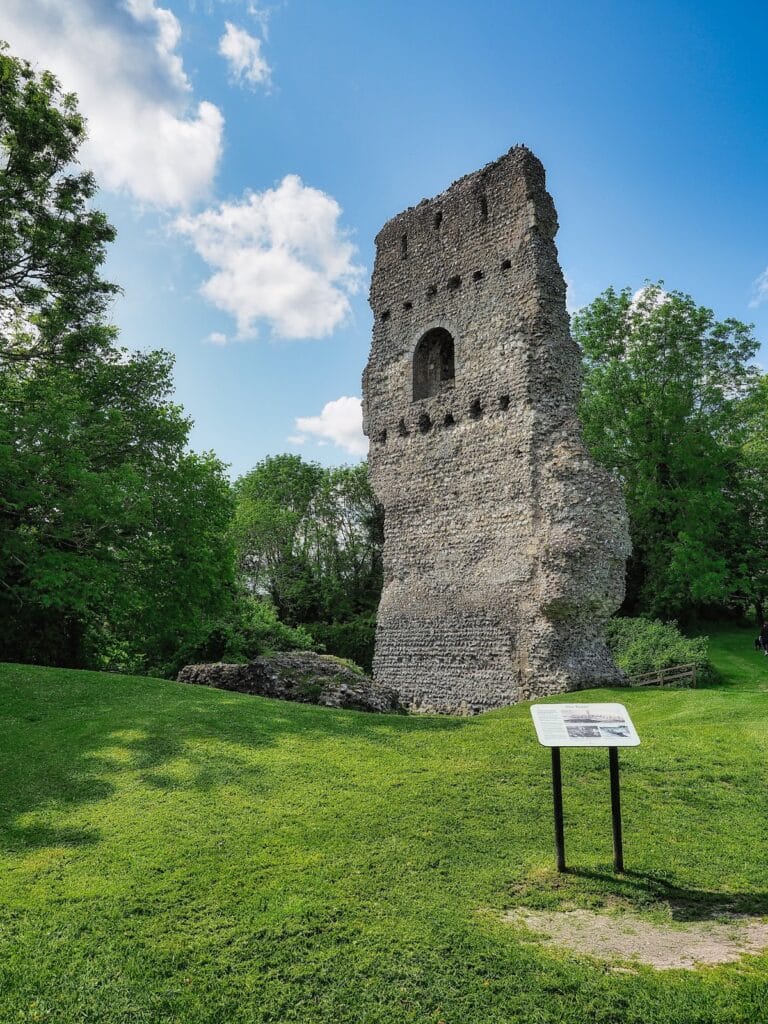
The principal above-ground survival is a single wall approximately 11 metres high, 9.5 metres long, and 2.5 metres thick. Built with a facing of Horsham Stone, a regional sandstone, it contains a doorway and a second opening above it. The wall apparently formed the northern end of the western wall of a tower or keep, a fortified structure that could serve as both stronghold and residence.
Thirteenth- and fourteenth-century records refer to a chapel and domestic buildings, including a hall and stables. Their arrangement and relationship to one another are not established. The 2021 and 2022 geophysical surveys provide indications of further buried archaeology beneath the castle area.
Knepp Wildland setting
The surrounding Knepp Wildland uses free-ranging Longhorn cattle, Exmoor ponies, Tamworth pigs, fallow deer, and red deer to restore ecological processes through reduced intensive land management. The rewilding has been associated with the spontaneous return of rare species and with breeding populations of the purple emperor butterfly, turtle dove, and nightingale.