Castle of Castilnovo: A Medieval Fortress and Palace in Spain


Site at a Glance
- Rating
- 4.2
- Popularity
- Low
- Country
- Spain
- Primary era
- Medieval
- External website
- Open
- Eras represented
- Medieval, Early Modern, Modern
- Civilizations
- Crown of Castile, Spanish
- Site type
- Military
- Remains
- Castle
On this page12 sections
History
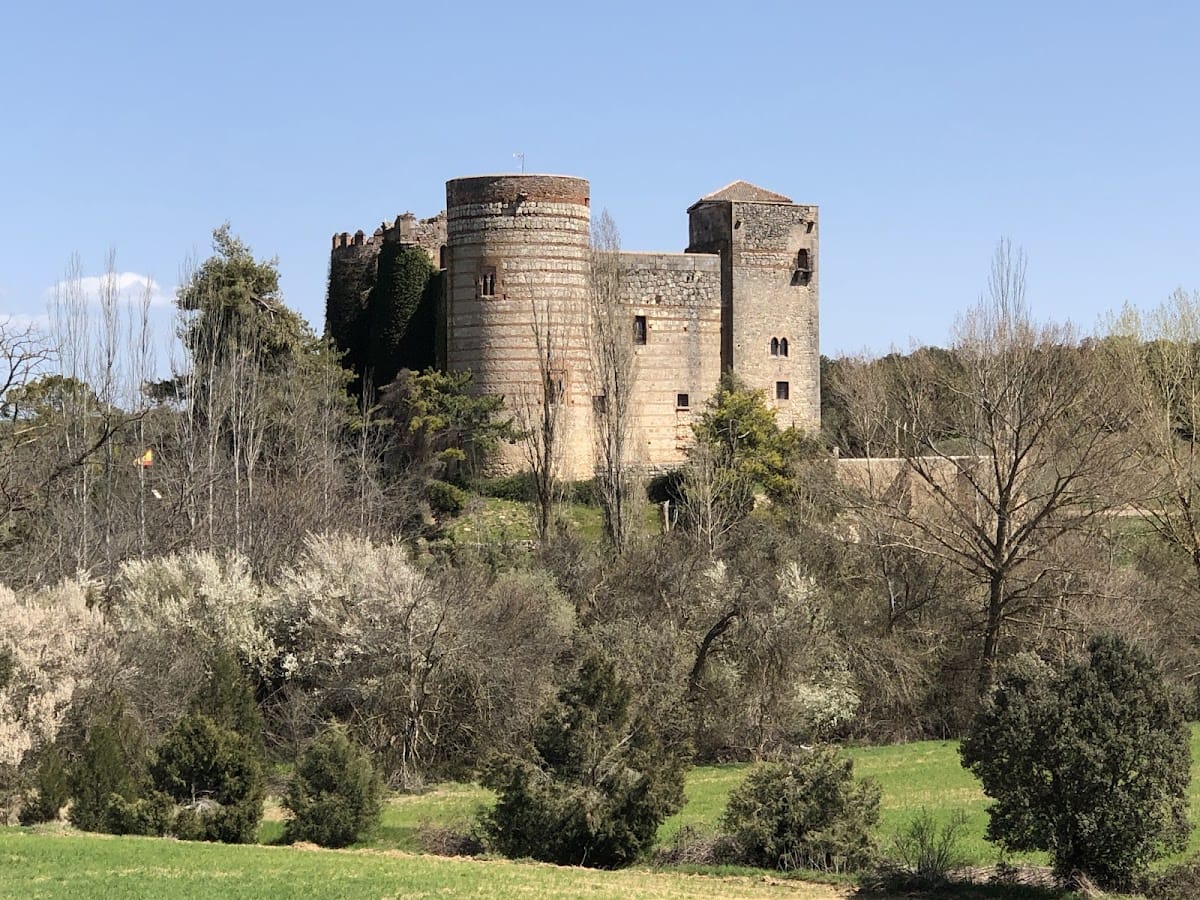
Castle of Castilnovo is a medieval fortification of probable Muslim origin in Spain, located in the municipality of Condado de Castilnovo in Segovia. Also called the Castle of Galofre, it developed between the twelfth and fifteenth centuries and later acquired Renaissance, nineteenth-century, and twentieth-century features. Its name means “New Castle,” referring to the fortress itself.
Possible Muslim origins
The castle’s earliest history remains uncertain. One tradition attributes its foundation to Abd al-Rahman I, the Umayyad prince who established the independent emirate of Córdoba in AD 756. Another connects the site with Almanzor, the powerful military ruler who dominated the Córdoba caliphate in the late tenth and early eleventh centuries. A literary reference places a fortification, perhaps a watchtower, in the surrounding region around AD 740. The oldest archaeological traces associated with the castle date from the twelfth and thirteenth centuries.
The surviving complex took shape over several centuries. Pointed arches on the western side of the arms courtyard belong to the twelfth or thirteenth century, while the six towers were added in later phases. Other parts of the building date from the Renaissance. The resulting structure combines the character of a defensive stronghold with that of a residence.
Royal and aristocratic ownership
Castilnovo became associated with prominent figures of the Castilian and Aragonese courts. Ferdinand I of Aragon and his wife, Eleanor of Alburquerque, lived in the castle. King John II of Castile later granted it to his favorite, the constable Álvaro de Luna, a constable being both a senior military commander and a leading royal official. After Álvaro de Luna’s death, Henry IV of Castile awarded Castilnovo to Juan Pacheco, Marquis of Villena.
Ferdinand the Catholic subsequently acquired the castle and extensive lands around it, forming the lordship of Castilnovo. He gave the estate as a dowry to his illegitimate daughter Juana of Aragon when she married Bernardino Fernández de Velasco, the first Duke of Frías. Juana died in 1510, leaving the castle to her husband. After his death in 1512, the property passed to their daughter, Juliana Ángela de Velasco y Aragón, who married her first cousin Pedro Fernández de Velasco, later the third Duke of Frías.
Castilnovo and the French royal hostages
The castle played a role in the diplomatic consequences of the Treaty of Madrid of 1526. This agreement followed the capture of King Francis I of France and required the French court to provide royal hostages, including the dauphin, the heir to the French throne, and the Duke of Orléans, the future King Henry II.
Emperor Charles V entrusted their custody to Íñigo, the second Duke of Frías. The two princes were first held at Villalba de los Alcores and Ampudia. After Íñigo died in 1528, his son moved them to Castilnovo and later to Pedraza de la Sierra, both properties of Juliana Ángela. She personally supervised their welfare during their confinement.
In 1557, Philip II made Juliana Ángela Countess of Castilnovo, recognizing her service to the Crown and the regard in which she was held by Charles V and Philip II. Following her death in 1559, the county, castle, and lands passed to her niece, the Countess of Osorno, and then to her daughter Juana de Velasco, the third Countess of Castilnovo. When Juana died without children, ownership passed first to the Counts of Lodosa and later to the Marquises of Belveder.
Nineteenth- and twentieth-century transformation
By the middle of the nineteenth century, Castilnovo belonged to a German prince. He sold it in 1859 to José Galofré, secretary and court painter to Queen Isabella II. Galofré restored and altered the building in keeping with nineteenth-century aesthetic preferences, and some portions of its medieval fabric may have been reconstructed during this work.
The castle later passed by inheritance to the Marquises of Quintanar, who added a wing in the manner of a Segovian rural house during the twentieth century. In the 1980s, they sold the property to the Spanish-Mexican association Castilnovo S.A. During the 2000s, the association enlarged the complex with a large hall and a Spanish-Mexican library and converted it into a large mansion. The property was also adapted as a hotel with an attached restaurant.
Castilnovo was declared a Spanish Asset of Cultural Interest in June 1931. This legal recognition reflects the importance of a complex whose appearance preserves layers from its medieval development through its later residential and restorative phases.
Remains
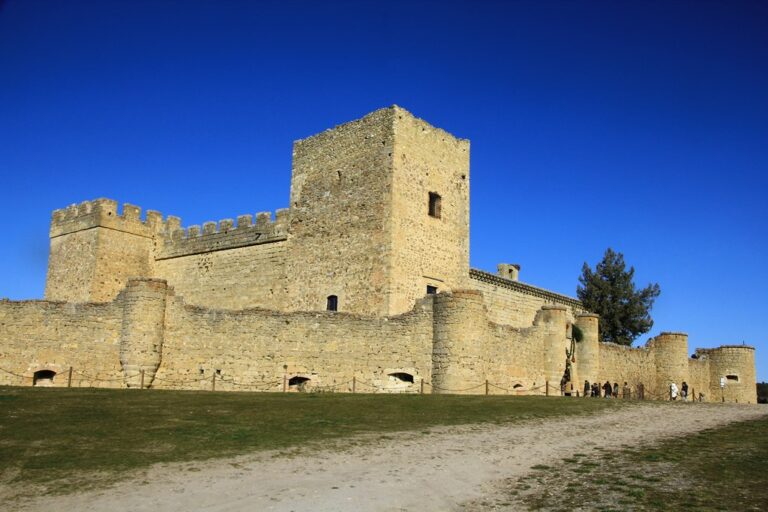
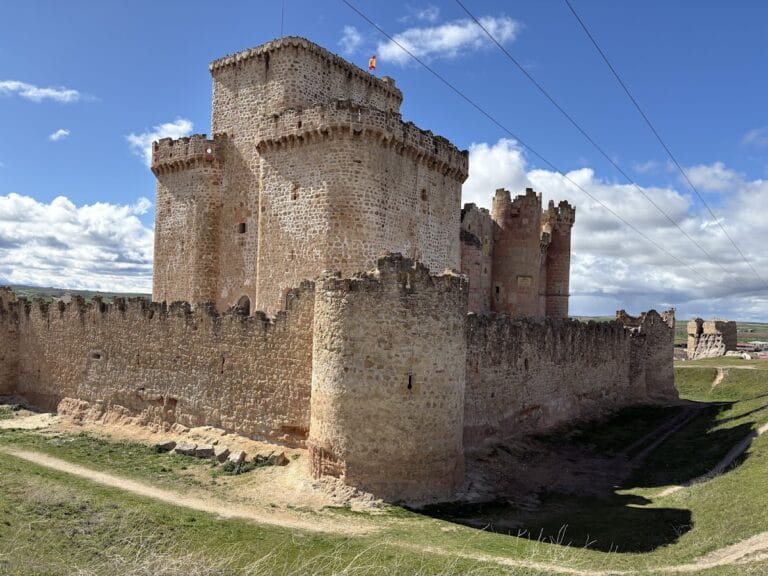
Castle of Castilnovo occupies a natural rocky outcrop at about 1,000 metres above sea level, in the depression of the San Juan River valley, a tributary of the Duratón. It stands roughly two kilometres west of Condado de Castilnovo, between Villafranca del Condado and Valdesaz. The square-plan complex combines fortress and palace functions, with successive alterations producing a mixture of medieval, Islamic-influenced, Renaissance, and later architectural forms. Dense vegetation surrounds the building and covers a substantial part of it.
Fortifications and towers
Six-tower enclosure
Six towers are joined by curtain walls, the continuous defensive walls linking fortified towers. Three are prismatic, with angular forms, and three are cylindrical. They are known as Solana, Puerta, Vieja, Moro, Caracol, and Álvaro de Luna. Solana, Puerta, and Vieja belong to the earlier group, while Moro, Caracol, and Álvaro de Luna were added later. Together, the towers give the complex its defensive framework, although the overall building also contains features suited to aristocratic residence.
Walls, openings, and balconies
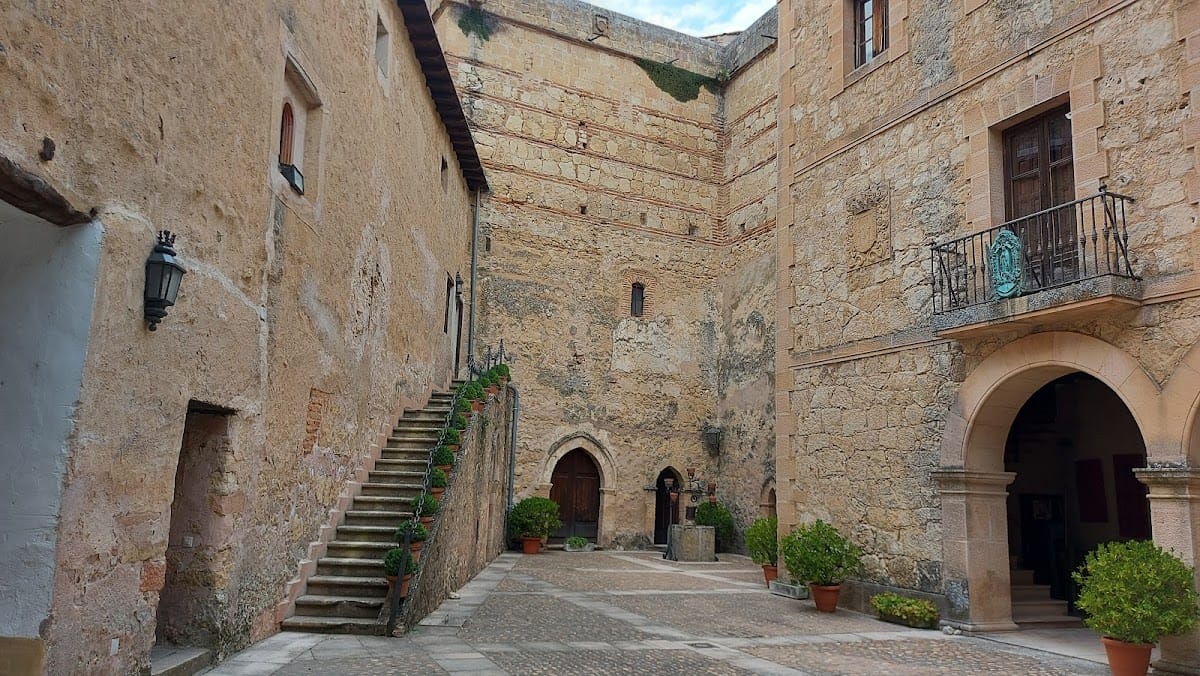
The towers and connecting walls contain numerous windows and balconies. Their openings include paired windows, rectangular frames surrounding arches, and horseshoe, ogee, and pointed arches. An alfiz is a rectangular frame placed around an arch. Some wall sections open toward the surrounding landscape through windows and wooden half-timbered balconies. The towers retain a more defensive character through their relatively limited number of windows.
The building uses several construction methods and materials. Ashlar masonry, made from carefully shaped stone blocks, appears alongside Mudéjar brickwork. Mudéjar architecture was produced in Christian-ruled Iberia by Muslim craftsmen or through the use of Islamic-influenced forms and techniques. Rubble masonry and alternating courses of brick and dressed stone add further variation to the castle’s fabric.
Courtyard and interior spaces
Arms courtyard
The arms courtyard forms an enclosed open area within the fortified complex, intended for circulation and military activity. On its western side, pointed arches date from the twelfth or thirteenth centuries. These arches belong to the castle’s early medieval development and remain part of the layered architectural character of the present complex.
Museum rooms and library
The castle also contains several museum rooms and a library. These interior spaces form part of the complex’s later residential and cultural adaptation, alongside the large hall and Spanish-Mexican library added during the twentieth and early twenty-first centuries. Their presence reflects the building’s transformation from a medieval fortification into a compound combining historic, domestic, and institutional uses.