Castillo de Nogalte: A Medieval Islamic Fortress in Puerto Lumbreras


Site at a Glance
- Rating
- 3.8
- Popularity
- Low
- Country
- Spain
- Primary era
- Medieval
- Eras represented
- Medieval, Early Modern
- Civilizations
- Crown of Castile
- Site type
- Military
- Remains
- Castle
On this page13 sections
History
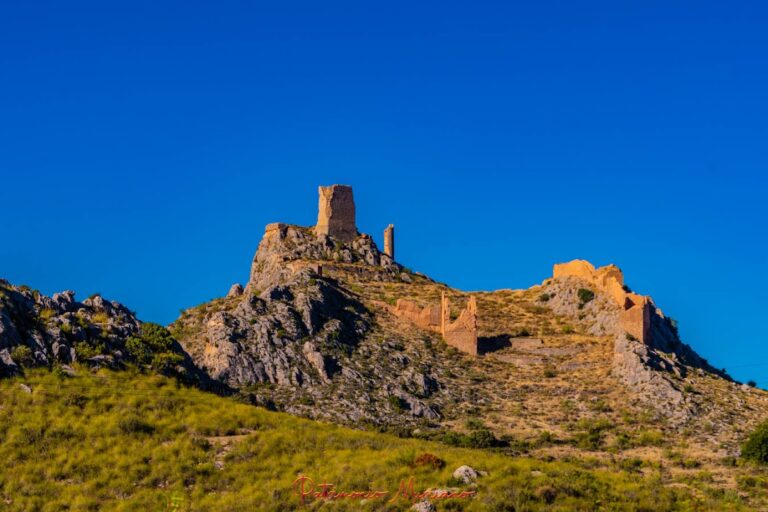
Castillo de Nogalte is a medieval Islamic fortress in Puerto Lumbreras, Spain, generally dated to around the thirteenth century. Its construction and development extended across the twelfth to fifteenth centuries. Built on a mountainous spur beside the modern urban area, it controlled routes and water sources connecting the Guadalentín valley, Granada, and Almería.
Earlier settlement and the Islamic fortress
The hill had been occupied long before the medieval fortress was built. The earliest settlement evidence belongs to the Bronze Age and includes ceramics associated with the Argaric culture, a society of southeastern Iberia known for its settlements, metallurgy, and distinctive burial practices. The Argaric settlement of Barranco de las Cuevas lies about 160 metres south of the castle.
The exact foundation date of Castillo de Nogalte is uncertain because surviving documentary evidence does not establish it. Construction methods and excavated materials point to the first half of the thirteenth century, when rural castles spread through the former Muslim kingdom of Murcia to protect agricultural communities and their holdings. The upper enclosure belongs to this Islamic phase and probably served as a fortified granary during a period of insecurity. Its internal spaces and millstones indicate that the safeguarding and processing of grain formed part of its function.
Christian conquest and adaptation
After the Christian conquest, the site entered a second phase of occupation and construction. Builders created the lower enclosure, altered the upper one, added a tower, and strengthened the defensive walls. The dimensions used in the rammed-earth construction correspond to standards approved by Alfonso X for the Kingdom of Castile in 1261. Alfonso X, known as Alfonso the Wise, ruled Castile and León from 1252 to 1284.
Juan García de Villamayor became the first recorded owner of the castle after receiving it as a royal grant in recognition of his services to Castile. He was Castile’s adelantado mayor, a senior royal representative in a frontier territory, and mayordomo mayor, a leading official of the royal household. The towers added during the Christian phase faced north and west, the directions from which an enemy could approach across the Nasrid frontier, the contested border between Castile and the Emirate of Granada.
Cave settlement and modern conservation
From the eighteenth century, demographic growth in Puerto Lumbreras encouraged the construction of cave houses on the castle hill. These modest family dwellings eventually formed one of the most important examples of rupestrian housing in the Region of Murcia. Rupestrian housing consists of dwellings excavated or formed within natural rock or earth slopes, and the settlement changed the appearance of the hill while becoming associated with the fortress.
Excavation campaigns at Castillo de Nogalte have taken place since 1999. Later interventions comprehensively rehabilitated the medieval castle and recovered parts of the caves cut into the hill. Since the El Castellar Master Plan began in 1996, successive projects have restored the castle, rehabilitated the interiors and exteriors of the cave houses, and reorganized the wider hill environment. Some cave houses were adapted for interpretation within the Medina Nogalte heritage complex, which also includes the Priest’s House and the House of the Goblins.
Castillo de Nogalte has been protected as a Bien de Interés Cultural under the Second Additional Provision of Spain’s Law 16/1985 of 25 June. The designation is recorded from 1997 under reference RI-51-0010066. In Spain’s heritage system, a Bien de Interés Cultural is a protected designation for sites and objects recognized as having cultural importance.
Remains
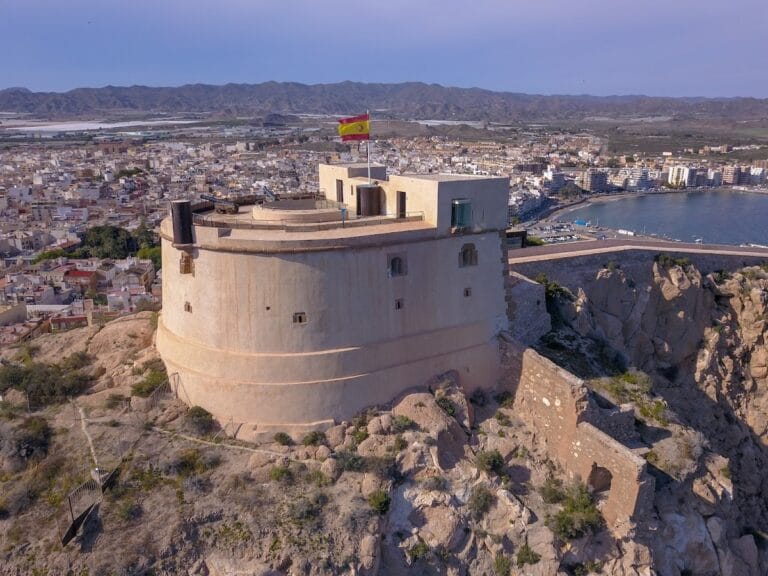
The fortress occupies a mountainous spur on the southern edge of the Sierra de la Torrecilla, beside Puerto Lumbreras. Its position overlooks water outcrops and natural routes leading east toward Lorca and the Guadalentín valley, north through the Nogalte ravine toward Granada, and west through the Almanzora valley toward Almería. The surviving fortification is arranged in two distinct enclosures linked by a sharply turning entrance passage, with walls built chiefly in rammed earth, a technique that compacts earth or earth-based mixtures inside formwork.
Upper enclosure
Fortified granary
The upper enclosure covers about 1,000 square metres. Its polygonal plan extends for approximately 60 metres and reaches up to 18 metres in width. The entrance lies on the eastern slope and turns through a right angle, preventing a direct approach into the enclosure.
At least three adjoining quadrangular spaces occupied the interior. Several millstones were found in these rooms, which were probably used to store grain. A large cistern measures 12.5 by 2.8 metres. It was made from concrete rammed earth and lined with hydraulic mortar, a water-resistant mortar suitable for holding water.
Lower enclosure and connecting passage
Christian defensive works
The lower enclosure belongs to the period after the Christian conquest. Its northern and eastern sides, together with part of its southern side, have been identified. Inside, earthen walls divide the space into adjoining rectangular rooms. The earlier Islamic fortification was altered through the addition of a tower and the strengthening of its defensive walls.
Triple-bent entrance
Communication between the two enclosures followed a passage formed by parallel walls. The route bends three times, creating a controlled entrance between the upper and lower parts of the fortress.
Cave houses and associated buildings
Rupestrian settlement
The cave houses excavated into the hill form a rupestrian settlement linked to the castle. Their construction altered the physical character of the slope, while restored sections have been adapted for interpretation as part of the Medina Nogalte heritage complex.
Medina Nogalte buildings
The wider heritage complex includes the Priest’s House and the House of the Goblins alongside the castle and cave houses. These associated buildings form part of the restored and interpreted group on the castle hill.