Castillo de Alhama: An Islamic Fortress in Spain


Site at a Glance
- Rating
- 4.3
- Popularity
- Low
- Country
- Spain
- Primary era
- Medieval
- Eras represented
- Medieval
- Civilizations
- Almohad
- Site type
- Military
- Remains
- Castle
On this page9 sections
History
Castillo de Alhama is an Islamic fortress in Spain, built between the eleventh and twelfth centuries on a rocky hill above the Guadalentín Valley in Alhama de Murcia. Its strategic position supported the defense of the borders of the Kingdom of Castile and gave the fortress control over the surrounding landscape.
Islamic Stronghold
Alhama reached its height in the early thirteenth century, during a period of major population growth. The fortress functioned as a ḥiṣn, an Islamic fortified settlement that could also administer the nearby rural territory. In this role, it controlled the surrounding area and organized the settlements connected to it.
The surviving construction is associated with the Almohads, a North African Islamic dynasty that ruled parts of the western Mediterranean, including territories in the Iberian Peninsula, during the twelfth and thirteenth centuries.
Castilian Frontier and Fajardo Lordship
After the Treaty of Alcaraz, the Kingdom of Murcia was incorporated into the Crown of Castile. Castillo de Alhama then became the property of the Castilian nobleman Juan García de Villamayor. Its role shifted toward the organization of a frontier zone between the Crown of Aragon, a Christian monarchy whose territories bordered Castile, and the Nasrid Kingdom of Granada, the last Muslim-ruled kingdom in medieval Iberia.
At the end of the fourteenth century, the castle town entered the lordships of the House of Fajardo, a noble lineage whose territories were held under aristocratic authority. During the following century, the complex served as the family’s seigneurial fortress and helped control a substantial part of the Kingdom of Murcia.
Decline and Conservation
After the end of the Reconquista, the gradual Christian conquest of Muslim-ruled territories in the Iberian Peninsula, and the fall of Granada, the fortress lost strategic importance. Its decline accelerated after the military character of the Kingdom of Murcia was dissolved, the last Morisco rebellion was suppressed in 1571, and the population of Arab origin was expelled in the early seventeenth century. Castillo de Alhama was eventually abandoned and fell into ruin.
During the twenty-first century, interventions consolidated the surviving remains and excavated parts of the complex. Since 7 August 1997, Castillo de Alhama has held protection as a Spanish Asset of Cultural Interest, a formal designation for protected cultural heritage, under reference RI-51-0009976.
Remains
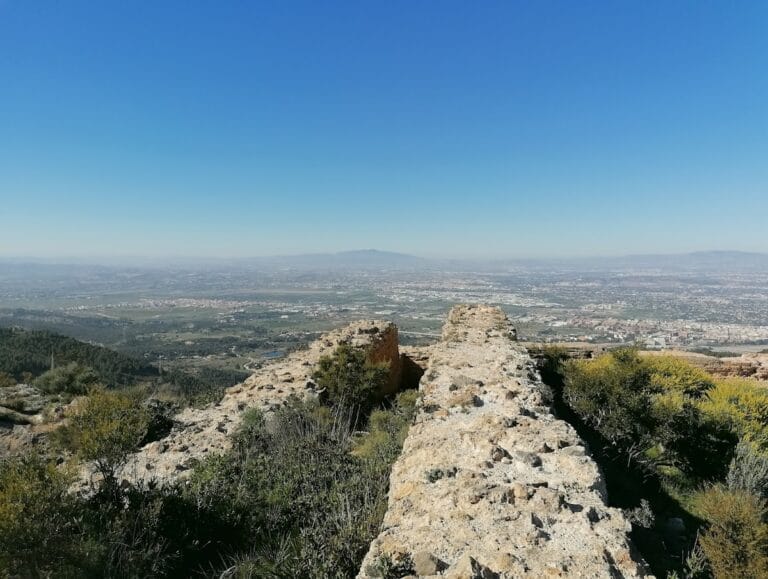
Castillo de Alhama occupies a rocky hill at approximately 248 metres above sea level, overlooking the Guadalentín Valley near Alhama de Murcia. The complex is divided into two distinct areas: one served political and military purposes, while the other provided refuge and residence for the population. Its surviving fabric combines rammed earth, ashlar masonry, and mortar.
Fortified and Residential Areas
Defensive Area
Sections of defensive walls survive on the hill, forming part of the area arranged for political and military functions. The walls belong to the fortress complex associated with Almohad construction and preserve the use of rammed earth, ashlar masonry, and mortar.
Refuge and Residence
A separate part of the complex served as a refuge and residential area for the population. Its division from the political and military sector reflects the organization of the castle into distinct functional spaces.
Keep
The castle also retains a prismatic keep. Inside it are pointed arches and surviving traces of cisterns, features connected with the building’s defensive role and provision for storing water. The keep forms one of the principal surviving structures within the excavated and consolidated remains.