Castello di Montechiarugolo: A Medieval Fortress and Noble Residence in Italy



Site at a Glance
- Rating
- 4.5
- Popularity
- Medium
- Country
- Italy
- Primary era
- Medieval
- External website
- Open
- Eras represented
- Medieval, Early Modern, Modern
- Civilizations
- Duchy of Milan
- Site type
- Military
- Remains
- Castle
On this page24 sections
History
Castello di Montechiarugolo is a medieval fortress in Italy, established around 1121 by the Sanvitale family as a military post defending the Enza valley. Its position beside the river gave it a strategic role, while its later rebuilding and decoration transformed it from a frontier stronghold into an aristocratic residence.
Foundation and destruction
In 1255, the fortress passed to Count Guido Anselmo, whose descendants became known as the Guidanselmi. In 1313, Giovannino Sanvitale joined the Baratti and da Palù families in a rebellion against the Guelphs of Parma. The Guelphs were one of two major political alignments in medieval Italy, broadly associated with papal interests. The podestà of Parma, supported by Giberto III da Correggio, besieged the castle and compelled the rebels to surrender. Both the fortress and its adjoining settlement were then completely destroyed.
After Parma entered the Duchy of Milan in 1348, the Visconti rebuilt Montechiarugolo as a stronghold controlling the valley. The Visconti were the ruling dynasty of Milan, and their reconstruction restored the site’s military importance.
The Torelli lordship
In 1404, the da Correggio and Rossi families seized the fortress. Ottobuono de’ Terzi, lord of Parma, attacked them, secured their surrender, and returned Montechiarugolo to the dukes of Milan. He advised that the fief be entrusted to Guido Torelli, a condottiere, meaning a professional military commander who led troops under contract.
In 1406, Giovanni Maria Visconti formally invested Torelli with the fiefs of Montechiarugolo and Guastalla. Torelli began rebuilding the castle on a polygonal plan. In 1428, Filippo Maria Visconti confirmed the Torelli lordship and granted the family the title of counts. After Guido Torelli died in 1449, his sons disputed the division of his territories. Pietro Guido forcibly took Montechiarugolo in 1456, although it had been assigned to his brother Cristoforo. Cristoforo counterattacked and recovered the fortress.
War and aristocratic transformation
During the conflict between Louis XII of France and Ludovico Sforza in 1500, Gian Giacomo Trivulzio attacked Montechiarugolo with artillery and damaged the castle before transferring it to Antoine de Gimel, governor of Parma. Francesco Torelli reacquired it in 1503 and repaired the damage caused by the sack.
In the middle of the sixteenth century, the castle hosted Francis I of France and Pope Paul III. It was attacked and occupied again during the War of Parma in 1551, a conflict between Ottavio Farnese, supported by Henry II of France, and Pope Julius III, who was allied with Emperor Charles V. The Torelli recovered possession after the war.
In the following decades, Pomponio Torelli commissioned extensive interior decoration, giving the fortress the character of an aristocratic residence. His son Pio succeeded him in 1608. In 1611, Pio Torelli was accused of conspiring against Duke Ranuccio I Farnese alongside members of the Sanvitale families of Sala Baganza and Fontanellato, Barbara Sanseverino, Orazio Simonetta, and other nobles. Ranuccio secured their death sentences and confiscated their property. These actions ended the County of Montechiarugolo. The Farnese ruled Parma and played a decisive part in the castle’s later political history.
Ducal administration and the Battle of Montechiarugolo
In the centuries that followed, the castle belonged to the ducal administration of Parma and served as a food-storage warehouse. During the rule of Duchess Marie Louise, it was converted into a military warehouse and gunpowder factory. This industrial and military use damaged parts of the decoration in the interior rooms.
On 4 October 1796, Montechiarugolo was the scene of a battle during the French Revolutionary Wars. Austrian troops retreating from Napoleon’s siege of Mantua sought refuge in the castle while trying to reach Tuscany. Troops sent by the newly established Reggio nell’Emilia Republic under Carlo Ferrarini forced them to surrender after a brief engagement. Napoleon commemorated two soldiers from Reggio who died in the fighting and praised the action, which probably represented an early sign of the Italian Risorgimento, the nineteenth-century movement that led to Italy’s political unification.
Restoration and twentieth-century internment
After Italian unification, the state sold the castle to Antonio Marchi in 1864. He restored the long-neglected building, and it passed to his descendants, who remain its owners. The castle is recognized as Italian national heritage.
In June 1940, after Italy entered the Second World War, Fascist authorities converted one wing into a civilian male internment camp for people from enemy states. Jewish refugees, including people from Germany and territories occupied by the Third Reich, were also held there. The three-storey building could accommodate about 200 people, although the number of internees between 1940 and 1943 never exceeded 150. Carabinieri and police officials guarded the camp. Its garden and internal courtyards made confinement less severe, and contact with local residents continued despite official restrictions.
About 50 Jewish refugees arrived between June and July 1940. French and British civilians, including young Anglo-Maltese university students, joined them in August. Later arrivals included prisoners transferred from Scipione Castello and 58 Yugoslav sailors from Dalmatia. At least 65 Jewish people passed through Montechiarugolo, most for short periods, while nine remained there in the summer of 1943.
On 9 September 1943, as German troops arrived, about half the prisoners escaped through the rear of the castle, including all nine Jewish internees then present. The camp closed, and about 50 remaining prisoners were transferred elsewhere. Of the 65 Jewish internees, eight were later arrested in different parts of Italy and killed at Auschwitz. Fifty-seven survived, including three who had emigrated before the summer of 1943.
Legend of Fata Bema
A popular tradition associates the castle with Fata Bema, a prophetic woman supposedly linked to a celebration held in May 1593, Pio Torelli, and Ranuccio I Farnese. According to the legend, Bema later lived at Montechiarugolo and remained there until her death. Each year, during the night of 18 to 19 May, her ghost is said to return, climb the mastio, or principal fortified tower, and look toward Parma. The story also connects her with an Egyptian mummy preserved inside the castle, but this is a traditional legend rather than established historical evidence.
Remains
Fortifications and courtyards
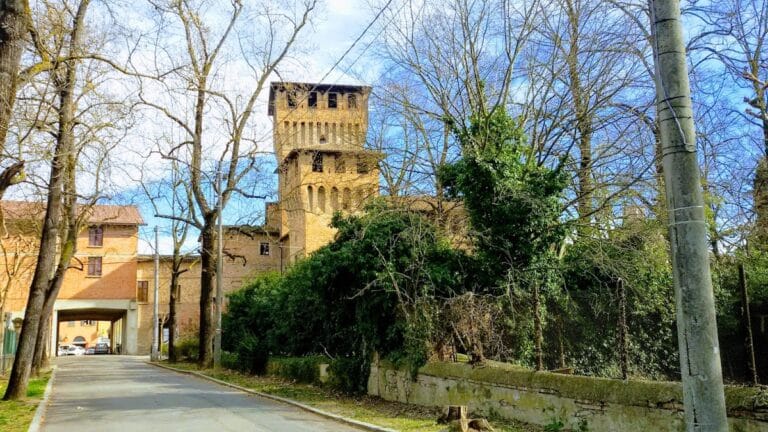
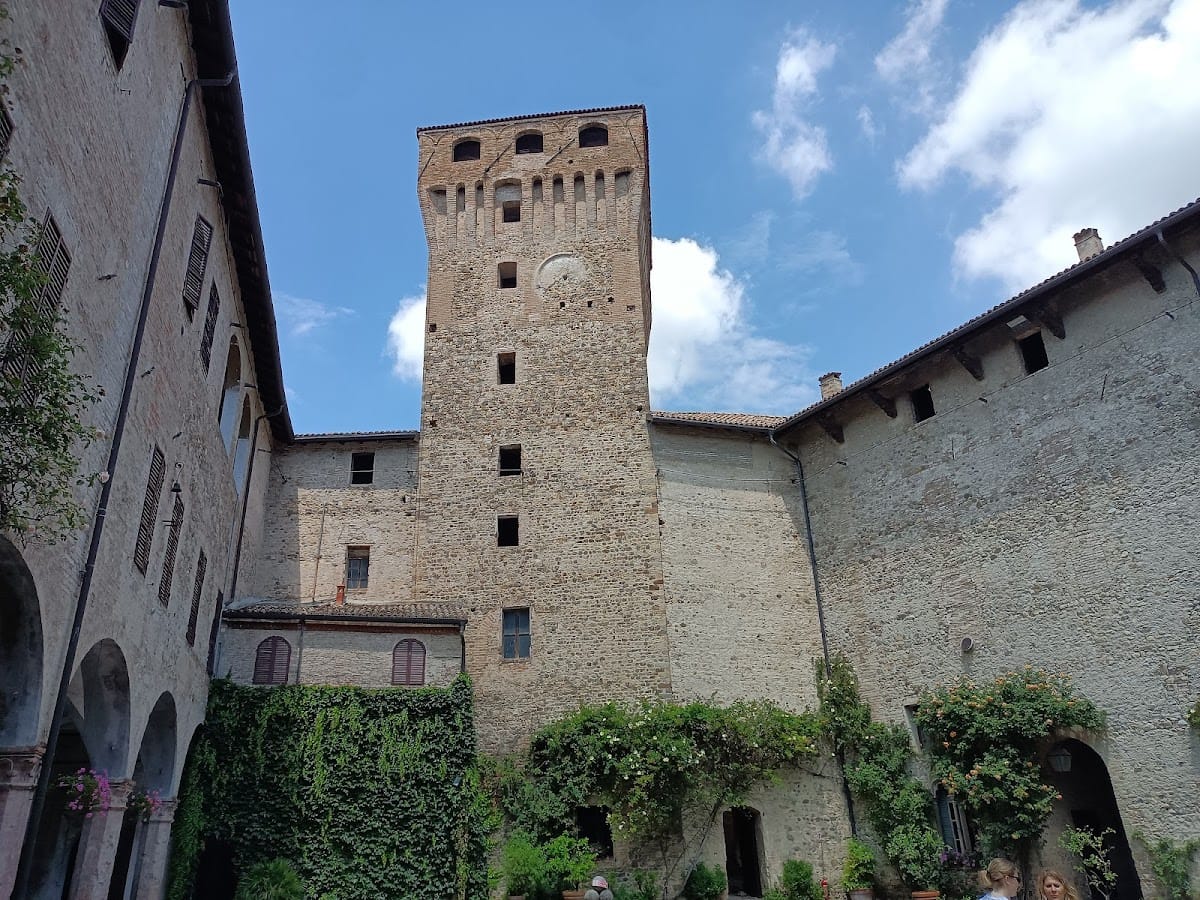
Built in brick on an irregular plan, the castle is arranged around two internal courtyards. The much larger Courtyard of Honour forms the principal open space, while the smaller Well Courtyard lies beyond the mastio. The fortress occupies a natural escarpment beside the bed of the Enza. On the landward side, a broad and deep moat was originally crossed by two separate drawbridges placed at two surviving but damaged ravelins, outer defensive works set beyond the main moat.
A second outer enceinte, or enclosing defensive wall, once surrounded the settlement. Its corners carried bastions, and it was adapted in the second half of the fifteenth century with positions for guns. Substantial traces remain along the northwestern edge of the historic centre. The brick facades, especially on the southwest and north sides, retain the appearance of a late-medieval castle. Ghibelline crenellations crown the walls, while the wall walks are supported by numerous machicolation brackets, projecting structures with openings through which defenders could drop missiles or other materials. A roof was added after the castle was built.
Entrances and outer spaces
Southern approach
The southern entrance route passes through an entrance garden and crosses the moat on a masonry bridge leading to the southern ravelin. A second masonry bridge, replacing the former drawbridge, connects the ravelin to the castle. Two tall slots preserve the evidence of the earlier drawbridge bolts. From there, a round-arched entrance opens into the Courtyard of Honour.
Courtyard of Honour
The southern side of the Courtyard of Honour has a fifteenth-century portico supported by polygonal brick columns with lotus-shaped capitals. Old cannonballs are arranged in a pyramid in the courtyard. Two eighteenth-century statues, acquired by the Marchi family from the garden of the Ducal Palace at Colorno in the late nineteenth century, also stand there.
Castellazzo garden
On the north side of the Courtyard of Honour, a masonry bridge leads to the Castellazzo, an old bastion converted into a garden. Hedges, rose bushes, and peonies grow within it. High brick retaining walls support the garden, and some have collapsed toward the valley.
Towers and valley-facing structures
The tall mastio rises between the two courtyards and dominates the complex. Wall walks run around the upper perimeter and remain in good condition. Small round gun loops beneath the crenellations were added toward the end of the fifteenth century for light artillery. On the side facing the valley, a projecting loggia, or open-sided gallery, rests on high brackets. Its single-pitched roof is supported by slender sandstone columns with lotus-shaped capitals.
Decorated residential rooms
Eastern loggia
The four principal ground-floor rooms open onto the long eastern loggia. It has a timber-beamed ceiling, stone columns, and fifteenth-century frescoes on its walls and masonry parapet. Restored during the final years of the twentieth century, the paintings include the Torelli and Visconti coats of arms within green and red diamond patterns. The Visconti emblem covers the rear wall. Numerous inscriptions from Guido Torelli’s period record major events in the history of the Torelli family. The loggia overlooks the valley, with Castello di Montecchio Emilia visible across the Enza and the hill castles of Quattro Castella in the distance.
Salone delle Feste
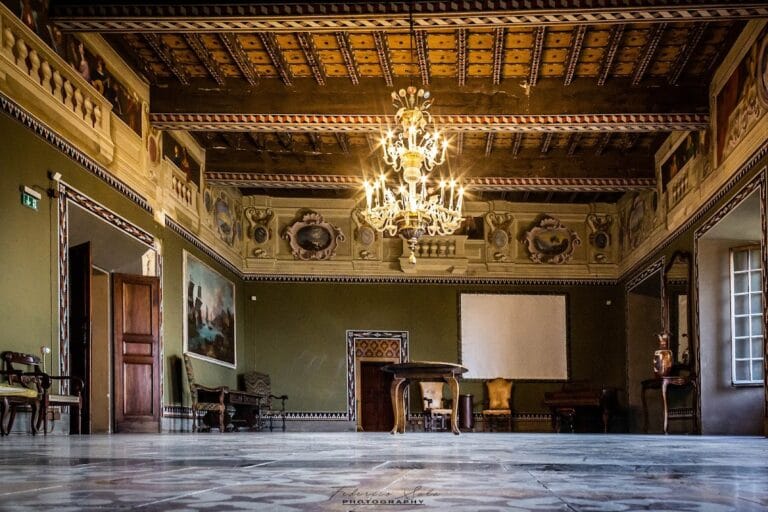
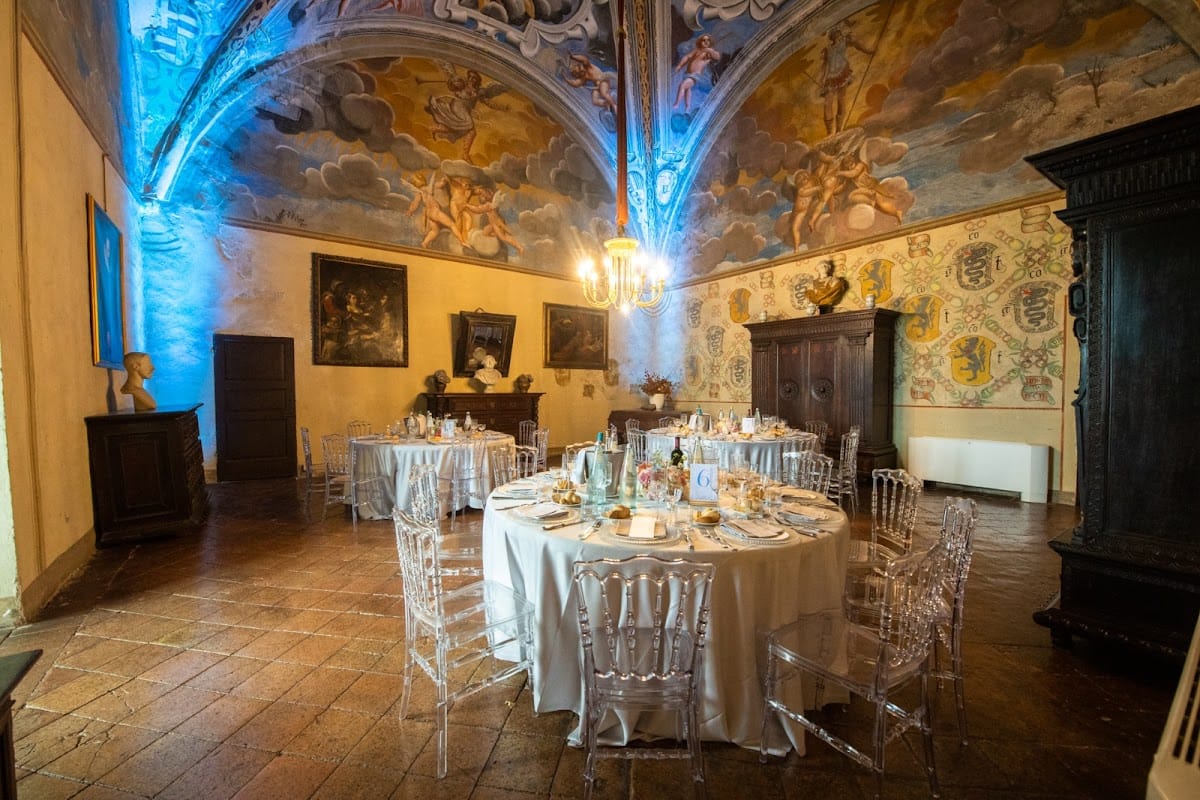
The Salone delle Feste connects directly with the Courtyard of Honour and is lit by elaborate nineteenth-century Neo-Gothic three-light windows. Late-sixteenth-century frescoes attributed to the school of Cesare Baglioni cover half of the cross-vault and the broad lunettes, the curved areas beneath the arches. They show grotesque ornament, intertwined vegetation, monochrome female figures, and numerous heraldic arms. The Visconti biscione, a serpent-like family emblem, occupies the centre of the vault. Other arms belong to the Contrari, Pico, Nobili, Torelli of Coenzo, Anguissola, Bentivoglio, Masi, Rossi of San Secondo, and Barbiano di Belgioioso families, as well as Pope Pius V and Cardinals Agostino Trivulzio and Michele Monelli.
The room contains antique furnishings and seventeenth- and eighteenth-century portraits, including works formerly associated with the Farnese family and installed by the Marchi family after 1864. The window reveals opening onto the loggia preserve a fifteenth-century Gothic-Lombard fresco of the Annunciation, divided between the Archangel Michael and the Madonna. It is attributed to a pupil of Michelino da Besozzo. Early seventeenth-century frescoes of flower-scattering putti decorate the vault.
Camera di Mezzo
The Camera di Mezzo retains fragments of its fifteenth-century fresco decoration. Its former wall scheme consisted of a diamond-patterned network containing inscriptions, jewelled rings, and Borromeo coats of arms. The wall opposite the entrance preserves numerous traces, including the Gothic-lettered motto Humilitas. A deteriorated sixteenth-century painted fragment on the opposite wall depicts a boat referring to the Sirens episode in the Odyssey.
Room of the Four Elements
The Sala dei Quattro Elementi, also called the Sala delle Sirene, contains four tempera paintings by Domenico Muzzi from the second half of the eighteenth century. Tempera uses pigment mixed with a binding medium. The paintings represent water, air, earth, and fire through Neptune on his chariot, Juno ordering Aeolus to release the winds, Pluto abducting Proserpina, and Venus ordering Vulcan to forge the arms of Aeneas.
The room also contains a wooden and metal model of a small Temple of Arcadia, probably made by the architect Ennemond Alexandre Petitot in 1769. The paintings and model originally came from the Ducal Palace at Colorno and were acquired by Antonio Marchi toward the end of the nineteenth century. A large painting of Pia de’ Tolomei, dating to about 1850, gives the room its additional name, Camera della Pia.
Adjoining frescoed room
A room next to the Camera di Mezzo has fifteenth-century wall frescoes rediscovered and repainted between 1920 and 1930. They feature diamond patterns, Guido Torelli’s initials, mottos, and emblems, including the rampant lion, or “cat,” granted to the Torelli in 1424 after the liberation of Naples from the Aragonese. Its vault and lunettes contain allegorical paintings originally made between the late sixteenth and early seventeenth centuries and repainted in the twentieth century. Their subjects include Fame, Fortune, martial Virtue, and Abundance or Fortitude.
Corner bedroom
The corner bedroom, perhaps once Pomponio Torelli’s study, has a cross-vault and wall lunettes covered by a late-sixteenth-century fresco cycle. One interpretation connects the imagery with human life, showing putti, monochrome angels, four male activities, and four stages of the day. A 2006 study instead identified allegories of physical strength, ingenuity, benevolent fortune, and happiness in the vault, together with Night, Day, Time revealing Truth, Consideration, Vigilance, and Discernment in the lunettes. The paintings have been attributed to Innocenzo Martini and Giovanni Antonio Paganino, and in more recent studies to Cesare Baglioni.
The bedroom contains a Renaissance bed, a Baroque cradle, a richly carved late-seventeenth-century wardrobe and chest, and late-seventeenth-century wooden wall panelling from the sacristy of the collegiate church of San Giovanni Battista at Pieveottoville. Two carved nineteenth-century doors are covered with fourteen small gold-background paintings, and two panels depict the Annunciation.
Former chapel and adjoining rooms
The former chapel overlooks the loggia. Its seventeenth-century frescoes depict music-making angels and scenes from the life of Saint Francis of Paola. Nearby rooms preserve fragments of a late-sixteenth-century painted frieze from the school of Cesare Baglioni and relief depictions made by Girolamo Magnani between 1870 and 1880.
Mastio and upper rooms
The first-floor room of the mastio has a sixteenth-century coffered ceiling. In the upper floor of the north wing, a large room originally served as an armoury before Pomponio Torelli converted it into a library. The library’s contents were later confiscated by the Farnese, leaving no trace of the collection.
Mummy chamber
A small, dark room adjoining the decorated apartments contains a glass case with an ancient Egyptian mummy reportedly found inside the castle in the eighteenth century. The tradition of Fata Bema identifies the mummy with her body. It also says that a note beside it warned against moving it, and that attempts to remove it caused earthquakes, floods, and other disasters. This association belongs to the castle’s legend rather than to its established history.