Castello di Felino: A Medieval Hilltop Castle in Italy


Site at a Glance
- Rating
- 4.3
- Popularity
- Low
- Country
- Italy
- Primary era
- Medieval
- External website
- Open
- Eras represented
- Medieval, Early Modern
- Civilizations
- Unclassified
- Site type
- Military
- Remains
- Castle
On this page14 sections
History
Castello di Felino is a medieval hilltop castle in Italy, built and enlarged over centuries as control of Felino and its surrounding lands passed among powerful aristocratic families. The settlement existed before 948, while the first certain reference to a castrum, meaning a fortified settlement or castle, dates to 1140. Its position above the Baganza Valley made it a defensive center and, later, a residence and administrative seat within the Rossi domains.
Early fortification and the Ruggeri lordship
A document from 870 and a letter written in 948 mention a fortification in the area of the former Curtis Felini, although they do not reveal its form or dimensions. The tradition that Marquis Luppone built the castle in 890 has no firm support. In 1140, Abbess Agnese of the monastery of Sant’Alessandro in Parma secured Pope Innocent II’s recognition of the monastery’s rights over two chapels, one within and one outside the fortress. This is the earliest definite evidence of a castle at Felino.
Following the conflict between Emperor Frederick Barbarossa and the Italian Communes, the Emperor granted Felino and the lands of San Michele de’ Gatti, Barbiano, Carignano, and Paderno to Guido de’ Ruggeri of Parma and his heirs in 1186. Local tradition associates the Ruggeri family with parts of the castle’s construction. The fortress was tested during the wars of the fourteenth century. In 1325, troops of Azzone Visconti, supported by the Pallavicino family, burned and plundered Felino, but Bonaccorso de’ Ruggeri and the defenders held the castle.
On 17 August 1345, forces commanded by Francesco d’Este captured the castle after fighting troops loyal to Luchino Visconti. When the Visconti recovered Parma the next year, Agnese de’ Ruggeri regained Felino. In 1346, Bonaccorso bequeathed the fief and castle, together with its associated lands, to his sons-in-law Giacomo de’ Rossi, Count of San Secondo, and Ugolino de’ Rossi. Further marriages between the two families concentrated ownership in the Rossi lineage.
Felino under the Rossi
Felino later became the dependency of Bertrando de’ Rossi. Rodolfo Visconti granted Bertrando broad exemptions over the fief and its dependencies in 1368, and Gian Galeazzo Visconti confirmed them in 1387. A successful market increased the settlement’s importance. Because of its central position within Rossi territory, Felino became the site of the lordly chancery for more than a century and the most populous center in the family’s possessions.
After Rolando de’ Rossi died without male children in 1389, his property passed to Bertrando, who probably died in 1396. Bertrando’s legitimate sons then inherited his lands. Giacomo de’ Rossi, Bishop of Verona, made Felino Castle his residence until his death in 1418, while Pietro Maria I de’ Rossi generally lived at San Secondo. Giovanni probably disappeared by 1402.
In 1403, Giacomo and Pietro began reinforcing their castles as rivalry among the major families of the Parma area intensified. Felino’s settlement was repeatedly looted and burned by forces connected with Giacomo dalla Croce, Bartolomeo Gonzaga, Guido Torelli, and Bonifacio da Valle. In May 1404, Pietro fled to Felino after Ottobuono de’ Terzi entered Parma. Terzi’s forces later plundered the settlement and attacked the castle in August, but the assault failed. His men returned to loot Felino in 1405.
After Pietro was captured while defending Grondola Castle in 1408, Ottobuono again ravaged Felino. The following year, Ottobuono and Cardinal Ludovico Fieschi attacked the castle while Giacomo de’ Rossi directed its defence. The garrison, said to have numbered 4,000 men and commanded by Michele Attendolo, repelled the attack, and Ottobuono suffered a wound to the foot. His death at Rubiera on 27 March, followed by the surrender of his widow and brothers, changed the conflict’s direction. Niccolò III d’Este, an ally of the Rossi, then became Lord of Parma.
In 1420, Guido Torelli, acting for Duke Filippo Maria Visconti with Pallavicino support, occupied Felino temporarily with armed men to prevent renewed clashes after campaigns in the Parma region. Following Pietro Maria I’s death in 1438, his son Pier Maria II de’ Rossi inherited his lands and undertook a major programme of fortification. Felino’s final medieval form probably emerged during this period. In 1449, an army led by Jacopo Piccinino attacked the castle, where Rossi and Sforza troops had gathered, but the assault was unsuccessful.
The War of the Rossi and the end of Rossi control
Felino was repeatedly attacked during the War of the Rossi in 1482 and 1483. In May 1482, men under Zanone della Vella sacked the settlement in retaliation for a Rossi raid near Parma. Sforza troops then devastated and burned the village, but a sortie from the castle drove them back after four days.
Pier Maria II had died on 1 September, and his will of 1464 had assigned Felino, San Secondo, Bardone, Berceto, Neviano de’ Rossi, and Noceto to his son Guido de’ Rossi. Guido’s brother Giovanni, called “the Dispossessed,” tried to seize Felino Castle, was imprisoned in its dungeons, and escaped during the night. Their brother Giacomo took command of the garrison while Guido established himself at San Secondo.
On 12 October, Guido made peace with Ludovico Sforza, known as Ludovico il Moro, the Duke of Milan from 1494 to 1499. The agreement required Guido to surrender Felino, San Secondo, and Torrechiara. Giacomo refused to give up Felino, so the war continued. On 7 May of the following year, Sforza forces approached with forty companies, bombarded the castle, and secured the surrender of two of its three captains. Ludovico il Moro ordered the fortifications and outer walls demolished, sharply reducing the castle’s military role.
Felino, Torrechiara, and San Secondo were assigned to Leone Sforza, Ludovico’s younger son. After Leone died in 1496, their revenues passed for a time to Duchess Beatrice d’Este. Following the French conquest of the Duchy of Milan in 1499, Louis XII invested Troilo I de’ Rossi with the three fiefs, but inhabitants loyal to Filippo Maria de’ Rossi prevented him from taking Felino. Royal lieutenant Gian Giacomo Trivulzio then ordered the castellans to surrender the fortresses. Louis XII assigned Felino and Torrechiara to Marshal Pietro di Rohan, who sold them in 1502 to Marquis Galeazzo I Pallavicino of Busseto for 15,000 scudi.
Filippo Maria de’ Rossi planned an unsuccessful attempt to recover Felino in 1512 and captured it in 1513, but the Pallavicino family retook the castle four days later. The eastern keep was probably rebuilt during this period. Through inheritance, Felino and Torrechiara passed to Pallavicino II Pallavicini and then, after his death in 1522, to his daughter Luisa Pallavicino. Her marriage in 1545 to Sforza I Sforza, son of Costanza Farnese, brought the two fiefs to him as her dowry.
From the Farnese administration to modern ownership
During the War of Parma in 1551, Ferrante I Gonzaga temporarily captured the two Sforza castles. The war opposed the forces of Duke Ottavio Farnese, supported by King Henry II of France, to Pope Julius III and his ally Gonzaga. In 1600, Cardinal Francesco Sforza transferred the Felino fief to Count Cosimo Masi. Cosimo’s son Giovan Battista was arrested and executed in 1612 with other nobles from the Parma region for alleged participation in a feudal conspiracy against Duke Ranuccio I Farnese. The Duke confiscated their properties, including Felino.
Duke Odoardo I appointed General Girolamo Rho Count of Felino in 1632. In 1645, rights over the fief and castle passed to Minister Giacomo Gaufridi, Marquis of Castelguelfo. Ranuccio II Farnese ordered Gaufridi’s execution in 1650, then raised Felino from a county to a marquisate and granted it to State Secretary Pier Giorgio Lampugnani. When Camillo Lampugnani, the last member of his family, died in 1762, Felino returned to ducal administration.
In 1763, Duke Philip of Bourbon exchanged ownership rights over the castle with the endowment of the Diocese of Parma for the County of Mezzani. The following year, he granted the feudal rights over the marquisate to Prime Minister Guillaume du Tillot. On 7 February 1775, the fief was definitively absorbed into the Ducal Chamber. From the late eighteenth century, the castle served as a country retreat for the bishops of Parma. Bishop Francesco Pettorelli Lalatta made several rooms more suitable for residence, but a long period of decline followed. Bishop Francesco Magani, the last bishop to stay there in the early twentieth century, described the building as ruinous.
In 1935, the bishop’s endowment sold the castle to the Brian family, who converted it into housing for agricultural workers on their estate. The Pianzola family and the Counts Del Bono acquired it in 1962 and adapted parts of the complex for a restaurant. Sergio Alessandrini purchased it in 1974 and carried out an extensive restoration. The property later passed to his descendants. The restored castle contains a restaurant, and its cellars housed the Felino Salami Museum from 2004 to 2024.
Remains
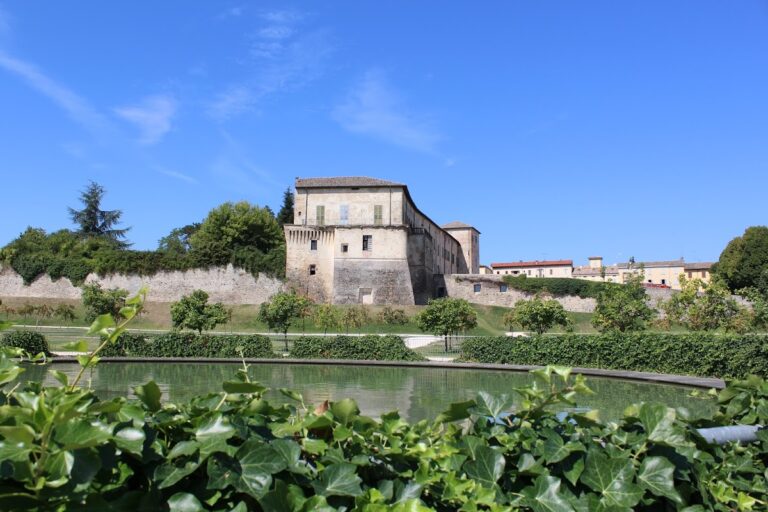
Castello di Felino occupies a hill at the edge of the Baganza Valley and is set within a park reached through a tall eighteenth-century brick portal with a round-arched opening. A covered entrance beside the portal formerly led to the Porta Nova, where the guardhouse stood. The castle follows a rectangular plan around a central courtyard. Four large corner towers occupy the corners, while a smaller turret in the middle of the southwestern side guarded the short bridge leading to the entrance. A deep moat surrounds the complex, with surviving traces of the walls and other defences that once accompanied it.
Walls, towers, and entrance
Outer defences
The buildings rise from a tall sloping stone base fitted with scattered gun embrasures. Long corbels, or projecting supports, remain on the outer elevations of the four principal building bodies and on the southern tower. They once carried machicolations, projecting defensive structures with openings through which objects or liquids could be dropped onto attackers. The western and northern towers end in roofs without cornices and retain a different external treatment from the eastern keep.
Main entrance
The principal facade has its entrance at the center. A high stone bridge reaches the opening, with a final wooden span that formerly operated as a drawbridge. Above the round-arched doorway stands a raised plastered turret, enlarged between the seventeenth and eighteenth centuries. Two tall openings originally accommodated the beams used to lift the drawbridge. Higher up, a small triangular pediment and a central opening are accompanied by two symmetrically placed single-light, round-arched windows.
Eastern keep
The eastern keep, the castle’s principal fortified tower, was probably rebuilt during the first half of the sixteenth century. It has an irregular pentagonal plan that projects northward, a cornice carried on corbels, and a donjon rising above it. The upper structure reaches approximately 330 meters above sea level.
Courtyard and residential wings
The rectangular courtyard contains a well at its center and is enclosed on all four sides by wings altered during the castle’s long history. The southwestern and northwestern wings open onto the courtyard through a portico supported by brick pillars. Above it, a loggia continues along the southeastern side, creating a connected upper gallery.
The northeastern wing preserves traces of round arches on two levels. They belonged to a double loggia that was demolished at an uncertain date but appears in eighteenth-century records. Several rooms retain old fireplaces and contain displays of weapons, armor, and other objects. Among them is a bell cast in 1652 on the commission of Duke Ranuccio II Farnese.
Oratory and basement spaces
Oratory of St. Peter the Apostle
Pier Maria II de’ Rossi ordered the Oratory of St. Peter the Apostle in 1454 and 1455 on the second floor of the eastern tower. Its ceiling has an umbrella vault, whose curved surfaces radiate from a central point or support. Restoration work in 1997 revealed wall frescoes. The lunettes contain paintings from several periods, chiefly coats of arms associated with former owners of the castle, including the Rossi, Pallavicino, Sforza, Gaufridi, Anguissola, Rho, and Lampugnani families and individuals.
Two frescoes are especially notable. One shows the coat of arms of Cardinal Francesco Sforza of Santa Fiora and is attributed to Cesare Baglione. The other is the Madonna of the Robin, probably painted during the fifteenth century. Together with the heraldic paintings, these works preserve the changing political and familial associations of the castle’s occupants.
Cellars and kitchens
The basement contains cellars and old kitchens faced entirely in stone and brick. Their spaces are covered by barrel vaults, continuous semicircular or segmental vaults extending along the length of a room. These lower rooms form part of the surviving service areas within the castle’s reconstructed and altered interior.