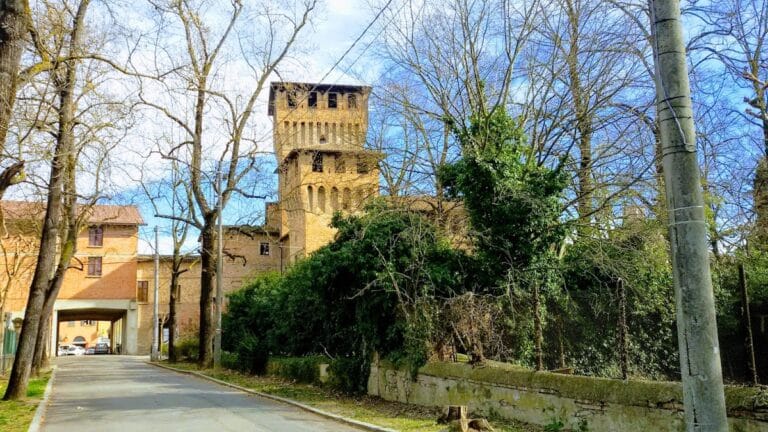
Castle of Bianello: A Medieval Hilltop Fortification in Italy


Site at a Glance
- Rating
- 4.5
- Popularity
- Low
- Country
- Italy
- Primary era
- Medieval
- External website
- Open
- Eras represented
- Medieval, Early Modern
- Civilizations
- Holy Roman Empire
- Site type
- Military
- Remains
- Castle
On this page9 sections
History
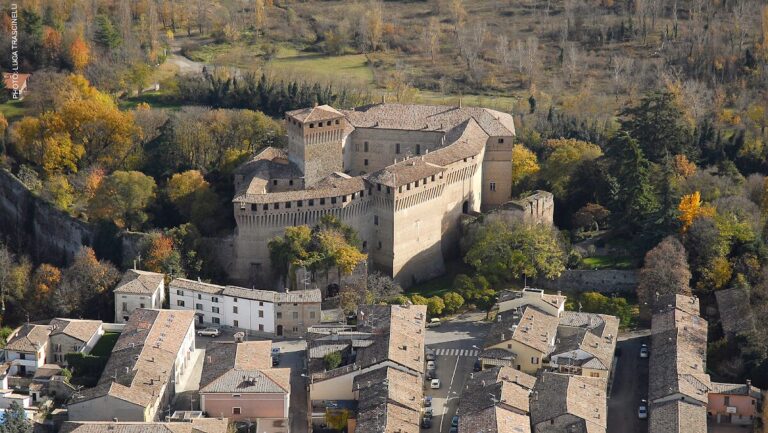
Castle of Bianello is a restored hilltop fortification in Quattro Castella, Italy, first mentioned in 1022. It formed part of a defensive system connected with the Canossa family and the Apennine hills, which created a natural barrier against invasions from the north.
Early records and the Canossa family
The origins of the four hilltop fortifications associated with Quattro Castella remain uncertain. The oldest reliable reference dates from 835, when Queen Cunegonda recorded the transfer of a place called Curte de quatuor arcas to the Monastery of Sant’Alessandro in Parma. The identification of that place with Quattro Castella cannot be established with certainty. Bianello itself appears in the historical record in 1022.
In 1044, ownership of the four castles passed to the Canossa family, a powerful medieval dynasty whose territories extended from the Po Valley toward Tuscany. Bianello became closely associated with the neighboring Castle of Canossa and with Countess Matilda of Canossa, an influential ruler in northern Italy during the late eleventh and early twelfth centuries. Tradition holds that Matilda often stayed at Bianello and that Henry IV spent time there as a penitent before his meeting with Pope Gregory VII at nearby Canossa in 1077.
Matilda and the imperial connection
In 1111, Matilda received Henry V, the son and successor of Henry IV, at Bianello after his return from Rome, where he had been crowned emperor of the Holy Roman Empire. At the castle, Henry V proclaimed Matilda vice-queen and imperial vicar in Italy. An imperial vicar exercised the emperor’s authority in a particular territory. The event was linked with a period of peace that culminated about a decade later in the Concordat of Worms, the 1122 agreement that helped settle the dispute between the papacy and the empire over the appointment of bishops.
In 1160, Duke Welf transferred the fortress to Guido of Canossa. This created a separate branch of the Canossa dynasty, known as the Bianello branch. During the early fourteenth century, Giberto III da Correggio took possession of Bianello and the neighboring Castle of Monte Lucio. In 1342, control of the four hills passed to another family using the name da Canossa, although its blood relationship to Matilda remains uncertain.
Feudal tenure and later transformation
In 1358, Gabriotto da Canossa received the territory directly from Emperor Charles IV. This formal grant of authority, known as an investiture, was confirmed in 1459 by Emperor Frederick III for Nicolò da Canossa, the son of Alberto. The Canossa branch retained Bianello until 1742, when it was sold to Count Giovanni Gabbi. The fief, meaning a territory held through a feudal relationship, was officially abolished in 1796.
The Gabbi family reacquired the castle in 1803. During the Restoration, the Este house selected Bianello as the first seat of the municipal administration of Quattro Castella. After the creation and unification of the Kingdom of Italy, the building was adapted for military use as a barracks. It was auctioned in 1867 and bought by Dr Luigi Caggiati of Parma, who converted it into a summer residence.
In 1881, the castle was sold to the Genoese shipowner Giovanni Battista Bacigalupo and later passed by inheritance to his son Carlo. The family of Count Girolamo Cantelli, also known as the Cantelli-Cremonini family, acquired it in 1897 and retained ownership until the Municipality of Quattro Castella purchased it in 2003. Castle of Bianello belongs to the circuit of the Associazione dei Castelli del Ducato di Parma, Piacenza e Pontremoli and is designated an Italian cultural property.
Remains
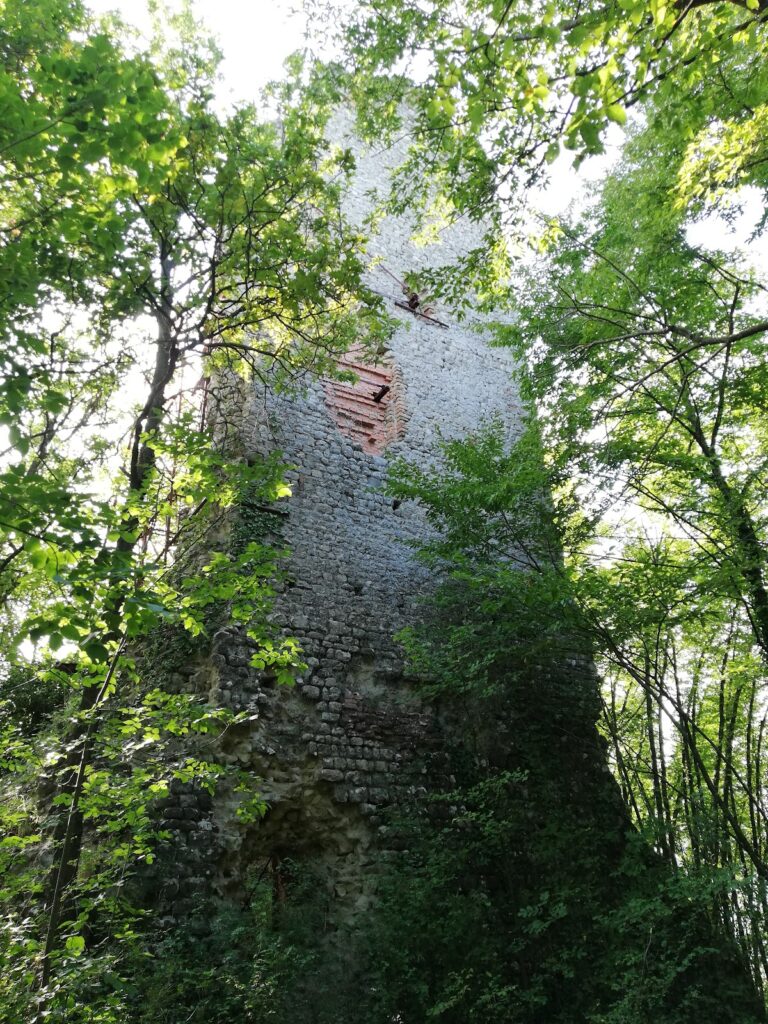
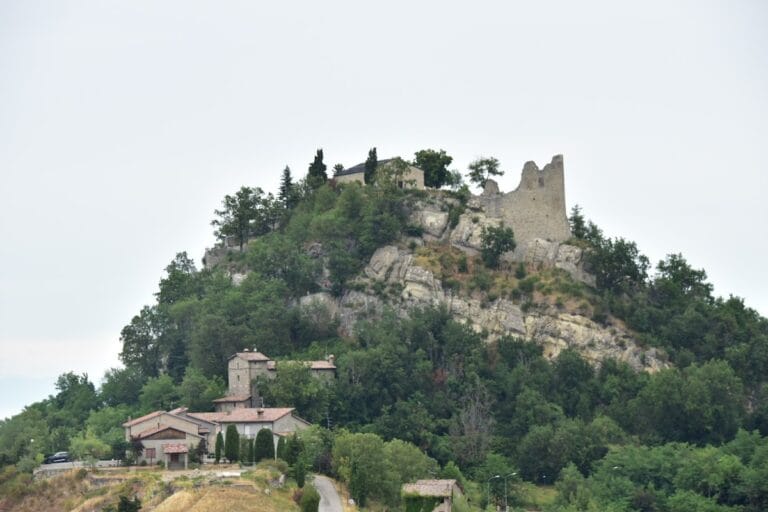
Castle of Bianello is a restored rubble-stone fortification positioned on one of four hills overlooking Quattro Castella. The four hilltop strongholds were aligned at Monte Vetro, Bianello, Monte Lucio, and Monte Zane, also called Monte Zagno or Mon Giovanni. Bianello is the only one of these four fortifications that survives.
Walls and historic interiors
Entrance wall
A stone at the entrance to the surrounding wall carries the inscription Comitissae Matildis opus, meaning “work of Countess Matilda.” The wording connects the building with Matilda of Canossa, although the castle’s origin is regarded as considerably earlier than her lifetime.
Noble floor
Several rooms on the first, or noble, floor are reached by an imposing Neo-Baroque staircase. These rooms preserve frescoes from the seventeenth and eighteenth centuries. One room contains a fourteenth-century painting of Matilda of Canossa holding a pomegranate blossom, presented as a symbol of her regency and wisdom.
Prisons and former guesthouse
The castle’s prisons retain original inscriptions made by prisoners during different historical periods. At the foot of the building, the former guesthouse survives as part of the complex and is occupied by a restaurant.