Gallenstein Castle Ruins: Admont Abbey’s Medieval Fortress in Austria


Site at a Glance
- Rating
- 4.7
- Popularity
- Low
- Country
- Austria
- Primary era
- Medieval
- External website
- Open
- Eras represented
- Medieval, Early Modern
- Civilizations
- Duchy of Styria, Holy Roman Empire
- Site type
- Military
- Remains
- Castle
On this page16 sections
History
Gallenstein Castle Ruins are the remains of a medieval hilltop fortress in Austria, immediately east of St. Gallen in Styria. Built under the authority of Admont Abbey, a Benedictine monastery founded in 1074, the castle became the administrative and defensive centre of the abbey’s estates from the late thirteenth century. Its summit, at 631 metres above sea level, also controlled access through three surrounding valleys.
From Imperial Territory to Admont Castle
Around 1000, the extensive forests around present-day St. Gallen belonged to the emperors of the Holy Roman Empire, a politically decentralised European polity ruled by medieval German kings and emperors. In 1007, King Henry II transferred the surrounding territory to the Archdiocese of Salzburg. Archbishop Gebhard granted it to the newly founded Admont Abbey in 1074, after which the clergy began settling and developing the neighbouring valleys.
In 1278, Rudolf of Habsburg, also known as Rudolf I, granted Abbot Heinrich II permission to build fortifications in the area. This date is regarded as the foundation of Gallenstein Castle, and the early fortress was completed in 1285. A district court operated there from the late thirteenth century. In the same year, a relative of Heinrich II became estate administrator, but accusations of serious abuses led to his imprisonment in 1296. After his release, he murdered the abbot in revenge. He was later captured and executed at Rottenmann.
Medieval Administrative and Defensive Centre
Gallenstein also served as a refuge for the Benedictines of Admont and for the monastery’s treasures. In 1291, during a noble revolt against Duke Albert, Heinrich II sheltered at the fortress with his monks and the abbey’s valuables. The stronghold probably helped prevent Salzburg-Bavarian forces from invading the area.
A chapel dedicated to Saint Peter was established at the castle around 1290. During the fourteenth century, Gallenstein developed into the main administrative centre of Admont’s extensive estates, whose territory was approximately equivalent to one-third of the modern Liezen District. The castle administrator acquired the title of burgrave, an official responsible for administering and defending a castle or its surrounding territory. Friedrich von Saurau rebuilt the Chapel of Saint Peter in 1396.
Much of the castle burned in 1467, but Abbot John III quickly restored the complex. In 1471, Burgrave Hans von Trautmansdorf and his soldiers suppressed a peasant revolt against Admont Abbey. Because the people of St. Gallen had remained loyal to the abbey, part of their tax burden was removed as a reward.
During the wars fought under Matthias I of Hungary, Abbot Antonius I Gratiadei appropriated part of the monastery’s treasures. He was captured in the early 1490s and imprisoned in one of Gallenstein’s towers. He was reportedly kept in relatively comfortable conditions, but died there after several months.
Refuge during Conflict
Gallenstein’s fortifications were repeatedly modernised during the Late Middle Ages, and the fortress acquired a reputation for being impregnable. No enemy is recorded as having attempted to besiege it. During the Peasants’ War of 1525, a widespread uprising against social, economic, and religious grievances, Abbot Georg von Steinach withdrew there with his monks and Admont’s treasures. Many Styrian residents fleeing Graz also sought refuge inside the castle.
The fortress held enough food, weapons, and ammunition for its defence, which required a garrison of about 50 men. Although the rebel army approached, its leaders did not assault Gallenstein, while the less strongly fortified Admont Abbey was thoroughly looted. After the revolt was suppressed, some captured rebel leaders were imprisoned in a dungeon at Gallenstein that the guards ironically called the “Peasant Chamber.”
In 1532, Burgrave Georg Sebastian von Steinach defeated a Turkish army at the Battle of Pfaffensteig with help from local militia. The financial cost of the war led Admont’s clergy to pledge the castle to him, effectively making him its owner. Further reconstruction of the fortifications began under his authority.
Rebuilding and Decline
In 1591, peasants angered by higher taxation burned the settlement of Mayerhof below the castle but did not attack the fortress. Reconstruction of the upper part of the Red Tower and the lower chapel began in 1595 or 1596 and continued until 1599. A severe storm shattered most of the castle windows in 1602.
Major rebuilding and expansion followed between 1621 and 1628 under Abbot Matthias Preininger. The Italian brothers Bartolomeo and Benedetto della Torre directed the work. When peasant unrest resumed in Upper Austria in 1626, 120 marksmen were stationed at Gallenstein. The treasures of the monasteries of Admont, Garsten, and Spital am Pyhrn were also moved there for safekeeping.
Lightning caused a fire that badly damaged the Gray Tower in 1683. Another lightning strike in 1727 set the castle ablaze, and Gallenstein burned completely. The fortress was not fully restored, although it continued to serve as the administrative centre of the surrounding estates. It was also looted several times during the French Revolutionary Wars.
The difficult approach to the castle and its inadequate water supply led regional governor Ferdinand Berthold to request the transfer of estate administration to St. Gallen in 1831. The castle was sold to the iron-goods merchant Josef Langensteiner, who ordered the removal of its metal components. Its copper roof was stripped and sold in 1832, while walls and towers became sources of building stone for local farmers. Gallenstein consequently became effectively abandoned.
Return and Partial Restoration
The ruins returned to Admont Abbey’s control late in the nineteenth century. The surrounding forests had followed a separate ownership history: they were sold to Innerberger Hauptgewerkschaft in 1882 and transferred by that company to Alpine-Montan-Gesellschaft in 1883.
Initial rebuilding of the ruins began in 1950 under the patronage of the Styrian Castle Association. Large-scale repairs, initiated in 1968 at the instigation of the Austrian Castle Association, restored the two principal towers and parts of the complex. Gallenstein was not completely reconstructed. It is municipal property and remains a partially restored ruin.
Remains
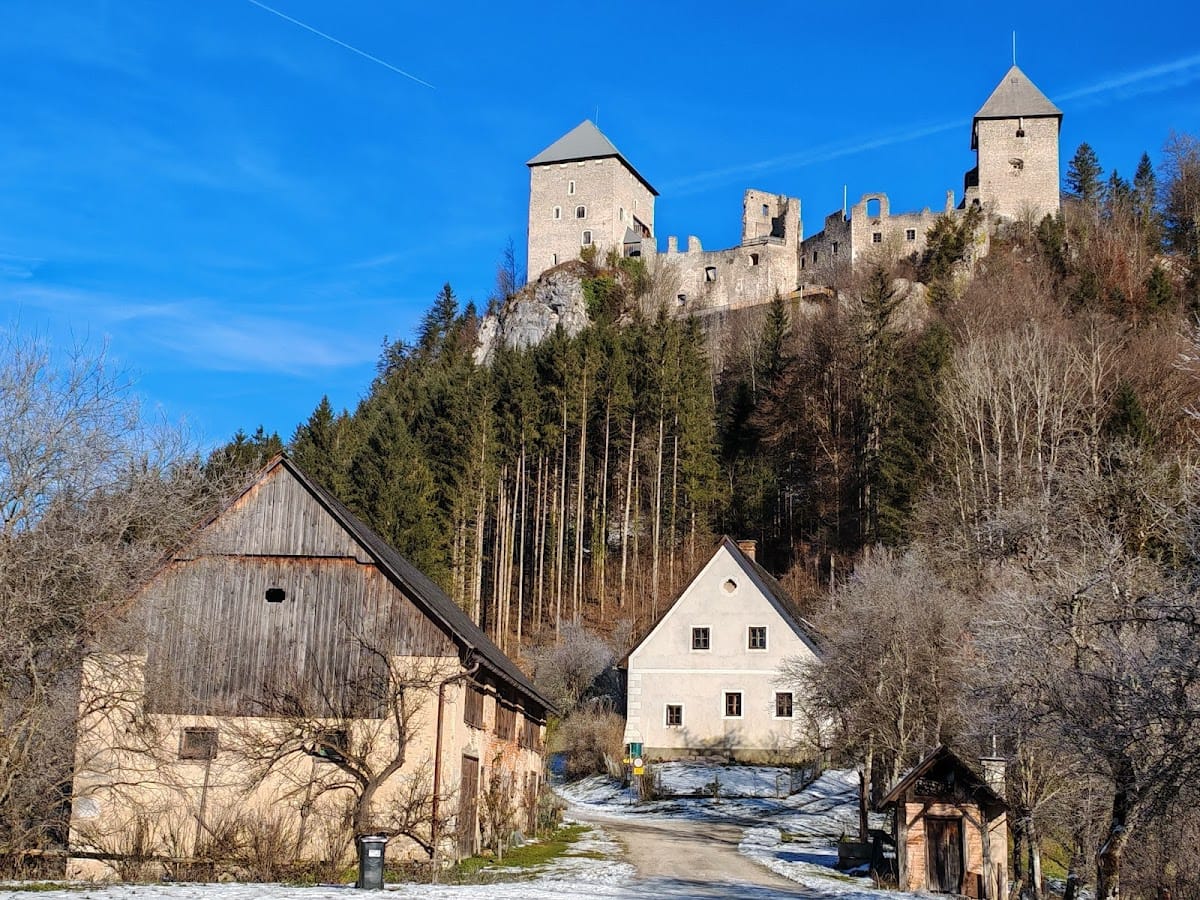
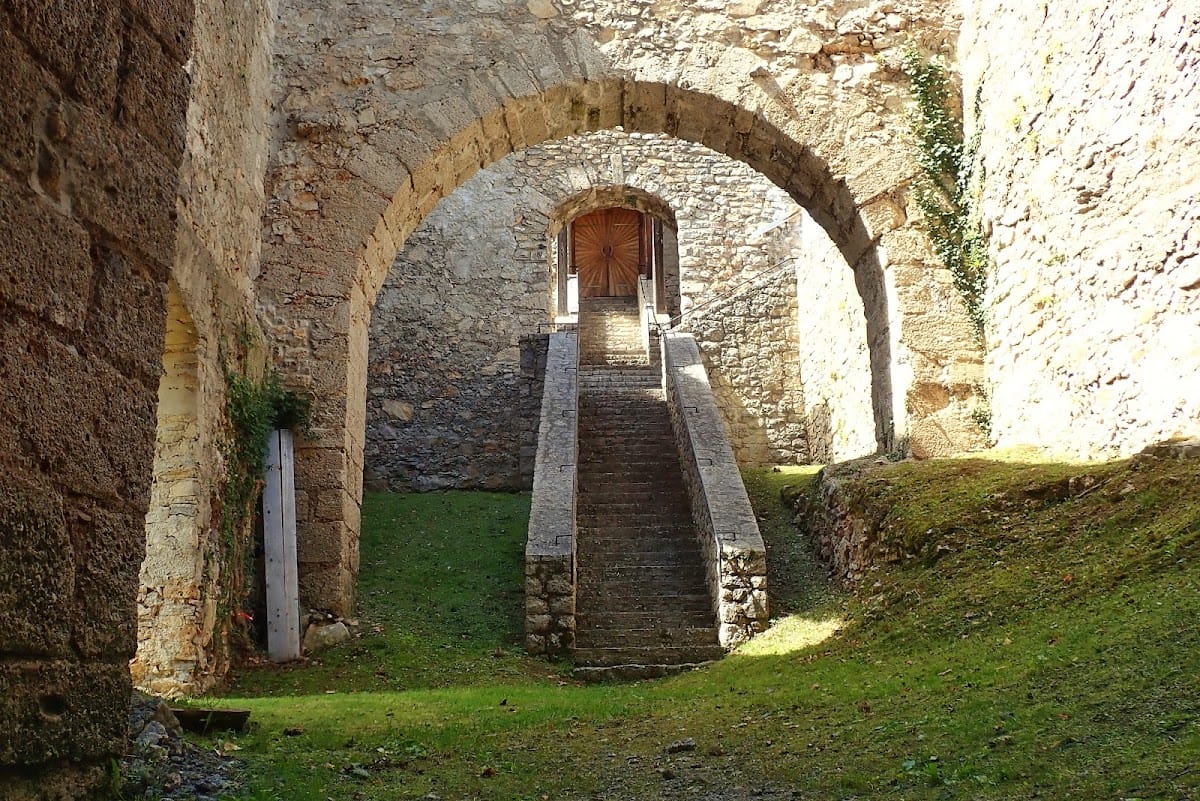
Gallenstein occupies a high rocky summit with steep or precipitous slopes. The position was selected partly because it provided control over three valleys. Historic access came only from the south. The approach from the former Mayerhof crossed a moat by drawbridge and passed through two gates. Beyond a small tower, two more gates led toward the Gray Tower, while a fifth gate opened into the citadel, which had a narrow inner courtyard and a keep, the principal fortified tower combining residential and defensive functions.
Fortifications and Towers
Red Tower
Gallenstein was a three-towered fortress with Gothic square-plan towers named the Red Tower, Gray Tower, and White Tower. The Red Tower was built of rubble masonry, with tuff blocks at its corners. A crenellated defensive wall connected it with the residential buildings, while service buildings and servants’ rooms adjoined the northern part of the wall. The upper section was rebuilt between 1595 or 1596 and 1599 after earlier damage.
Gray Tower and White Tower
Lightning damaged the Gray Tower in 1683, and the castle’s later ruinous condition followed the major fire of 1727. The White Tower formed the western end of the outer courtyard and was a substantial square residential tower. Its interiors have been carefully restored. A central wall divides the ground floor, which has a vaulted ceiling, while the upper floors had beam ceilings.
Residential Buildings and Keep
The large residential keep dominated the complex. The principal residential building stood in the western part of the castle and had three storeys. The keep and the roofed gate tower survive among the principal restored elements. The gate tower was rectangular and protected the entrance route into the fortress.
Chapels and Water Supply
Chapel of Saint Peter
The Chapel of Saint Peter stood near the second gate. It was established around 1290 and rebuilt by Friedrich von Saurau in 1396. Two of its windows retain Gothic tracery, the patterned stone framework that divides and decorates Gothic windows. Further remnants of early Gothic window tracery also survive from the chapel.
Chapel in the White Tower
A second chapel occupied the White Tower, adding a separate religious space to the castle’s residential and defensive complex.
Northern Courtyard and Cistern
The northern part of the fortress contained a courtyard with a water cistern. This section forms part of the surviving complex and is currently closed to visitors.
Walls and Later Defensive Works
Covered passages and roofed wall walks surrounded the principal buildings, protecting defenders from arrow fire. During the seventeenth-century rebuilding, new vaulted casemates were added. Casemates are protected vaulted chambers built into fortifications for uses such as storage, accommodation, or defence. The parapets along the outer walls were also renewed and raised.
Bastions were constructed beside the castle walls in the seventeenth century. A bastion is a projecting fortification designed to strengthen defensive fire along the walls. Most of these works have disappeared, while substantial remains of a large southern bastion survive. The complex is only partly restored: the two principal towers and several other structures have been repaired, while other parts remain ruined or have been lost.