Burg Ehrenfels: A Thirteenth-Century Hilltop Castle in Austria


Site at a Glance
- Rating
- 4.8
- Popularity
- Very Low
- Country
- Austria
- Primary era
- Medieval
- Eras represented
- Medieval
- Civilizations
- Duchy of Styria, Holy Roman Empire
- Site type
- Military
- Remains
- Castle
On this page7 sections
History
Burg Ehrenfels is a thirteenth-century hilltop castle near Kammern in Liesingtal, Austria, associated with the Ehrenfels family as their ancestral stronghold. The family had immigrated from the Swiss canton of Graubünden and held the castle as feudal vassals of the Bamberg High Diocese, the ecclesiastical principality governed by the bishop of Bamberg. Burg Ehrenfels is documented in 1229.
Feudal service and rebellion
The Ehrenfels family became involved in the 1292 uprising of the Landsberger League, a noble alliance that rebelled against Duke Albrecht I of Austria. They supported the rebels, but after the uprising was suppressed, they were required to compensate Admont Abbey by surrendering property.
Wulfing von Ehrenfels served the Bamberg authorities as an administrator and vicedom in St. Leonhard in the Lavant Valley from 1356 to 1362. A vicedom was a senior territorial deputy who represented a prince or ecclesiastical lord. His four sons later converted the family residence into a fortified castle.
Raiding and the end of the family
Two of Wulfing’s sons became notorious as highway robbers and raiders. During one episode, they intercepted Bishop Albert of Passau at St. Pölten as he travelled to Vienna at the invitation of Duke Albrecht II for his wedding. They held the bishop for almost a year at Schloss Kammer in Upper Styria while demanding a ransom. The brothers and their accomplices were excommunicated in Salzburg and Passau. Duke Albrecht eventually freed the bishop and brought their activities to an end.
Another member of the family, Wolfhard von Ehrenfels, entered the church and became Bishop of Basel in 1381 and Bishop of Lavant in 1411. The Ehrenfels family died out in 1422.
Later references and abandonment
The castle was called “Veste Ernvels” in 1439 and was described as the “upper castle” around 1500. It was probably abandoned sometime afterward, ending its role as the stronghold of the Ehrenfels family.
Remains
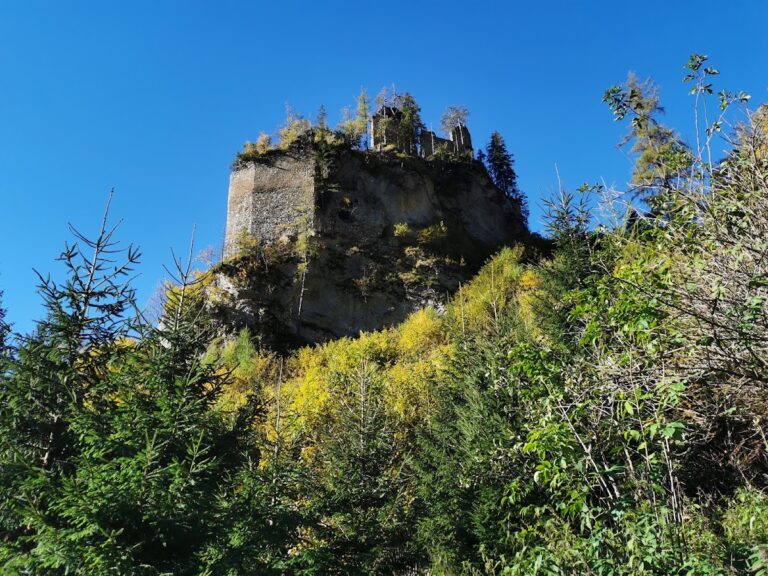
Burg Ehrenfels occupies a hilltop at approximately 1,150 metres above sea level above the Gföhler Wand near Kammern. Its surviving masonry is compact and made of regular rubble stone, while the physical remains are concentrated in the ruined keep, the principal defensive tower of a medieval Central European castle.
Rocky hilltop setting
Sheer rock slopes surround the castle, and the wider terrain is steep and difficult. A narrow, steep path connects the site with the neighbouring Burg Kamerstein, also called Kammerstein. This elevated position and difficult approach formed the physical setting of the fortified settlement.
Ruined keep
The principal surviving structure is the ruined Bergfried, or keep. Its compact, regular rubble-stone walls preserve the remains of the castle’s main defensive tower, while the rest of the castle survives only in fragmentary form.