Castell de Ciutat: A Historic Fortress in La Seu d’Urgell, Spain



Visitor Information
Google Rating: 4.5
Popularity: Low
Google Maps: View on Google Maps
Official Website: www.hotelelcastell.com
Country: Spain
Civilization: Medieval European
Remains: Military

History
Castell de Ciutat is a fortress located in the municipality of La Seu d’Urgell in Spain. It sits prominently on a hill within the Urgellet valley and was constructed by medieval Christian powers to serve as a defensive and administrative center.
Although the site’s importance is recognized from early times, written records explicitly mentioning the castle appear from the 12th century onward. It is believed that the fortress corresponds to the “pujo Urgelli” referenced in documents from the 11th century. Originally, the Counts of Urgell established their main residence here, known as the “palacio Civitatis,” which was documented in 1099. This residence functioned as the noble seat before the counts eventually moved nearer to the border regions.
In 1135, a dispute arose between Viscount Pere Ramón of Castellbò, who fortified the old comital palace, and Bishop Pere Berenguer, who claimed rights over the site dating back to the 10th century. Count Ermengol VI intervened and ruled in favor of the viscount, setting conditions to balance control. Despite this ruling, the count’s will in 1154 designated the castle to the church. That same year, a concord was reached in which the viscount recognized the bishop’s secular claims and agreed to refrain from actions hostile to the church using the fortress.
Further cementing ecclesiastical control, in 1167 Count Ermengol VII formally ceded Castell de Ciutat to the church as a freehold during Bishop Arnau de Preixens’ leadership. Then, in 1190, an arrangement was made between Count Ermengol VIII and Viscount Arnau de Castellbò. The viscount surrendered authority over Castellbò and other fortifications in exchange for royal approval and funding to reconstruct Castell de Ciutat. Conflicts persisted but were settled by peace treaties in 1194 and 1206, both affirming the count’s ultimate sovereignty.
The viscounty of Castellbò became part of the County of Foix in 1226. By 1256, the Count of Urgell transferred possession of Castell de Ciutat as a freehold to Roger IV of Foix. This transition elevated the fortress as a strategic stronghold for the Counts of Foix in the region.
The castle underwent a full reconstruction during the 17th century. At that time, contemporary descriptions, such as those in the medieval document known as the “Spill,” noted a four-sided structure without towers, surrounded by a substantial moat, with a courtyard containing a stone well providing fresh water. A chapel dedicated to Saint George was present, although it lacked its own income or endowment.
In the early 18th century, during the War of Spanish Succession, the castle was commanded by General Josep Moragues i Mas, a leading figure in Catalan resistance. The fortress fell to Bourbon forces in 1713, and Moragues later attempted without success to recapture it in 1714.
The mid-18th century saw another rebuilding in 1751, adapting the fortress to contemporary military design. The castle was once again restored during the Carlist Wars of the 19th century. After a period of abandonment in the 20th century, the historic core was eventually restored, and the complex developed with new uses, marking the latest phase in the castle’s enduring history.
Remains
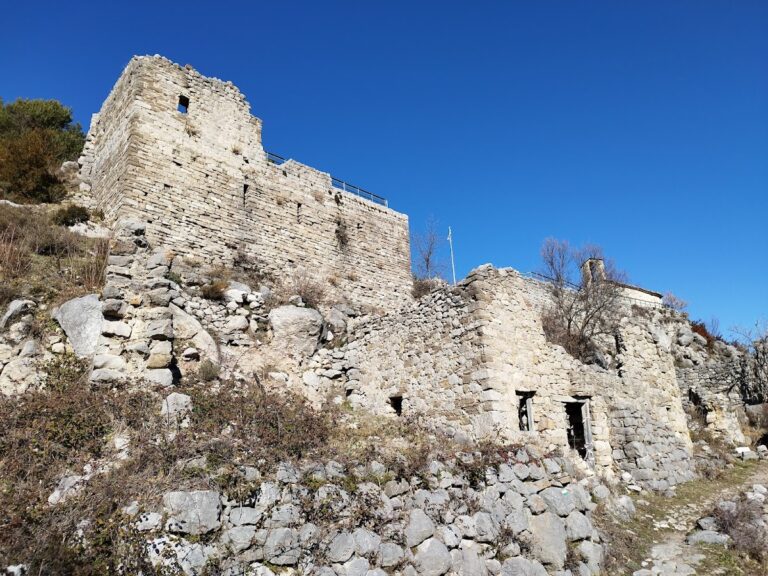
Castell de Ciutat today reflects its layered military past through a mixture of medieval fragments and later fortifications. The current structure follows the Vauban style, a form of star-shaped fort design popularized in the 17th and 18th centuries, optimized for resisting artillery attacks. The fortress includes five named bastions: Trobada, Cup, Sant Esteve, Sant Ermengol, and Sant Isidre. Each bastion projects outward from the main walls to allow overlapping fields of fire, typical of this defensive approach. An advanced guard position known as the Solsona tower stands before the primary stronghold, adding a forward line of defense.
Within the castle’s courtyard remains the medieval stone well described in early documents. This circular well, constructed from cut stone, provided fresh water to the inhabitants and stands as a tangible link to the medieval fortress layout.
Only one fragment of the original medieval construction is tentatively identified on the northwest section of the upper structure. This piece, a portion of wall, differs noticeably from later work. It is built using unshaped granite cobbles bound together by a very sturdy mortar, suggesting a construction date earlier than the extensive 17th and 18th-century reconstructions. The base of a former tower may be discerned within this fragment, hinting at the castle’s earlier defensive arrangements.
Thus, the surviving features at Castell de Ciutat present a combination of foundational medieval remains embedded within a predominantly modernized fortress complex, shaped by centuries of military adaptation and historical developments.
Nearby sites