Burg Freckleben: A Romanesque Spur Castle in Germany
Site at a Glance
- Rating
- 4.5
- Popularity
- Low
- Country
- Germany
- Primary era
- Medieval
- External website
- Open
- Eras represented
- Medieval
- Civilizations
- Holy Roman Empire
- Site type
- Military
- Remains
- Castle
On this page14 sections
History
Burg Freckleben is a Romanesque hilltop spur castle in Germany, located in Freckleben in the Salzland district of Saxony-Anhalt. Its earliest origins are uncertain, but the site developed into an important medieval fortification and aristocratic residence on the road between Halle, Aschersleben, and Halberstadt.
Early fortification and aristocratic residence
Freckleben was first mentioned in 762 as “Frekenlevo” in the Fulda Foundation Book. Its extensive earthworks may belong to this early period, although a Carolingian fortification, from the era of Charlemagne’s Frankish dynasty and its successors in the eighth and ninth centuries, remains unproven.
On 22 October 973, Emperor Otto II confirmed an exchange of estates through which Archbishop Adalbert of Magdeburg acquired Freckleben. Adalbert died there in 981, indicating that the site already contained a representative aristocratic residence.
The Stade margraves and the archbishopric of Magdeburg
During the twelfth century, Freckleben belonged to the margraves of the Nordmark, a frontier territory in the eastern part of the medieval German kingdom, and to the comital family of Stade. The first keep and parts of the enclosing defensive wall date from their rule.
Count Udo of Freckleben, the last member of the Stade family, was killed by the men of Albrecht the Bear at Aschersleben on 15 March 1130. Albrecht was a twelfth-century German nobleman and margrave of Brandenburg. After Udo’s death, the future Emperor Lothar III took the lordship as a lordless fief and granted it as an imperial fief, meaning that it was held directly from the emperor. Eckerich of Frakenleve and Otto of Frakenleve were named in records in 1135.
Archbishop Wichmann of Seeburg acquired Freckleben from Emperor Frederick I in 1166 through an exchange of estates. Because the castle stood beside an important route linking Halle with Aschersleben and Halberstadt, it became an important connection between the archbishopric’s possessions.
Expansion and changing lordship
Around 1200, the upper castle was substantially expanded. The third keep and other buildings were erected during this phase, creating a more developed enclosed courtyard. The keep’s elevated entrance was arranged for a drawbridge, which required a corresponding building on the opposite side of the approach.
Burgraves administered the castle until 1296. In that year, the last burgrave, Walter V of Arnstein, entered the Teutonic Order, a German religious-military order founded during the Crusades and active in eastern and central Europe. The burgrave’s office was not filled again. The lordship was subsequently granted as a fief to different noble families and was repeatedly divided.
In 1479, Princes Waldemar and Georg of Anhalt purchased the lordship from the Dorstädt and Strobart families and received it as a fief from the Archbishopric of Magdeburg. From the sixteenth century, Freckleben was administered as a domain, an estate managed as a source of princely or state revenue and commonly including agricultural land and buildings. During the division of Anhalt in the seventeenth century, the property passed to the Dessau line.
Domain administration and modern changes
Under nineteenth- and twentieth-century domain administration, the agricultural buildings were repeatedly remodeled. The domain became state property in 1896. Around 1900, a large round tower in the lower castle was demolished. In 1945, the domain was divided and several new-farmer holdings were established in the castle buildings.
Substantial parts of the fortifications and well-preserved Romanesque buildings survive. Burg Freckleben is designated as a cultural heritage monument of Saxony-Anhalt, while the date of its earliest fortification remains uncertain.
Remains
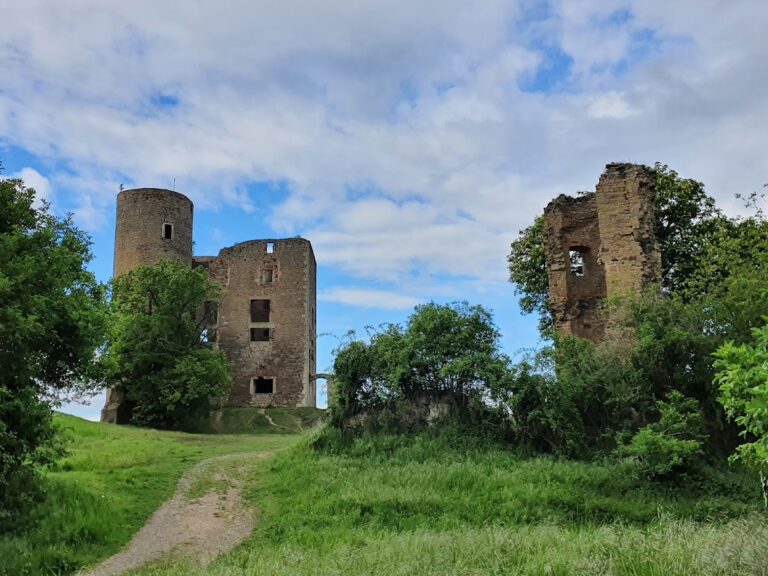
The castle occupies a projecting ridge, or spur, protected by steep slopes on three sides. Its roughly oval earthwork enclosure measures about 300 by 600 metres, making it several times larger than the later medieval castle. On the southern side, three successive ramparts with two intervening ditches defended the enclosure. Another rampart lies about 120 metres farther south, following the natural slope. The arrangement is consistent with the possibility of an early Carolingian fortification.
Lower castle
First keep
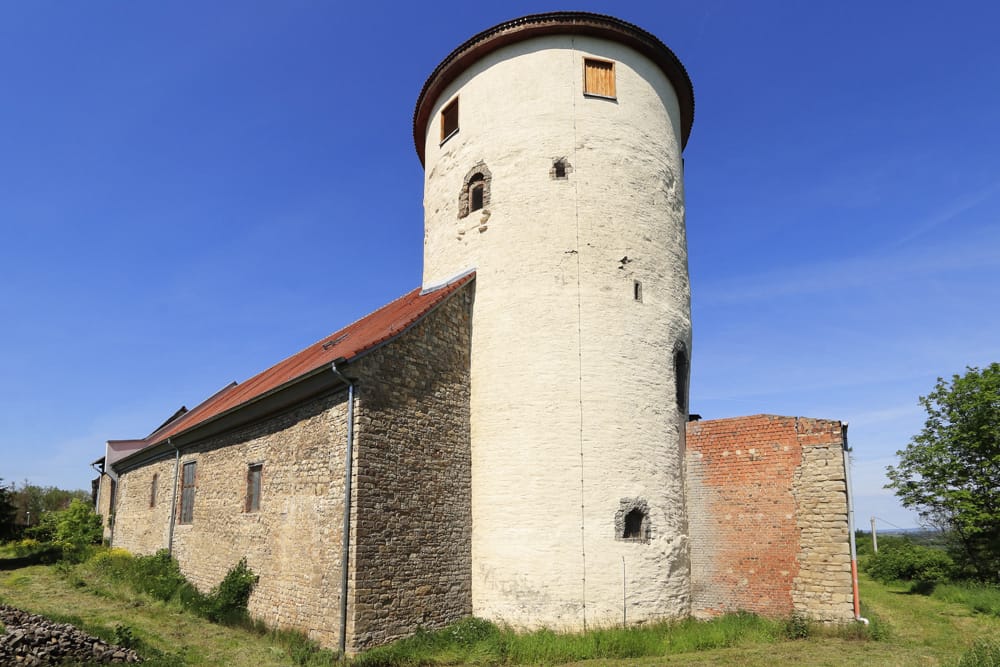
The lower castle contains the first keep, a round tower built during the first half of the twelfth century. Its massive masonry and simple rounded-arch Romanesque details indicate this date. The tower has walls about three metres thick, an internal diameter of approximately four metres, and an external masonry casing 1.3 metres thick that belongs to a later strengthening phase. It survives to a height of 16 metres.
Wall and residential remains
Parts of the lower castle’s curtain wall, an enclosing defensive wall joining fortified structures, also survive from the period of the Stade margraves. The basement of a residential building remains in the southeast, while a building north of the first keep has unusually thick walls and was probably used as a residence.
Second keep
The lower castle’s large second keep was demolished around 1900. Its removal forms part of the modern alteration of the castle complex, alongside the repeated remodeling of the agricultural buildings during domain administration.
Upper castle
Third keep
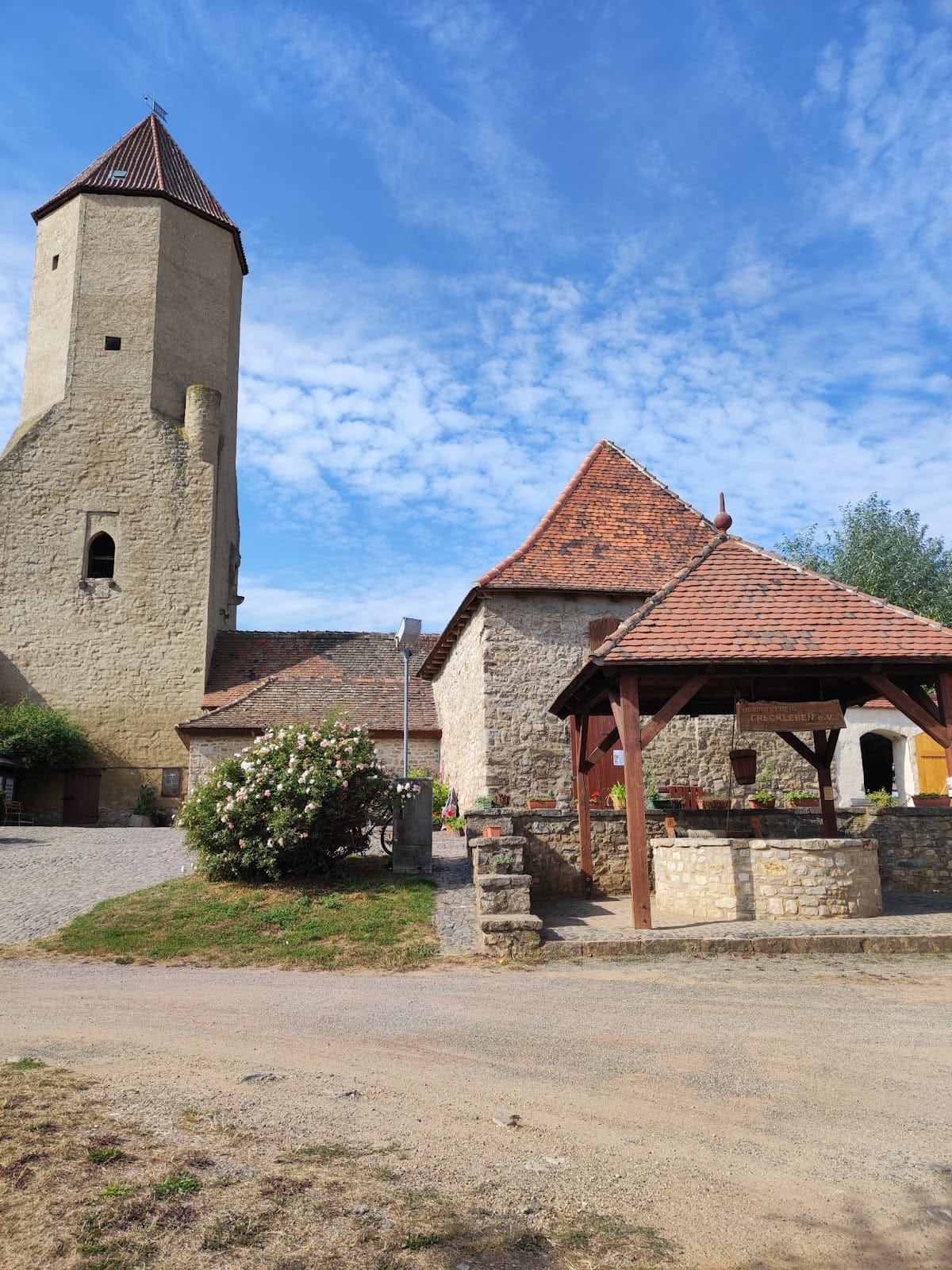
The third keep was built around 1200. Its lower four storeys have a rectangular plan, while the fourth upper storey changes to an octagonal shape. The third and fourth upper storeys contain a fireplace and a projecting enclosed medieval latrine, known as a garderobe. These arrangements indicate that the upper levels were designed for residential use as well as defense.
The outward-facing elevations of the third and fourth upper storeys contain Romanesque paired windows. Its elevated entrance has an abutment for a drawbridge, showing that the approach was connected with a building on the opposite side.
Courtyard buildings
Other buildings in the upper castle were also erected around 1200. The courtyard was probably built up on all sides, and the arrangement of the keep entrance required an opposing building. The surviving Romanesque castle fabric therefore includes the third keep together with associated structures forming the upper-castle enclosure.
Surviving construction details
The principal surviving remains consist of the earthworks, sections of the curtain wall, the first and third keeps, and Romanesque castle buildings. The upper two storeys of the third keep contain spiral spindle ladders, which have been described as unique in Germany.