Kamýk Castle: A Gothic Royal Stronghold in Czechia

Site at a Glance
- Rating
- 4.4
- Popularity
- Low
- Country
- Czechia
- Primary era
- Medieval
- External website
- Open
- Eras represented
- Medieval, Early Modern
- Civilizations
- Holy Roman Empire, Kingdom of Bohemia
- Site type
- Military
- Remains
- Castle
On this page9 sections
History
Kamýk Castle is a Gothic castle ruin in Czechia, built at the beginning of the fourteenth century on a rocky spur above the village of Kamýk in northern Bohemia. King John of Luxembourg ordered its construction, and the stronghold was first documented in 1319, when the king granted it to Jindřich of Kamýk as a hereditary fief, a holding passed through inheritance in return for continuing obligations to the ruler.
Royal foundation and the Elbe route
Jindřich held Kamýk until 1347. His descendants, the Kamýcký family of Pokratice, later lost their claim and moved to Pokratice. The castle then returned to John’s son and successor, King Charles IV, who granted it in fief in 1352 to Zbyněk Zajíc of Hazmburk as compensation for a debt.
The castle’s foundation was probably connected with collecting tolls from shipping on the Elbe. Together with nearby Střekov Castle, it apparently supported royal authority over the river route. Its holders owed military and other feudal service to the king, linking the stronghold’s local administration with the interests of the Bohemian Crown.
Conflict, rebuilding, and abandonment
Kamýk passed among several noble families and remained with Jan Jiří Kamýcký of Lstiboř until 1628. During the Hussite Wars, fifteenth-century religious and political conflicts in Bohemia associated with the reform movement founded by Jan Hus, the surrounding area was devastated in 1428. That same year, forces led by Zikmund Děčínský of Vartenberk, Jan Smiřický of Smiřice, and members of the Zajíc family captured the castle by stratagem. It ultimately passed to Mikuláš Zajíc of Hazmburk, its lawful owner.
In 1547, Vilém Kamýcký of Lstiboř directed repairs and an enlargement that reshaped the residence. New residential buildings were set against the enclosing wall, and a palace was created at the foot of the central castle rock. The castle was abandoned in 1600.
Saxon forces plundered Kamýk in 1632 during the Thirty Years’ War, the major European conflict of 1618 to 1648. After this attack, the castle definitively fell into ruin, and by about 1650 it was already described as abandoned or derelict. The ruins burned twice more in the early nineteenth century.
Conservation and historical memory
Initial conservation work took place around 1885 in preparation for a planned reconstruction. Kamýk has been protected as a cultural monument since 1964.
Remains
Castle structures
Central tower and fortifications
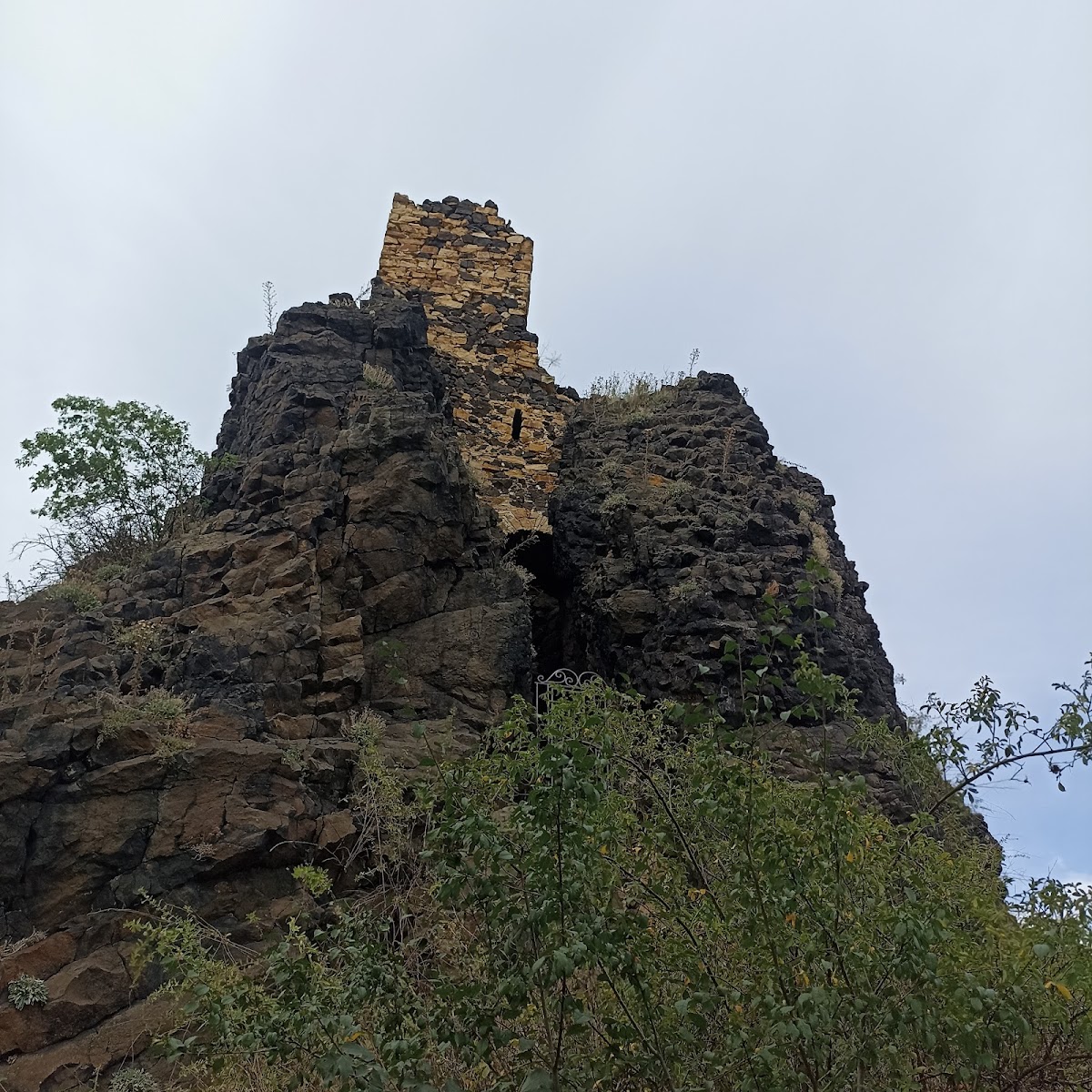
The ruin stands at approximately 350 metres above sea level on a steep, rocky basalt spur in the Bohemian Central Uplands near Litoměřice. The principal medieval structure was a pentagonal residential tower, or donjon, the castle’s main fortified tower combining defensive and residential functions. Built on the summit of the basalt rock, it was enclosed by a castle wall and forecourt fortifications.
Renaissance palace
The rebuilding of 1547 added residential buildings along the enclosing wall and created a new palace at the foot of the central rock. Parts of both the palace and the tower survive. On the southern side, a wall retains fragments of three partly preserved rectangular windows, while only limited remains of the wider castle complex can still be seen.
Ruins in nineteenth-century art
The form of the ruins led to the popular name “steep tooth.” Ernst Ferdinand Oehme depicted Kamýk in a watercolor painted in 1841, measuring 18 by 26.6 centimetres and now held by the Kulturhistorisches Museum Magdeburg. Around 1852, he also painted The Ruin of Kamaik, showing the tower, castle courtyard, surrounding hills, and a bend of the Elbe. The work presented the ruined castle as a Romantic image of transience.