Tyre: A Historic Maritime City and World Heritage Site in Lebanon
Table of Contents



Visitor Information
Google Rating: 4.6
Popularity: Medium
Google Maps: View on Google Maps
Official Website: whc.unesco.org
Country: Lebanon
Civilization: Byzantine, Crusader, Greek, Phoenician, Roman, Venetian
Remains: City

Context
The Tyre World Heritage Site is situated on a coastal peninsula along Lebanon’s southern Mediterranean shore, within the modern city of Tyre. The site occupies a strategic maritime position, originally an island connected to the mainland by natural harbors and later by a man-made causeway. Its location provided direct access to important sea routes and facilitated control over a fertile coastal plain, which supported agricultural settlements and smaller towns in the vicinity. The surrounding landscape includes low-lying plains and nearby hills, offering natural resources that contributed to the city’s economic and strategic development.
Archaeological investigations have documented continuous occupation at Tyre from the Bronze Age through the Roman and early Islamic periods. The site’s long habitation reflects its role as a major urban center and maritime hub in the eastern Mediterranean. Tyre’s setting enabled it to become a focal point for trade, craftsmanship, and cultural exchange across successive empires. While some areas retain well-preserved remains, others have been affected by modern urban expansion, complicating preservation and excavation efforts. Research since the early 20th century has progressively revealed the site’s complex historical layers.
History
Tyre’s extensive history spans over four thousand years, marked by its evolution from a Bronze Age settlement into a prominent Phoenician city-state and later a significant urban center under various imperial dominions. Its strategic maritime location fostered economic prosperity and political influence throughout antiquity. The city’s resilience is evident in its survival through multiple sieges and regime changes, maintaining urban continuity until its gradual decline following the early Islamic period. Each historical phase contributed distinct political, cultural, and architectural developments that shaped Tyre’s identity within the broader eastern Mediterranean context.
Bronze Age and Early History
Archaeological evidence confirms Tyre’s occupation from the third millennium BCE, initially established on an island featuring two natural harbors. Excavations on Al Ma’shook hill and surrounding areas reveal continuous settlement during the Bronze Age, with the city exercising control over a fertile coastal plain and adjacent minor settlements. Tyre is referenced in 14th-century BCE Egyptian sources, including the Amarna Letters and inscriptions from the reigns of Sety I and Ramesses II, underscoring its early diplomatic and commercial significance. The city was renowned for producing a distinctive purple dye derived from murex shells, a luxury commodity associated with royal and elite use. Nearby sites such as Old Tyre (Palaityros) contain Bronze Age tombs and a sanctuary dedicated to Heracles (Melqart), reflecting early religious practices and funerary traditions.
Iron Age and Phoenician Expansion
During the Iron Age, Tyre emerged as the preeminent Phoenician maritime power, surpassing neighboring cities like Sidon. It established a network of prosperous colonies across the Mediterranean, including Kition in Cyprus, Carthage and Utica in North Africa, and Lixus and Gades in the western Mediterranean. The city’s legendary ruler, King Hiram, traditionally dated to the 10th century BCE, is credited with promoting the cult of Melqart and providing materials and expertise for the construction of Solomon’s Temple in Jerusalem. The al-Bass necropolis, dating from the late 10th century BCE, served as Tyre’s principal burial ground during this period, with approximately 320 cremation urns excavated. These urns, often arranged in pairs containing ashes, bones, personal belongings, and drinking vessels, illustrate a funerary custom emphasizing family and social identity while masking social stratification. Tyre’s dominance in maritime commerce was sustained by its control over extensive trade routes and colonial outposts throughout the eastern Mediterranean.
Assyrian Imperial Period
Between the 9th and 7th centuries BCE, Tyre came under the suzerainty of the Neo-Assyrian Empire, paying tribute to rulers such as Tiglath-pileser III and Sennacherib. Despite repeated military campaigns and sieges targeting the city’s mainland territories, the island city itself was never conquered. Assyrian policy favored maintaining Tyre’s commercial networks and extracting tribute rather than direct annexation. Epigraphic evidence indicates that some Tyrian kings, including Ithoba’al I and Lulli (Eulaeus), exercised authority over both Tyre and Sidon, suggesting political consolidation. During this period, Tyre’s influence extended along the Levantine coast from Sarepta in the north to Acre in the south, preserving its role as a key maritime and economic center under Assyrian oversight.
Babylonian and Achaemenid Persian Rule
Following the collapse of Assyria, Tyre fell under Babylonian control. Nebuchadnezzar II besieged the city for thirteen years beginning circa 598 BCE, successfully capturing the mainland but failing to take the island stronghold. The city’s king, Ba’al II, accepted the presence of a Babylonian official at court, and hostages were sent to Babylon, indicating subjugation. The prolonged siege contributed to the loss of Tyre’s western Mediterranean colonies, many of which aligned with Carthage. In 539 BCE, the Achaemenid Persian Empire incorporated Tyre into its domain. Under Persian rule, Tyre contributed valuable resources such as cedar wood for the reconstruction of the Jerusalem Temple. The city’s naval forces formed a significant component of the Persian fleet, with approximately 300 triremes and 50,000 rowers recruited from Phoenician ports. Tyre remained loyal during various revolts, including the Ionian Revolt, and gradually experienced Hellenic cultural influences, exemplified by the adoption of Athenian coinage standards by the mid-4th century BCE.
Hellenistic Period
The siege of Tyre by Alexander the Great in 332 BCE was a pivotal event. After a seven-month siege, Alexander constructed a causeway approximately one kilometer long to connect the island city to the mainland, which subsequently transformed the island into a peninsula through sediment accumulation. The city fell with significant casualties, including the execution of thousands of inhabitants. Alexander repopulated Tyre with Greek settlers and loyal Phoenicians and established a Macedonian garrison, initiating the Hellenistic era. Following Alexander’s death, Tyre was contested by his successors, alternating between Ptolemaic and Seleucid control. The city adopted Greek urban institutions, including magistrates, councils, and assemblies, and was redesigned with characteristic Hellenistic features such as a colonnaded street and the “Square Building.” Tyre sustained its importance as a commercial and cultural center, producing notable intellectuals and hosting festivals. In the 2nd century BCE, Tyre asserted independence from the Seleucids, issuing its own coinage for nearly two centuries.
Roman Conquest and Imperial Period
In 64 BCE, Pompey incorporated Tyre into the Roman sphere, recognizing it as an autonomous ally. The city prospered under Roman administration, particularly through its renowned purple dye industry. Extensive construction projects from the 1st to 3rd centuries CE included a large hippodrome capable of seating approximately 40,000 spectators, public baths, a palaestra for athletic training, a colonnaded Mosaic Road, and the Arch of Hadrian. The al-Bass necropolis expanded considerably during this period, featuring over 40 tomb complexes and at least 825 graves with imported marble sarcophagi adorned with Greek inscriptions and mythological reliefs, reflecting social stratification. Tyre served as the capital of the Roman province Syria Phoenice and was later elevated to colonia status, receiving veterans from the Third Legion Gallica. The city was a center of Greek intellectual life, producing philosophers such as Porphyry and sophists like Hadrian. Christian communities were established by the 1st century CE, with New Testament accounts recording visits by Jesus and Paul. Despite suffering during the civil war of 193/194 CE, Tyre was rewarded by Emperor Septimius Severus with enhanced status and privileges.
Late Antiquity and Byzantine Period
In late antiquity, the al-Bass necropolis expanded further, incorporating a paved main road and a smaller Byzantine arch. Frescoes from circa 440 CE discovered at this sanctuary may represent the earliest known depiction of the Virgin Mary. Two marble-decorated churches were erected in the 5th and early 6th centuries CE, marking the apex of Christian architectural activity in the city. Tyre endured several destructive earthquakes in the 6th century, including the 551 CE Beirut earthquake and tsunami, which destroyed the Great Triumphal Arch. Political instability and warfare during this century weakened the city. The Sasanian king Khosrow II briefly captured Tyre around the transition from the 6th to 7th century CE, but Byzantine control was restored prior to the Muslim conquest.
Early Islamic Period (640–1124 CE)
In 640 CE, Arab forces of the Rashidun Caliphate conquered Tyre, integrating it into the Islamic world. The city functioned as a naval base for the Umayyad caliphs and experienced relative prosperity for approximately five centuries. Arabic gradually replaced Greek as the language of administration. Tyre avoided early Crusader attacks by paying tribute but was unsuccessfully besieged by King Baldwin I in 1111–1112. The city allied with the Seljuk ruler of Damascus and Fatimid forces to repel Crusader advances.
Crusader Period (1124–1291 CE)
Tyre was captured by Crusader forces on 7 July 1124 after a protracted siege involving Frankish and Venetian contingents. The city and its surrounding territory, including the al-Bass area, were divided under the Pactum Warmundi, allocating two-thirds to the royal domain and one-third to autonomous Italian merchant colonies from Genoa, Pisa, and Venice. The Venetians showed particular interest in the silica sands of al-Bass for glass production. The Crusaders constructed the Savior Church on the site of the former hippodrome, commemorating the tradition that Jesus sat on a rock there. Pilgrims left numerous inscriptions on the church walls, attesting to its religious significance during this period.
Mamluk Period (1291–1516 CE)
Following the Mamluk Sultan Al-Ashraf Khalil’s capture of Tyre in 1291, the city’s fortifications were demolished to prevent Crusader reoccupation, precipitating a decline in urban prominence. By the mid-14th century, travelers such as Ibn Battuta described Tyre as largely ruined. Building materials from ancient monuments, including the Roman-Byzantine necropolis, aqueduct, and hippodrome, were repurposed for construction in nearby towns. The aqueduct remained as a solitary vestige of the city’s former infrastructure.
Ottoman Period (1516–1918 CE)
Tyre was incorporated into the Ottoman Empire in 1516 but remained a relatively minor settlement until the early 17th century. The Druze leader Fakhreddine II, appointed Emir, encouraged Shiite and Christian settlement east of Tyre, influencing the city’s demographic composition. French geographers in the 18th century documented the ruins of the aqueduct at al-Bass. By the late 19th century, surveys described the Birket el Bass area as a ruined and dry water reservoir, with early 20th-century maps labeling it a swamp. The city’s ancient monuments suffered neglect amid changing political and social conditions.
Modern Rediscovery and Archaeological Excavations (20th century–present)
In the 1930s, the French Mandate authorities established an Armenian refugee camp at al-Bass, which later became one of the first Palestinian refugee camps after 1948. Large-scale archaeological excavations of the Roman-Byzantine necropolis at al-Bass were conducted from 1957 to 1967 but were interrupted by political unrest. UNESCO designated Tyre and al-Bass as a World Heritage Site in 1984 to protect the area from urban encroachment and conflict damage. Spanish-led excavations between 1997 and 2008 uncovered extensive Phoenician cremation graves. The site sustained damage during the 2006 Lebanon War, including to Roman funerary frescoes. Conservation efforts continue amid challenges posed by urban development, looting, and regional instability.
Daily Life and Importance by Period
Iron Age and Phoenician Expansion
During the Iron Age, Tyre’s population was predominantly of Canaanite-Phoenician origin, organized around a mercantile elite controlling extensive maritime trade networks. Artisans specialized in industries such as purple dye production, glassmaking, and shipbuilding. Social structures were likely patriarchal, with elite men occupying political and religious offices, while women’s roles, though less documented, may have included domestic management and participation in cultic activities. Economic life centered on maritime commerce and craft production, with large-scale manufacture of Tyrian purple dye near the harbors. Archaeological evidence from the al-Bass necropolis reveals cremation burial customs involving paired urns containing ashes, bones, and personal items, reflecting familial and social identities. Religious life focused on the cult of Melqart, with temples serving as centers for civic rituals and festivals. The city’s political organization included kingship and priesthood, with rulers such as King Hiram documented in inscriptions.
Assyrian Imperial Period
Under Assyrian suzerainty, Tyre retained much of its Phoenician character and autonomy, with a population still predominantly Phoenician but subject to tribute obligations. The city’s social hierarchy centered on a royal house and merchant elite, while mainland territories experienced disruption. Inscriptions attest to kings such as Ithoba’al I and Lulli/Eulaeus, who sometimes ruled both Tyre and Sidon, indicating political consolidation. Economic activities continued to focus on maritime trade, with exports including purple dye, timber, and manufactured goods. Assyrian policy allowed workshops and shipyards to operate, sustaining commercial vitality. Religious practices remained centered on Melqart and other Phoenician deities, with no significant interruption in cultic life.
Babylonian and Achaemenid Persian Rule
The Babylonian siege and subsequent Persian conquest brought administrative changes but continuity in daily life and economy. The population remained largely Phoenician, though Babylonian and Persian officials introduced new cultural influences. The acceptance of Babylonian officials and hostages suggests a social hierarchy balancing local autonomy with imperial oversight. Under Persian rule, Tyre contributed naval forces to the imperial fleet, reflecting maritime expertise. Production of purple dye and timber exports continued alongside agriculture. Greek cultural influences increased, including adoption of Athenian coinage standards. Diet and clothing reflected Mediterranean norms, with staples such as bread, olives, fish, and wine. Religious life saw gradual Hellenization alongside traditional Phoenician cults.
Hellenistic Period
Following Alexander’s conquest, Tyre’s population became culturally diverse, including Greek settlers, loyal Phoenicians, and Macedonian military personnel. Civic organization adopted Greek models, with magistrates, councils, and assemblies documented epigraphically. Economic life diversified, maintaining maritime trade and incorporating coin minting and public festivals. Urban infrastructure was remodeled with Greek features such as colonnaded streets and public buildings like the “Square Building.” Domestic interiors featured mosaic floors and painted walls, indicating increased wealth and Hellenistic artistic influence. Religious practices blended Phoenician and Greek traditions, with Melqart syncretized with Heracles and new cults introduced. The city fostered a vibrant cultural scene, hosting intellectuals and poets.
Roman Conquest and Imperial Period
Under Roman rule, Tyre flourished as a colonia and provincial capital, with a population comprising Roman settlers, local Phoenicians, and veterans. Social stratification became more pronounced, as evidenced by elaborate marble sarcophagi bearing Greek inscriptions and mythological motifs. Civic officials such as duumviri and magistrates are attested epigraphically. Economic activities expanded with industries including purple dye production, glassmaking innovations, and maritime trade. Public leisure facilities such as baths, a palaestra, and a large hippodrome attest to social life. Domestic architecture featured courtyard houses with mosaic floors and painted walls. Religious life was diverse, encompassing traditional Phoenician cults, Greco-Roman deities, and an established Christian community. Educational and cultural activities thrived, with philosophers and sophists contributing to intellectual life.
Late Antiquity and Byzantine Period
Tyre’s late antique phase was characterized by continuity and Christianization, with a predominantly Greek-speaking Christian population governed by ecclesiastical and civic authorities. The al-Bass necropolis expanded, and marble-decorated churches were constructed. Frescoes from the sanctuary of Apollo include early depictions of the Virgin Mary. Economic life remained tied to maritime trade and agriculture, though seismic events caused infrastructural damage. Domestic spaces retained mosaic decoration and courtyard layouts. Public buildings such as basilicas and paved roads supported communal life. Religious festivals and ecclesiastical instruction became central to social customs. Tyre functioned as a Byzantine provincial center with ecclesiastical prominence despite political instability.
Early Islamic Period (640–1124 CE)
The Arab conquest introduced Islamic administration and Arabic language, while the population remained religiously diverse initially. Islam gradually became dominant, with the city serving as a naval base for the Umayyad caliphs. Social hierarchy included Muslim governors, local elites, and Christian communities maintaining churches and schools. Economic activities continued maritime trade and shipbuilding, though the purple dye industry declined. The abandonment and sand coverage of the al-Bass necropolis reflect changing funerary customs. Domestic architecture adapted to Islamic styles, with courtyard houses and modest decoration. Markets featured goods from across the Islamic world. Religious life centered on mosques and Islamic festivals, with Christian worship persisting in designated quarters.
Crusader Period (1124–1291 CE)
The Crusader conquest introduced a Latin Christian ruling class alongside a diverse population of local Christians, Muslims, and Phoenician descendants. Social structure was stratified, with Frankish nobility, Italian merchant colonies, and local inhabitants. The Pactum Warmundi formalized this division, granting autonomy to merchant communities. Economic life emphasized maritime trade, glassmaking exploiting al-Bass silica sands, and agriculture. Crusader architecture included the Savior Church and fortifications. Diet included Mediterranean staples supplemented by imported European goods. Markets were vibrant, with Italian merchants controlling key commodities. Religious practices centered on Latin Christianity, with pilgrimages evidenced by inscriptions in the Savior Church. The city functioned as a Crusader stronghold and commercial hub.
Mamluk Period (1291–1516 CE)
Following the Mamluk conquest and demolition of fortifications, Tyre’s population declined sharply, with urban elites disappearing and the economy contracting to subsistence activities. Archaeological evidence indicates reuse of building materials from ancient monuments, reflecting economic hardship. Domestic life was modest, with limited architectural development. Markets and transport networks were reduced, focusing on local needs. Tyre’s civic role was minimal, functioning as a minor settlement overshadowed by regional centers.
Ottoman Period (1516–1918 CE)
Under Ottoman rule, Tyre remained a small town with a mixed population including Muslims, Shiites, Christians, and Druze settlers encouraged by local emirs.
Modern Rediscovery and Archaeological Excavations (20th century–present)
The 20th century saw Tyre’s transformation into a site of archaeological and humanitarian significance. Refugee camps at al-Bass introduced new demographic dynamics, with Palestinian and Armenian populations engaging in agriculture and artisanal work. Archaeological excavations revealed extensive urban and funerary remains, informing understanding of ancient daily life and civic organization. Conservation efforts have aimed to preserve mosaics, sarcophagi, and monumental structures, while urban development and conflict pose ongoing challenges. Modern inhabitants maintain livelihoods in agriculture, trade, and services, with cultural life influenced by diverse communities. Tyre’s role today combines heritage preservation with contemporary social and economic functions, reflecting its layered history and enduring regional importance.
Remains
Architectural Features
The Tyre World Heritage Site preserves a complex urban landscape with architectural remains spanning from the Bronze Age through the early Islamic period. The city’s original island configuration was altered following Alexander the Great’s siege in 332 BCE, when a causeway was constructed, transforming the island into a peninsula. The site includes a variety of civic, religious, military, and funerary structures, illustrating the city’s multifaceted character. Construction techniques encompass ashlar masonry, sandstone, and local limestone. The city experienced significant expansion during the Hellenistic and Roman periods, with large-scale public buildings and infrastructure. Later periods saw partial abandonment and reuse of materials, particularly during the Mamluk and Ottoman eras. Preservation varies, with some monumental structures substantially intact and others fragmentary or submerged.
Key Buildings and Structures
Roman Baths (City Baths)
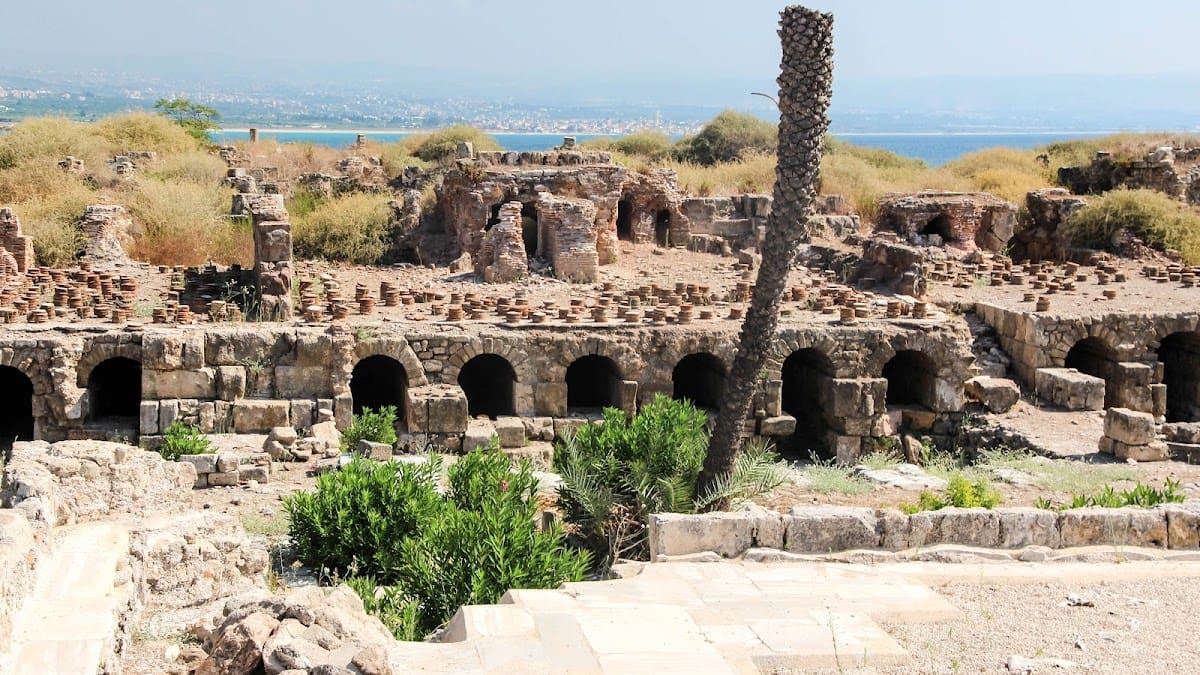
Dating to the 2nd century CE and rebuilt in the 3rd century, the Roman Baths form a substantial complex near the Mosaic Road on the island’s coastal edge. The structure was elevated on arcades to mitigate humid soil conditions, resulting in a notably tall building. The baths incorporated a hypocaust system for underfloor heating, with distinct chambers for cold, tepid, warm, and hot baths. Constructed atop the ancient Phoenician city wall—the sole visible remnant of the fortifications captured by Alexander the Great—the baths include vaulted chambers and raised platforms. Although some areas are fragmentary, the complex demonstrates advanced Roman engineering adapted to local conditions.
Palaestra
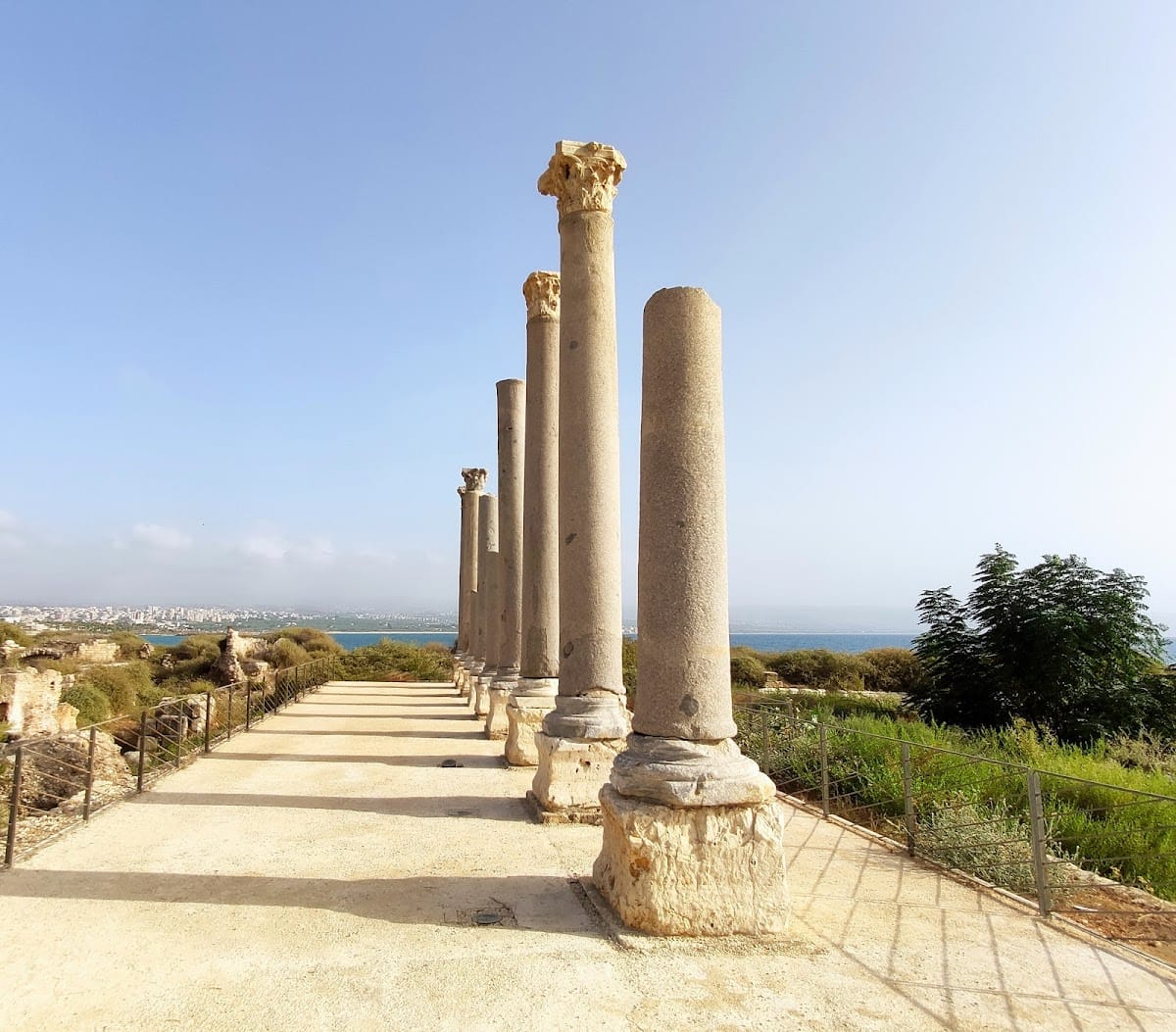
Located immediately south of the City Baths, the palaestra dates to the Roman period and measures approximately 30 by 30 meters, relatively small compared to other Roman palaestrae. Nine Egyptian granite columns remain standing, arranged around a colonnade enclosing a race track smaller than the 100-meter track at Lepcis Magna. Excavations uncovered two parallel sandstone walls beneath the palaestra bearing fire damage, likely associated with destruction during Alexander’s siege in 332 BCE. The layout includes open spaces for athletic training and a surrounding portico, reflecting Roman leisure and physical culture.
Mosaic Road
The Mosaic Road is a monumental colonnaded street constructed in the late 2nd century CE, possibly dedicated to Emperor Septimius Severus following the civil war of 193/194 CE. Unique in the region, both the sidewalks and central passageway are paved with mosaics. The flanking colonnades served functional and decorative purposes. The pavement was renewed during the Byzantine period, indicating continued use. The road facilitated religious processions and served as a principal thoroughfare within the city’s urban core.
Square Building (Rectangular Arena)
This rectangular structure, approximately 45 by 35 meters, lies along the Mosaic Road. Originally built in the Hellenistic period, its current form dates to the 4th century CE. Constructed from local limestone, it features seating on all sides and could accommodate around 2,000 spectators. Its function remains uncertain; it may have served as a council meeting place (prytaneum) or an arena for martial arts. An inscription referencing a successful boxer supports the arena interpretation. The design includes tiered seating and a central open area.
Temple of Melqart
The Temple of Melqart, dedicated to Tyre’s chief deity, was among the city’s most significant sanctuaries. Herodotus noted the temple’s antiquity, estimating it to be approximately 2,300 years old by the 5th century BCE. The temple was richly adorned with votive offerings and featured two notable pillars—one of pure gold and another of emerald stone. Today, structural remains are minimal, limited to a few Egyptian-style columns reused in a Crusader church. The temple’s precise location is uncertain but is believed to be near the Crusader-era church within the city.
Tower of Hiram
Likely constructed in the early 7th century CE during or after the Sasanian invasion, the Tower of Hiram is a fortified military tower situated near the road connecting the mainland to the city, close to the al-Bass cemetery. It protected a freshwater spring accessible via an internal staircase. The adjacent road may have been designed to pass by this well, suggesting the site could have hosted an earlier nymphaeum (a monument dedicated to water). The well remained in use into the early 20th century. The tower’s masonry and defensive features are partially preserved.
Egyptian Harbor
One of Tyre’s two ancient harbors, the Egyptian Harbor lies to the south. Remains of a 750-meter-long mole with a wide central entrance are still visible, along with submerged ruins of ancient buildings. Originally a sandy beach or anchorage, the harbor was expanded and engineered by Tyrian builders. It was likely submerged during the earthquake of 501 CE. Underwater archaeological surveys have documented structural remains, including harbor walls and quay installations.
Glass Makers’ Quarter
Located near the City Baths and Mosaic Road, this industrial zone contains several furnaces used for glass production. The furnaces date to Late Antiquity but likely originated as early as the 4th century BCE. Glass production involved firing a mixture of sand, silt, and other ingredients until liquefied. The area’s proximity to baths and main roads is notable. Archaeological remains include furnace bases, slag deposits, and associated workshop debris.
Aqueduct (Al-Bass Aqueduct)
The aqueduct ran parallel to the main road leading to the city, passing the hippodrome. Its arches formed an arcade opening onto shops along the road. Water sources included springs at Al-Ma’shook, Ras el-Ain, and Al-Rashidiyeh (“Old Tyre”) to the south. The conduit extended just over seven kilometers. Portions of the aqueduct’s arches and channels survive, illustrating the city’s water supply system.
Arch of Hadrian (Al-Bass)
Constructed in the 2nd century CE, likely commemorating Emperor Hadrian’s visit around 130–131 CE, the Arch of Hadrian stands approximately 21 meters tall. Its core is sandstone, originally covered with plaster and painted in various colors. The arch is flanked by smaller pedestrian gates topped by a now-lost wall with niches for statues. Large rooms on both sides served as guard chambers; mosaic remains survive in the northern room. The arch marked the city’s official outer boundary. The road leading from the arch to the Tower of Hiram was repaved during the Byzantine period, with two pavement levels visible near the arch.
Byzantine Arch (Al-Bass)
This smaller arch at the eastern entrance of the al-Bass archaeological site dates to the Byzantine period and has undergone heavy restoration. It marks the easternmost monument of the ancient city and provides access to the main road through the necropolis. The arch’s masonry includes limestone blocks and decorative elements consistent with Byzantine architectural styles.
Hippodrome (Al-Bass)
Built in the 2nd century CE, the hippodrome measures approximately 480 meters in length and 90 meters in width, with a seating capacity of around 40,000 spectators. Primarily used for chariot races, the site includes a central granite obelisk. Luxurious buildings with mosaics and baths for supporters of the Blues (west) and Greens (east) factions flank the arena. The hippodrome also hosted other sports and possibly the Tyrian Games. It was the site of the martyrdom of five Egyptian Christians during the Diocletianic persecution. The remains include seating tiers, mosaic floors, and bath complexes.
Necropolis of El-Bass
The necropolis, located along the main Roman and Byzantine avenue leading into Tyre, contains hundreds of stone and marble sarcophagi from the Roman and Byzantine periods. Many bear Greek inscriptions or trade identifications, such as “wealthy purple dye manufacturer.” Sarcophagi are decorated with frescoes and bas-reliefs depicting Homeric scenes and other motifs. The northern section includes a Phoenician cremation cemetery dating to the Iron Age (9th century BCE), with about 320 urns excavated over 500 square meters. The Roman necropolis expanded between the 1st and 4th centuries CE, comprising over 40 tomb complexes, at least 825 graves, and remains of nearly 4,000 individuals. Marble sarcophagi were imported from Greece and Asia Minor. The necropolis extended over a kilometer along the road leading to the triumphal arch. Burial practices shifted from egalitarian Phoenician customs to Roman displays of socioeconomic status. During the Byzantine period, the necropolis further expanded, including construction of a 400-meter-long, 4.5-meter-wide limestone-paved main road. Two churches with marble decorations were built in the 5th and early 6th centuries CE near the Apollo shrine. The Great Triumphal Arch was destroyed in the 551 CE earthquake and tsunami. The necropolis was abandoned in the 7th century CE and subsequently covered by sand dunes.
Apollo Shrine (near El-Bass)
The sanctuary dedicated to Apollo, constructed possibly at the end of the Hellenistic era or early 1st century CE, is the oldest monument at the El-Bass site. A fresco dated to 440 CE was found at the entrance, which may represent the earliest known image of the Virgin Mary worldwide. The shrine’s masonry includes limestone blocks and decorative elements consistent with late Hellenistic and early Roman religious architecture.
Cathedral (Crusader Period)
Built in 1127 CE by the Venetians on the former island, the Crusader cathedral is located within the town site of Tyre. Partial remains survive alongside some walls of the ancient Crusader castle. The cathedral’s masonry includes reused ancient columns and stones, reflecting the reuse of earlier materials. The structure’s layout and surviving walls indicate a basilica plan typical of Crusader ecclesiastical architecture.
City Walls and Crusader Castle
Remnants of the medieval fortifications, including parts of the Crusader castle walls, remain visible on the former island. The castle formed part of the city’s defensive system during the Crusader period. The masonry includes large ashlar blocks and defensive towers, though much of the structure is fragmentary.
Other Remains
Cisterns used for water storage on the island predate Alexander the Great’s dam and the aqueduct. These cisterns collected rainwater during winter and were supplemented by water brought by boat. They remained in use through the 12th century CE, as noted by the Andalusian Muslim pilgrim Ibn Jubayr, and were utilized by Crusaders until the city’s capture in 1291 CE. Surface traces and submerged remains of ancient buildings are visible in the Egyptian Harbor. Two parallel sandstone walls beneath the palaestra show fire damage, likely from Alexander’s siege. Remains of a ruined birket (water reservoir or pool) north of the aqueduct were described as dry in the 19th century. Possible remains of a nymphaeum exist at the site of the Tower of Hiram.
Preservation and Current Status
The preservation of Tyre’s archaeological remains varies considerably. The Roman Baths, Mosaic Road, and sections of the hippodrome retain substantial architectural elements, though some areas are fragmentary. The al-Bass necropolis contains well-preserved sarcophagi and funerary monuments, although many have suffered from looting and environmental degradation. The Arch of Hadrian and Byzantine Arch have undergone restoration, with modern materials used to stabilize structures. Damage sustained during the Lebanese Civil War and the 2006 Lebanon War affected frescoes and other delicate features. Urban development poses ongoing threats, particularly in less visible areas. Conservation efforts continue under local and international heritage authorities, focusing on stabilization, documentation, and protection against looting and erosion. Some areas remain stabilized but not fully restored, preserving the ruins in situ.
Nearby sites