Toron: A Crusader Fortress and Lordship in Lebanon


Site at a Glance
- Rating
- 4.3
- Popularity
- Low
- Country
- Lebanon
- Primary era
- Early Modern
- Eras represented
- Medieval, Early Modern
- Civilizations
- Crusader, Kingdom of Jerusalem, Ottoman
- Site type
- Military
- Remains
- Castle
On this page13 sections
History
Toron is a Crusader fortress in Lebanon, located at Tebnine, that was built by Hugh of Falkenberg in 1106 during the campaign against Fatimid-held Tyre. Occupying a strategic route between Tyre and Damascus, it became the center of the Lordship of Toron, a subordinate feudal domain within the Principality of Galilee and the Kingdom of Jerusalem, the Crusader state established in the Levant after the First Crusade.
Foundation and the Lordship of Toron
Hugh of Falkenberg, also known as Hugh of Saint-Omer, established the fortress to support the Crusader conquest of Tyre. After his death in 1106, Izz al-Mulk attacked the surrounding population, killing inhabitants and taking booty. By 1109, Toron had become an independent lordship and was granted to Humphrey I.
The lordship then passed through Humphrey II and Humphrey IV. Humphrey II inherited Banias through his marriage to the daughter of Rainier Brus, lord of Banias and Assebebe. From about 1148, Banias and Toron were united until Nur al-Din Zangi, the emir of Damascus, captured Banias on 18 November 1164.
Territorial connections and military orders
In 1157, Humphrey II transferred part of Banias and the fortress of Chastel-Neuf to the Hospitallers, a Latin Christian military-religious order that administered fortified sites in the Crusader states. After Banias was recovered, it became part of the lordship of Joscelin III. Toron’s dependent lordships also included Maron. Chastel-Neuf, built by Hugh of Falkenberg around 1105, was captured by Nur al-Din in 1167, while Maron was transferred to the Teutonic Knights in 1229 in exchange for their claims to Toron.
Humphrey II held the office of constable of Jerusalem. Humphrey IV married Isabella, daughter of King Amalric I, and Toron entered the royal domain during their marriage. After their divorce, the lordship was restored to Humphrey IV. Toron was notable for passing directly through the male line for several generations. Its rulers were also connected with the Lordship of Transjordan through Humphrey III’s marriage to its heiress and through Humphrey IV’s maternal inheritance.
Conquest and destruction
Toron remained under Crusader control until 1187, when Saladin’s forces captured it after the Battle of Hattin. German Crusaders besieged the fortress in November 1197, but its Muslim garrison resisted until relief arrived from Egypt. The fortress later became part of the royal domain of Tyre, which passed to the princes of Antioch and then to their Montfort heirs.
In 1219, al-Mu’azzam, the emir of Damascus, dismantled the defenses of Toron, Safad, and Hunin. He feared that fortified places in Palestine might be returned to the Crusaders in exchange for Damietta, the Egyptian port captured by the Fifth Crusade and used to threaten Cairo. In 1220, Toron and the surrounding territories, then known as the Lordship of Joscelin, were sold to the Teutonic Order while the region remained under Muslim control. Gerhard von Malberg became the nominal commander of Toron Castle in 1227.
Restoration and the final Crusader period
The treaty concluded in 1229 between Frederick II and Sultan al-Kamil returned Toron, along with Jerusalem, to the Crusaders. The castle was transferred to the Teutonic Order, and restoration began. A dispute followed between the order and Alice of Armenia, the heir of the Lordship of Toron and a niece of Humphrey IV. Alice successfully asserted her rights before the High Court, after which Frederick II restored the lordship to her.
Toron returned to Ayyubid control in 1239, when the truce ended. An agreement between Richard of Cornwall and Sultan al-Salih Ayyub returned it to the Crusaders in 1241. The fortress withstood an attack by Khwarazmian forces in 1244, although Jerusalem fell to the same forces. Toron then faced intermittent pressure and siege until Baybars captured it in 1266. The Crusader garrison was permitted to surrender and withdraw toward the coast.
Later rebuilding and modern history
The fortress was repeatedly destroyed and rebuilt because of its strategic position. After the Mamluks destroyed the medieval castle in 1266, Shiite sheikh Nasif al-Nassar rebuilt a later fortress in the mid-eighteenth century during his opposition to Ottoman rule. The surviving enclosure was also shaped by Dahir al-Umar, pasha of Acre, who rebelled against the Ottoman Empire.
Chabib Pasha al-Assaad was born in Tibnine in 1852, and the al-Assaad family residence occupied the center of the medieval ruins. Toron ceased to be a center of political power after Chabib Pasha al-Assaad moved to Sidon; he died in 1917. Napoleon’s army sacked the fortress in 1804. Vichy French forces occupied it in 1940, and a British army battalion arrived the following year and held it until Lebanon became independent in 1943. In 1978, the first Irish soldiers deployed to the region after United Nations Security Council Resolutions 425 and 426 held a medal ceremony on the roof of the western tower. In 2026, Toron was inscribed as part of the Castles of Mount Amel on both the World Heritage List and the List of World Heritage in Danger.
Remains
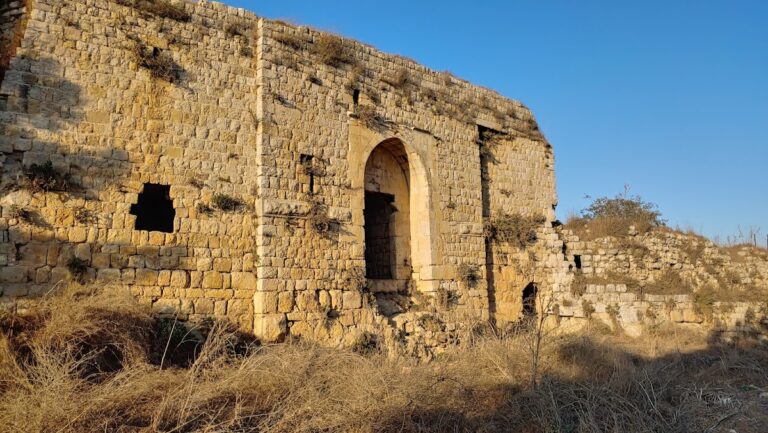
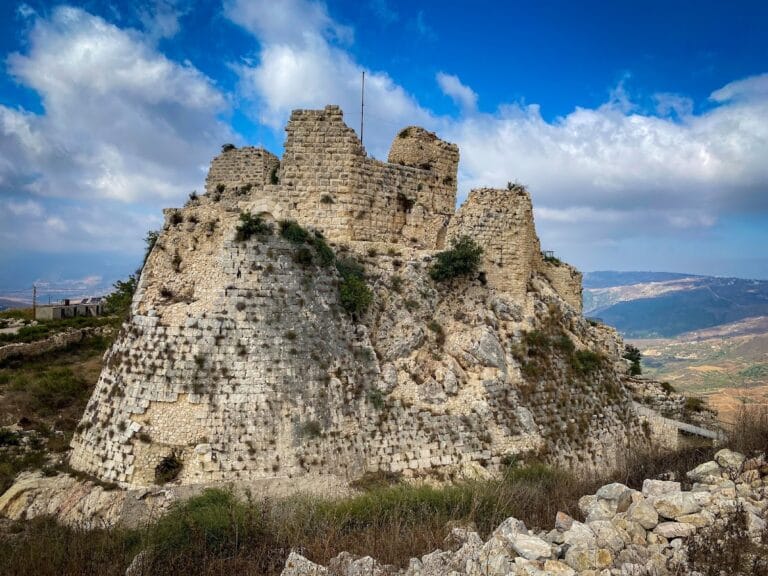
Toron stands on a steep hill north of Tebnine at an elevation of about 725 meters above sea level. The hill is a tell, a mound formed by accumulated remains of successive settlements, dating to the Bronze Age. The medieval fortress followed the contours of this mound in an oval plan. Its present appearance is predominantly that of the later Ottoman-period structure, while only foundations and several courses of large masonry blocks survive from the original Crusader castle.
Medieval fortress layout
Defensive enclosure and towers
The medieval castle had twelve rectangular towers arranged around its oval enclosure. The southern tower served as the donjon, the principal fortified tower of a medieval castle. Later rebuilding used the surviving medieval walls as the basis for new fortifications, preserving the connection between the earlier defensive plan and the structure visible today.
Water supply and chapel
A water-supply installation known as a berquil stood outside the enceinte, the enclosing defensive wall or fortified perimeter. Inside the fortress was a chapel dedicated to the Virgin. These installations formed part of the castle’s medieval functional layout, alongside its defensive towers and enclosure.
Later fortress and furnishings
Ottoman-period enclosure
The later fortress has an enclosure flanked by square and semicircular structures. Built and altered after the destruction of the Crusader castle, it reflects the mid-eighteenth-century rebuilding associated with Nasif al-Nassar and the work of Dahir al-Umar. The al-Assaad clan later used the fortress, and in 1881 it served as the residence of the local Ottoman governor, with about twenty Muslims living there.
Marble lions
Two chained marble lions once guarded the main entrance. They remained there until 1921, although their date and connection with the successive ruling groups are unknown. They later disappeared and were probably removed and sold by local inhabitants.
Toron’s position on the hill allowed it to overlook extensive areas of the surrounding terrain. This strategic setting contributed to the fortress’s repeated use by different armies and to the successive destruction, rebuilding, and alteration of its physical fabric.