Roman Forum of Beirut: Civic Center of Roman Berytus


Site at a Glance
- Rating
- 4.2
- Popularity
- Very Low
- Country
- Lebanon
- Primary era
- Classical
- Eras represented
- Classical
- Civilizations
- Roman
- Site type
- Civic
- Remains
- Forum
On this page12 sections
History
The Roman Forum of Beirut was the principal civic and public space of Roman Berytus in Lebanon, a major Roman urban center in the eastern Mediterranean. Its colonnades and decorated façades expressed the city’s prosperity and public authority during the Roman period. The complex brought together religious, administrative, and communal functions within the center of the ancient city.
Roman Berytus and the Forum
The forum stood near present-day Place de l’Etoile. Its urban arrangement included a temple precinct at the southern limit, a civic basilica on the northern side, and a large bath complex farther north. A theatre and a large hippodrome also occupied the surrounding urban area. The forum was connected to the regular street plan of Berytus, although the city’s rectangular layout had to be adjusted to the uneven rocky ground.
The Cardo Maximus, the principal north-south street in a Roman city plan, ran through Berytus and formed part of the forum’s wider urban setting. Its later identification helped clarify the arrangement of Roman Beirut and the relationship between the forum and the city’s principal streets.
Earthquake, Continued Use, and Later Change
The earthquake of 551 damaged Berytus severely. The forum’s public buildings were only partly restored afterward. The city itself continued to exist, but its remaining population did not have the resources to rebuild the monuments fully. Part of the bath complex associated with the forum remained in service until the tenth century.
The pavement of the Cardo Maximus continued to be used through Souk al-Najjarin until 1934. It was then removed to create the star-shaped plan of Etoile Square, changing the physical arrangement of the area above the ancient street.
Excavation and Preservation
Parts of the forum were uncovered in the 1940s. Excavations carried out during the construction of parliamentary offices in 1994 exposed the northern façade of a Roman public building, including marble-clad arched niches. The discovery established the presence of the forum in this area.
In the early 1970s, the clock tower at the center of Etoile Square was dismantled to allow archaeological investigation. Roman columns were found beneath it and remained intact below ground. The clock tower was reconstructed in 1998 during Beirut’s post-war rebuilding. Excavations and studies by the French archaeologist Jean Lauffray further identified major elements of Roman Berytus’s urban plan. The remains of the forum and nearby Roman monuments later became part of debates about the preservation of Beirut’s archaeological heritage.
Remains
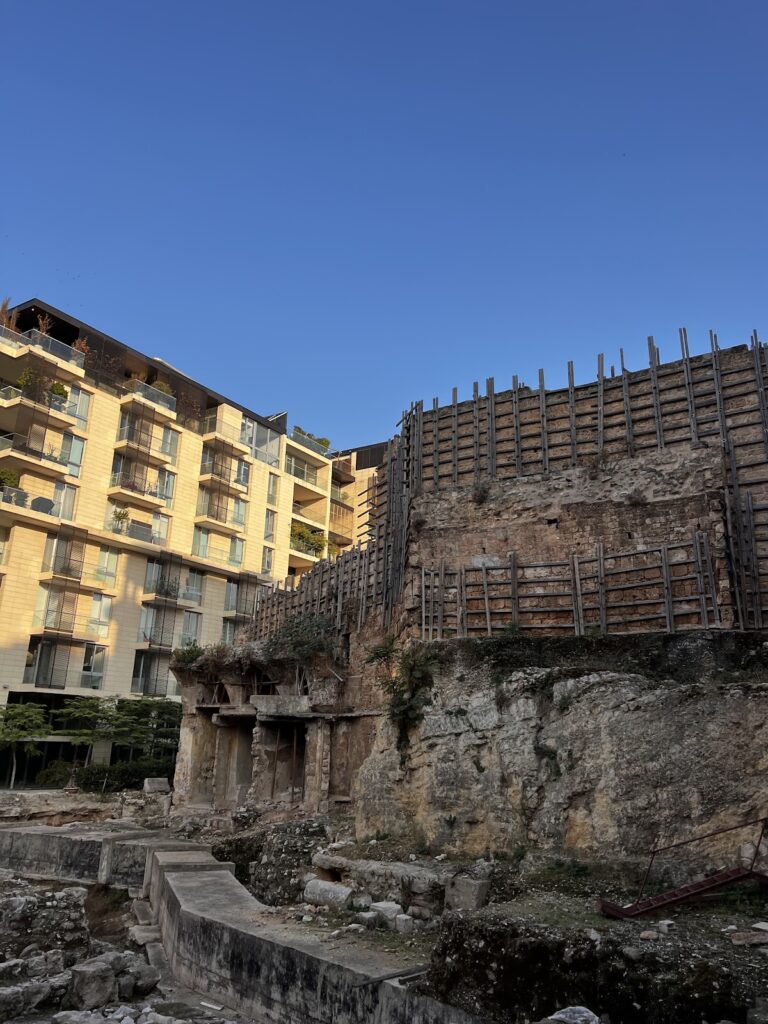
The surviving remains represent an urban complex arranged around colonnaded public buildings, a temple courtyard, a civic basilica, a major north-south street, and a bath complex. Marble decoration, granite columns, and buildings adapted to exposed rock reveal how Roman construction was fitted to the irregular terrain of Beirut.
Forum Buildings
Temple Precinct and Civic Basilica
A temple courtyard marked the southern end of the forum. On its northern side stood the civic basilica, a public building approximately 99 metres long. Its Corinthian portico, a colonnaded porch with capitals decorated with acanthus-leaf motifs, was made from polychrome materials. Columns and a fine frieze from the basilica have been reconstructed opposite the National Museum of Beirut.
Northern Public Building
The northern public building had a façade decorated with arched niches faced in marble. Its surviving architectural elements, together with excavated colonnades and other decorated façades, convey the monumental treatment of the forum’s public spaces. The façade was uncovered during work connected with the parliamentary offices.
Street and Bath Complex
Cardo Maximus
The colonnaded Cardo Maximus crossed Roman Berytus along a south-north axis. Ancient granite columns have been re-erected at the presumed crossing of the city’s two principal streets, near the forum. The street’s pavement also survived in later use through Souk al-Najjarin before its removal in 1934.
Roman Baths
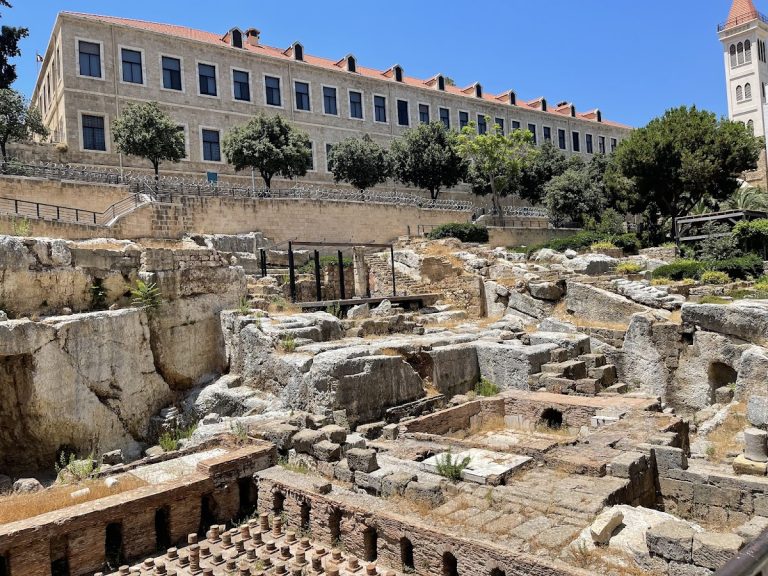
The Roman baths behind the Parliament Building were partly excavated into the rock. Their surviving arrangement included hot, tepid, and cold halls, along with a heating system. The cold section contained a natatio, a shallow pool associated with the cold room, or frigidarium. The pool was faced with marble. The bath complex was preserved within a small archaeological area established during the 1990s, and later redevelopment revealed additional Roman architectural remains.
Columns Beneath Etoile Square
Roman columns remain beneath the clock tower in Etoile Square. They were exposed when the earlier tower was dismantled for archaeological investigation and were left intact when the tower was re-erected above them in 1998. Together with the forum remains and the bath installations, they preserve parts of the Roman city beneath the modern center of Beirut.