Strechau Castle: A Historic Fortress and Residence in Austria

Visitor Information
Google Rating: 4.7
Popularity: Low
Google Maps: View on Google Maps
Official Website: www.burg-strechau.at
Country: Austria
Civilization: Unclassified
Remains: Military

History
Strechau Castle is located in the municipality of Lassing bei Selzthal, Austria. It was originally built by medieval Europeans during the High Middle Ages as a fortified stronghold controlling the surrounding landscape.
The earliest fortification dates back to the latter half of the 11th century, when a single tower was constructed atop the Burgberg, or castle hill. This initial structure provided a defensive lookout and stronghold for the local nobility. From around 1120, the “von Strechau” family, also known by their other names “von Winklern” or “von Ennstal,” took on the role of burgraves, serving as castle keepers and administrators.
In the early 13th century, ownership passed to Rudolf and Konrad von Trenstein, two brothers who held the castle as a fief under the Archbishop of Salzburg. This reflected the common medieval practice of granting land and castles in exchange for loyalty and services to powerful ecclesiastical authorities.
By 1282, control of the castle shifted to Duke Albrecht I. The duke entrusted its administration to the Abbot of Admont, turning the castle into a ducal possession managed by the church. Throughout the 14th and early 15th centuries, the castle changed hands multiple times, reflecting the turbulent political landscape of the region.
In 1528, the Mosheim family sold the castle to Hanns Hofmann von Grünbühel. Under Hofmann’s ownership, the castle became a center for Protestant influence. He appointed Protestant preachers from Nuremberg and undertook significant renovations including the addition of a Renaissance-style arcade courtyard and mannerist ceiling paintings in the Protestant chapel, showcasing the religious and cultural shifts of the period.
During the Counter-Reformation, an effort by the Catholic Church to regain dominance, the last Hofmann owner, Anna Potentiana Jörger, was compelled to sell Strechau Castle to the Admont Abbey under Abbot Urban Weber, also known as Textor. Between 1629 and 1892, the abbey expanded and adapted the castle significantly, adding functional buildings such as a large granary and stables, as well as representative spaces including a grand hall decorated in the Baroque style and a Catholic chapel dated to around 1650.
In the 19th century, following the disruptions caused by French occupations, the castle was modified by Anton Stary, the administrator for Admont Abbey, to serve Archduke Johann as a personal and representative residence. It was here that Archduke Johann met Anna Plochl, his future wife, and he planned their wedding celebration at the castle, though it was ultimately forbidden by Emperor Franz I.
After the revolutionary year 1848, the castle’s official administration ceased, and it remained neglected for approximately fifty years. In 1892, industrialist Julius Hofmeier acquired the property, undertaking restoration efforts and creating an estate. Through the 20th century, Strechau Castle saw various uses including operation as a National Political Academy (NAPOLA) school between 1938 and 1945, and later as a convalescent home for children.
Since 1978, the site has been recognized as a protected historic monument. Purchased by Harald Boesch, the castle has undergone further renovations. Beginning in 2006, part of the castle has been dedicated to a vintage car exhibition, reflecting its ongoing adaptive use.
Remains
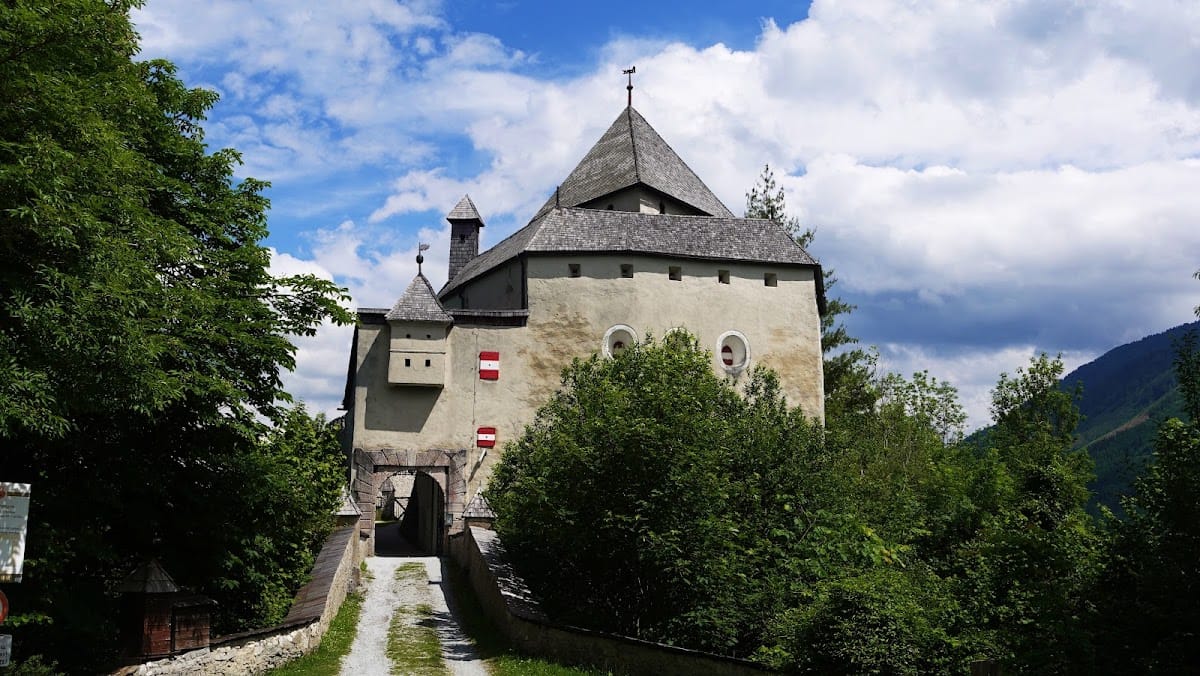
Strechau Castle is arranged around a central courtyard, featuring medieval and Renaissance construction elements that reveal its complex history of adaptation and expansion. The castle’s main entrance stands beneath a gate built into the former bastion, a defensive fortification projecting outward from the main walls. Above this entrance is a projecting oriel, a type of enclosed lookout that would have provided additional defensive advantage. The bastion itself contains three oval openings in the wall, designed to hold cannons—a reflection of early modern military technology integrated into the medieval fortress.
The castle’s roof is covered with wooden shingles and is distinctively decorated with three weather vanes. One of these depicts a witch flying on a broomstick, a unique and symbolic feature that adds character to the silhouette of the building.
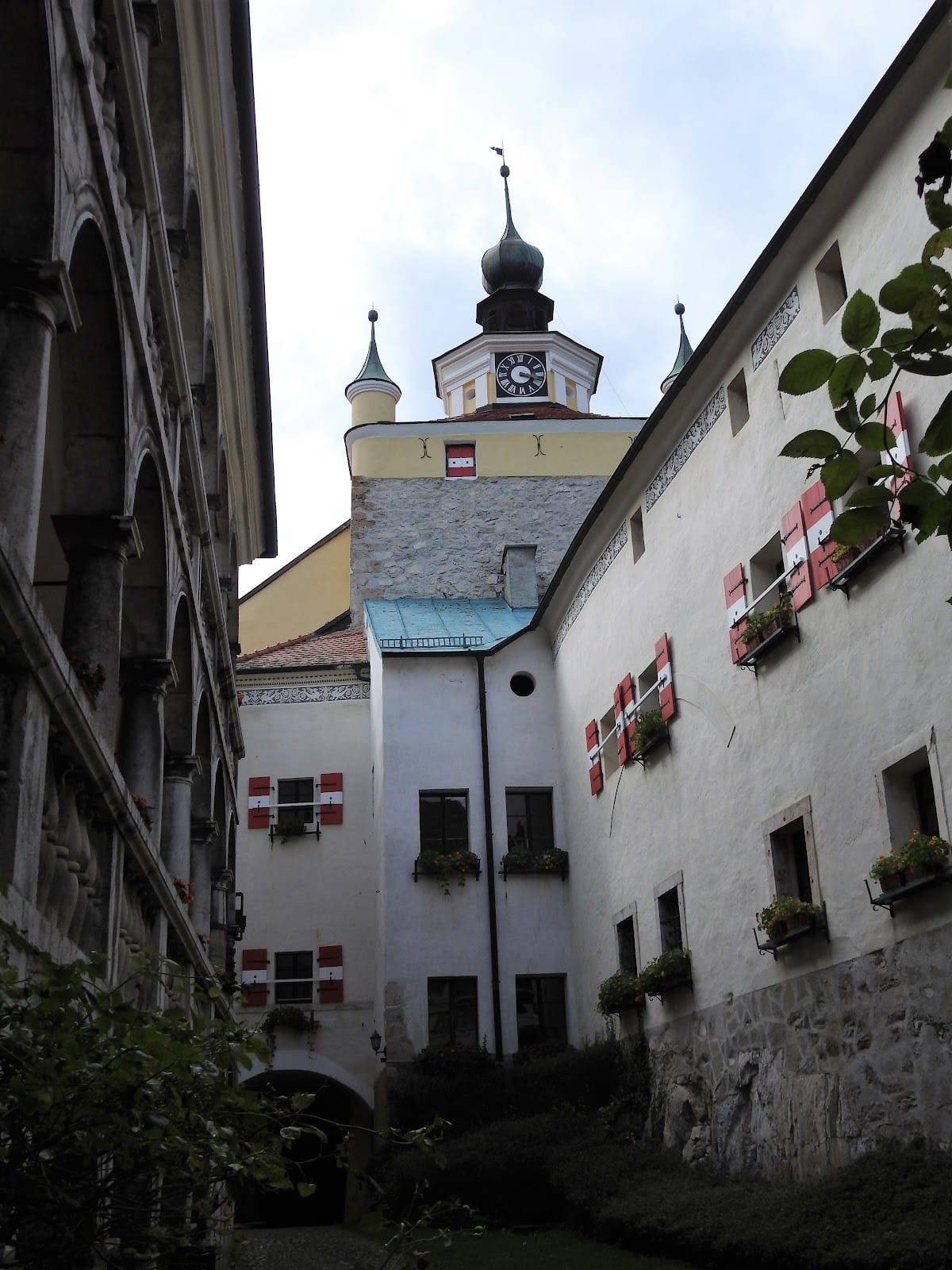
Running along the length of the courtyard are several functional buildings once serving as stables and utility structures. Among these is a powder magazine used for storing gunpowder, as well as the steward’s house, illustrating the castle’s role as an administrative and agricultural hub.
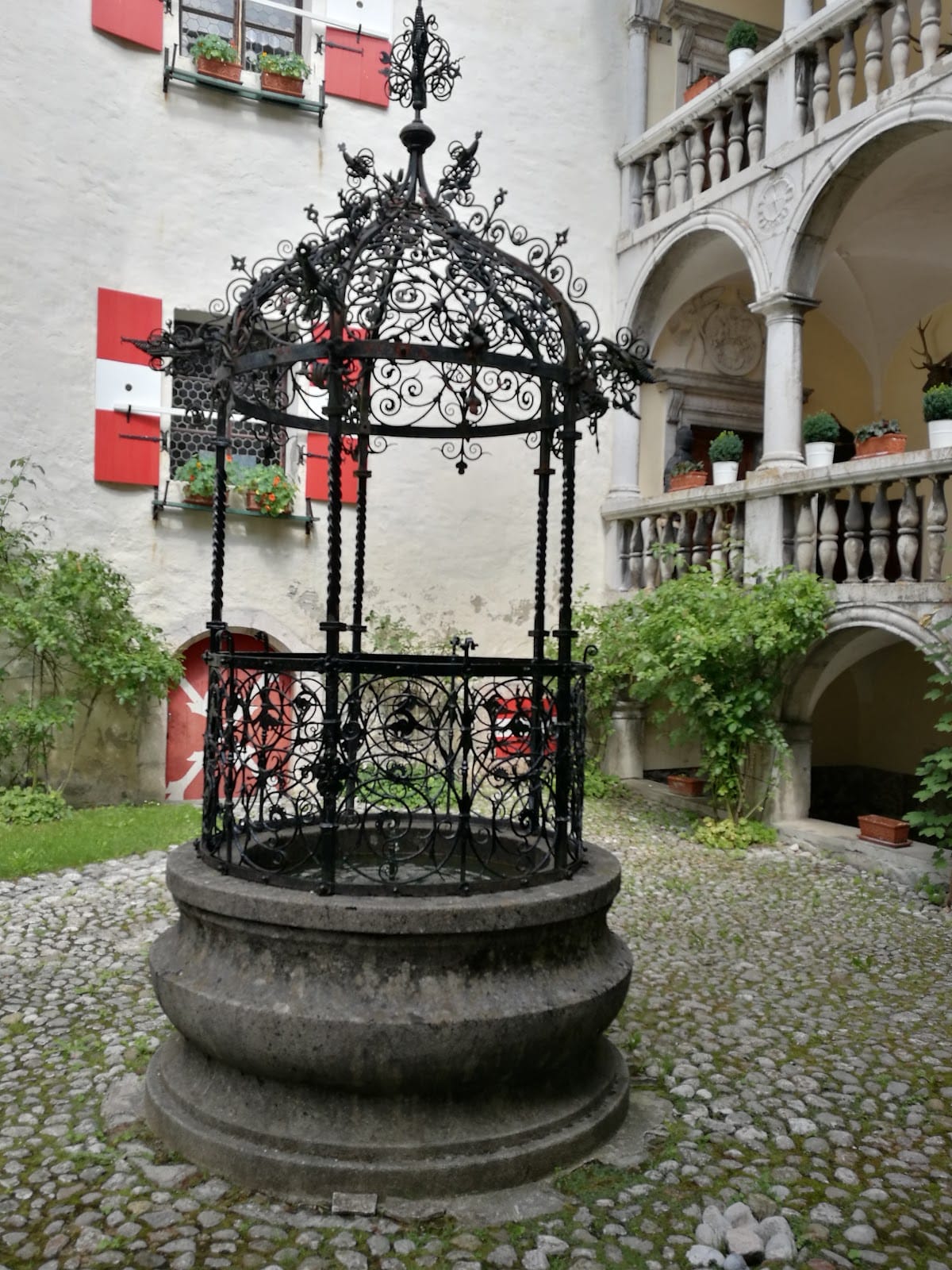
The inner courtyard is particularly notable for its Renaissance architectural elements. On the east and west sides, three-story arcades form elegant galleries supported by columns and decorated with ornamental details. This courtyard layout reflects the stylistic transition of the castle from purely military use to a residence reflecting Renaissance ideals of proportion and decoration.
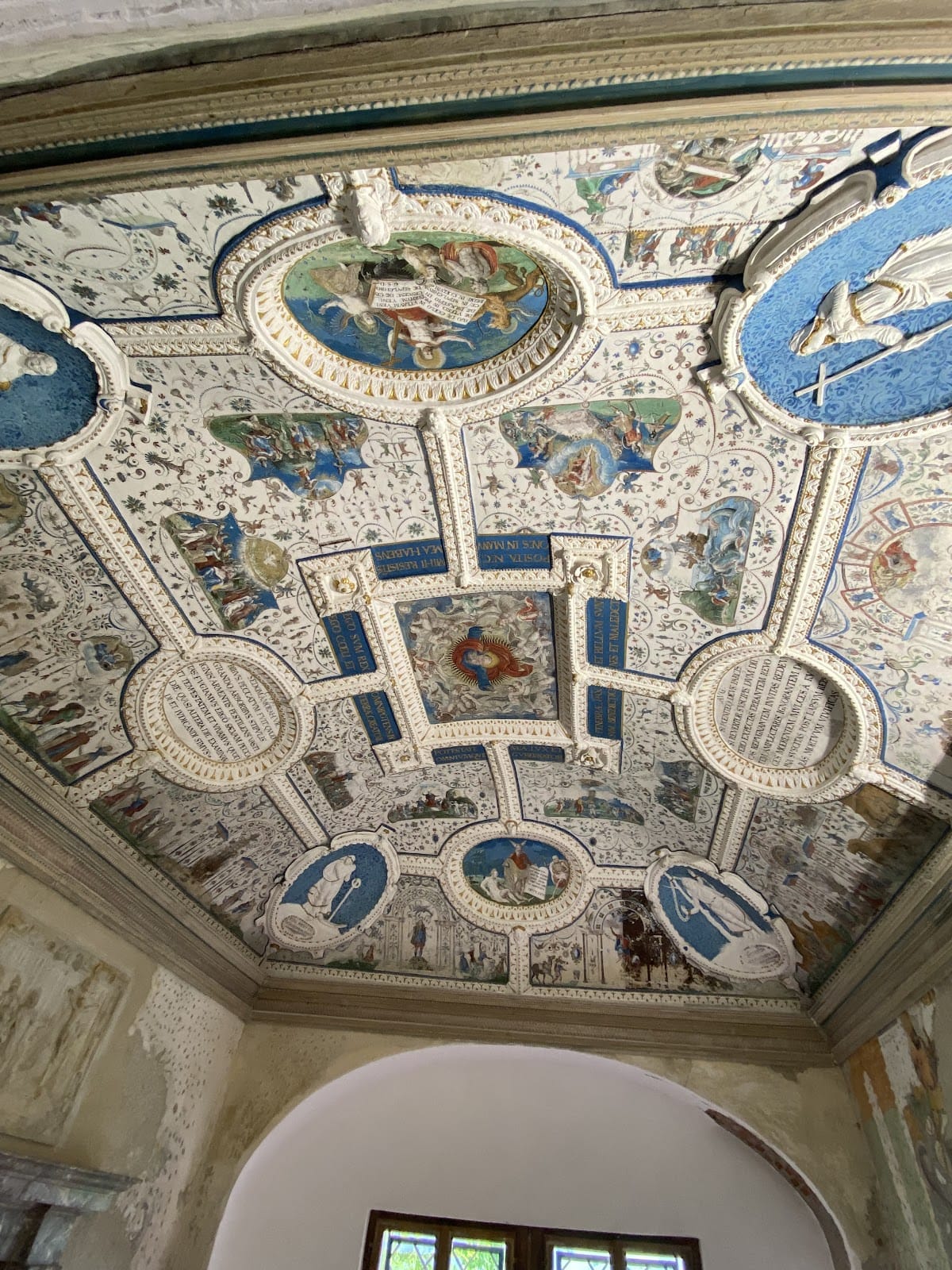
Inside the castle, several rooms retain significant historical decorative programs. The “Kaiserzimmer,” or Emperor’s room, contains a Baroque-style door dated to 1637, demonstrating the influence and status of its occupants during that era. The former Protestant prayer room features ceiling paintings from 1579, illustrating a carefully crafted theological program developed by the Lutheran scholar David Chyträus. These paintings blend religious themes with artistic style from the late Renaissance period.
On the second floor of the east wing is a grand hall with a richly decorated ceiling from 1652. This ceiling blends stucco work with oil paintings that depict scenes from Ovid’s Metamorphoses, an ancient Latin poetic work recounting mythological transformations. Alongside these classical motifs, a Baroque oil painting represents the New Testament parable of the wedding feast (Matthew 22:1–14), integrating religious narrative with the decorative scheme.
The castle’s small Marian chapel, located in the south wing, showcases a four-bay cross-ribbed vault—a structural feature where intersecting ribs provide support to the vaulted ceiling. Its Baroque interior furnishings include an altar attributed to Georg Remele, a sculptor from Admont Abbey, installed in 1637. The altar prominently features a central Madonna and Child statue, flanked by figures of Saint Barbara and Saint Catherine. Above them, carved into the broken pediment, is an image of the Archangel Michael, completing the chapel’s rich iconographic program within a space used for Catholic worship after the Counter-Reformation.
Together, these architectural and artistic elements bear witness to Strechau Castle’s evolution from a medieval defensive tower to a multi-period residence with religious, military, and administrative significance. Many of these features have been preserved or restored, allowing the building to remain a valuable cultural monument.
Nearby sites


