Moha Castle: A Medieval Fortress in Belgium


Site at a Glance
- Rating
- 4.3
- Popularity
- Low
- Country
- Belgium
- Primary era
- Medieval
- External website
- Open
- Eras represented
- Medieval
- Civilizations
- Holy Roman Empire
- Site type
- Military
- Remains
- Castle
On this page10 sections
History
Moha Castle is a fortified medieval castle in Belgium, near the village of Moha in the municipality of Wanze, whose earliest stone defenses were built between the mid-tenth and early eleventh centuries. The fortress occupied a strategic position in a buffer zone between the County of Namur, the County of Huy within the Principality of Liège, and the Duchy of Brabant.
Origins and early lords
The name of Moha appears in several early forms, including Musal, Musac, Muisal, and Musau or Muisau. These forms are probably connected with the Germanic term Musegau, possibly meaning “gau of the moss,” although a link with Mosa, the Meuse, has also been proposed. By the late thirteenth century, the original s had changed to h. Forms such as Mouhaut, Muhin, Monhaut, Mohal, and Mouhal eventually contributed to the Walloon form Mouha and the modern name.
A late medieval chronicle preserves a tradition that, in 692, the land of Abion was granted to Mohelin of Albore, a companion-in-arms of Charles Martel, the eighth-century Frankish political and military leader and grandfather of Charlemagne. The chronicle says that Mohelin built a castle called Mohal and names several counts of Moha during the ninth and tenth centuries. These figures do not appear in official acts, so the tradition remains uncertain.
A more plausible explanation places the creation of the allod of Moha, land held as free property rather than as feudal tenure, in the second half of the tenth century. This was a period when the Carolingian territorial system was fragmenting. The territory may have emerged from the division of the pagus hasbaniensis, a historical county or district, and may have been granted as a benefice, meaning land given as patronage or in return for service. The precise arrangement cannot be established from medieval evidence.
Excavations show that the rocky spur was levelled and enlarged with layers of fill between the mid-tenth and early eleventh centuries. The first known stone defensive structures were built during the same period. The first lord of Moha securely identified in official records was Albert of Musal. A charter said to name him in 1031 was later recognized as a forgery probably based on a document from 1026 to 1028, but Albert appears independently in 1044 and in records from shortly after 1055. He is explicitly called count of Moha only in the latter records. After his death in the 1060s, Albert I of Dasbourg appears as count of Moha in 1067.
The Dasbourg counts
The Dasbourg, or Dabo, family acquired the county through the marriage of Henry I of Dasbourg to Albert of Musal’s daughter. The family originated in Eguisheim and held territories in Lorraine and the Meuse region. Under the early Dasbourg counts, Moha was used largely as a reserve of land for pious donations, which reduced the territorial extent of the county. The counts probably lived at Moha only intermittently, governing it through trusted officials and a small garrison.
Hugh II of Dasbourg sought to preserve greater authority over lands associated with religious institutions by establishing the principle of avouerie. This arrangement gave a lay protector responsibility for defending and representing ecclesiastical property. Hugh also took part in regional feudal conflicts, including the struggle over Bouillon in 1141 and wars in Hesbaye in 1147. These conflicts appear to have encouraged him to reside more frequently at Moha rather than in his Lorraine possessions.
Albert II of Dasbourg, also known as Albert of Dabo-Moha, spent much of his life in the county and aligned his interests with those of his nephew, Henry I of Brabant. Moha served him as a stronghold during conflicts involving Bilsen, Colmont, Berloz, Hainaut, Flanders, and the Namurois, the territory and political sphere associated with Namur. In 1194, after Albert supported Henry the Blind against Baldwin V of Hainaut, his county was devastated by fire. Albert nevertheless remained a threatening presence for neighbouring powers, especially the people of Huy.
Transfer to the Prince-Bishops of Liège
Albert II had no heir at first and donated his county to Henry I of Brabant, later withdrawing the gift for reasons that are unknown. In 1204, he ceded the lordships of Moha and Waleffes to Hugh of Pierrepont, the Prince-Bishop of Liège. A prince-bishop combined episcopal office with territorial political authority. The agreement allowed Albert to retain the use of the county for life. If he died without heirs, the lordship would pass to the Church of Liège; any heirs would hold it as vassals of the bishops of Liège.
Albert regretted the arrangement after the birth of his daughter Gertrude. When he died in 1212, Henry I of Brabant claimed suzerainty over Moha, while Hugh of Pierrepont supported the succession rights of Thibaut I of Lorraine, Gertrude’s fiancé. Henry’s defeats at the Battle of Steppes in 1213 and the Battle of Bouvines in 1214 ended his claims. Gertrude married three times, but Thibaut IV of Champagne repudiated her because of her infertility. She and her third husband, Simon, Count of Leiningen, both died in 1225.
After Gertrude’s death, Hugh of Pierrepont took possession of Moha Castle on 19 March 1225 without opposition. The fortress then became part of the Prince-Bishop of Liège’s chain of strongholds, which was intended to check Namur and Brabant. Its position also made it a nearby refuge during disturbances in Liège and Huy while keeping it close to both centres.
War, imprisonment, and destruction
Moha played a military role during the revolt led by Henry of Dinant and in later conflicts involving Huy, Liège, and the Prince-Bishop. In 1255, Huy attempted to seize the fortress but failed. The Count of Jülich, stationed at Moha with the episcopal army, defeated the retreating forces between Antheit and Vinalmont on 10 August.
During the conflict between Awans and Waroux, Adolph of La Marck used Moha to apply economic pressure. Huy attacked the castle in 1315 but did not capture it. The attackers burned the village church of Moha and the Abbey of Val-Notre-Dame, after which the Prince-Bishop strengthened the fortress.
In 1324, during another conflict between Liège and its prelate, the bishop sought refuge at Moha while Huy maintained temporary neutrality. A dispute over a toll on carts crossing the ford at Huy was settled in favour of the Hutois, the inhabitants of Huy, but this accommodation ended in 1340. Huy and Saint-Trond later allied against Liège. In response, the lord of Hamal, the bishop’s marshal, and the guards of Moha destroyed the houses of the confederates. The conflict ended after the rebels were defeated at Waleffe on 21 July 1347.
Huy made another attempt in 1376, using deception rather than a direct assault. Its forces pressured Hubin of Fanson, a knight of Huy who commanded Moha for the episcopal party, into requesting a truce. When representatives arrived to conclude it, Hutois troops entered the castle by force. The Prince-Bishop rejected a further truce, and on 6 May the attackers burned the fortress and demolished its walls. Liège and Huy later divided the artillery taken from Moha. The wider conflict ended with the Peace of Caster on 14 June.
Under the Prince-Bishops, Moha also served repeatedly as a prison. Captives included enemy soldiers held for ransom and political prisoners whom the bishop wished to neutralize. Criminal prisoners associated with the castle included Eustache le Franchomme of Hognoul, executed in 1315, Istase, who suffered the same fate, Henri of Pitresem, imprisoned in 1329, and Hermann Winseler, a citizen of Saint-Trond sentenced by the Tribunal of the XXII, a Liège judicial institution named for its twenty-two members. The castle also hosted the consecration of Engelbert III of La Marck as bishop of Liège in 1345.
Afterlife of the ruins and modern preservation
After the destruction of 1376, the fortress ruins were abandoned, although the fief continued to be held during the fifteenth and sixteenth centuries. The castle chapel apparently survived. In 1622, with the consent of Ferdinand of Bavaria, it was transferred to the Jesuit college of Huy. Hermits used it regularly until 1767, after which Augustinian fathers celebrated Mass, heard confessions, and administered Communion there four times a year.
The chapel was looted and desecrated shortly after the French Revolution. Its walls remained standing until it was dismantled in 1826. The wider ruins continued to provide stone for nearby buildings and village houses until 1889, when the Belgian state purchased the site under the influence of Georges of Looz to halt its deterioration.
Major clearance work followed in 1895 under Ferdinand Tihon, whose findings were published in 1896 and revised in 1908 and 1910. The Huy Bridges and Roads service carried out consolidation during the late nineteenth and early twentieth centuries and again during the interwar period. German troops briefly occupied the site during the Second World War. Vegetation later obscured the remains until 1992, when Les Amis du Château féodal de Moha was founded to coordinate preservation, interpretation, and presentation.
The first scientific excavations took place from 1996 to 2001. Didier Crahay carried out limited test excavations, known as sondages, in several areas and uncovered structures whose dates remained uncertain. The work produced competing interpretations of the castle’s development and emphasized the fragility of the ruins. Conservation campaigns followed from 2004 to 2019 under an intervention plan prepared by Jacques de Pierpont. New excavations have continued since 2020, focusing on the fortress’s earliest phases and on occupation before the medieval castle. The ruins received protected heritage status in Wallonia in 1981 under monument number 61072-CLT-0006-01.
Remains
Hilltop setting and fortress fabric
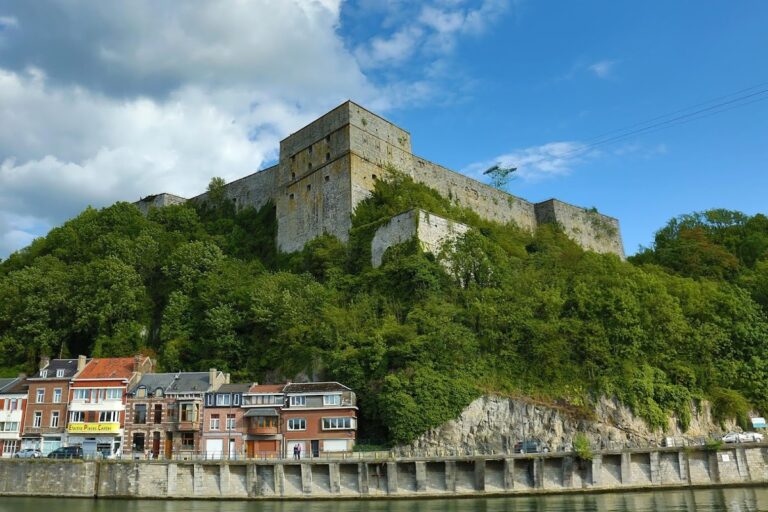
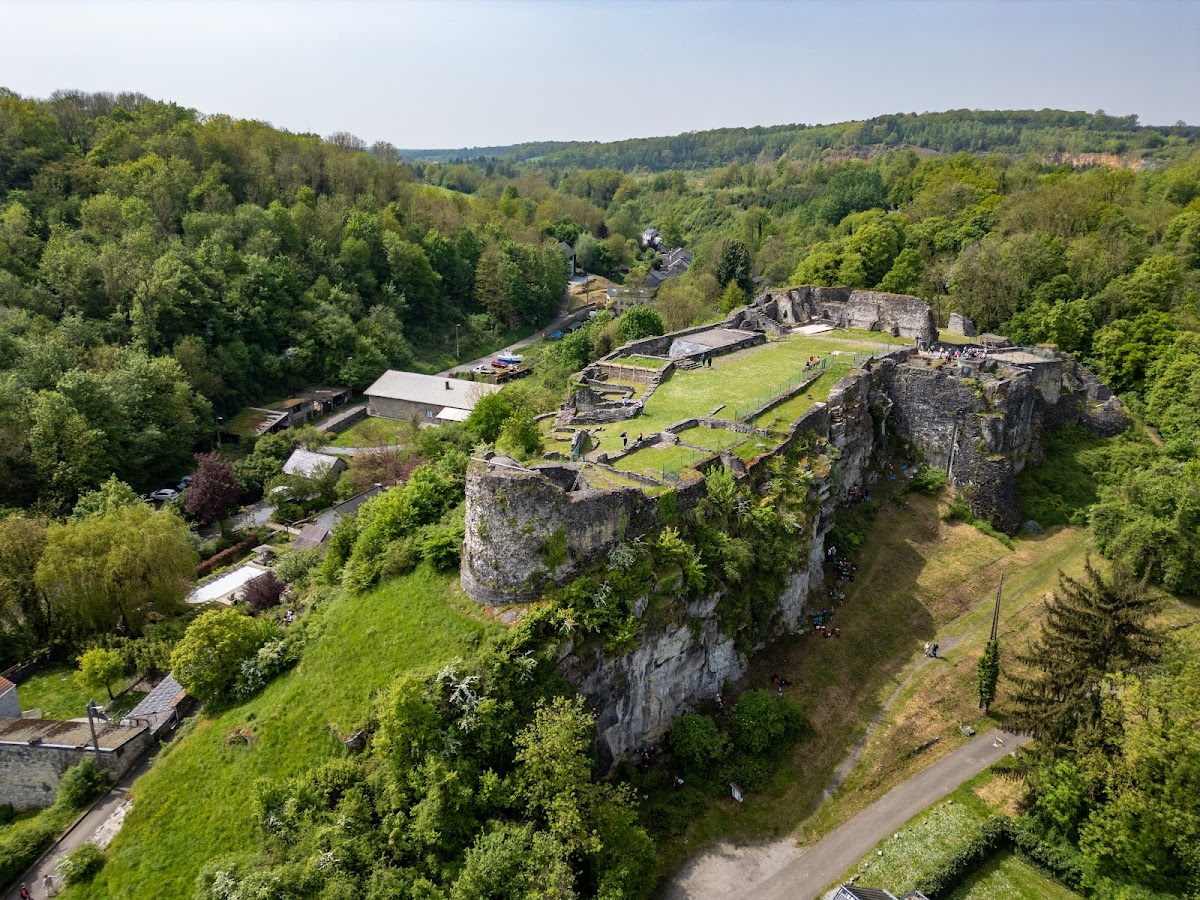
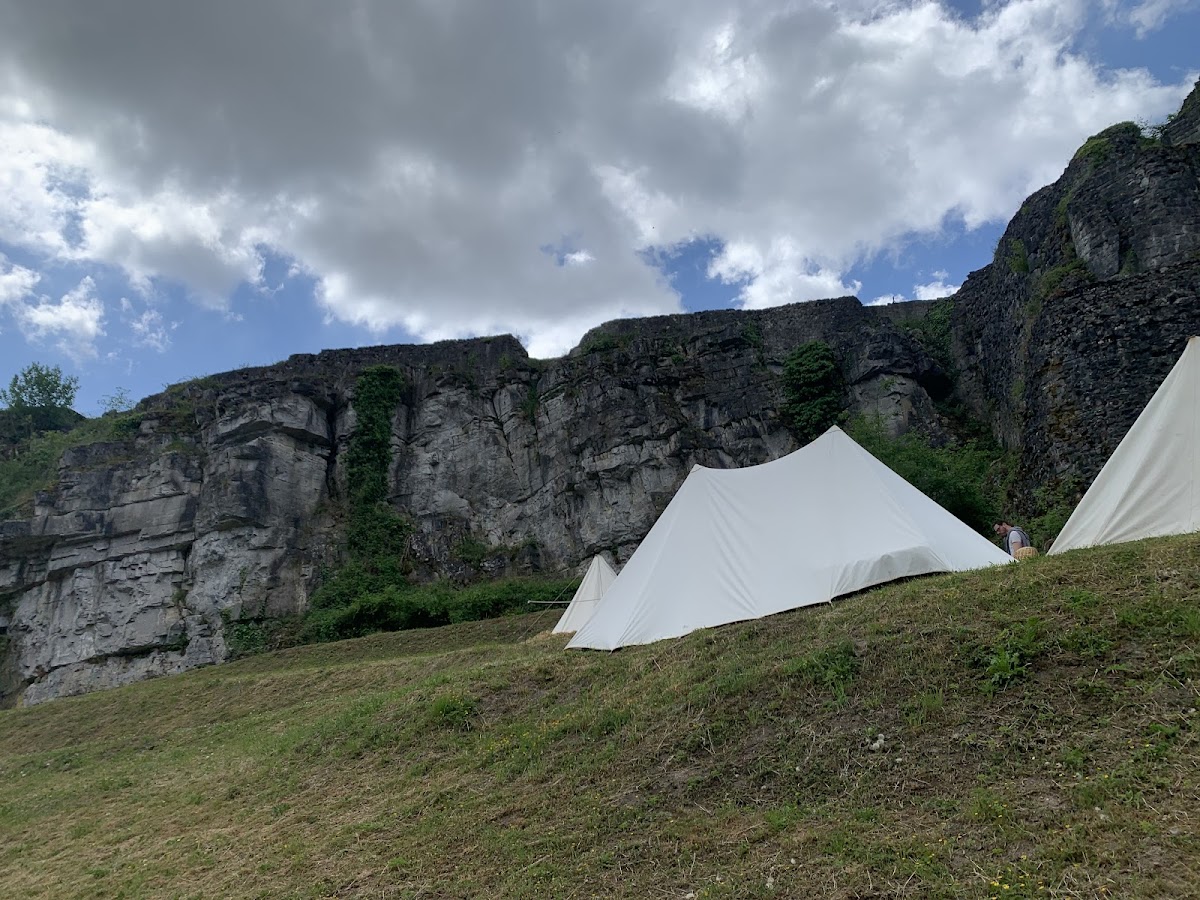
Moha Castle occupies a rocky spur approximately 100 metres north of the village of Moha, at the confluence of the Mehaigne and Fosseroule. The hilltop position formed the physical basis of the fortress. Between the mid-tenth and early eleventh centuries, the surface of the spur was levelled and enlarged with layers of fill, creating a broader platform for occupation and defense. Stone defensive structures from the same period represent the earliest known fortified fabric. The castle was later destroyed by fire and demolition in 1376, and the surviving remains now form a ruin.
Chapel and later survival
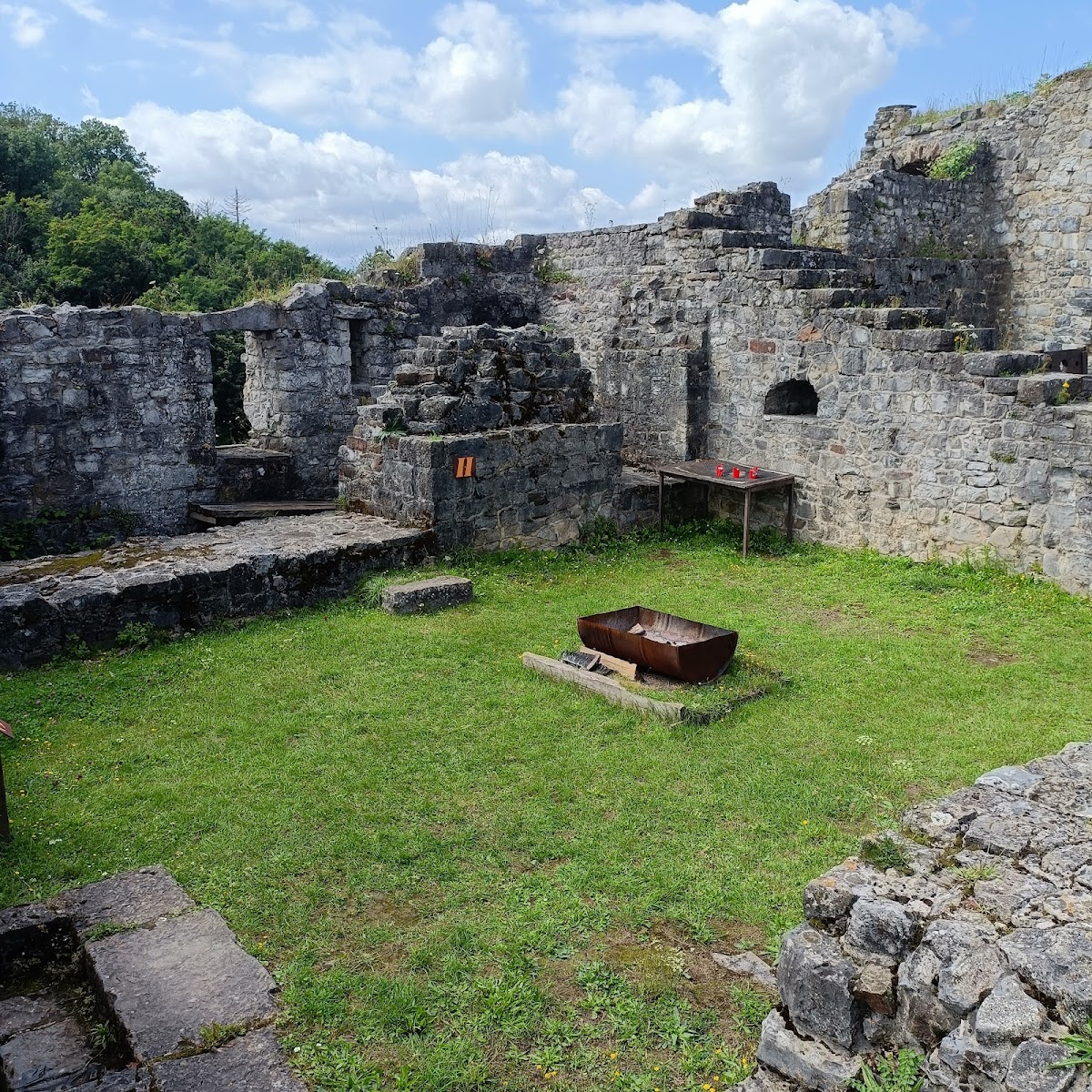
The castle chapel appears to have escaped the destruction that demolished the fortress walls in 1376. It remained in use after the medieval stronghold was abandoned, passing to the Jesuit college of Huy in 1622 and later serving religious communities. The chapel’s walls survived until the building was dismantled in 1826. The fortress ruins were then progressively quarried for building stone until 1889. Later clearance and consolidation exposed and stabilized parts of the surviving structures, while conservation work addressed the fragile condition of the remains.
Archaeological evidence
Excavations on the spur have revealed occupation long before the medieval castle. Prehistoric activity is represented by flint blades and flakes. Pottery from Hallstatt C and D, phases of the Early Iron Age, and pottery from the Later Iron Age show continued use during later prehistoric periods. Evidence from the Early Roman Empire is scarce, while material becomes more frequent again during Late Antiquity and the Early Middle Ages. Excavations since 2020 have concentrated on these earliest phases and on the development of the first medieval defenses.