Schloss Hanfelden: A Fifteenth-Century Castle in Austria


Site at a Glance
- Rating
- 4.6
- Popularity
- Very Low
- Country
- Austria
- Primary era
- Medieval
- External website
- Open
- Eras represented
- Medieval, Early Modern
- Civilizations
- Duchy of Styria, Habsburg, Holy Roman Empire
- Site type
- Domestic
- Remains
- Castle
On this page7 sections
History
Schloss Hanfelden is a castle in Austria, in Unterzeiring in the municipality of Pölstal, Styria, whose present building derives largely from the fifteenth century. Its appearance was later shaped by early Baroque alterations, while its ownership history reflects the region’s connections with toll collection, mining, noble families, and religious conflict.
Origins and the Fifteenth Century
Caspar Han, also recorded as Hann, was a toll lessee at the Triebener Tauern and may have begun a residential seat at the site around 1410. The property took its name from the Hann family. In the mid-fifteenth century, the estate belonged to Wilhelm Zeller, who died in 1448.
Hans Han the Younger, probably descended from the earlier toll lessee Hans Han the Elder, received the estate as a fief from Maximilian I. In 1494 he began rebuilding a deserted farm. Current dendrochronology, the dating of wooden building elements through their annual growth rings, and building research indicate that the first residential tower may instead have been built only around 1500. The earlier development mentioned in written records may therefore have concerned a farm that had already been abandoned by that time.
Maximilian I and the Hann Family
Several documents signed at Unterzeiring show that Maximilian I was present there in October 1506. Maximilian was King of the Romans from 1486 and Holy Roman Emperor from 1508. A local tradition holds that he had already stayed at Schloss Hanfelden for three months around 1475 while overseeing attempts to reactivate the flooded silver mine at Oberzeiring.
The Hann family sold the castle in 1579 to their relative Hans Rauchenberger. Alterations associated with Rauchenberger gave the complex its present early Baroque form. A Wilhelm von und zu Hanfelden is recorded as the owner again in 1593.
Later Ownership and Investigation
In 1629, the Rauchenberger family was forced to leave the country because of its Protestant religious affiliation. The castle then changed owners frequently and was already in poor repair by the beginning of the eighteenth century.
The mining entrepreneur Franz Xaver Neuper acquired Schloss Hanfelden from the Schwarzenberg family in 1856. His descendants remain its owners. The castle has been protected as a monument since 1965, and its largely authentic preservation has made it important for architectural and heritage-conservation study.
Since 2016, the Institute of Prehistoric and Historical Archaeology at the University of Vienna, working with the Schloss Hanfelden interdisciplinary working group under Professor Claudia Theune, has carried out archaeological and building-historical investigations. This work has contributed to the revised understanding of the site’s earliest residential construction.
Remains
Setting and Castle Structure
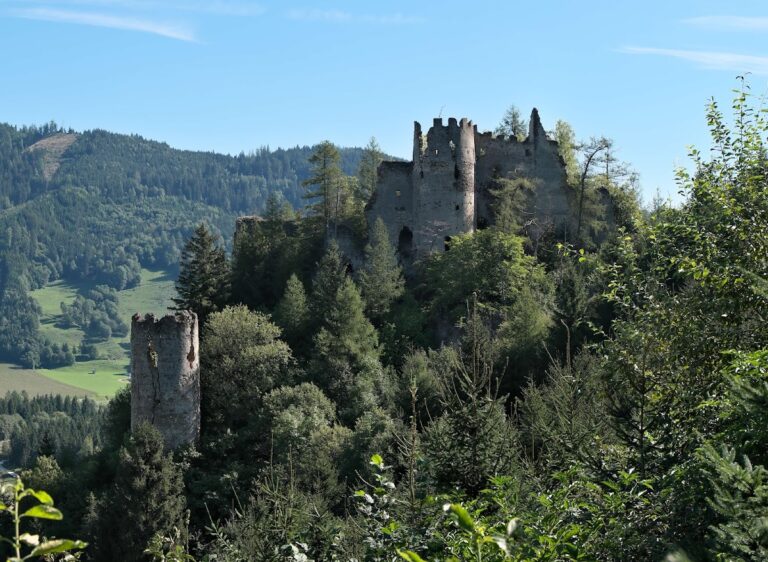
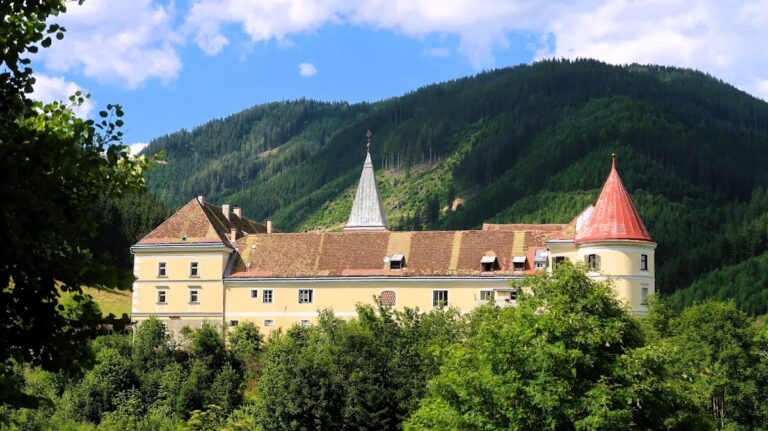
Schloss Hanfelden stands at about 983 metres above sea level in Unterzeiring. The surrounding landscape is mainly hilly, becoming mountainous to the north, and is largely covered by mixed forest. The complex is substantially a fifteenth-century castle structure, and it still appears largely as Georg Matthäus Vischer depicted it in his Topographia Ducatus Stiriae, a seventeenth-century descriptive work on the geography, settlements, and notable buildings of Styria. Its present early Baroque appearance results from the alterations associated with Hans Rauchenberger after 1579.
Interior Chambers and the Maximilian Room
Two chambers at Schloss Hanfelden are the only surviving chambers in Styria whose core construction is late medieval and formed with blockwork, a technique using horizontally laid, interlocking timber members to create walls or chambers. The so-called Maximilian Room preserves the memory of the tradition that Maximilian I stayed at the castle. It contains an inscription about the king’s visit to Zeiring that was made approximately a century after the visit.