Schloss Schlüßlberg: A Historic Castle in Austria

Visitor Information
Google Rating: 4.6
Popularity: Very Low
Google Maps: View on Google Maps
Country: Austria
Civilization: Unclassified
Remains: Military

History
Schloss Schlüßlberg is situated in the municipality of Schlüßlberg, Austria. Its origins trace back to the medieval period, when it was established by local builders known as Herwort and Walchun de sluzilberch in the later half of the 12th century. Originally, the fortress served a strategic purpose, controlling access to the nearby Trattnachtal valley and thus acting as a defensive barrier in the region.
During the 14th century, the site became associated with the Schlüsselberger family. This family, rising from peasant roots to knighthood, likely held the castle as vassals of the nearby Mondsee Abbey. Throughout the succeeding decades, the fortress passed through various hands. Named proprietors in the late medieval period include Hans, Chunrad, and Ulrich von Schlüßlberg, followed by Rudolf der Schifer in the early 1400s. In 1429, Erasmus von Hohenfeld acquired the property, at which time he most probably commissioned the construction of the castle’s Gothic chapel dedicated to St. George.
Ownership changed multiple times in the 15th and 16th centuries, reflecting shifting regional powers and family fortunes. By the 17th century, the castle came under the possession of the Hoheneck family, who transformed it from a medieval stronghold into a more comfortable palace. This period saw the introduction of baroque elements and the establishment of a fideicommiss, a legal arrangement to keep the estate within the family, formalized in 1718.
After the original Hoheneck male lineage ended in 1796, the estate changed hands among several noble families, including the Freiherren von Imsland and Graf Sigmund Engl in the 19th century. By the early 20th century, ownership had transferred to Sigmund Freiherr von Schneeburg, followed by Oswald Graf Spiegelfeld-Hoheneck during the 1930s. The Nazi regime forcibly ended the fideicommiss system in 1938, disrupting the family’s legal hold on the property.
Since 1963, the property has been managed by the Spiegelfeld-Schneeburg family, under a private foundation connected to Georg Spiegelfeld-Schneeburg. Restoration efforts throughout the 20th century, including repairs to the chapel and key defensive structures, have helped preserve the site’s historical character.
Remains
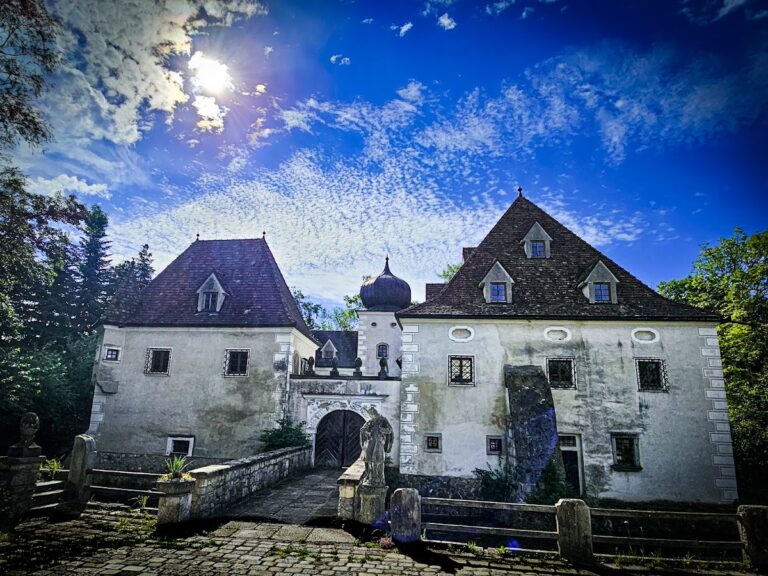
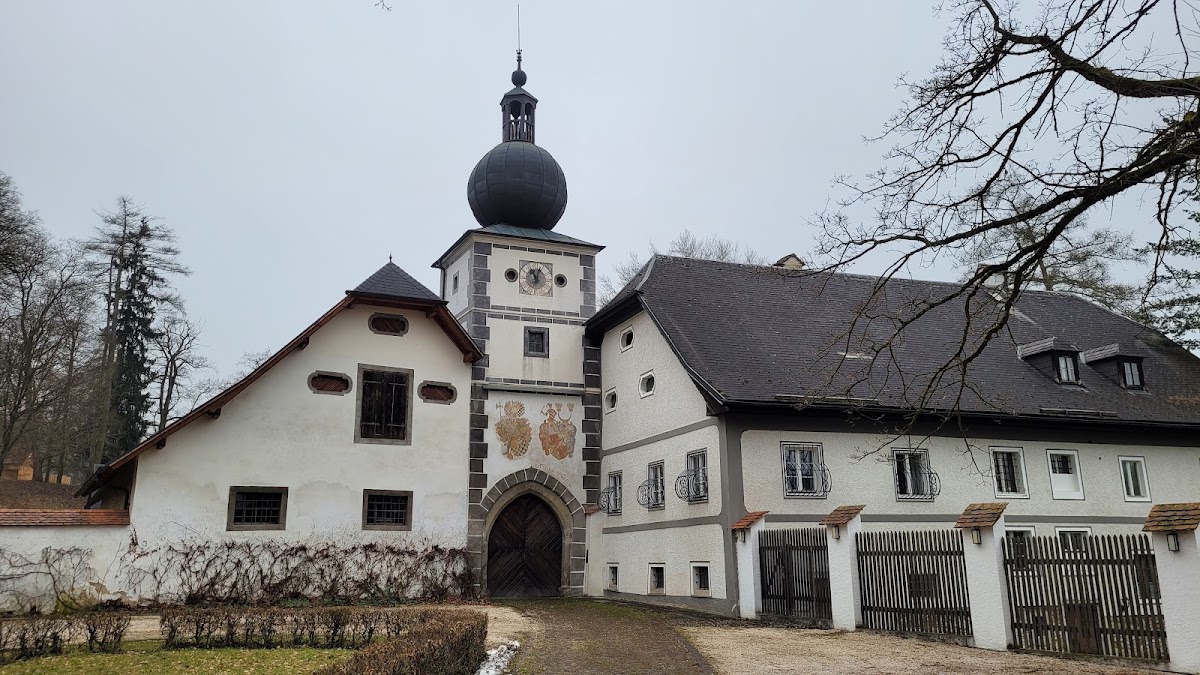
Schloss Schlüßlberg stands as a three-story, square-configured building that incorporates a medieval core from its original construction. Its main architectural form reflects 17th-century design, with later baroque modifications evident in features such as ornate stucco ceilings. The entrance is dominated by a gate tower topped with an onion-shaped dome, erected in 1690. This tower is notable for displaying a fresco of the Hoheneck family coat of arms, symbolizing their influence during the castle’s transformation into a palace.
Adjacent to the gate tower are a residential house and an agricultural building dating back to the 17th century, suggesting the site’s dual function as both noble residence and working estate. The main palace extends behind these structures, forming the central living and administrative area of the complex. In front lies the Meierhof, or manor farm, which historically served agricultural purposes. Further uphill is an enclosed area for fallow deer, illustrating aspects of estate management and leisure.
The chapel dedicated to St. George is a key medieval element, constructed in a Gothic style before 1431. It was later renovated in baroque fashion in 1708, blending architectural periods. Restoration work in the mid-20th century repaired both the chapel and the delicate stuccoed interiors, preserving their historical finishes.
One of the defensive elements of the complex, the northern zwinger wall—which is an outer defensive wall located near the gate—collapsed prior to the 1970s but was subsequently rebuilt. Overall, comprehensive restoration during the later decades of the 20th century has maintained the structural integrity and historical features of Schloss Schlüßlberg, allowing the complex to retain its layered architectural heritage.
Nearby sites