Wasserschloss Gallspach: A Historic Noble Seat and Water Castle in Austria


Site at a Glance
- Rating
- 3.8
- Popularity
- Very Low
- Country
- Austria
- Primary era
- Early Modern
- Eras represented
- Medieval, Early Modern
- Civilizations
- Habsburg, Holy Roman Empire
- Site type
- Domestic
- Remains
- Castle
On this page12 sections
History
Wasserschloss Gallspach is a historic noble seat and water castle in Austria, in the town of Gallspach. It is first documented as a noble residence in 1120, although 1111 is also given as an alternative date. The present castle developed between the sixteenth and eighteenth centuries. Its early lords were members of the Gallspach family, also known as the Gailispachers, who served the Schaunbergers as ministeriales, dependent service nobles with administrative and military duties.
Medieval origins
Members of the Gallspach family appear in charters connected with St. Nikola monastery. Sigeboto de Gailispach is named in a document from around 1100, while Reginhart de Gailesbach appears in another charter from around 1120. Heinrich of Gallspach is recorded around 1250, and Hans Gailispegh held Gallspach as a Schaunberg feudal vassal between 1376 and 1378. The family later lived at Haitzing Castle. By 1343, both a house and a fortress were recorded at Gallspach.
Eberhard V of Walsee owned Gallspach from 1343 to 1354. He sold the castle in 1354 to Heinrich Geumann while retaining the feudal right, meaning the superior lordship over the property. In 1461, the lordship was granted to Stephan II Geumann and his brother Bartholomäus. In 1479, Reinprecht V of Walsee granted Gallspach, including the castle and the church benefice, to Christoph II Geumann.
The Geumann and Geymann lordship
After the Walsee family became extinct, Gallspach was granted directly by the territorial ruler. During the reign of Emperor Frederick III, Hans, Tristram, and Balthasar Geymann received Gallspach in 1492. In 1496, King Maximilian I granted the castle and lordship again to Hans Geymann, administrator of Lankowitz, for himself and his cousins Balthasar and Tristram.
The cousins divided their inheritance in 1502. Balthasar received Gallspach and its market, while Tristram received Tratteneck. The Geumann family retained Gallspach until the Counter-Reformation, the Catholic response to the spread of Protestantism in the sixteenth and seventeenth centuries. Because the family was Protestant, its members had to emigrate, and Gallspach was sold to Christoph Weiß of Würting in 1633.
Changing ownership after 1633
Christoph Ludwig Weiß’s guardians sold Gallspach in 1638 to Tobias Prodlvischer of Waldberg, who died in 1670. Prodlvischer ended Gallspach’s feudal tenure by paying 211 florins to the territorial ruler. His widow, Johanna, Lady of Hofeck, bequeathed the property to her brother Veit Spindler in 1685.
Ownership changed several times during the following decades. Baron Dr. Augustin von Erhardt held Gallspach from 1688 to 1695. His daughter Maria Theresia von Erhardt, who was married to Count Ehrgott von Kueffstein, owned it from 1695 to 1706. Ehrgott von Kueffstein held the property from 1706 to 1708, followed by Liebgott von Kueffstein from 1708 to 1709.
In 1709, Gallspach passed to the Hohenecker, or Hohenegger, family. Johann Georg Adam von Hoheneck incorporated it into a family entail, an inheritance arrangement intended to keep an estate together, along with the lordships of Schlüßlberg and Trattenegg. The last male Hohenecker, Johann Georg Achaz Count Hoheneck, died in 1796. Gallspach then passed to the Imsland family because Maria Anna Baroness von Imsland had been born a Countess Hoheneck.
From the nineteenth century to the Zeileis family
Later owners included Maria von Spieß, born von Imsland, from 1871 to 1880; Franz Brodböck from 1880 to 1901; Georg and Elise Schienerl from 1901 to 1908; and Hugo Seyrl from 1908 to 1912. These successive sales reduced the estate associated with the castle.
The Zeileis family has owned Schloss Gallspach since 1912. Valentin Zeileis moved his laboratory from Vienna to Gallspach in 1920 and established a medical practice beside it. As patient numbers exceeded the available space despite repeated alterations, a radiation-physics institute was built behind the castle in 1929. The castle also suffered fire damage during the Peasants’ Wars. It remains privately owned by the Zeileis family and is protected as a listed monument in Austria.
Remains
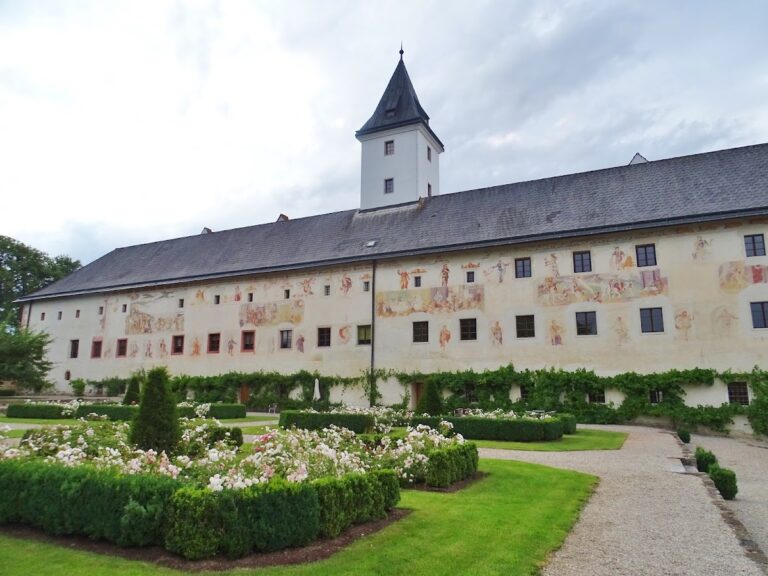
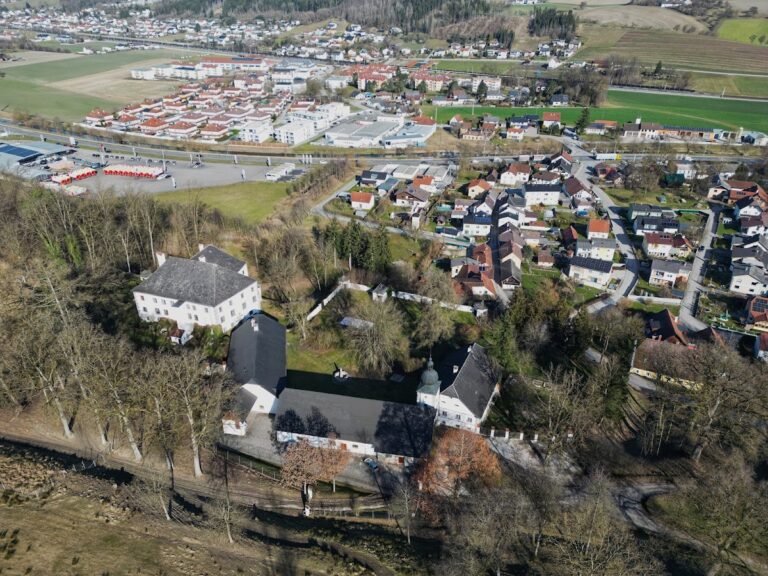
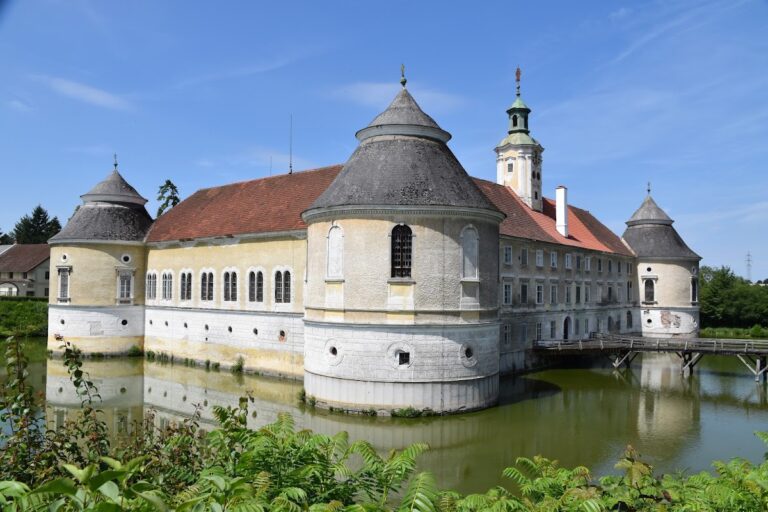
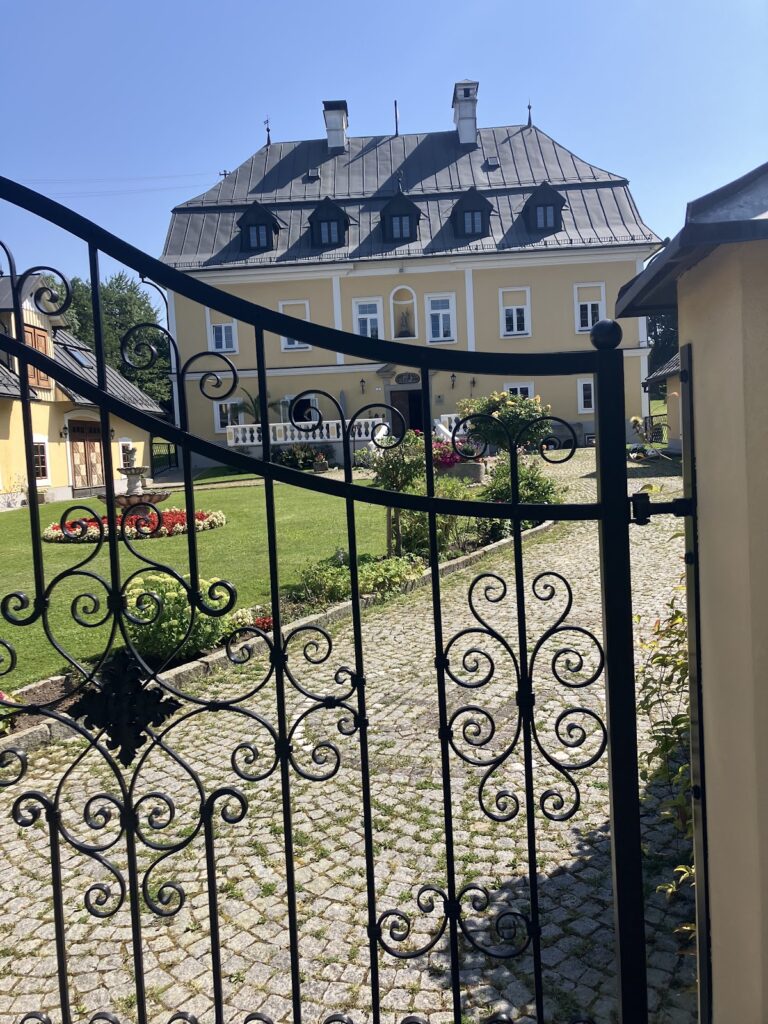
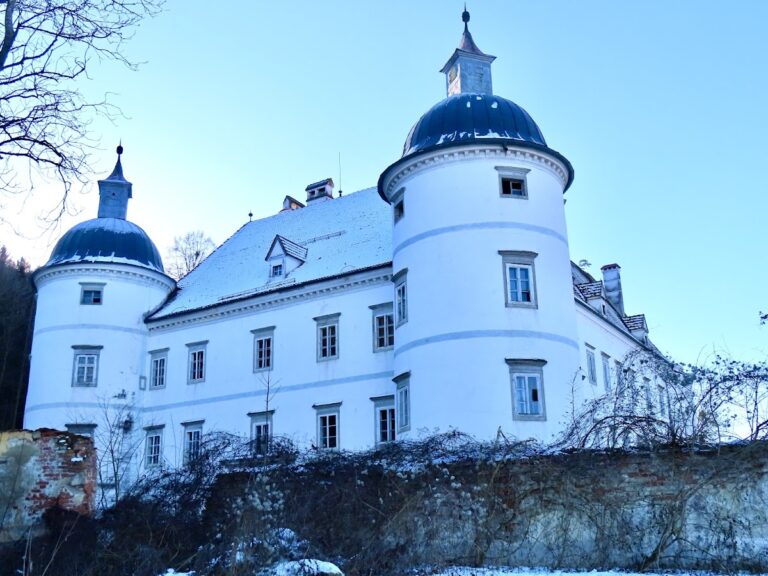
Wasserschloss Gallspach is a two-storey complex of four wings arranged around an inner courtyard. Built between the sixteenth and eighteenth centuries, it has the overall appearance of a quadrangular farmstead. The entrance faces the market square, while water features, bridges, and associated buildings form part of the wider arrangement.
Castle buildings and courtyard
Entrance and earlier castle remains
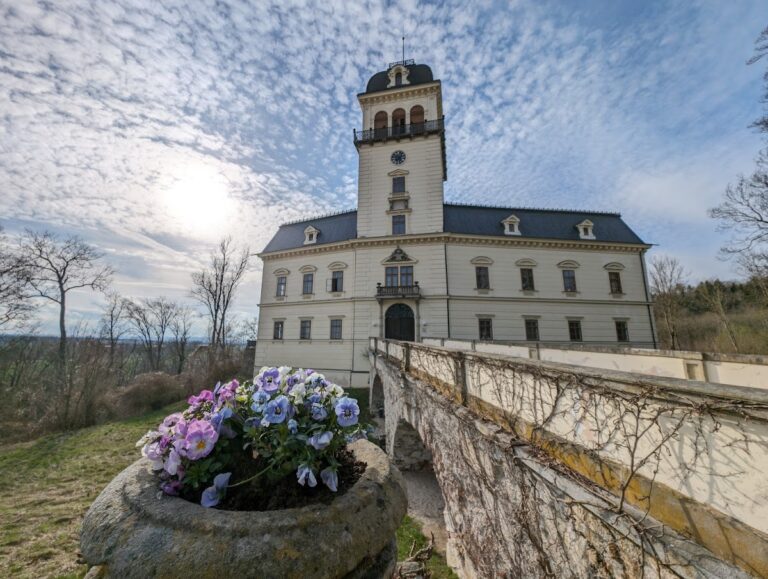
The main approach crosses a bridge and reaches a gate hall facing the market square. The entrance consists of a large gate with a smaller wicket gate, a pedestrian door set within or beside the main gateway. A round tower projecting from the masonry preserves part of the earlier castle. Arcaded galleries, covered courtyard passages formed by a series of arches, extend along two sides of the inner court.
Brewery and surrounding water features
The rear courtyard formerly contained the brewery. A bridge links the castle with the brewery buildings. A pond-like moat and an additional pond surround the complex, reinforcing its character as a water castle and defining its relationship with the neighboring structures.
Zeileis institute and garden
Health and radiation-physics institutes
On neighboring property, Valentin Zeileis commissioned the Zeileis health institute, designed by the architects Heinrich Schmid and Hermann Aichinger. The same architects designed the radiation-physics institute built behind the castle in 1929. Radiation physics concerns the physical properties and effects of radiation, including its medical applications.
Bronze statues
The institute garden contains two bronze statues made in 1930 by the Viennese sculptor Josef Riedl. One represents a figure rolling a rock, while the other shows a figure emptying a water jug. The statues were installed in 1975 in honor of Valentin Zeileis.