Hueb Water Castle (Wasserschloss Hueb): A Historic Moated Castle in Austria
Site at a Glance
- Rating
- 4.5
- Popularity
- Very Low
- Country
- Austria
- Primary era
- Medieval
- Eras represented
- Medieval
- Civilizations
- Habsburg, Holy Roman Empire
- Site type
- Domestic
- Remains
- Castle
On this page8 sections
History
Medieval origins and early owners
Hueb Water Castle, known locally as Wasserschloss Hueb, is a historic moated castle in Austria, in the Hueb district of Eggendorf im Traunkreis. Hueb was first recorded in 1356 as a Volkensdorffer fief, meaning land granted by a superior lord in return for obligations, to Eberhard Mühlwanger, the city judge of Steyr. Siegmund and Heinrich Prueschenk later held it as feudal lords.
The Sproll family acquired Hueb in 1525. In 1557, its owner was Daniel Luger, a citizen of Steyr. Johann Steurer, son of Urban, owned the property around 1588. During his tenure, heavy taxation helped provoke a peasant uprising, and the neighboring estates of Eggendorf and Leompach were also attacked.
Seventeenth-century ownership and rebuilding
Hueb changed hands several times during the seventeenth century. Klaudius Philipp Pröller von Ladendorf owned it in 1608, followed by Johann Friedrich Mörk von Gneisenau in 1650. Schlierbach Abbey, a Cistercian monastery in Upper Austria, later held the property, as did Ehrenreich von Schallenberg, who united Hueb with Eggendorf.
Wolf Spiller von Mitterberg held Hueb from 1696 to 1709. During this period, severe fire damage led to the castle’s rebuilding around 1700. The reconstruction belongs to the Baroque period, an early-modern European style associated with dramatic forms and elaborate decoration.
Modern ownership
The Wiesmayer family purchased the castle in 1956. After previously running the tavern in Weitersdorf, the family established an inn at Hueb. The property passed to the Wimmer family in 1961.
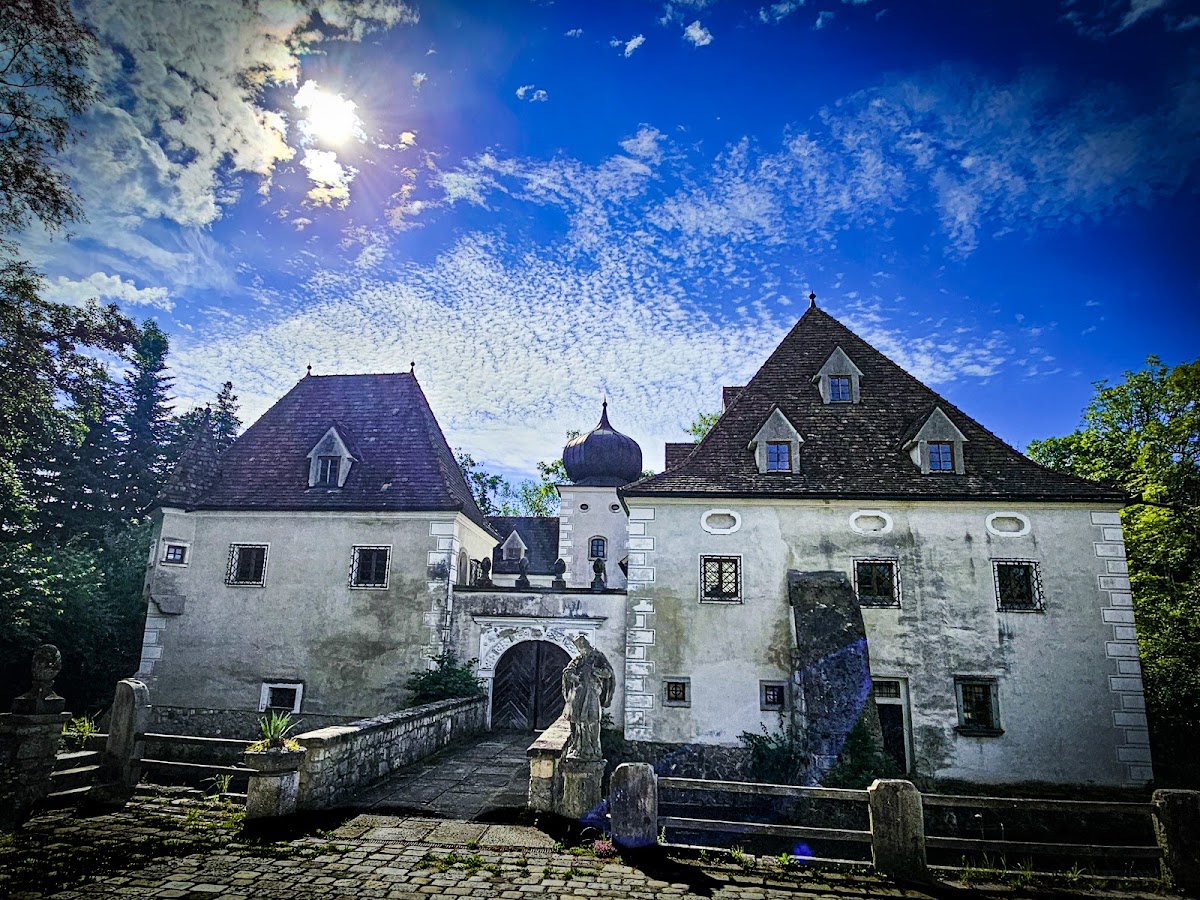
Hueb Water Castle is now privately owned by Erwin Machgraber, an antiques dealer from Marchtrenk. He is seeking to restore the property in a historically appropriate style. The castle currently has an uninhabited appearance and requires renovation.
Remains
Moated castle and exterior features
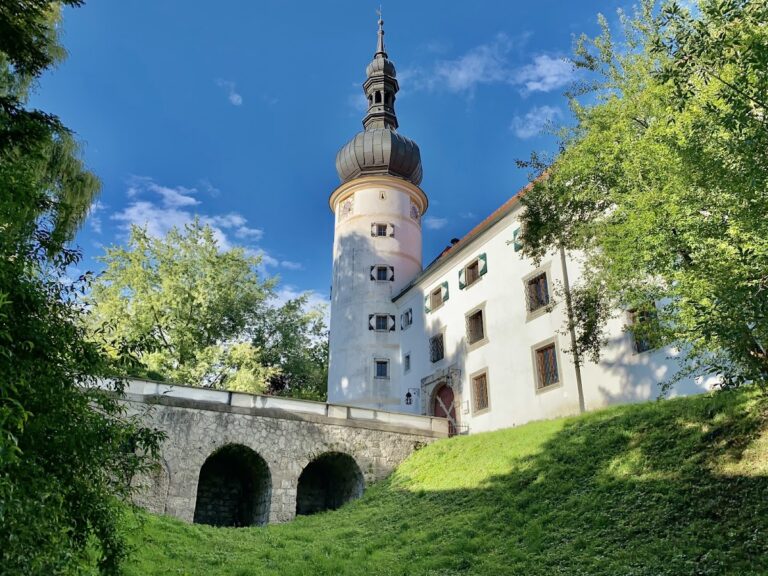
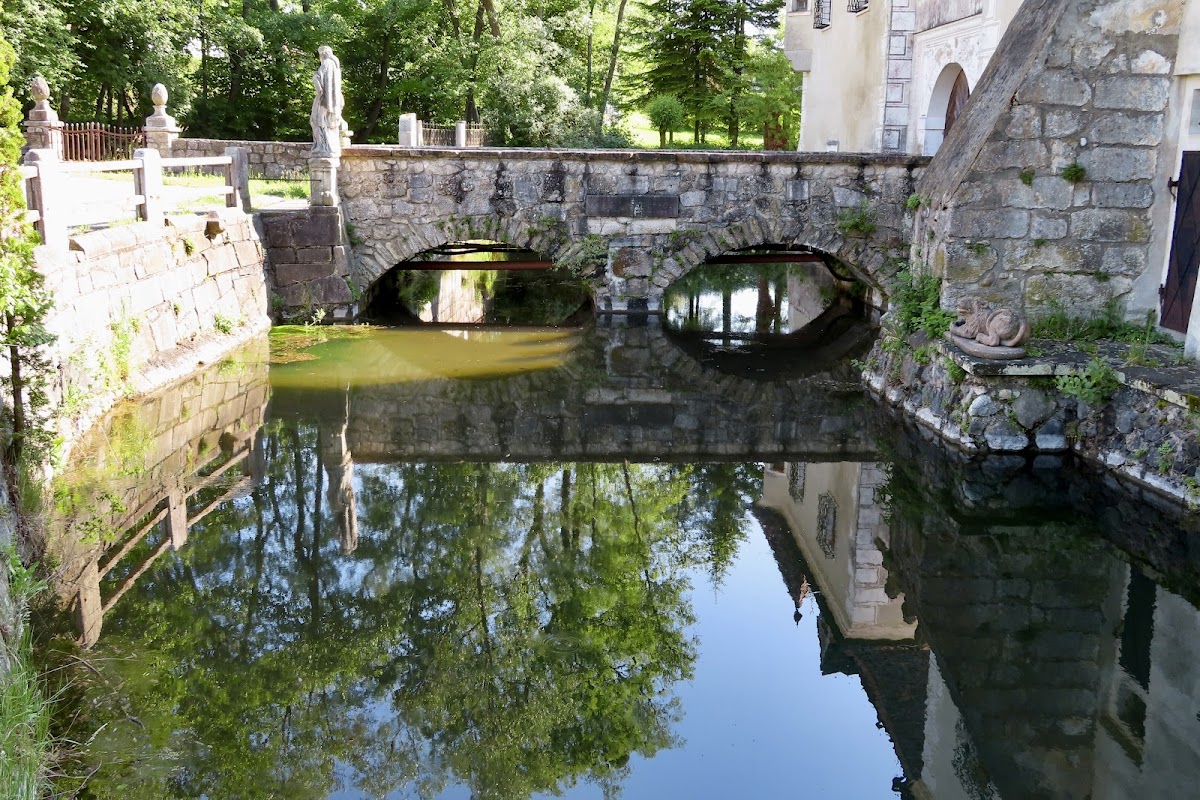
The castle stands within a pond that surrounds it on all four sides. A stone bridge provides the approach across the water and carries a statue of Saint John Nepomuk, a medieval Bohemian priest and martyr who became especially associated with bridges and protection from drowning.
Corner turret and rear tower
One corner of the building has a projecting corner turret. A large tower dominates the rear and is covered by an onion-shaped roof. Open arcades, galleries formed by repeated arches or openings supported by columns, occupy both the ground and first floors. On the first floor, to the left of the tower, an open terrace has a granite balustrade, or low ornamental railing.
Castle park
The surrounding park contains numerous stone figures and other monuments. These include a representation of Mary as Queen of Heaven with Jesus and angels, Baroque figures, and lions. Together with the pond, bridge, tower, arcades, and terrace, these surviving elements form the physical setting of the privately held castle.