Schloss Kainberg: A Historic Castle in Kumberg, Austria

Visitor Information
Google Rating: 4.6
Popularity: Very Low
Country: Austria
Civilization: Unclassified
Site type: Military
Remains: Castle

History
Schloss Kainberg is located in the municipality of Kumberg in Austria and was originally established by medieval European builders. Its origins trace back to the early 13th century when a fortified manor was likely built on this site.
The earliest documented resident of the estate was Otto von Chunperch in 1218. At that time, the property was classified as freehold land held by a ministerial family closely tied to the nearby Seckau Abbey, a religious institution that played an administrative role in the region. The Kainberg family maintained ownership for more than three centuries, establishing a long period of stability for the estate.
In 1547, the estate passed to Gilg von Saurau, marking the beginning of several changes in ownership over the years. Between 1570 and 1575, Otto VI von Ratmannsdorf undertook a substantial transformation of the manor, redesigning it into a Renaissance-style castle. This major renovation shaped much of the castle’s character seen today.
Subsequent years saw the castle change hands several times due to religious affiliations and financial difficulties. Notable proprietors during this period included Siegmund Friedrich Freiherr von Gleispach, the Seckau Abbey itself, and Georg Siegmund Graf Dietrichstein. These transfers underscore the castle’s integration within the shifting political and ecclesiastical networks of the region.
Since 1841, the castle has remained in the possession of the Wimpffen family, who continue to live in the historic residence. Their long tenure reflects a period of continuity after centuries marked by more frequent transitions.
Remains
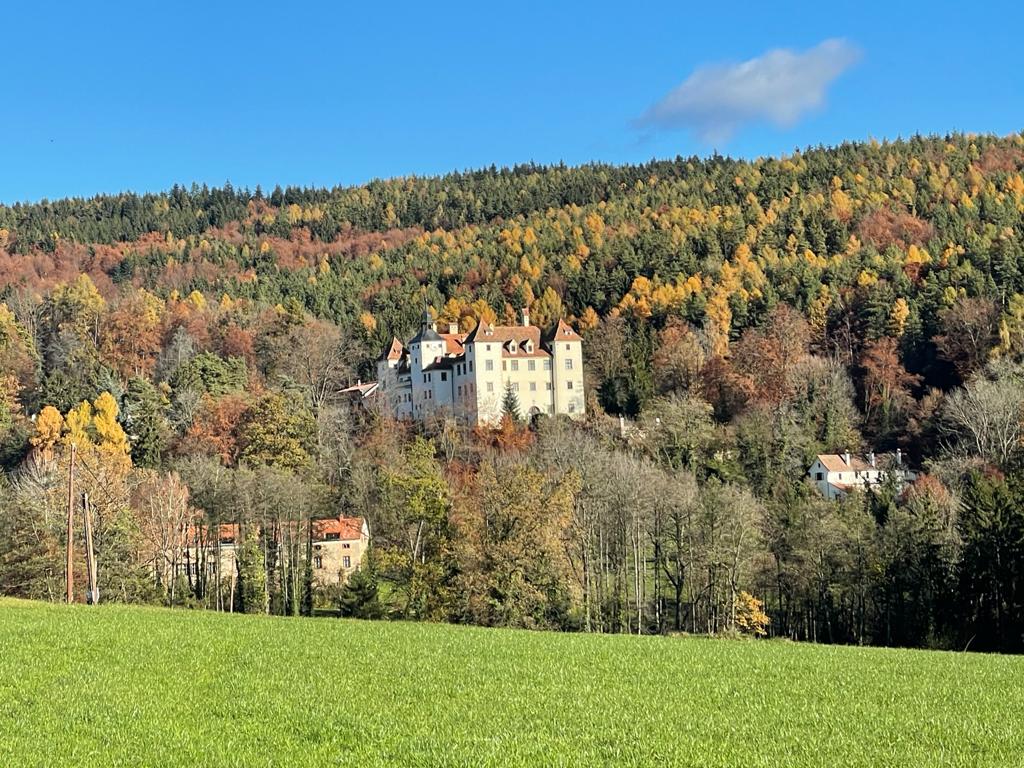
Schloss Kainberg is a three-story quadrangular building that encloses a rectangular courtyard surrounded on three sides by arcades—rows of arches opening onto the courtyard. These arcades were originally open but were mostly glazed during the 19th century, allowing light while providing protection from the elements.
Each of the castle’s four corners is anchored by a square tower topped with pyramid-shaped roofs, emphasizing the structure’s balanced and fortified design. A distinctive feature is the clock and bell tower positioned mid-way along the western wing, crowned with a lantern-like roof, which houses a small chapel dedicated to the Three Holy Kings. This chapel adds a religious dimension within the castle’s fabric.
The southern wing presents a round-arched entrance gate, serving as the main access point to the compound. Though the castle was once defended by a protective wall and moat that no longer survive, earlier defensive features are suggested by the historical presence of a rectangular tower at the southwestern corner, which is no longer standing. In the southeast, an original bastion, a projecting part of the fortification, was adapted into a garden space over time.
The oldest part of the complex is the northern wing, dating back to the 15th century. This wing preserves much of its original interior details, especially on its upper floors, offering a rare window into the building’s medieval origins. Inside, visitors can find a variety of stylistic elements reflecting periods of renovation, including neo-Baroque stucco ceilings that add decorative richness, as well as a Renaissance-style coffered ceiling in one corner room, notable for its painted imitation of wood grain. An 18th-century tiled stove also survives, indicative of historic heating methods.
The castle’s large hall is adorned with stucco decorations featuring leaf and strapwork designs from the early 18th century, demonstrating an interest in ornamental detail during that period. An Empire-style stove installed around 1800 further highlights the layers of history visible inside Schloss Kainberg, blending functional and artistic elements from different eras.
Nearby sites