Roman Villa San Biagio: A Historic Roman Residence in Sicily


Visitor Information
Google Rating: 3.8
Popularity: Very Low
Google Maps: View on Google Maps
Country: Italy
Civilization: Roman
Remains: Domestic

History
The Roman Villa San Biagio is located in the San Biagio district of Terme Vigliatore, near Messina in Sicily, Italy. This luxury suburban residence was built by the Romans on a site that had been occupied since the Hellenistic period, dating back to the 3rd or 2nd century BCE.
The villa’s initial construction took place at the end of the 2nd century BCE or the beginning of the 1st century BCE. It was established as a rural retreat reflecting the wealth and status of its owners during the late Republican era. The site’s continuous occupation suggests it remained an important residential estate through changing political and social conditions.
During the early Imperial period, the villa underwent at least two significant renovations. The first occurred in the mid-1st century CE, followed by further modifications in the 2nd century CE. These changes included major updates to the thermal bath complex.
The villa continued to be used into late antiquity, as shown by ceramic finds and building debris. However, its expansion or construction was suddenly halted, likely due to the devastating earthquake of 365 CE. This seismic event, recorded by the historian Ammianus Marcellinus, also damaged nearby sites such as the Villa of Patti and the city of Tindari, marking a turning point in the villa’s history.
Rediscovered in the early 1950s, the site was excavated under Luigi Bernabò Brea and later Vinicio Gentili. Their work revealed the main residential buildings, private baths, and service areas, shedding light on the villa’s layout and use over several centuries.
Remains
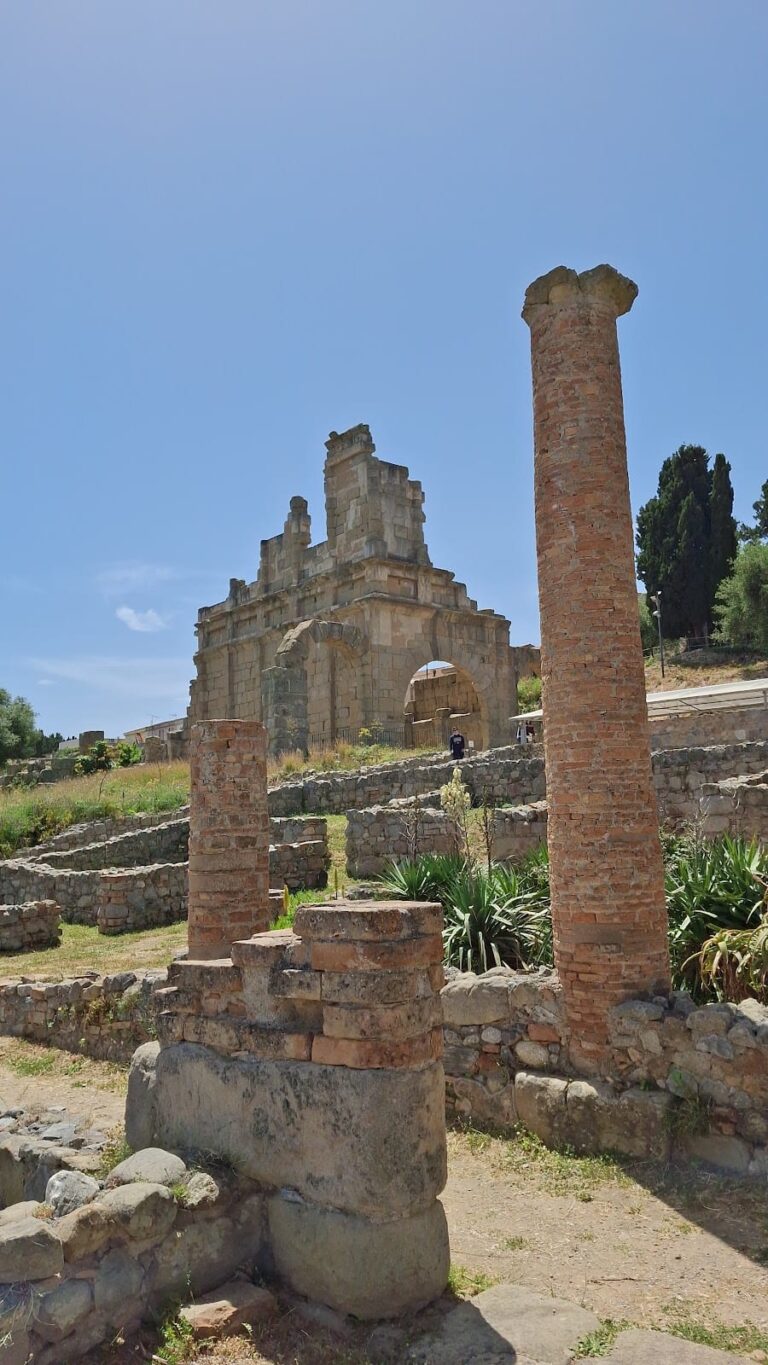
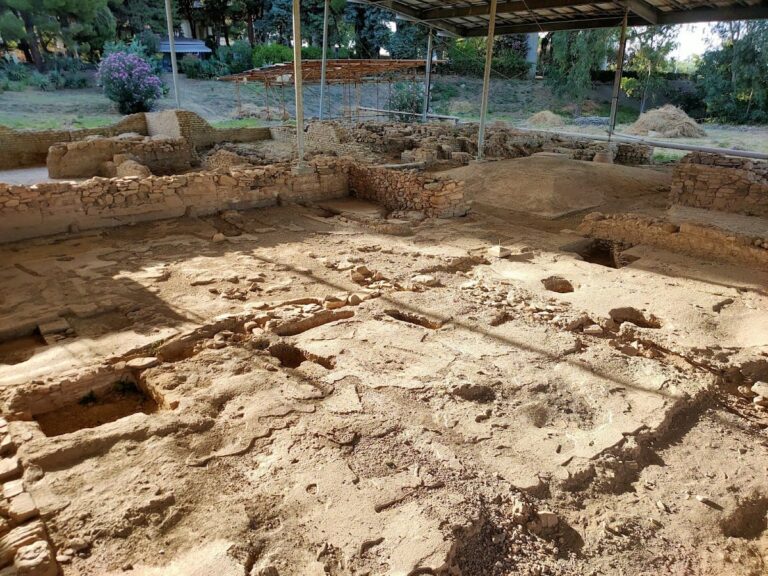
The villa is arranged around a large square courtyard, or peristyle, measuring about 17 meters on each side. This courtyard was surrounded by eight brick columns on each side, coated with stucco, though only low walls remain today. The complex extends along an east-west axis with three main sections: service rooms to the east, private living quarters in the center, and the thermal bath complex to the west.
The residential area includes a porticoed garden and a large reception room called the tablinum, located on the courtyard’s south side. The tablinum features a two-columned facade and a niche likely meant for a statue. Its floor is decorated with an opus sectile mosaic made of hexagonal colored marble pieces arranged in geometric patterns, dating to the 2nd century CE.
Adjacent to the tablinum are private apartments for the villa’s owners, consisting of several rooms such as bedrooms (cubiculum) and a large hall (oecus). These rooms have black-and-white mosaic floors.
The thermal complex includes three main bathing rooms: the frigidarium (cold bath), tepidarium (warm bath), and calidarium (hot bath). These rooms were heated by a hypocaust system, which circulated hot air beneath raised floors and through ceramic ducts in the walls. The frigidarium contains a black-and-white mosaic depicting a fishing scene with dolphins, swordfish, and an opera boat, attributed to an Italic mosaic artist and dating to the early 2nd century CE.
Additional bath-related rooms include the apodyterium (changing room), unctorium (massage room), destrictarium (body cleaning room), and three pools (piscinae).
Service areas consist of storage rooms (cella penaria), small chambers (cellae), guard rooms (celle ostiarie), and an entrance vestibule (vestibulum). These functional spaces supported the villa’s daily operations.
Fragments of sculptures, stuccoes, and ceramics have been found and are displayed in a small exhibition room near the entrance. Protective structures built in the 1960s remain in place to safeguard the mosaics and wall paintings, preserving the villa’s heritage.
Nearby sites