Roman Temple of Évora
Table of Contents


Visitor Information
Google Rating: 4.6
Popularity: High
Google Maps: View on Google Maps
Official Website: www.cultura-alentejo.pt
Country: Portugal
Civilization: Roman
Remains: Religious

Ancient Roman Temple in Portugal’s Évora
The Roman Temple of Évora, known in Portuguese as Templo romano de Évora, is an ancient structure located in Évora, Portugal. It is often mistakenly referred to as the Templo de Diana, named after the Roman goddess. This temple is a significant landmark representing the Roman and Lusitanian civilizations in the region. It is part of the historical center of Évora, which UNESCO has designated as a World Heritage Site.
History of the Temple
The construction of the temple is believed to have occurred around the first century CE. It was built in honor of Augustus, who was worshipped as a god during and after his reign. The temple was situated in the main public square, known as the forum, of Évora, which was then called Liberalitas Iulia. In the second and third centuries, the temple underwent modifications as the urban landscape evolved, focusing on religious and administrative functions.
In the fifth century, the temple was destroyed by invading Germanic tribes. During the 14th century, the site was repurposed as a stronghouse for the town’s castle. Historical accounts describe the temple as being in ruins at that time. In 1467, King Afonso V permitted the removal of stones from the temple for construction and defense purposes. The remnants of the temple were integrated into a tower of the Castle of Évora during the Middle Ages.
From the 14th century until 1836, the temple’s structure was used as a butcher shop, which contributed to the preservation of its remains.
Restoration Efforts
The first reconstruction of the temple’s appearance took place in 1789 under the direction of James Murphy. By the early 19th century, the structure still displayed architectural features typical of post-Reconquista Arabic buildings. In 1836, the butcher shop ceased operations, leading to further archaeological interest in the site. In 1840, Cunha Rivara, the director of the Public Library of Évora, initiated the first major archaeological excavation in Portugal, uncovering parts of a primitive aqueduct.
By 1863, the structural integrity of the temple was compromised, leading to partial destruction of the ceiling. In 1869 the demolition of medieval structures surrounding the temple was advocated to restore its original form. Three years later the remnants of these medieval structures were removed, and a restoration program was initiated, reflecting the Romantic ideals of the time.
Architectural Features
The Roman Temple of Évora is located in the central square of the city, positioned on what would have been the highest point of the acropolis. It is surrounded by several religious buildings linked to the Inquisition, including the Sé Cathedral and the Palace of the Inquisitor. The original design of the temple likely resembled the Maison Carrée in Nîmes, France.
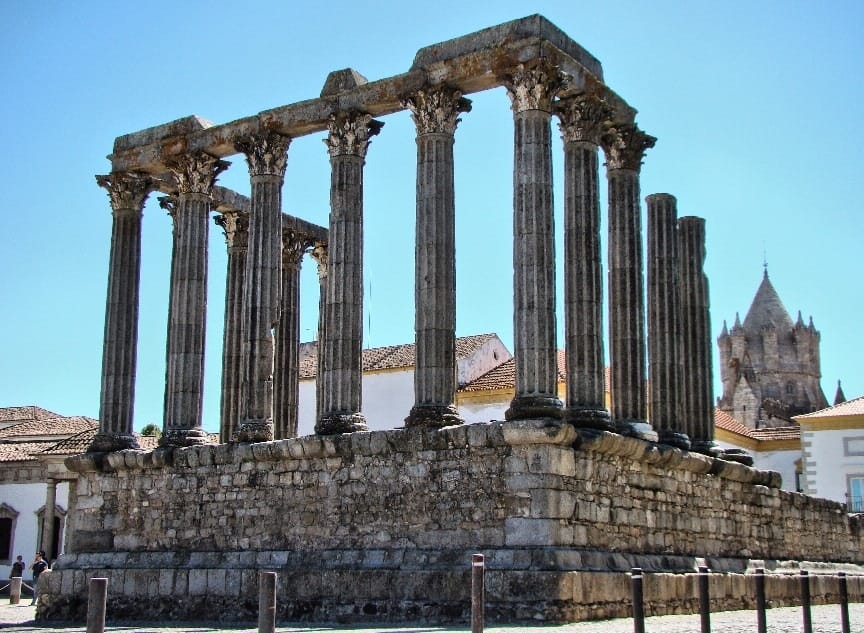
What remains of the temple includes a complete base, or podium, constructed from both regular and irregular granite blocks. The structure features an intact colonnade along its northern facade, consisting of six columns, as well as additional columns on the eastern and western facades. The temple is oriented southward, with a prominent staircase design. Archaeological investigations suggest the presence of a reflecting pool and a monumental portico, originally featuring six columns.
Materials and Construction
The podium of the temple measures 25 meters in length, 15 meters in width, and 3.5 meters in height. The Corinthian columns, which are fluted, vary in height from 1.2 meters to 6.2 meters. These columns rest on circular white marble pedestals sourced from Estremoz. The capitals of the columns are decorated with floral motifs. The entablature is made of granite masonry, and traces of a reflecting pool have been discovered in recent excavations.
The temple’s construction exhibits a balance between granite and marble, contributing to its status as one of the best-preserved Roman ruins on the Iberian Peninsula. However, it is important to note that the current appearance of the temple has been influenced by restoration efforts in the Romantic style.
Nearby sites