Rafenstein Castle: A Medieval Fortress Near Bolzano, Italy
Visitor Information
Google Rating: 4.3
Popularity: Very Low
Google Maps: View on Google Maps
Country: Italy
Civilization: Unclassified
Remains: Military

History
Rafenstein is a medieval castle ruin situated near the town of Bolzano in northern Italy. It was established in the 13th century by the inhabitants of the region, playing an important role in controlling a secondary route between Rauhenbühel and Bolzano. The castle’s location was strategically significant throughout the Middle Ages and continued to hold importance until the 19th century.
The earliest recorded mention of Rafenstein comes from 1217, identifying it as a fief under the Bishop of Trento. At that time, a castellan named Albert von Rafenstein was responsible for the castle. During the first half of the 13th century, ownership changed several times among local noble families, including Berthold Schwab von Bozen and Morandin von Bozen, followed by the brothers Friedrich and Beral von Wangen in the mid-1200s. This period established the castle’s role as a fortified residence and administrative center.
In 1277, Rafenstein suffered near-total destruction during a siege linked to conflict between the Bishop of Trento and Duke Meinhard II of Tyrol. After this devastation, the castle was rebuilt in the 14th century by Konrad Schinlein. He restored key structures such as the main residential building, known as the palas, and reinforced sections of the defensive ring wall, ensuring the castle’s continued military relevance.
The 14th and 15th centuries saw further shifts in ownership. In 1363, Francisk von Auer acquired the castle and was ennobled as von Rafenstain, lending his coat of arms to the castle’s identity. The von Rafenstain family line ended in 1398, after which the Goldecker family took control. By the mid-1400s, the Weineck family held the castle, and around 1500 the Gerstel family assumed ownership. The Gerstels undertook significant expansion efforts that lasted until 1544, enhancing both the living quarters and defenses.
In the second half of the 16th century, possession passed through several hands: Daniel von Spaur acquired it in 1563, followed by Franz Wettin in 1585, and the Wolkenstein family in 1599. Under the Wolkensteins, the fortifications were strengthened to meet the challenges posed by evolving military technology. A chapel was also built near the main tower during this time, reflecting changing domestic and spiritual needs.
Around the year 1600, Marx Sittich von Wolkenstein composed parts of his detailed regional description, or “Landesbeschreibung,” while residing at Rafenstein. He also established a cabinet of curiosities within the castle, showcasing an array of exotic archaeological artifacts, including the remains of a Nile crocodile, highlighting a fascination with distant cultures and natural wonders.
In the 18th century, the castle’s windows received an update in the rococo style, suggesting an attempt to modernize its appearance and comfort. However, during the Napoleonic Wars, French troops bombarded Rafenstein in 1797, resulting in severe damage to the northeast corner of the castle.
Following the damage, the castle was gradually abandoned during the 19th century. Archaeological excavations conducted between 2008 and 2014 uncovered important traces of the castle’s medieval and Renaissance past, including kitchens, wall treatments, and marble decorations. The discovery of a French soldier’s skeleton in the northeast ruins corroborated historical accounts of the French siege. Supported by local heritage groups, restoration initiatives during this same period enabled limited public access to the site from 2014 onward.
Remains
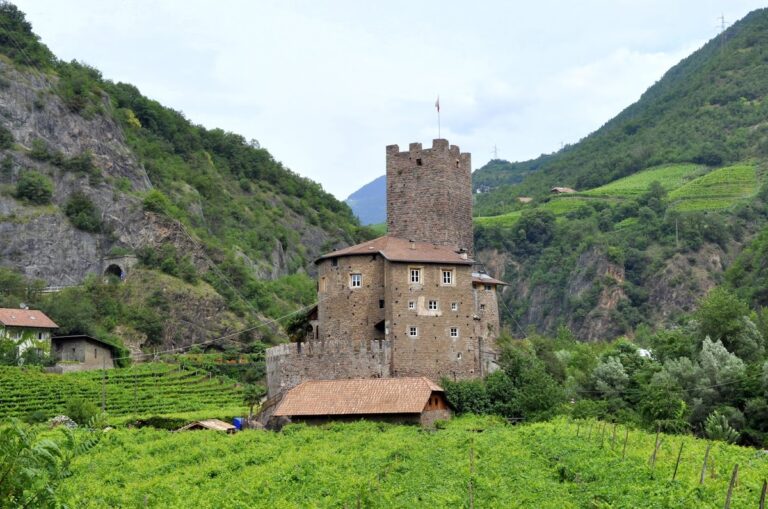
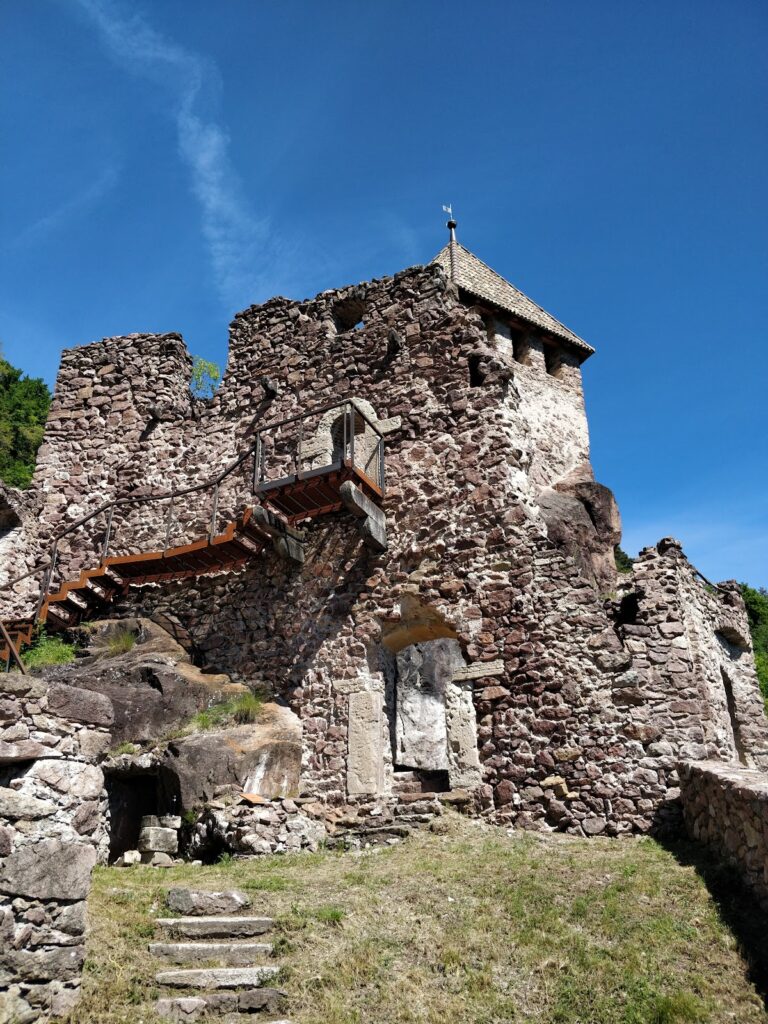
Rafenstein is located on a rocky hill 692 meters above sea level on the western flank of the Talvera valley, overlooking the Sarntal valley. Its layout reflects centuries of construction and adaptation, beginning with 13th-century medieval masonry characterized by thick, whitewashed stone walls measuring two to three meters in thickness.
The earliest structures included the palas, or main residential building, situated in the castle’s southeast corner. This building served as the principal living quarters and administrative heart. Surrounding the palas was a ring wall that originally enclosed the castle’s inner courtyard. This wall concluded at a tower on the northern side, establishing a defensible perimeter.
During the 14th century, expansions added a zwinger, an outer courtyard designed to trap and expose attackers, along with a gate tower and an elongated southern wing. These additions enhanced both the castle’s defenses and domestic space. The ring wall was reinforced, and the palas underwent restoration to replace damages suffered during the 13th-century siege.
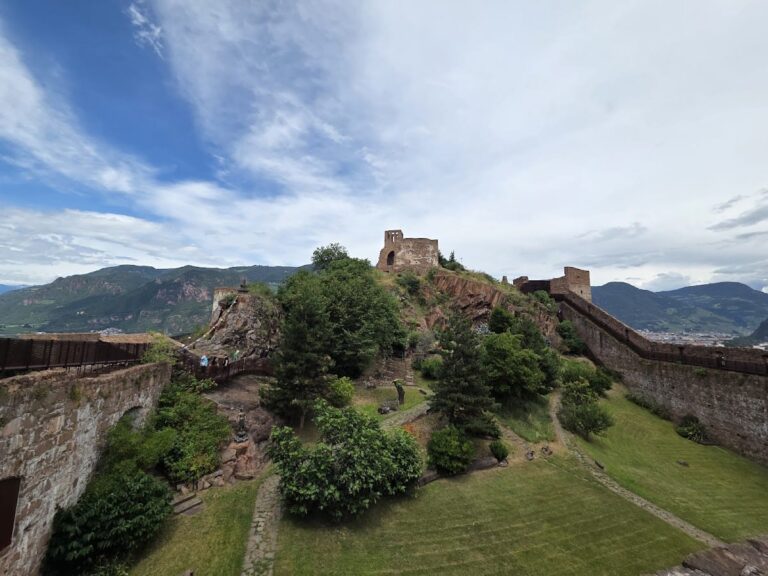
In the 16th century, major renovations transformed the castle’s fortifications to meet the demands of firearm warfare. The ring walls between the palas and northern tower were reshaped into two-story buildings, while an additional two-story structure was integrated along the northern wall between the tower and entrance gate. A new outer ring wall encircled the castle, featuring four round bastions—rounded defensive towers designed to deflect incoming projectiles—and a gate tower presenting a more Renaissance-style architectural character.
The main tower itself was heightened in the early 1600s, and its windows were enlarged, reflecting a shift from purely military utility toward improved comfort and light. Nearby, the southern wing gained a chapel, serving religious functions within the fortified setting.
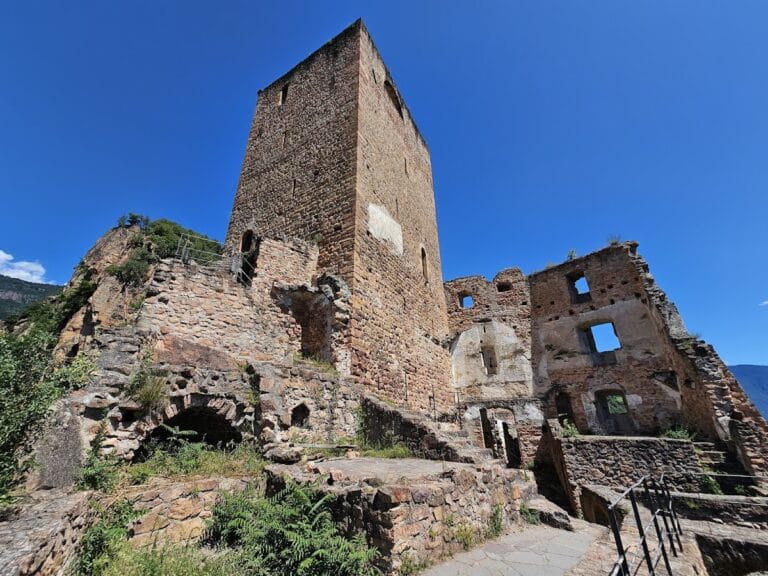
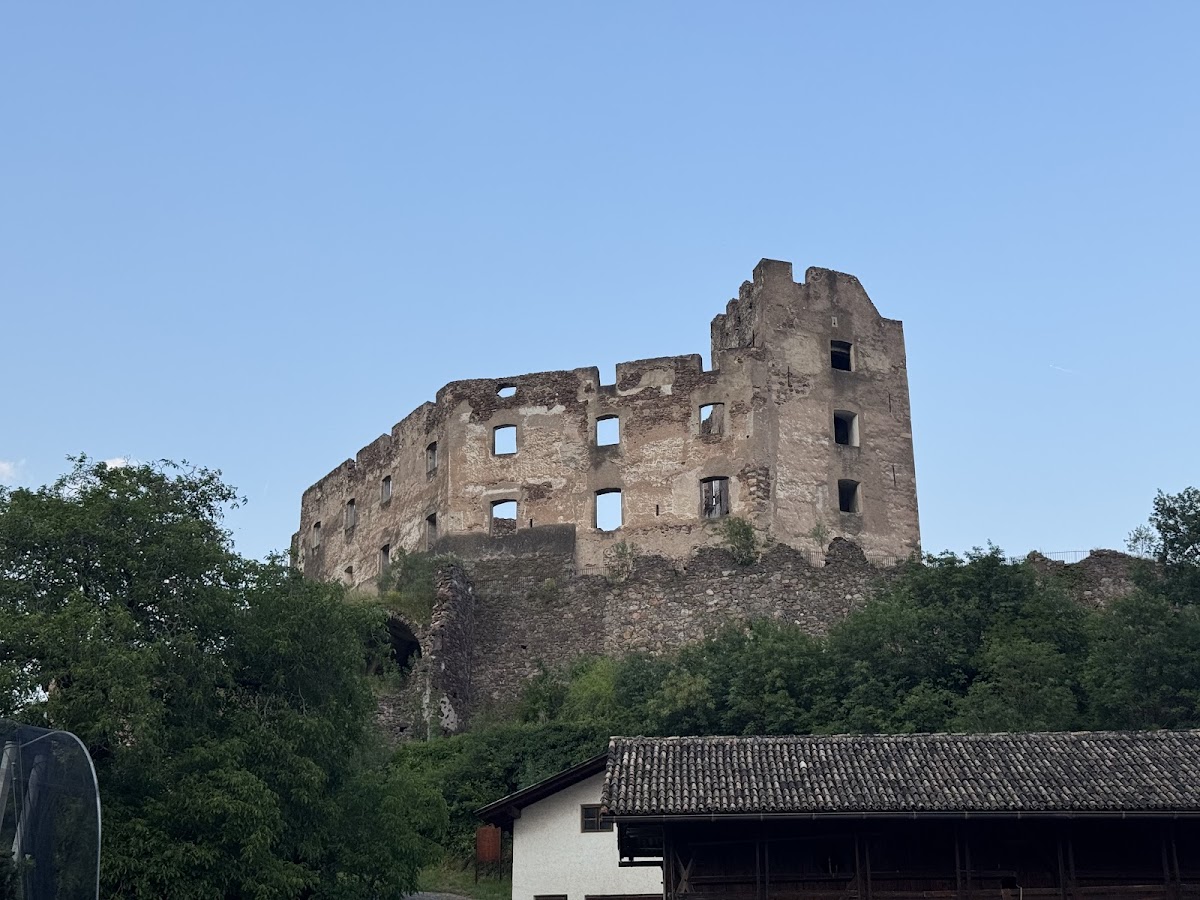
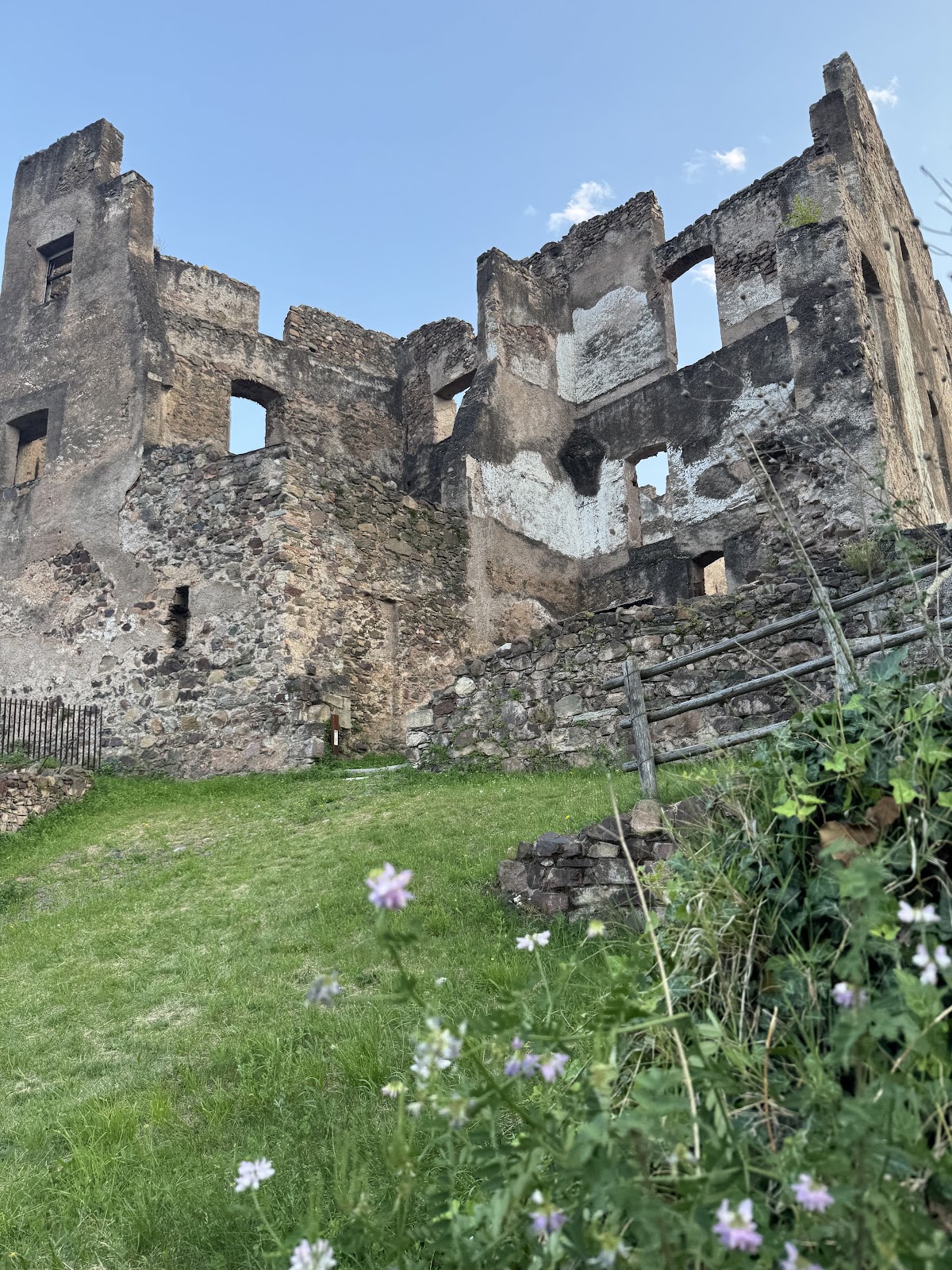
Despite centuries of alterations, some parts of the walls and bastions have collapsed or remain partially ruined. The northeast corner, specifically, was destroyed by French artillery fire in 1797 and has remained in that state, affecting the castle’s silhouette today. From a distance, the core whitewashed building often appears unfinished or abandoned due to the condition of these ruins.
Archaeological investigations from 2008 to 2014 uncovered several significant features within the castle. Among these were medieval kitchen remains that provide insight into historical domestic life. Walls discovered during excavation showed whitewashed surfaces, and Renaissance-era marble friezes and columns were also found, indicating decorative enhancements linked to the castle’s later owners.
A small museum housed inside the gate tower displays artifacts uncovered on site, such as uniform buttons from a French soldier found in the northeast corner, supporting accounts of the 1797 bombardment. The museum includes a detailed model of Rafenstein as it appeared during the time of Francisk von Rafenstain, offering a visual representation of the castle’s historical form.
Access to the ruin is possible by a steep, narrow road from Bolzano, while a gentler route comes from the nearby town of Jenesien. Though partly restored, the site’s remote position and delicate condition necessitate supervised visits.
Nearby sites