Sigmundskron Castle: A Medieval Fortress and Museum in South Tyrol


Site at a Glance
- Rating
- 4.5
- Popularity
- Low
- Country
- Italy
- Primary era
- Medieval
- External website
- Open
- Eras represented
- Medieval, Modern
- Civilizations
- Habsburg, Holy Roman Empire
- Site type
- Military
- Remains
- Castle
On this page13 sections
History
Sigmundskron Castle is a medieval fortress in Bolzano, Italy, first recorded around 945 under the names Formicaria and later Formigar. Its position above the Adige Valley gave it an important place in the political and judicial affairs of the Bolzano area. In 1027, Holy Roman Emperor Conrad II entrusted the castle to the Prince-Bishop of Trent.
Medieval Episcopal Stronghold
From the twelfth century, the castle was held by ministerial families, dependent nobles who served a ruler or church lord in military and administrative roles. Several of these families adopted the aristocratic name Firmian. The thirteenth-century holders included the Estrich, Hahn, Häring, Kastraun, Ripp, and Zungel families, while castle burgraves are recorded from 1144.
The castle was closely connected with the bishopric’s authority in the region. A ford across the Adige below the fortress appears in records from 1163 as the location of the bishops’ feudal court in the Bolzano area. This connection placed Sigmundskron within the administration of the Prince-Bishop of Trent as well as within the military landscape of the valley.
Habsburg Expansion
Part of the complex entered Habsburg possession around 1370. Around 1473 or 1474, Sigismund of Austria, known as Sigismund the Rich and the territorial prince of Tyrol, acquired the castle. He renamed it Sigmundskron, meaning “Sigismund’s Crown,” and greatly enlarged it into a fortress intended to resist firearms.
Sigismund soon had to pledge the castle because of financial difficulties, although he retained jurisdiction through a Burgfrieden, a castle district governed by its own judicial authority. This district remained subject to the territorial court of Gries and Bolzano. From the seventeenth century, the cost of maintaining the enlarged complex contributed to its deterioration. The castle was eventually abandoned and fell into ruin.
Later Ownership and Political Assembly
From the late eighteenth century, Sigmundskron belonged to the Counts of Wolkenstein. The Counts of Sarnthein held it from 1807 to 1870, followed by the Counts of Toggenburg, whose ownership continued until 1994.
On 17 November 1957, more than 30,000 South Tyroleans gathered among the ruins in the largest protest in South Tyrolean history. Led by Silvius Magnago, a prominent advocate of regional autonomy, they protested the failure to implement the 1946 Paris Agreement and demanded effective provincial autonomy. Their slogan, “Los von Trient,” or “Away from Trento,” connected the ruined castle with the region’s political movement.
Restoration and Museum Use
In 1976, a family of innkeepers partially restored the semi-ruined complex and opened a restaurant there. Ownership passed to the Autonomous Province of Bolzano in 1996. After considerable controversy, the mountaineer Reinhold Messner received a concession in spring 2003 to establish a mountain museum at the castle.
Architect Werner Tscholl designed the adaptation, and restoration and conversion continued until 2006. The Messner Mountain Museum Firmian opened on 9 June 2006 as the principal site and one of the branches of the Messner Mountain Museum network. The castle consequently became both a museum complex and a contemporary symbol of South Tyrolean autonomy.
A Neolithic grave discovered during restoration in March 2006 added another period to the site’s history. It contained the skeletal remains of a woman and was estimated to be 6,000 to 7,000 years old.
Remains
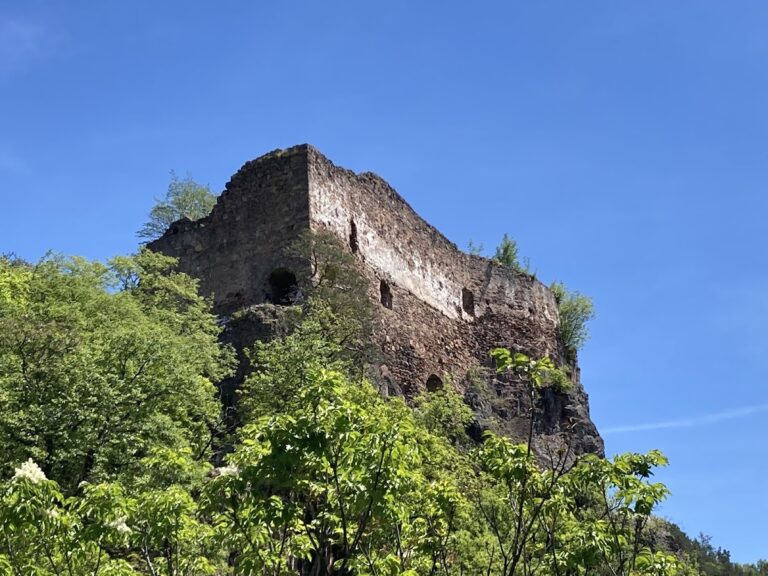
Sigmundskron occupies a porphyry rock, a volcanic rock, on the northernmost spur of the Mitterberg, also called Kaiserberg, at the southwestern edge of the Bolzano basin. The rock rises above the Adige and Eisack rivers, while the Merano to Bolzano expressway runs through a tunnel beneath it. The extensive castle and fortress complex survives in a ruined condition, with its early remains concentrated near the highest point and its later defensive works extending across the rocky site.
Early Fortress and Chapel
Formigar
The earliest castle, Formigar, survives in relatively small traces around the summit of the fortress grounds and the castle chapel. These remains belong to the first recorded phase of the site and occupy the highest part of the complex.
Saint Blaise and Saint Ulrich Chapel
The chapel at the highest point is dedicated to Saint Blaise and Saint Ulrich of Augsburg. It may predate the fortification, while an addition in the Romanesque style, the medieval architectural style used for the extension, dates to around 1100. A bishop’s palace was added during the twelfth century, forming part of the ecclesiastical complex around the early fortress.
Fifteenth-Century Fortress
Enclosing Walls and Towers
Sigismund’s fifteenth-century expansion produced a substantial enclosing fortification and corner towers designed to withstand firearms. The surviving defensive layout includes an entrance gate or gate tower, an eastern curtain wall, and a southern circulation route running along that wall. Eastern and western rounded defensive structures, known as rondels, project from the fortified walls.
Residential and Service Buildings
Within the fortified enclosure are a palas, the principal residential or representative building of a medieval castle, an entrance courtyard, a service building, and the structure called the White Tower. South of the bridge across the Adige below Sigmundskron stands the building known as the Fischerkuchel. In German usage, Sigmundskron can refer not only to the fortress but also to the territory below it and the Adige bridge known in Italian as Ponte Adige.
Museum Adaptation
The modern conversion was designed to respect the historic setting of the ruins. Steel, glass, and iron elements were added instead of rebuilding the castle as a historicist masonry structure. The museum occupies more than 1,100 square metres and presents the relationship between humans and mountains through objects gathered from around the world.
The White Tower contains a small museum of contemporary history, while an arena within the castle provides space for conferences, exhibitions, and concerts. These additions coexist with the surviving walls, towers, chapel, and other remains of the medieval and Habsburg fortress.
Nearby sites