Burg Hundeluft: A Medieval Water Castle in Germany


Site at a Glance
- Rating
- 4.7
- Popularity
- Very Low
- Country
- Germany
- Primary era
- Medieval
- Eras represented
- Medieval
- Civilizations
- Holy Roman Empire
- Site type
- Military
- Remains
- Castle
On this page7 sections
History
Burg Hundeluft is a medieval water castle in Germany, first documented around 1280 during a dispute between Margrave John II of Brandenburg and Günter, Archbishop of Magdeburg. The site was established to secure an old trade route and a crossing over the Rossel south of the castle. As a lowland water castle, it stood in relatively flat, wet terrain rather than on a hill.
From manor to contested stronghold
In 1307, Hundeluft was recorded as a village with a manor belonging to the Diseke family. In 1405, the castle and village were pledged to Johann von Quitzow as security for a promised reward. Prince Albrecht of Zerbst had promised the reward after Johann helped him capture Dessau Castle, but when Albrecht could not pay, he offered Hundeluft instead.
Johann appointed Cuno and Godemar Walwitz as castle captains, officials responsible for commanding and overseeing the stronghold. Under the brothers, Hundeluft became a base for raids, arson, and plundering in the border region between the Margraviate of Brandenburg and Electoral Saxony. Johann von Quitzow was regarded as a feared robber knight, a noble warrior involved in armed raiding and plunder.
Capture and later decline
On 8 February 1414, Prince Albrecht of Zerbst captured Hundeluft after a siege lasting one day and one night. Cuno and Godemar Walwitz fled to Dessau, while the castle and village passed into Albrecht’s possession.
The castle and village were destroyed during the Thirty Years’ War, the European conflict fought from 1618 to 1648 through intertwined religious, dynastic, and territorial struggles. In 1735, the last hereditary lord of the von Zerbst family sold Hundeluft Castle and village to the Prince of Anhalt-Zerbst. The castle was no longer used as a residence, and its buildings were dismantled during the second half of the eighteenth century. Their materials were reused in buildings in the village and at the manor.
During the early nineteenth century, the grounds were redesigned as a park. They became overgrown during the twentieth century. The surviving remains are registered in local heritage registers as both an archaeological monument and an architectural monument.
Remains
Layout and defenses
Burg Hundeluft was a water castle surrounded by swamp and water, standing about 1.5 metres above the surrounding marshy ground. The complex covered approximately 12,000 square metres and consisted of a principal fortified enclosure and an outer bailey, a subsidiary enclosed area used for service buildings and related activities. The roughly pentagonal core castle occupied about 800 square metres. Its original entrance lay on the northwestern side, while an inner and an outer water-filled moat protected the enclosure.
Castle buildings and water supply
Three residential and service buildings were built against the shield wall, the especially strong section of fortification protecting an important side of the castle. A round tower stood in the northwestern part of the complex. It had an external diameter of 5 metres and was not incorporated into the outer wall. Two wells in the southern part of the site supplied water to the castle grounds.
The outer bailey contained a long timber-framed building now known as the Alte Burg. Timber framing uses a structural framework of wooden members with infill between them, and the building remains under heritage protection. A chapel also stood within the castle grounds.
Surviving fabric
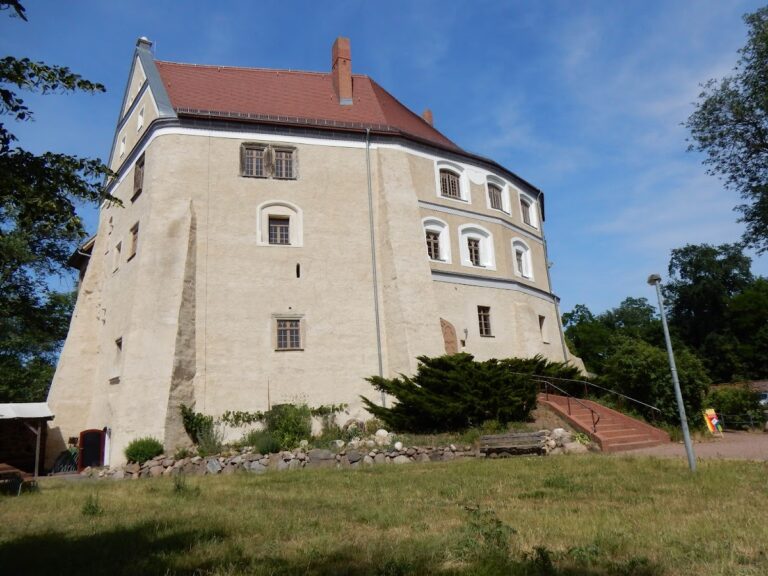
Only individual stones and a boulder wall survive from the former castle complex. The wall reaches a height of up to 2 metres, providing the principal visible evidence of the earlier fortified site.