Pollentia: A Roman Municipium near Alcúdia, Spain

Visitor Information
Google Rating: 4.2
Popularity: Medium
Google Maps: View on Google Maps
Official Website: www.alcudia.net
Country: Spain
Civilization: Roman
Remains: City

History
Pollentia is a Roman settlement established near the modern town of Alcúdia in Spain. It was founded around 70 BCE following the Roman conquest of Mallorca, which occurred approximately fifty years earlier in 123 BCE under Consul Quintus Caecilius Metellus Balearicus. Originally created as a military camp, Pollentia rapidly grew into the principal urban center in the Balearic Islands, reflecting its growing importance in the process of Romanization throughout the region.
The city’s name, meaning “the Mighty,” signified its greater prominence compared to Palma, another Roman city on the island. Pollentia evolved into a municipium, a self-governing town granted certain Latin rights, and likely welcomed settlers from the Roman province of Hispania. Its strategic location along Mediterranean maritime routes made it a vital port and a key stopover for ships traveling from Italy towards other parts of the western Mediterranean, supporting its prosperity during the early Roman imperial period.
In the late 1st century BCE, Pollentia underwent significant urban development, including the construction of important public and religious buildings such as a capitoline temple, which underlined its civic and religious functions. Despite its early growth, the city faced devastation in the 3rd century CE when a fire caused widespread damage. Around this time, Pollentia was fortified with defensive walls, signaling attempts to protect the settlement amid increasing regional instability.
The city’s fortunes changed dramatically in 426 CE when it was attacked and sacked by the Vandals, led by King Gunderic. Nevertheless, Pollentia continued to exist during the periods of Vandal and later Byzantine control, maintaining a diminished yet ongoing occupation into the early medieval era. Its gradual decline culminated around the early 10th century when the population shifted to a newly founded medieval town known as Alcúdia, located nearby.
Archaeological interest in Pollentia began sporadically as early as the 16th and 17th centuries, but systematic excavations did not commence until the early 20th century. This work was initiated by Gabriel Llabrés Quintana and later extended by his son Joan Llabrés Bernel. Mid-20th-century efforts further advanced the study of the site with the contributions of archaeologists Lluís Amorós, Martí Almagro, and Antoni Arribas, supported by the William L. Bryant Foundation. Today, excavations continue to provide insight into Pollentia’s historical role and structure.
Remains
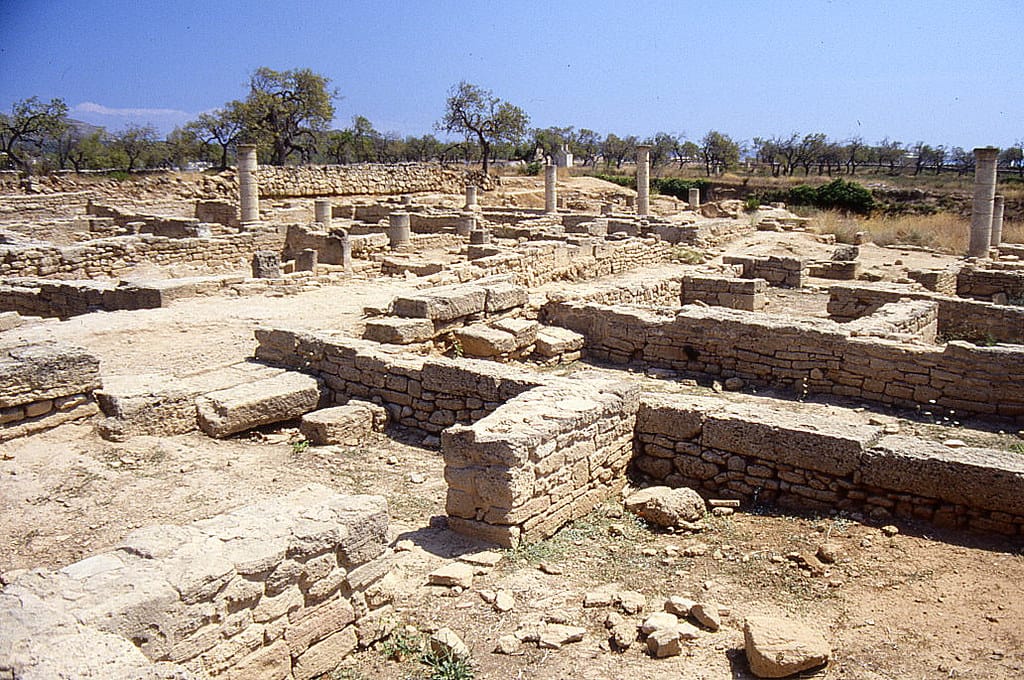
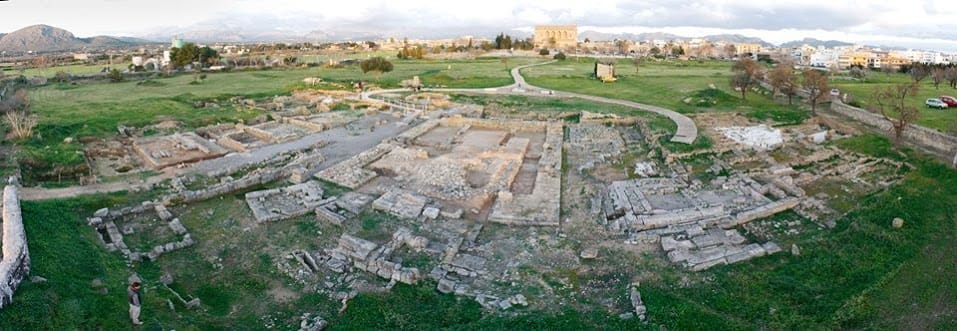
The remains of Pollentia cover an area of about 15 to 18 hectares and reflect the orthogonal street layout typical of Roman urban planning. The city’s residential sector includes several well-preserved houses and villas constructed with stone and decorated with features such as marble, stucco, and mosaic flooring. These homes were connected to baths and equipped with water supply and sewage systems, illustrating the advanced infrastructure of the settlement.
One notable residential area is Sa Portella, situated near the modern church of Sant Jaume in Alcúdia. It contains several Roman dwellings arranged along organized streets. Among these, the Casa dels dos Tresors stands out, built around a central atrium with surviving columns of its entrance portico. Opposite this house lies the Casa del Cap de Bronze, a villa featuring a colonnaded walkway where excavations uncovered a bronze head of a young girl. Additionally, the Casa Nord-oest is identifiable by its foundations, which support a fragment of the city’s 3rd-century defensive wall.
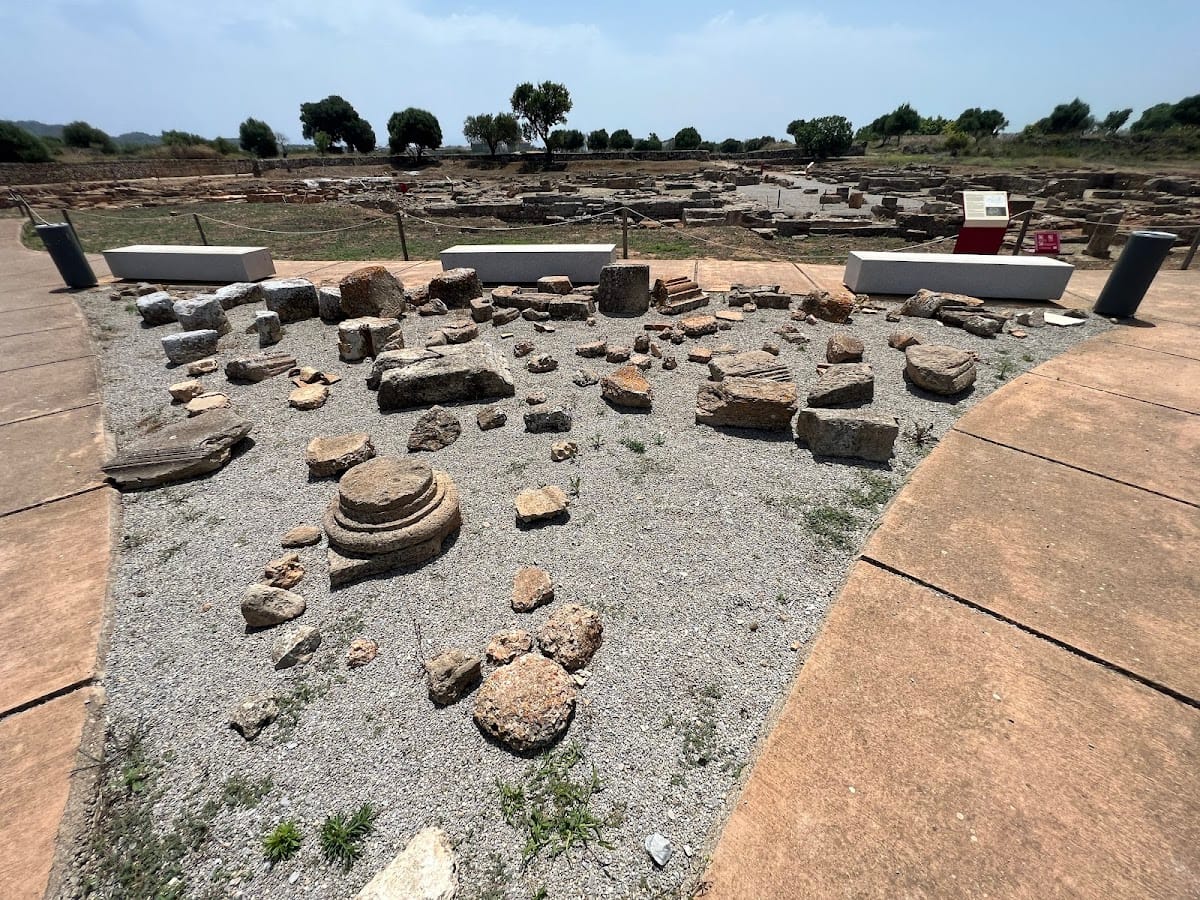
The civic heart of Pollentia lies about 200 meters southeast of Sa Portella in the Roman forum, which functioned as the city’s administrative and religious center. The forum features the ruins of a capitoline temple from the 1st century BCE that was erected on a raised platform or podium. This main temple was flanked to the east by two other religious buildings, and to the west, across a north-south street, was a commercial area consisting of small shops known as tabernae arranged along narrow alleys. A small square shrine measuring five by three meters, known as an aedicula and aligned with the four cardinal directions, stood to the south of the temple. Following the forum’s destruction, much of this area was repurposed as a burial ground.
Approximately 400 meters southeast of the forum, outside the original city limits, lies a Roman theater constructed in the 1st century CE. The theater has a semicircular seating area, or cavea, with ten surviving rows hewn mostly from the bedrock, except for the lowest row, which consists of large sandstone blocks. From the third row, three staircases carved into the rock provide access to the upper seating. The orchestra is semicircular with a diameter of five meters and is separated from the stage by a rock formation known as the proskenion, perforated with five holes likely intended for stage rigging. This theater could accommodate roughly 2,000 spectators. Remarkably, two large cavities in the seating correspond to earlier artificial caves used as burial sites before the theater was built, with additional holes related to graves created after the theater had fallen into disuse.
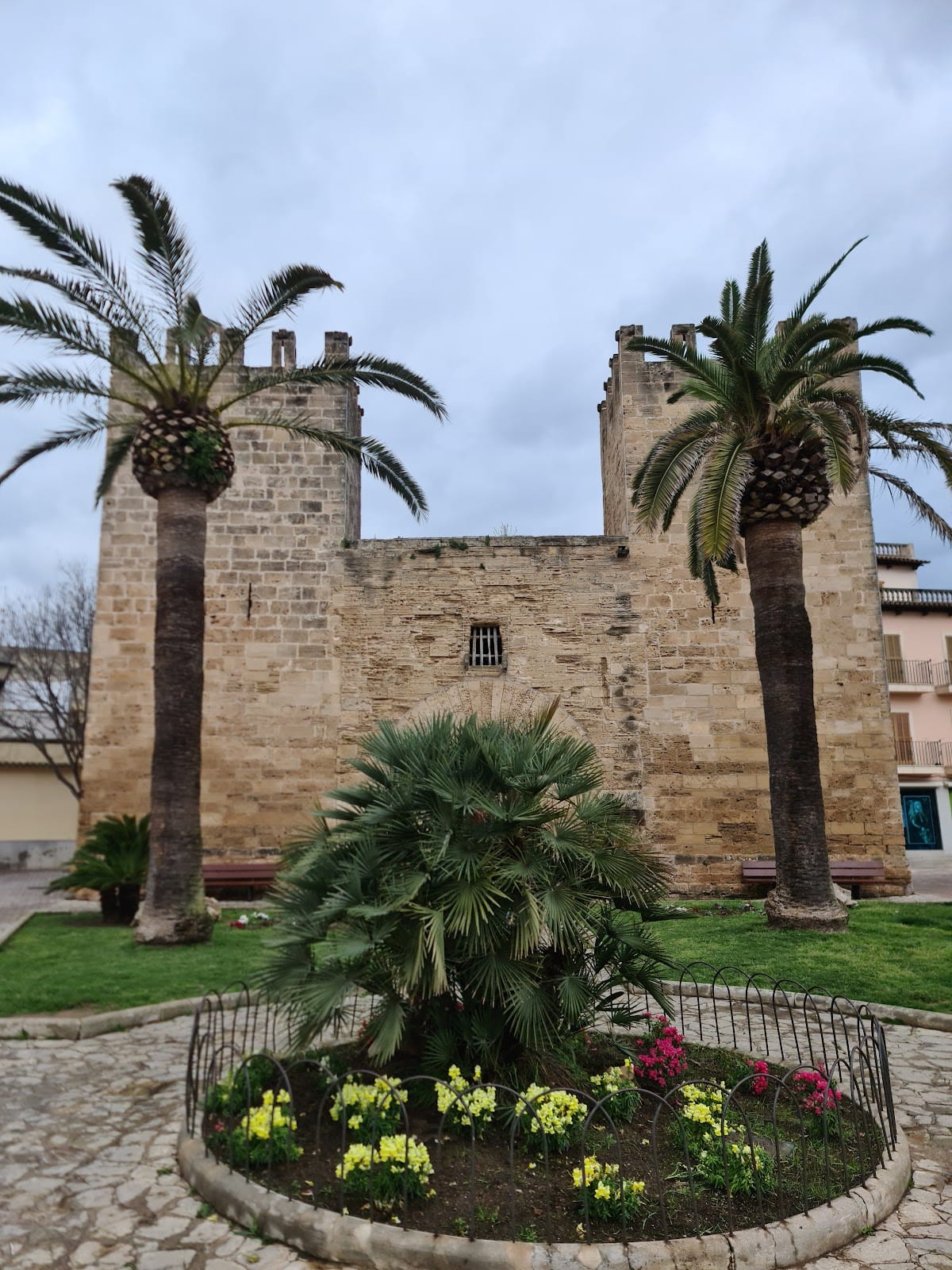
Pollentia was defended by a city wall built in the 3rd century CE, parts of which remain visible today, particularly near Sa Portella. The city maintained two harbors: a smaller northern port located in the Bay of Pollença and a larger southern port close to what is now Port d’Alcúdia. These ports supported the city’s commercial activities by facilitating maritime trade.
Archaeological finds from the site include numerous bronze objects such as a standard belonging to the youth organization Collegium Iuvenum, a bronze head representing the god of healing Asklepios, and a horse’s head, all now preserved in the National Archaeological Museum. In addition, the excavations have uncovered ceramics, glassware, amphorae for storage, coins, stone inscriptions, marble sculptures, and colorful mosaics. Many of these artifacts are displayed locally in the Monographic Museum of Pollentia, which occupies a 16th-century former hospital building in Alcúdia.
Nearby sites