Pazin Castle: A Historic Medieval Fortress in Croatia

Visitor Information
Google Rating: 4.3
Popularity: Medium
Google Maps: View on Google Maps
Official Website: www.muzej-pazin.hr
Country: Croatia
Civilization: Medieval European
Remains: Military

History
Pazin Castle, located in the municipality of Pazin in modern-day Croatia, was originally constructed by medieval settlers within the framework of the early Croatian and Germanic influences of the region. The site’s earliest known documentation appears in an imperial charter from the year 983 AD, issued by Emperor Otto II, which confirmed a donation made decades earlier in 931 AD to the Bishop of Poreč. This early record marks Pazin Castle as one of Croatia’s oldest surviving fortifications.
During the Middle Ages, Pazin Castle belonged to the Istrian margraviate, a frontier territory ruled by margraves under varying Central European powers. From the 12th century onward, it became the administrative center of Pazin County, reflecting its importance within the evolving political landscape dominated by Germanic authorities, later absorbed by the Habsburg dynasty. Following the extinction of the original noble family controlling the castle in 1374, ownership transferred to the Habsburgs, who retained control for nearly four centuries. Throughout this period, the castle was often delegated to various noble families including Auersperg, Barbo, Mosconi, Swetkowitz, Turinetti de Prie, and Walsee, who managed or leased the property in the name of the ruling dynasty.
Situated on the border between Habsburg-controlled territories and the Republic of Venice, Pazin Castle held vital strategic importance. It endured repeated sieges and attacks, most notably a Venetian capture in 1508, after which the fortress suffered substantial damage. However, the defenders reclaimed the castle the following year. The early seventeenth century brought further conflict during the Austro-Venetian wars. Although the castle was damaged in these struggles, it withstood subsequent attacks and remained under Habsburg authority until peace was established in 1621.
In 1766 the Montecuccoli family assumed possession of Pazin Castle, maintaining their hold until the conclusion of the Second World War. After 1945, the castle was nationalized and repurposed as the headquarters of the Yugoslav secret police known as OZNA. During this time, the fortress also functioned as a detention and execution site, reflecting the tense political environment of the post-war period.
In the late nineteenth century, Pazin Castle entered cultural history as the inspiration for Jules Verne’s novel “Mathias Sandorf,” published in 1885. Verne’s story highlights the nearby natural feature called the Pazin abyss (Pazinska jama), a dramatic karst sinkhole below the fortress that lent a powerful atmosphere to the narrative’s setting.
Since 1987, preservation efforts have aimed to stabilize and restore the castle, overseen by the Croatian Ministry of Culture. These ongoing projects reflect the castle’s continued significance as a monument spanning over a millennium of regional history.
Remains
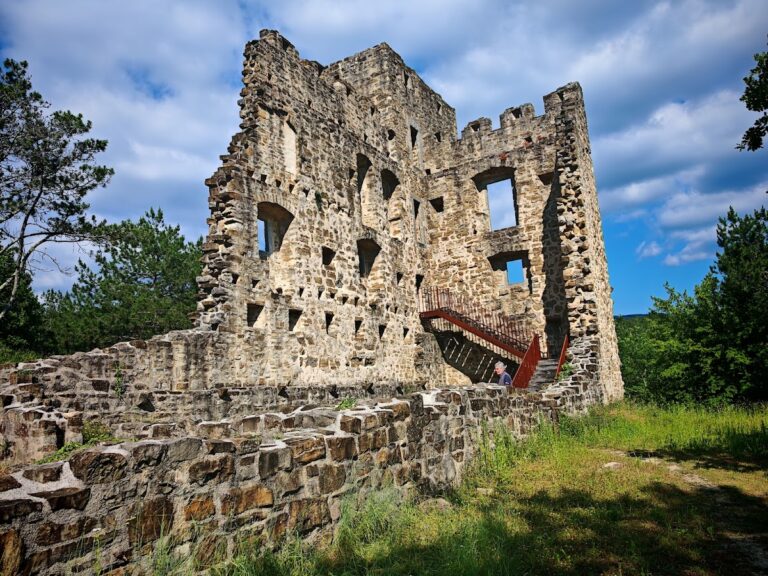
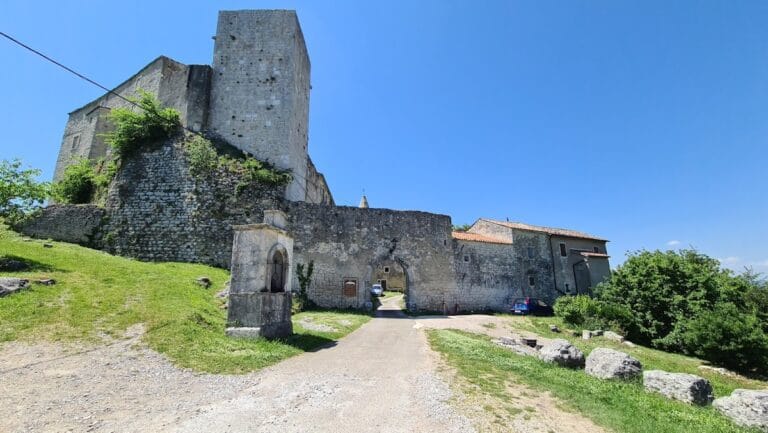
Pazin Castle rises prominently on a steep rock overlooking a deep karst abyss formed by the Pazinčica river, a natural chasm approximately 100 meters deep and 20 meters wide. This dramatic location distinguishes it from many other Istrian fortresses, which typically occupy hilltop positions, granting it both defensive advantage and imposing presence.
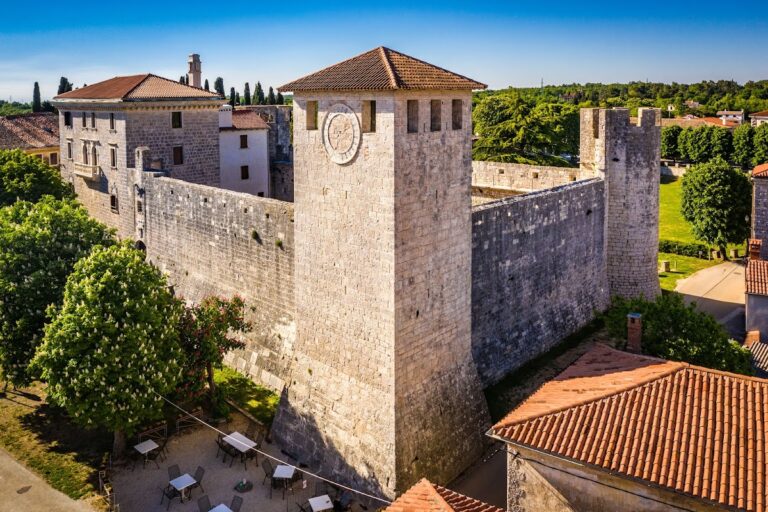
The fortress’s layout is an irregular polygon enclosing a central courtyard with a cistern for water storage, illustrating multiple phases of construction and adaptation across centuries, from its original Romanesque form through various Gothic and Renaissance modifications. Initially, the castle consisted of a simple elongated rectangular building featuring a ground floor and two upper stories. A quadrangular tower and a small chapel dedicated to the Virgin Mary, complete with its own bell tower, formed integral parts of this early structure.
Reconstruction work during the 12th to 14th centuries introduced German Gothic elements to the exterior façades and interior spaces while retaining the fundamental Romanesque floor plan. Further additions in the 15th century enhanced the castle’s functionality, including crenellated galleries running along the walls, stables for horses, kitchen facilities, storage rooms, and a large cistern situated near the main entrance to ensure a reliable water supply during sieges.
To strengthen defense, the castle was fortified with a double straight curtain wall on the eastern side and a semicircular forewall protecting the main quadrangular tower. Access to the fortress was through a steep ramp equipped with a double gate and drawbridge system, a method employed until the early 19th century to regulate entry and improve security.
Two main towers served as defensive strongpoints: a significant quadrangular tower situated above the abyss provided surveillance and protection towards the most vulnerable flank, while a semicircular tower constructed in 1560 stood on the northern side, reflecting advances in military architecture of the Renaissance period. In later centuries, some of the battlements and towers were reduced in height or sealed off during modifications carried out in the 18th and 19th centuries.
The castle’s principal façade displays five heraldic coats of arms representing various noble families associated with its history, including the Duinati, Walsee, and De Pisino, as well as two arms of uncertain origins, possibly linked to the Rab, Schül, or Steindorfer families. These emblems bear witness to the castle’s complex feudal allegiances over time.
Inside, the castle accommodates a range of cultural collections and administrative spaces. The second floor houses the Ethnographic Museum of Istria, preserving local cultural heritage, while the first floor is dedicated to the City Museum and municipal archives. A ceremonially used hall occupies the rotunda floor, and the ground floor contains general-purpose areas along with a collection of church bells that were melted down during the First World War. The castle stands as one of the best-preserved medieval fortresses in Istria, continuously in use for over a thousand years. Most sections have undergone restoration efforts, though the portion located directly above the abyss remains unrestored.
Nearby sites