Castello Morosini-Grimani: A Renaissance Fortress in Croatia


Site at a Glance
- Rating
- 4.7
- Popularity
- Medium
- Country
- Croatia
- Primary era
- Medieval
- External website
- Open
- Eras represented
- Medieval
- Civilizations
- Venetian
- Site type
- Military
- Remains
- Castle
On this page8 sections
History
Castello Morosini-Grimani is a fortified castle in Svetvinčenat, Croatia, whose earliest nucleus is variously placed in the twelfth century while its first documented existence belongs to the medieval period and construction is also dated to the mid-thirteenth century. Built to protect the settlement and its inhabitants, it stood along a commercial route connecting the Istrian interior with the coast. Its later form reflects the transition from medieval fortification to Renaissance architecture in Istria.
Medieval foundations and Morosini rule
During the medieval period, Istria was divided among the Patriarchate of Aquileia, a territorial principality governed by the patriarchs of Aquileia, the Republic of Venice, a maritime state with territories around the Adriatic, and the Holy Roman Empire, a loose central European political entity. From the thirteenth century, the de Castro-Pola family held Svetvinčenat and its surrounding territory as feudal lords.
In 1467, control of the castle passed to the Morosini dalla Sbarra family. They completed its fortification in 1485, creating a major Renaissance complex whose military purpose remained central. The name Morosini reflects this important phase of aristocratic ownership and building.
Grimani reconstruction and Venetian defense
A fire damaged the interiors in 1586. Three years later, the Grimani family acquired the castle through the marriage of Morosina Morosini and Marino Grimani. Venetian architects were commissioned to reconstruct it as an elegant fortified residence while retaining its defensive function. The Grimani and Morosini were prominent Venetian noble families, and their successive ownership shaped the castle’s present name.
Under the Grimani family, the castle served as a defensive stronghold, an administrative center, and a seigneurial residence, meaning the home of a feudal lord or noble landholder. Its fortifications supported the defense of the Republic of Venice against Ottoman and Austrian incursions. It remained under Grimani control for more than two centuries, although wars and local uprisings periodically disrupted the relative stability of the period.
Another major fire in 1616 destroyed part of the interiors. The castle nevertheless retained its strategic role until the fall of the Republic of Venice and continued to express the authority of the region’s noble families and the strategic importance of Istria.
Decline and modern conservation
The Republic of Venice fell in 1797 under the Treaty of Campo Formio, an agreement that ended the war between revolutionary France and Austria and transferred former Venetian territories to new rulers. Istria first passed under French and then Austrian control, after which the castle lost much of its strategic importance.
During the nineteenth century, the castle ceased to function as a residence or defensive structure. It was progressively abandoned, partially looted, and allowed to deteriorate, while decorations and furnishings were lost or moved to other noble residences. At the beginning of the twentieth century, Austrian authorities sought to protect historic monuments through the Central Commission for the Protection of Monuments, an institution responsible for preserving and studying monuments in Habsburg territories. Anton Gnirs, the commission’s commissioner for Istria, was associated with this work.
After the First World War, Svetvinčenat and Istria were annexed to the Kingdom of Italy. After the Second World War, they became part of Yugoslavia. The castle remained abandoned for much of the twentieth century, although restoration began during the postwar period. In the 1960s and 1970s, the Yugoslav government initiated work to recover and conserve parts of the complex. The restored castle became a cultural center, and further restoration in recent decades has aimed to preserve its integrity and interpret its history. Exhibition rooms now present the history of the Grimani family, Svetvinčenat, and the region’s political and military development, while the complex hosts concerts, historical events, and the Svetvinčenat Medieval Festival.
Remains
Fortified layout
Walls and corner towers
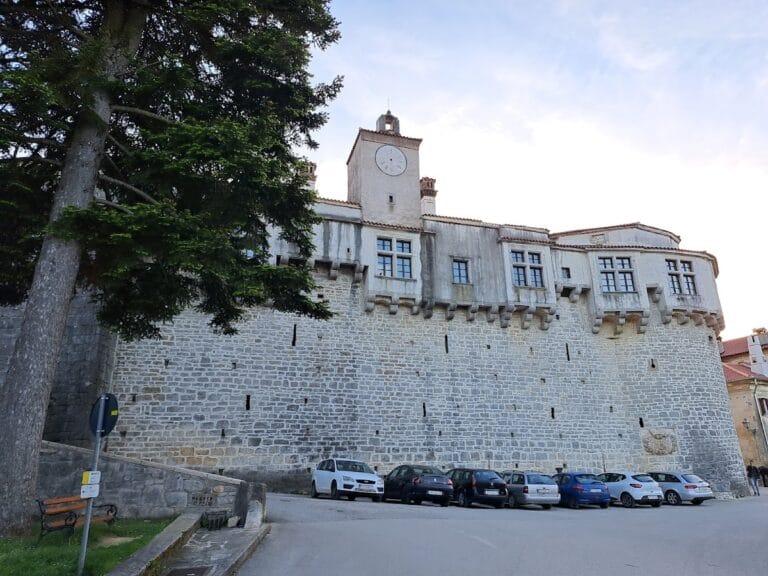
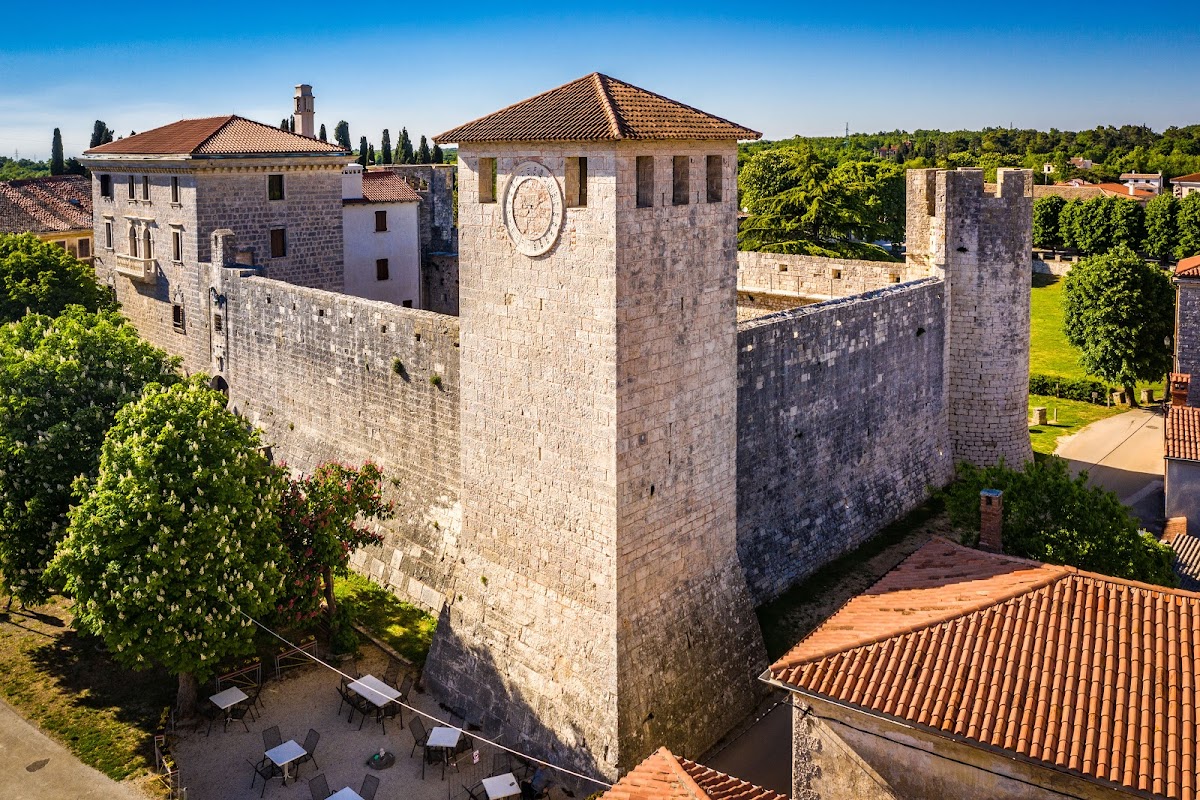
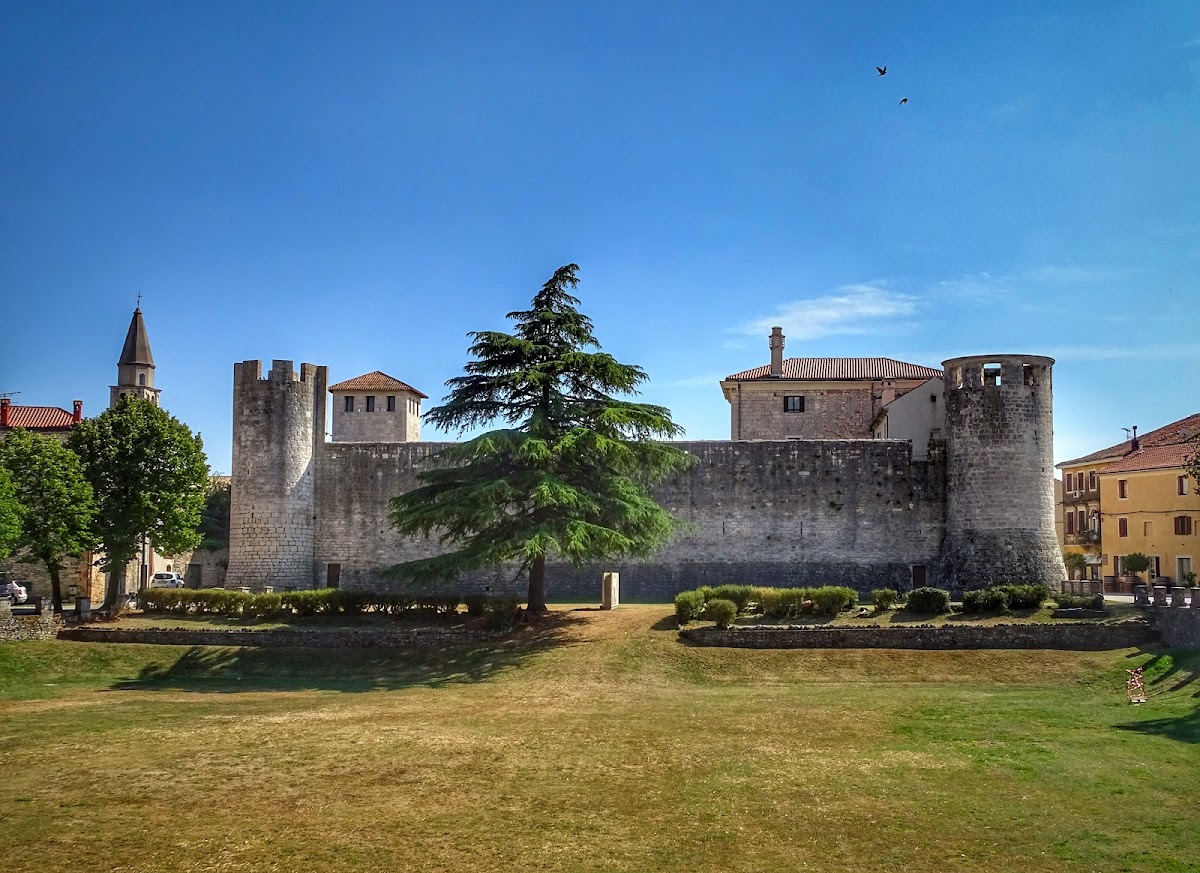
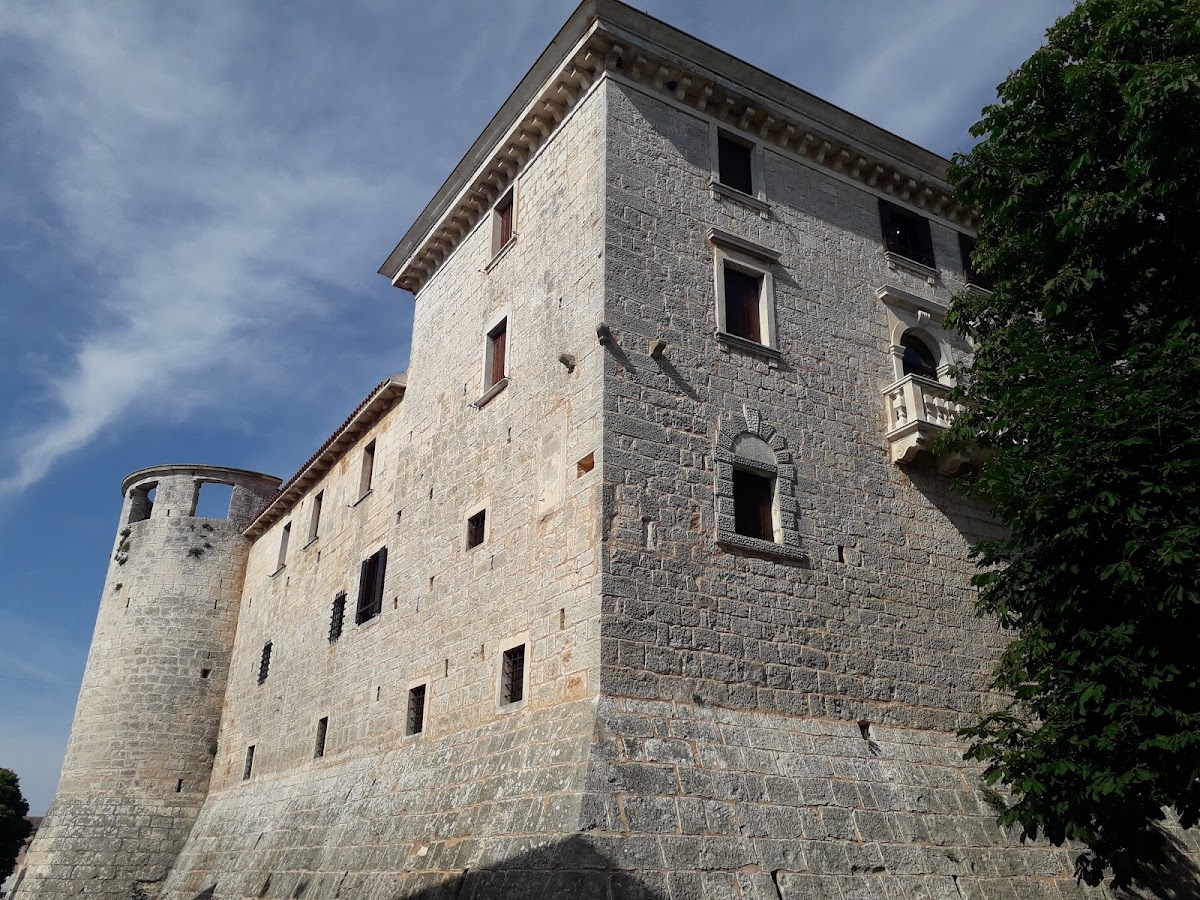
Castello Morosini-Grimani is a square, fortified Renaissance complex arranged on three levels around an internal courtyard. High, massive walls formed its principal defensive envelope, and a moat formerly surrounded the castle as an additional barrier. Three large corner towers strengthen the plan, including a keep, the castle’s principal fortified tower. Battlements, which are raised defensive sections along the walls, and loopholes, narrow openings for observation or firing, enabled defenders to watch and protect the complex.
Entrance and internal courtyard
The main entrance is marked by the Grimani family coat of arms. Inside, the courtyard provided space for the inhabitants’ daily activities during the medieval and Renaissance periods and also served defensive purposes. The walls, towers, and courtyard were restored during the Yugoslav projects of the 1960s and 1970s. Exhibition rooms within the castle now use the surviving complex to present its history and that of Svetvinčenat.