Parco Archeologico di Minturnae e Ponte Real Ferdinando: An Archaeological Park in Lazio, Italy
Table of Contents




Visitor Information
Google Rating: 4.5
Popularity: Low
Official Website: direzioneregionalemuseilazio.cultura.gov.it
Country: Italy
Civilization: Roman
Site type: Burial, City, Civic, Domestic, Economic, Entertainment, Infrastructure, Military, Religious, Sanitation

Context
The Parco Archeologico di Minturnae e Ponte Real Ferdinando is situated near the contemporary town of Minturno in Italy’s Lazio region, positioned along the Tyrrhenian coastline close to the Garigliano River’s mouth. The site occupies a coastal plain bordered by low hills, providing strategic access to both inland routes and maritime corridors. This location afforded control over natural waterways and land passages connecting the interior of the Italian peninsula with the sea, factors that significantly influenced the settlement’s historical development.
Archaeological evidence indicates that Minturnae’s origins predate Roman domination, with early Italic habitation by the Aurunci tribe. The site evolved into a Roman colony in the 3rd century BCE and maintained continuous occupation through the Republican and Imperial periods. Material culture and stratigraphic data reveal a decline during late antiquity, likely linked to environmental transformations and infrastructural neglect. The adjacent Ponte Real Ferdinando, an early 19th-century suspension bridge, underscores the enduring strategic importance of this river crossing. Present-day conservation integrates both the ancient urban remains and the historic bridge within a protected archaeological park that supports research and public engagement.
History
The archaeological complex of Minturnae and the Ponte Real Ferdinando encapsulates a multifaceted history shaped by regional political dynamics and imperial expansion. Initially an Italic settlement, Minturnae was incorporated into the Roman Republic as a colony in the late 4th century BCE, serving as a military and commercial node along the Tyrrhenian coast. Over subsequent centuries, the site experienced phases of urban growth and decline, reflecting broader patterns of Roman provincial administration, warfare, and economic change. The site’s decline in the early medieval period corresponds with environmental challenges and shifting political control in central Italy.
Pre-Roman and Auruncan Period (before 314 BCE)
Prior to Roman conquest, Minturnae was an established settlement of the Aurunci, an Italic people inhabiting central Italy’s coastal and inland areas. The Aurunci allied with the Samnites during the Second Samnite War, opposing Roman expansion. Archaeological and historical sources confirm that Minturnae was destroyed by Roman forces in 314 BCE as part of Rome’s campaign to subdue resistant Italic tribes. The site’s location near the Garigliano River and coastal routes made it a strategic point for controlling trade and military movements in the region.
Roman Conquest and Colonial Period (3rd century BCE)
Following its destruction, Minturnae was reestablished as a Roman colony between 295 and 296 BCE, reflecting Rome’s policy of consolidating control over newly conquered territories through settlement and urbanization. The colony’s urban layout was designed with the Via Appia as its principal east-west axis, functioning as the Decumanus Maximus. This road connected Rome to southern Italy, enhancing Minturnae’s role as a military outpost and commercial hub. The colony’s foundation granted Roman citizenship to settlers and imposed military obligations, integrating the site into the Republic’s administrative and defensive network along the Tyrrhenian coast.
Roman Republican and Imperial Period (2nd century BCE – 2nd century CE)
During the late Republic and early Empire, Minturnae developed as a municipium within the province of Latium et Campania. Its coastal position and proximity to the Via Appia facilitated control over land and maritime traffic between Rome and southern Italy. Literary sources, including Plutarch, reference Minturnae in military contexts, notably as the site where Gaius Marius fled while pursued by Sulla’s forces. Archaeological evidence documents significant urban development during this period, including the construction of Republican and Imperial fora, temples, a market (macellum), baths, and a theater capable of seating over 4,000 spectators.
The Republican forum, dating to the 2nd century BCE, was located north of the Via Appia and featured a rectangular square bordered by porticoes and two temples, including a Capitolium dedicated to Jupiter, Juno, and Minerva. The Imperial forum, constructed in the 2nd century CE south of the Via Appia, contained civic buildings such as the curia and basilica, serving as centers for municipal administration and assemblies. The macellum, also from the 2nd century CE, comprised tabernae arranged around a quadriporticus, facilitating commercial activities. The thermal complex included mosaic-decorated baths with hypocaust heating systems. These structures attest to Minturnae’s sustained urban vitality during the Pax Romana, although epigraphic evidence does not indicate a provincial capital status beyond its municipium designation.
Late Antiquity and Early Medieval Period (6th century CE)
The period from the 3rd to 6th centuries CE was marked by political instability, economic contraction, and external pressures on the Roman Empire. Minturnae remained inhabited during late antiquity, as stratigraphic layers reveal continued use of urban spaces. The town was incorporated into the late Roman Diocese of Italy and lay near contested frontiers during the Gothic Wars (535–554 CE) between the Byzantine Empire and Ostrogothic Kingdom. Although no direct archaeological evidence of military engagements at Minturnae survives, the region’s strategic importance is well documented.
By the early Middle Ages, Minturnae experienced decline due to environmental factors such as river silting and marsh expansion, which compromised agriculture and infrastructure. The settlement likely suffered from reduced maintenance and political fragmentation, including Lombard incursions between 580 and 590 CE, which probably contributed to its destruction or abandonment. Archaeological data suggest a gradual depopulation rather than abrupt devastation, with a shift toward rural settlement patterns in the surrounding territory.
Modern Period (19th–20th century)
In the 19th century, the Minturno area retained strategic significance, exemplified by the construction of the Ponte Real Ferdinando over the Garigliano River. Designed by engineer Luigi Giura and completed in 1832 under King Ferdinand II of the Two Sicilies, this iron chain suspension bridge was the first of its kind in Italy and among the earliest in Europe. It facilitated military and commercial transit along the Tyrrhenian coast and represented a notable achievement in industrial architecture within the Bourbon Kingdom.
The bridge was a focal point during the 1860 conflict between the Kingdom of Sardinia and the Kingdom of the Two Sicilies and again during World War II, when German forces destroyed it in 1943 to hinder Allied advances along the Gustav Line. Earlier, in 1820, Marshal Laval Nugent, commander of the Bourbon army, removed 158 sculptures from the archaeological site, many of which were dispersed internationally. These events underscore the continued military and cultural relevance of the Minturno area beyond antiquity.
Contemporary Period (21st century)
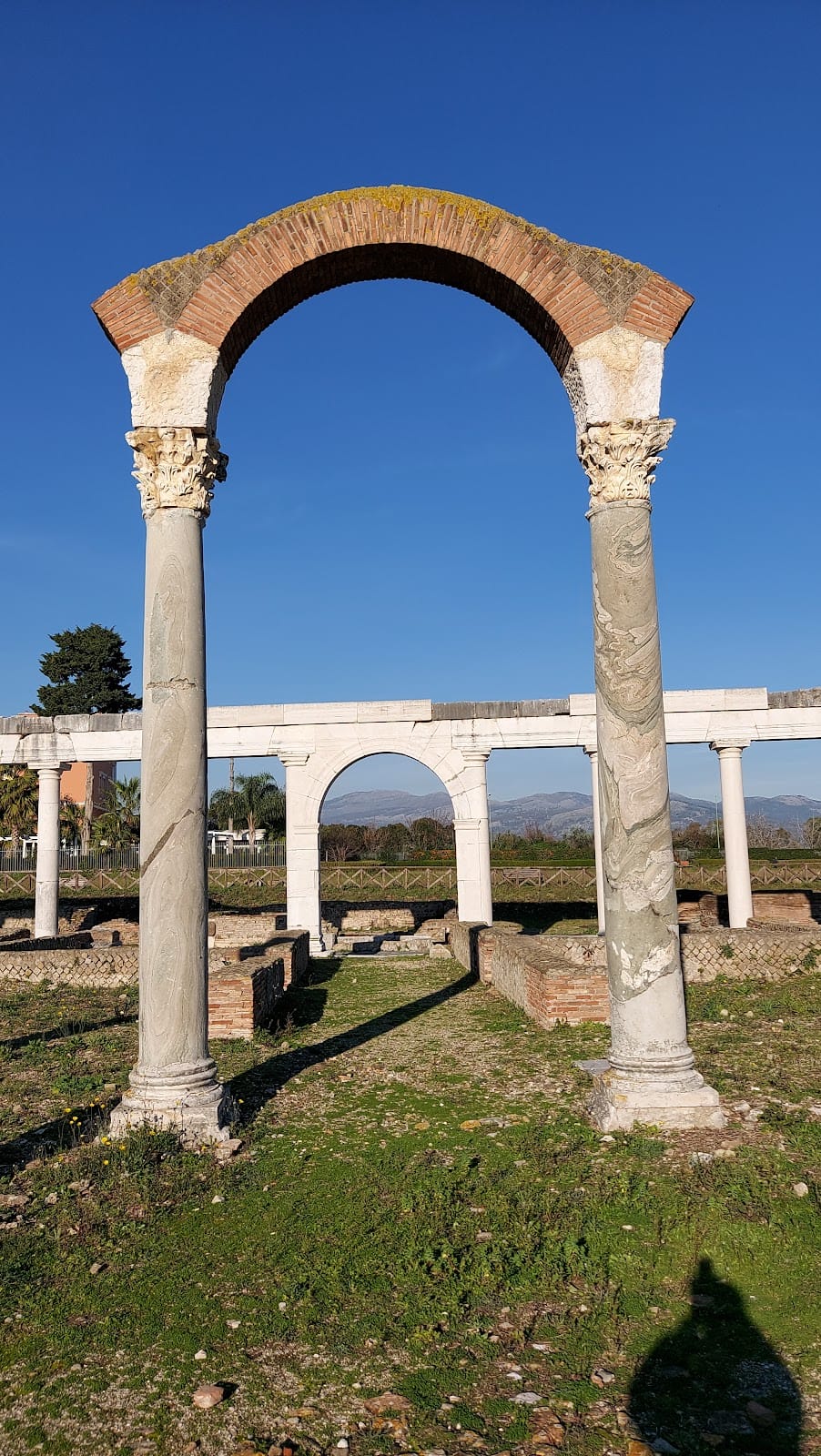
Today, the Parco Archeologico di Minturnae e Ponte Real Ferdinando is a state-managed heritage site that preserves both the ancient Roman urban remains and the historic suspension bridge. The park includes well-preserved structures such as the Republican and Imperial fora, macellum, thermal complex, Roman theater, and a basalt block section of the Via Appia. The nearby ruins of the Temple of the nymph Marica, a water deity, lie close to the river mouth, further enriching the site’s archaeological context.
Artifacts from Minturnae are housed in museums internationally, including collections in Zagreb, Philadelphia, and Naples. A statue of Emperor Trajan discovered near the Liri-Garigliano river served as a model for replicas displayed in Rome, Ancona, Benevento, and London. Since 1960, the Roman theater has hosted seasonal theatrical and musical events. Visitor numbers have increased substantially in recent years, reflecting growing public interest. Since 2021, architect Marco Musmeci has directed the archaeological complex and Antiquarium. In 2024, the site was inscribed as part of the UNESCO World Heritage designation “Via Appia. Regina Viarum,” and its official name was updated to “Parco archeologico di Minturnae e Ponte Real Ferdinando – Minturno (Latina).”
Daily Life and Importance by Period
Pre-Roman and Early Roman Period
Prior to Roman conquest, Minturnae was inhabited by the Aurunci, an Italic tribe with social organization based on clans and tribal affiliations. The population engaged primarily in agriculture and pastoralism, exploiting the fertile coastal plain and riverine resources. Control over nearby waterways facilitated local trade and resource exchange. Gender roles conformed to Italic norms, with men dominating public and military spheres and women managing domestic responsibilities.
After its destruction in 314 BCE and reestablishment as a Roman colony in 295–296 BCE, Minturnae’s demographic composition included Roman settlers alongside indigenous inhabitants. The urban plan, oriented along the Via Appia, structured daily activities around military logistics and commercial transit. Economic pursuits expanded to organized agriculture, artisanal crafts, and services catering to travelers. Domestic architecture likely featured modest houses with courtyards and storage spaces. Clothing styles reflected Roman customs, including tunics and cloaks adapted to the Mediterranean climate. Religious practices began incorporating Roman deities, with early temples serving civic and cultic functions.
Roman Republican and Imperial Periods
During the Republican and Imperial eras, Minturnae functioned as a municipium inhabited by Roman citizens, including local elites, freedmen, artisans, and slaves. Epigraphic evidence attests to municipal magistrates such as duumviri overseeing governance. Social stratification was evident, with landowning elites controlling agricultural estates and craftsmen and merchants operating workshops and market stalls. Family units centered on the domus or apartment buildings, with patriarchal authority prevailing.
The economy was based on agriculture—grain, olives, and vineyards—supported by local production and trade networks. The macellum and fora served as commercial centers where residents acquired foodstuffs, pottery, textiles, and imported goods. The presence of a thermal complex and a large theater indicates urban amenities and leisure activities. Archaeobotanical and faunal remains suggest a diet including bread, olives, fish, and wine. Domestic interiors featured mosaic floors and painted walls consistent with Roman aesthetic preferences. Transportation relied on the Via Appia for land travel and river routes for goods movement.
Religious life centered on temples such as the Capitolium dedicated to Jupiter, Juno, and Minerva, with public festivals reinforcing civic identity. The theater’s underground Antiquarium housed statues, votive offerings, and inscriptions, reflecting cultural engagement through performance and ritual. Minturnae’s position on the Via Appia connected it to imperial military and commercial circuits, though it did not serve as a major provincial capital.
Late Antiquity and Early Medieval Period
In late antiquity, Minturnae’s population likely declined, with a shift toward ruralization and reduced urban complexity. Social hierarchies persisted but with diminished elite presence amid political fragmentation. Archaeological evidence indicates continued use of civic spaces, albeit with declining maintenance. Household structures adapted to subsistence economies and local networks.
Economic activities became localized, focusing on small-scale agriculture and artisanal production. Trade and market functions contracted in response to regional instability. Dietary patterns remained centered on staple foods, with increased reliance on riverine resources. Domestic decoration and public building upkeep deteriorated, reflecting economic decline. Christianization influenced religious practices, with ecclesiastical structures likely supplanting pagan temples, though direct evidence at Minturnae is limited. The area’s strategic importance during the Gothic Wars underscores its military relevance despite waning civic governance. Environmental changes and Lombard incursions contributed to the gradual abandonment of urban functions and a transition toward rural settlement.
18th Century and Later Historical Context
In the modern era, the construction of the Ponte Real Ferdinando in the early 19th century exemplified the continued strategic and economic significance of the Minturno area. The bridge facilitated military and commercial transport along the Tyrrhenian coast, integrating the region into Bourbon infrastructural networks. Daily life around the bridge involved military personnel, merchants, and local laborers engaged in its operation and maintenance.
The bridge’s iron suspension design represented advanced engineering for its time, influencing regional transport and commerce. Its role in 19th- and 20th-century conflicts, including the 1860 battle and World War II, highlights the site’s enduring military importance. The preservation of both the bridge and ancient ruins today reflects the layered historical identity of Minturno as a nexus of inland and maritime connectivity.
Remains
Architectural Features
The archaeological remains at Minturnae predominantly date from the 3rd century BCE through the 2nd century CE, illustrating the city’s development as a Roman municipium. The urban plan follows a rectilinear grid aligned with the Via Appia, which served as the Decumanus Maximus. Construction techniques include opus incertum (irregular stonework) and opus reticulatum (diamond-shaped tufa blocks), with ashlar masonry employed in prominent public buildings. Roman concrete (opus caementicium) was used in vaulted structures such as baths and cisterns. The site’s proximity to the Garigliano River has influenced preservation, with lower-lying areas affected by silting and erosion. The adjacent Ponte Real Ferdinando, an 18th-century masonry and brick suspension bridge, remains a significant historic structure.
Key Buildings and Structures
The Forum
The forum complex comprises two main phases: the Republican forum from the late 2nd century BCE and the Imperial forum from the 2nd century CE. The Republican forum, located north of the Via Appia, is a rectangular plaza bordered on three sides by porticoes constructed in opus reticulatum. Two temples stood within this space, including the Capitolium dedicated to the Capitoline triad of Jupiter, Juno, and Minerva, confirmed by inscriptions and architectural features. The Imperial forum, situated south of the Via Appia, features large polygonal stone slab pavements and housed the curia (council chamber) and basilica, which functioned as centers for municipal administration and judicial proceedings. The basilica’s rectangular hall includes a central nave flanked by aisles separated by masonry piers, with walls built in opus incertum and traces of plaster decoration. A small temple podium dating to the 1st century BCE is also present within the forum area, though its dedication remains uncertain.
The Theatre
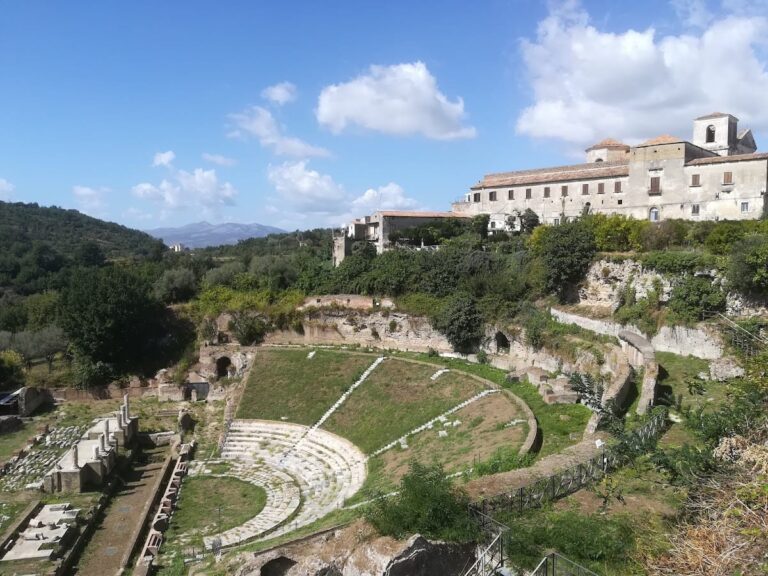
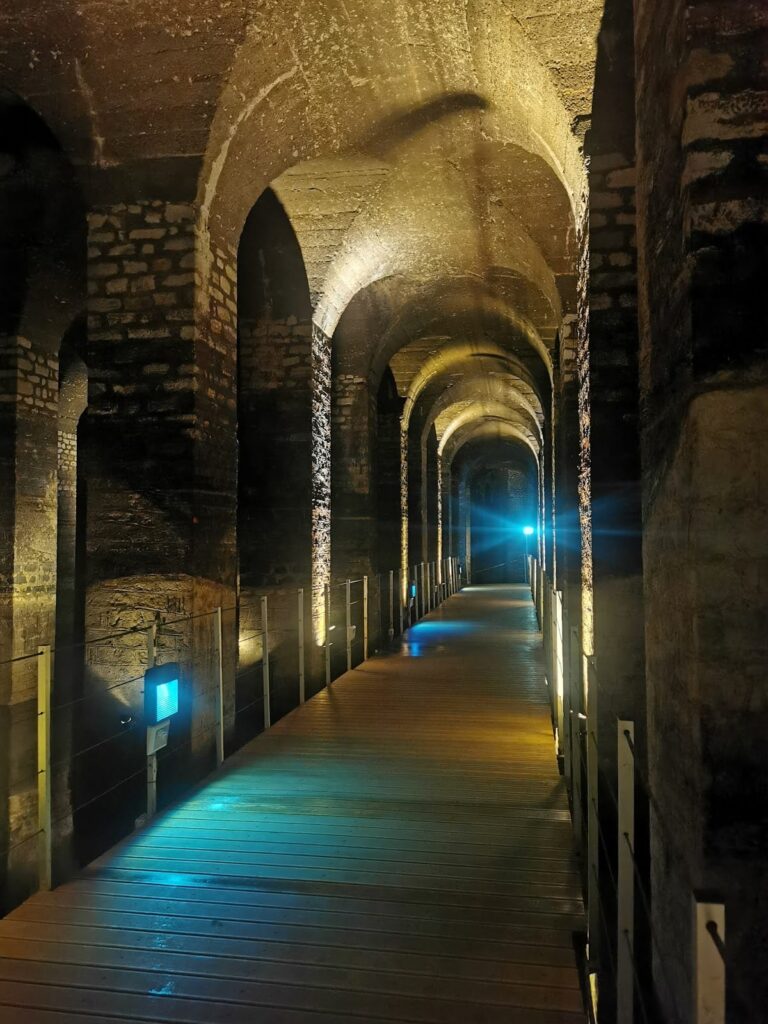
Constructed circa 80 BCE on the eastern edge of the town, the Roman theatre exhibits a cavea (seating area) partially hewn into the hillside and supported by masonry vaults. The orchestra retains its semicircular stone slab pavement. Foundations of the scaenae frons (stage building) survive, revealing a multi-roomed structure with brick and stone walls. Architectural features include vomitoria (passageways) within the seating tiers. Evidence of 3rd-century CE repairs is visible in reused bricks and mortar. The theatre’s underground spaces currently house the Antiquarium museum, which contains statues—including several headless figures—sculptures, votive offerings, inscriptions, and coins recovered from the nearby river, providing insight into the cultural life of Minturnae and its environs.
Public Baths (Thermae)
The thermal complex dates primarily to the 1st century CE, comprising a sequence of rooms arranged around a central courtyard. Key components include the caldarium (hot bath) equipped with a hypocaust system supported by brick pilae (small pillars), the tepidarium (warm room), and the frigidarium (cold bath), identified through mosaic floors and wall plaster remains. Walls are constructed of opus caementicium with brick facing. The complex features preserved water supply and drainage channels, indicating a sophisticated hydraulic infrastructure. Partial remodeling in the 3rd century CE is evident from altered wall alignments and the incorporation of reused materials.
City Walls and Gates
Defensive walls encircled the settlement, originally constructed in the 3rd century BCE and reinforced in the 1st century BCE. The lower courses consist of large polygonal stone blocks, transitioning to opus reticulatum masonry above. Several rectangular towers survive as foundations. The principal gate facing the Via Appia is partially excavated, revealing a double-arched entrance flanked by guard chambers. Masonry includes travertine blocks and later brickwork repairs. The walls are fragmentary, with some sections collapsed or buried, but sufficient to outline the city’s defensive perimeter.
Necropolises
Funerary areas are located outside the ancient city limits, primarily along the Via Appia. Tombs date from the 3rd century BCE through the Imperial period and include chambered and pit graves constructed with stone slabs and brick vaulting. Some tombs bear funerary inscriptions and relief decorations, though many are fragmentary. Grave goods such as pottery and personal items have been recovered. The necropolises are partially excavated, with surface surveys indicating additional uninvestigated burial sites.
Ponte Real Ferdinando
The Ponte Real Ferdinando, completed in 1832, spans the Garigliano River near Minturnae. It is a suspension bridge featuring iron chain stays supported by masonry piers with cutwaters. The superstructure employs local limestone and fired bricks bonded with lime mortar. The bridge remains largely intact, with documented 20th-century restorations incorporating reinforced concrete elements while preserving original masonry. It exemplifies early industrial engineering in Italy and marks the continued infrastructural significance of the Minturno area beyond antiquity.
Archaeological Discoveries
Excavations have uncovered a broad range of material culture spanning from the 4th century BCE to the 5th century CE. Pottery assemblages include locally produced amphorae for oil and wine, as well as imported fine wares such as Campanian and African red slip tableware, reflecting trade connections. Domestic artifacts include ceramic lamps, cooking vessels, and glass fragments recovered from residential contexts.
Inscriptions primarily date to the 1st and 2nd centuries CE and include dedicatory texts to local deities and public officials, confirming the civic functions of various buildings. Coins from Republican through late Imperial periods feature emperors such as Augustus, Trajan, and Constantine, recovered mainly from street layers and refuse deposits. Tools related to agriculture and craft production, including iron sickles and bronze needles, have been documented. Religious artifacts comprise terracotta statuettes and altar fragments, predominantly from the 1st to 3rd centuries CE. This assemblage attests to sustained occupation and diverse economic activities within Minturnae.
Preservation and Current Status
The preservation of Minturnae’s ruins varies by structure. The forum and basilica foundations are relatively well preserved, with some walls standing several meters high. The theatre’s cavea and stage foundations survive in fragmentary condition, affected by erosion and partial collapse. The baths retain hypocaust pillars and mosaic floors, though some areas show water damage. City walls are mostly fragmentary, with certain sections restored using modern materials for stabilization.
The Ponte Real Ferdinando remains structurally sound following 20th-century restoration that incorporated reinforced concrete while preserving original masonry. Vegetation growth and riverbank erosion pose ongoing threats, particularly in low-lying zones. Conservation efforts focus on masonry stabilization, vegetation control, and protection against looting. Excavations continue intermittently, with some areas consolidated but not fully restored to maintain archaeological integrity.
Unexcavated Areas
Several sectors within the ancient city remain unexcavated or only partially explored. The northern residential district, identified through surface surveys and geophysical prospection, exhibits subsurface anomalies consistent with building foundations. The southern outskirts near the river contain buried remains indicated by historic maps but remain unexcavated due to flood risk. The necropolises along the Via Appia also include uninvestigated tomb clusters.
Future excavation is constrained by conservation policies aimed at preserving site integrity and by modern land use. Non-invasive survey methods continue to map subsurface features with minimal disturbance, guiding potential targeted excavations while balancing preservation concerns.
Nearby sites