Castello di Gaeta: An Angevin-Aragonese Fortress in Italy

Site at a Glance
- Rating
- 4.5
- Popularity
- Medium
- Country
- Italy
- Primary era
- Medieval
- External website
- Open
- Eras represented
- Medieval, Early Modern, Modern
- Civilizations
- Kingdom of Naples, Kingdom of Sicily, Kingdom of the Two Sicilies, Spanish
- Site type
- Military
- Remains
- Castle
On this page7 sections
History
Castello di Gaeta is an Angevin-Aragonese castle in Italy, built through successive medieval and early modern phases on the Tyrrhenian coast. Its origins probably lie in the sixth century, during the Gothic War, or in the seventh century amid Lombard expansion, when Gaeta began to be described as a kastrum, a fortified settlement or stronghold.
Early fortress and imperial fortification
The castle is securely documented during the rule of Frederick II of Swabia, the medieval Holy Roman Emperor and ruler of the Kingdom of Sicily. During his conflicts with the papacy, Frederick stayed in Gaeta several times. Recognizing the site’s strategic position, he ordered the castle to be fortified in 1223.
Angevin and Aragonese development
The complex took its present form through two principal historical phases. The lower section was built under the Angevin rulers of the Kingdom of Naples, while the higher section was commissioned by rulers of the same kingdom from the Aragonese dynasty. These successive ruling houses shaped the two-part character of the fortress.
In the sixteenth century, Charles V of Habsburg ordered extensive additional military defenses. His work greatly strengthened the fortress of Gaeta and formed part of the military-building policies used to reinforce strategic strongholds in his territories. The castle later took part in the Siege of Gaeta of 1861.
Military, religious, and institutional uses
King Ferdinand II of Bourbon commissioned the Royal Chapel in 1849. The chapel was placed within the dome of the highest tower of the Aragonese section. The lower Angevin wing served as Gaeta’s military prison until 1980. Its prisoners included the Nazi war criminals Herbert Kappler and Walter Reder, as well as Italian Jehovah’s Witnesses imprisoned for refusing military service.
The Aragonese wing housed a Carabinieri trainees’ school, the Carabinieri being Italy’s national military police force, until the end of the Second World War. It now accommodates the Nautical School of the Italian Guardia di Finanza, a military corps chiefly responsible for customs, financial, and economic law enforcement. After 1980, the Angevin wing passed to the University of Cassino and Southern Lazio. It contains a university congress hall and has been intended for faculties concerned with maritime disciplines. The university currently owns the castle, which has Italian national heritage status and functions as a museum.
Remains
Castello di Gaeta occupies approximately 14,100 square meters in the historic center of Gaeta. Its surviving fabric is organized around two connected buildings from different historical periods: the lower Angevin section and the higher Aragonese section. Later defensive works associated with Charles V’s strengthening of the fortress are incorporated into the complex, linking the medieval buildings with its subsequent military development.
Aragonese section and Royal Chapel
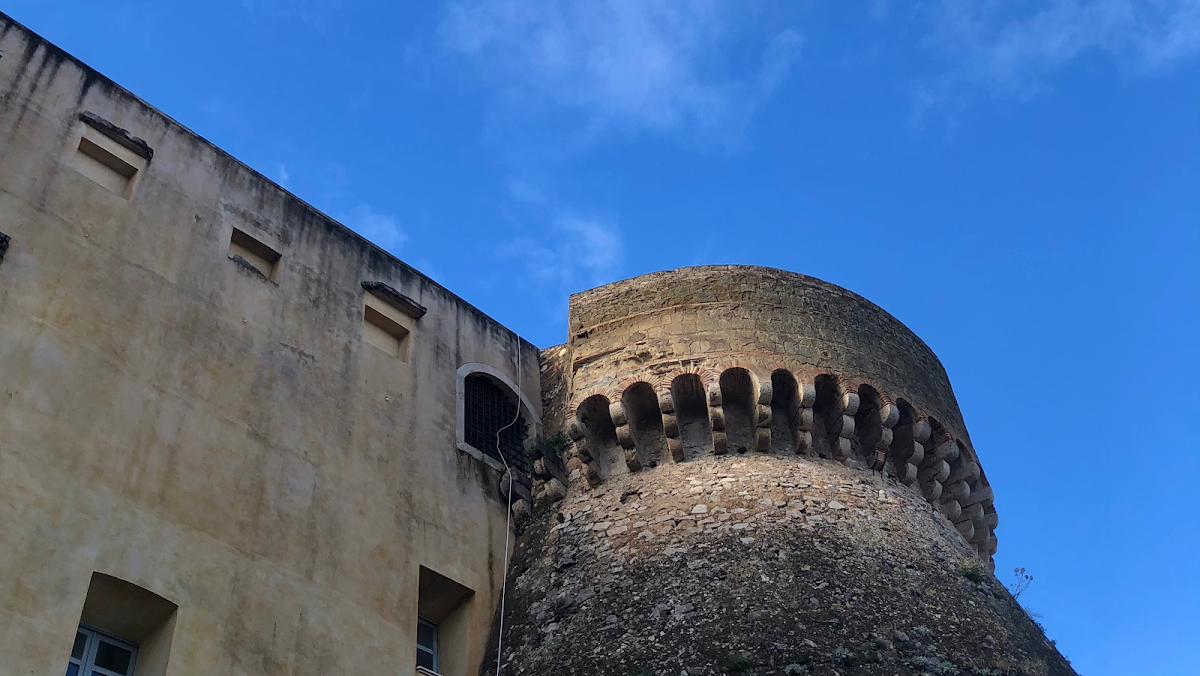
The higher Aragonese building contains the castle’s highest tower, known as the Tower of Gaeta. Its dome houses the Royal Chapel, commissioned in 1849 by Ferdinand II of Bourbon. The chapel forms part of the tower itself, while the Aragonese section remains one of the two principal connected elements of the fortress.
Angevin section and associated buildings
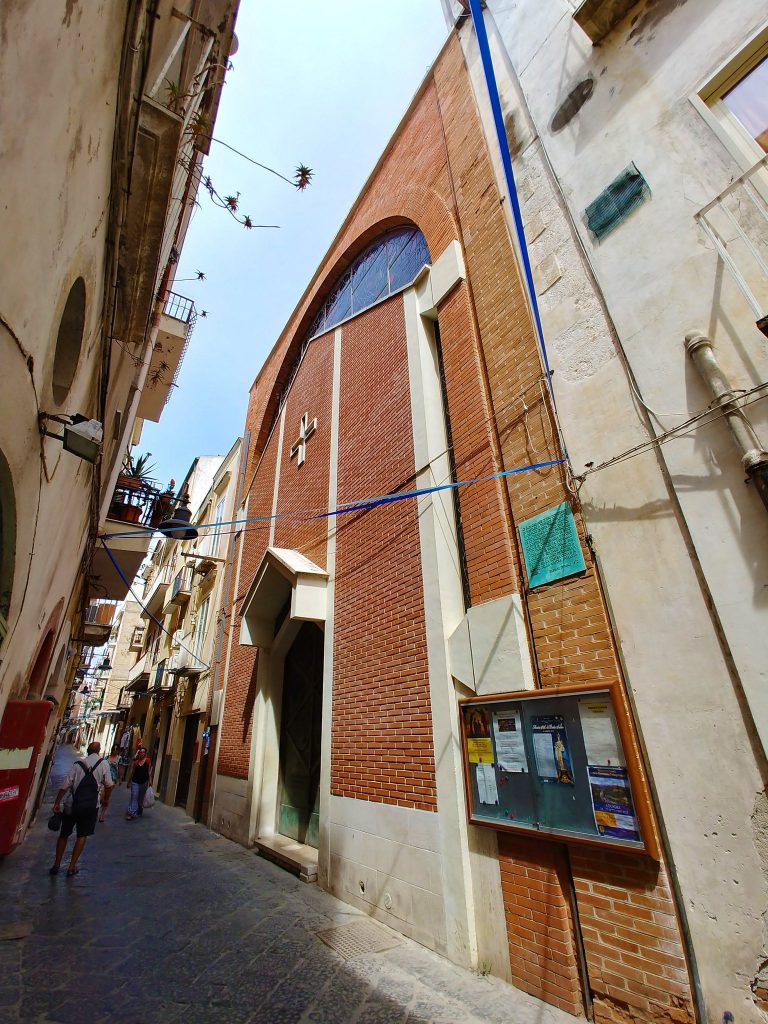
The lower Angevin building is the other principal component of the complex. It includes Santi Teodoro e Martino as one of the castle’s constituent parts. The wing’s later physical and institutional history includes its use as a military prison until 1980 and its subsequent adaptation for university purposes, including a congress hall.