Mystras: A Byzantine Fortress and Cultural Center in Greece
Table of Contents



Visitor Information
Google Rating: 4.7
Popularity: Medium
Google Maps: View on Google Maps
Country: Greece
Civilization: Byzantine
Remains: City

Context
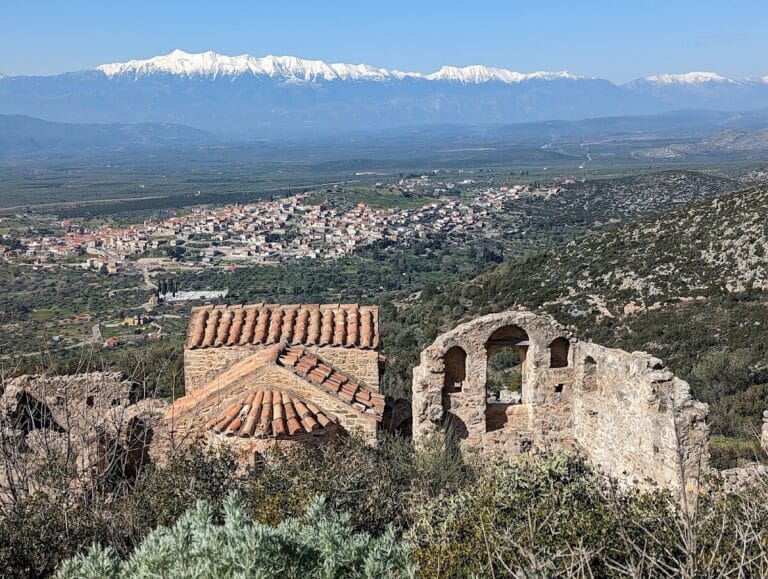
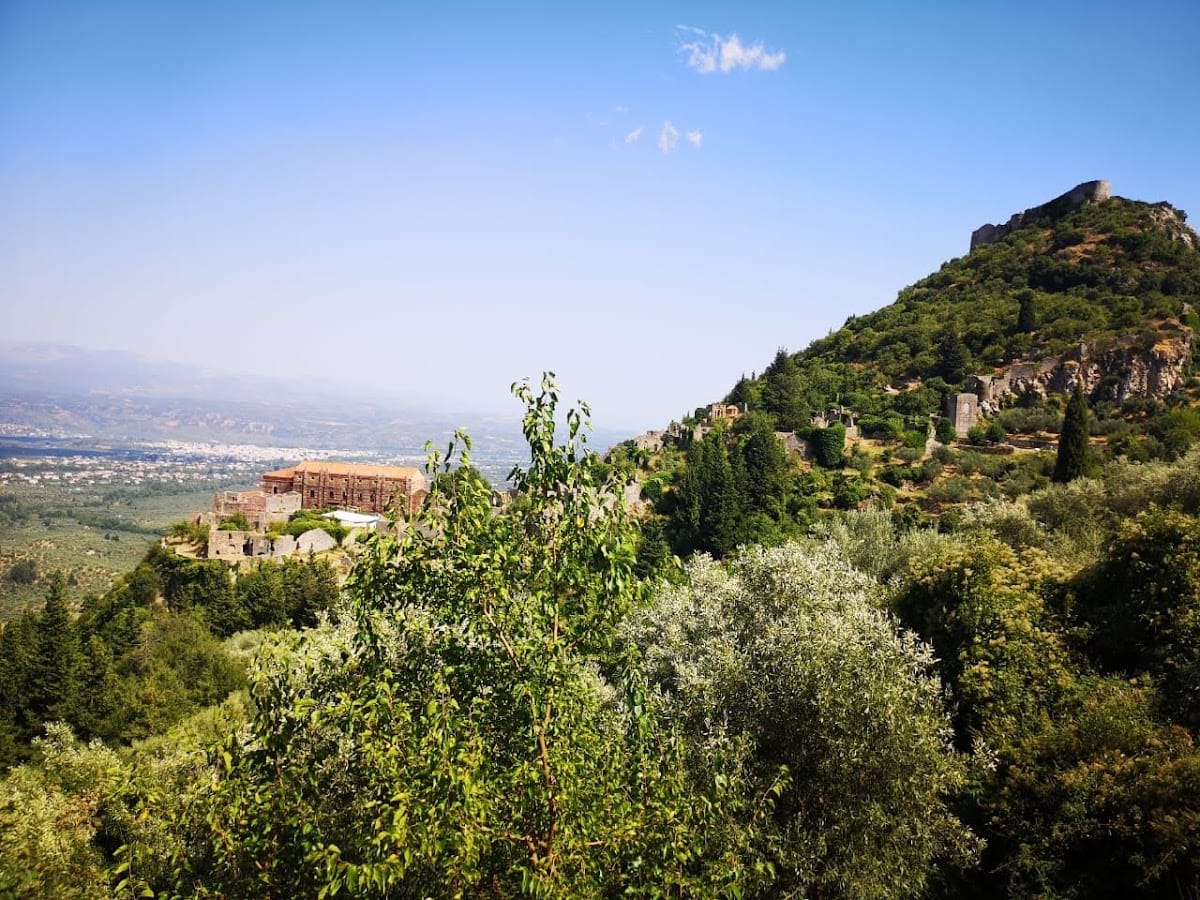
Mystras is located on the southwestern slopes of Mount Taygetos, overlooking the Eurotas valley near the modern city of Sparti in Laconia, Peloponnese, Greece. The site occupies a naturally defensible elevated plateau and adjacent terraced slopes above a steep ravine, commanding views over the surrounding plain and mountain passes. This strategic position provided control over land routes and access to water sources, facilitating both defense and settlement.
Established initially as a fortress in the mid-thirteenth century, Mystras developed into the administrative and cultural center of the Byzantine Despotate of the Morea from the fourteenth century onward. The site remained occupied through Ottoman and Venetian periods until the nineteenth century, when the population relocated to the newly founded town of Sparti. Today, Mystras preserves a largely intact medieval urban landscape, extensively studied and conserved since the nineteenth century, and recognized as a UNESCO World Heritage Site since 1989.
History
Mystras exemplifies the complex political and cultural transformations of the Peloponnese from the Crusader period through the late Byzantine era and into Ottoman and modern times. Founded as a Frankish fortress in the mid-thirteenth century, it evolved into a major Byzantine administrative capital and intellectual hub before its decline and eventual abandonment in the nineteenth century. The site’s history reflects broader regional dynamics, including the fragmentation of Byzantine authority, Latin occupation, Byzantine restoration, Ottoman expansion, Venetian interludes, and the Greek War of Independence.
Frankish Foundation and Rule (Mid-13th Century)
Following the Fourth Crusade and the establishment of the Principality of Achaea, William II of Villehardouin founded Mystras in 1249 as a fortress on a 620-meter spur of Mount Taygetos. This location was chosen to consolidate Frankish control over Laconia and to protect the nearby palace at Lacedaemon (ancient Sparta), completing the conquest of the Peloponnese peninsula. The fortress and its defensive walls were rapidly constructed, forming a key element in a network of fortifications including Grand Magne and Leuktron.
At its inception, Mystras was sparsely inhabited, with only a small chapel and a castellan’s residence on the hillside. The Frankish palace wing, erected between 1249 and 1262, exhibits Gothic architectural features such as limited external openings and thick walls, reflecting Western European influences adapted to local conditions. William II’s presence in the region during the winter of 1248–49 included site inspections that led to the selection of Mystras for fortification, underscoring its strategic importance within the Principality of Achaea.
Byzantine Restoration and Early Administration (1262–Mid-14th Century)
After William II’s defeat and capture at the Battle of Pelagonia in 1259, Mystras was ceded to the Byzantine Empire in 1262 under Emperor Michael VIII Palaiologos as part of the prince’s ransom agreement. Initially governed by annually appointed kephalai (governors), the administration evolved by the early fourteenth century to longer-serving officials titled epitropos. While the Byzantines initially prioritized fortresses such as Monemvasia, Mystras gradually expanded as Greek populations from Lacedaemon relocated there, seeking security and religious continuity.
Despite the steep and challenging terrain, early Byzantine settlers constructed houses and churches on the slopes beneath the fortress, benefiting from abundant water sources and improved sanitation compared to the valley below. The bishopric of Lacedaemon was transferred to Mystras, marked by the construction of the Metropolis church of Hagios Demetrios after 1264, establishing the city’s ecclesiastical significance. Religious leaders like the abbé Pacôme founded the Brontochion monastery (1311–1312) and attracted artists, possibly from Constantinople, who contributed to the construction of major churches such as Saints-Theodores and the Hodigitria. The city’s fortifications expanded to include two concentric walls enclosing the upper and lower city, with only two gates providing access to the upper town. The administration contended with Turkish pirate raids, including attacks reaching the city walls in 1334, reflecting ongoing regional instability.
Despotate of the Morea and Cultural Flourishing (1349–1460)
In 1349, Emperor John VI Kantakouzenos established the Despotate of the Morea as an appanage for his son Manuel Kantakouzenos, designating Mystras as its capital and the Despot’s residence. Manuel’s reign (1349–1380) brought relative peace and cooperation between Greek and Latin inhabitants, particularly in resisting Ottoman incursions during the 1360s. The Palace of the Despots expanded into a three-story complex inspired by Constantinople’s Tekfur Saray, featuring a large audience hall and residential quarters.
Under the Palaiologos dynasty, especially during Theodore I Palaiologos’s rule (1383–1407), Byzantine control was consolidated, with Ottoman suzerainty acknowledged to maintain stability. At its height, Mystras was the Byzantine Empire’s second-largest city after Constantinople, with an estimated population of approximately 40,000. It became a vibrant intellectual and cultural center, hosting the last major flowering of Byzantine art and scholarship known as the Palaeologan Renaissance. The philosopher Gemistos Plethon resided and taught here until his death in 1452, influencing Renaissance thought in Italy. The city’s churches, including Hagia Sophia, Peribleptos, Evangelistria, and Pantanassa, exemplify late Byzantine ecclesiastical architecture with diverse stylistic influences from Constantinopolitan, Romanesque, Gothic, and local traditions. Urban planning adapted to the steep slopes through terraced construction, narrow footpaths, and multi-story houses supported by arches. The Despotate’s administration was marked by internal family rivalries and conflicts with Latin neighbors and the Ottomans, culminating in the Ottoman conquest in 1460.
Ottoman and Venetian Periods (1460–1821)
Mystras fell to Ottoman Sultan Mehmed II on May 31, 1460, becoming the capital of the Sanjak of Mezistre. The city retained administrative importance, with the former Despot’s Palace serving as the residence of the Ottoman Pasha. The upper city housed Turkish elites and a military garrison, while Greeks primarily inhabited the lower city. The Hagia Sophia church was converted into a mosque, reflecting the new religious order. Silk production, encouraged by both the Palaiologos rulers and the Ottomans, sustained the local economy, establishing Mystras as a leading silk center in the Sparta valley. A Jewish community developed mainly in the suburbs outside the city walls.
Unlike other Ottoman regions, the area saw limited land grants (timars) to soldiers, resulting in a predominantly Greek rural population with few Turks outside military and administrative centers. Local elites maintained some municipal self-government, though the devshirme system imposed social tensions. Venetian forces occupied Mystras from 1687 to 1715 during the Morean War, initially welcomed but soon imposing harsh taxation and restrictions on the Orthodox Church. Venetian policies discouraged silk production, causing economic decline. After the Ottoman reconquest in 1715, Mystras regained provincial capital status and population rebounded. The city suffered during the Orlov Revolt in 1770, with reprisals causing massacres and destruction of religious sites. By 1800, the population partially recovered but remained diminished compared to its Byzantine peak. The city’s fortifications and buildings showed signs of neglect, reflecting diminished military importance.
Modern Rediscovery, Conservation, and Cultural Significance (20th Century–Present)
Mystras was inscribed as a UNESCO World Heritage Site in 1989, recognized for its exceptional preservation as a late Byzantine fortified city and center of the Palaeologan Renaissance. The site includes the fortress, the Palace of the Despots—the only surviving Byzantine palace—and numerous churches and monasteries such as Hagios Demetrios, Hagia Sophia, Saints-Theodores, Hodegetria, Peribleptos, and Pantanassa. Restoration efforts since the late twentieth century have focused on structural stabilization, fresco conservation, and infrastructure improvements.
The Palace of the Despots is undergoing substantial restoration, with plans to reopen to the public by 2026. The urban layout reflects adaptation to the steep terrain, with terraced construction and narrow footpaths. Architectural styles blend Byzantine “Helladic” traditions with Constantinopolitan, Romanesque, and Gothic influences, illustrating the city’s diverse cultural contacts. Mystras’s intellectual legacy, centered on figures like Gemistos Plethon, contributed to the transmission of Byzantine scholarship to Renaissance Europe. Today, the site is a major archaeological and cultural heritage destination near modern Sparta, with educational programs and cultural events preserving its historical legacy. The Pantanassa Monastery remains the only inhabited building, housing a small community of Orthodox nuns.
Daily Life and Importance by Period
Frankish Foundation and Rule (Mid-13th Century)
At its founding in 1249, Mystras functioned primarily as a military fortress with a limited civilian presence. The population consisted mainly of Frankish knights, soldiers, and castle officials, including the castellan residing near a small chapel. Social hierarchy was sharply defined, dominated by the Frankish nobility and military elite. Economic activity focused on sustaining the fortress and securing the surrounding territory, with little evidence of extensive crafts or markets at this early stage.
Residences were sparse and utilitarian, with the Frankish palace wing exhibiting Gothic architectural features such as narrow windows and thick defensive walls. Food consumption likely included staples common to medieval Peloponnese—grain, olives, and locally raised livestock—though direct archaeological evidence of diet from this phase is lacking. Transportation relied on footpaths and horse travel along mountain routes connecting Mystras to other fortresses like Grand Magne and Leuktron. Religious practice was limited to the small chapel within the fortress, reflecting the Frankish Catholic faith. The site’s role was primarily strategic, serving as a military stronghold securing Frankish control over Laconia.
Byzantine Restoration and Early Administration (1262–Mid-14th Century)
Following the Byzantine reconquest in 1262, Mystras transformed from a sparse military outpost into a growing urban center inhabited mainly by Greek Orthodox populations fleeing insecurity in the valley. The population diversified to include Byzantine officials, clergy, artisans, and farmers. Social hierarchy featured the governor (initially annually appointed kephale, later epitropos), ecclesiastical authorities such as the bishop of Lacedaemon, and a rising class of local residents.
Economic life expanded beyond military functions to include agriculture on terraced slopes, silk production initiated by monastic communities, and artisanal crafts. Workshops and small-scale production likely operated near the lower city, while markets developed around fortress gates. Houses were built on steep terraces with vaulted substructures for storage and stabling, reflecting adaptation to rugged terrain. Diet included bread, olives, wine, and locally grown vegetables, supplemented by livestock products. Interior decoration of homes and churches featured frescoes influenced by Constantinopolitan styles. Religious life centered on Orthodox Christianity, with monasticism playing a key role in community cohesion. Transportation remained primarily pedestrian, with narrow footpaths connecting terraces and gates. Mystras’s regional importance increased as it became the seat of the bishopric and a Byzantine administrative center, gradually supplanting older fortresses. Civic governance involved Byzantine-appointed officials overseeing defense, taxation, and religious affairs.
Despotate of the Morea and Cultural Flourishing (1349–1460)
During the Despotate period, Mystras reached its zenith as a populous and cosmopolitan city of approximately 40,000 inhabitants, second only to Constantinople in the Byzantine world. The population was predominantly Greek, with a significant presence of Albanian settlers serving as soldiers and farmers, alongside Byzantine aristocracy, clergy, artisans, and merchants. Social stratification was pronounced, with the Despot and his court at the apex, followed by ecclesiastical leaders, wealthy landowners, and a broad artisan and laboring class.
Economic activities flourished: silk production became a major industry supported by workshops and monastic patronage; agriculture thrived on terraced slopes; and vibrant markets operated in the Palace courtyard and lower city bazaars, trading local produce, textiles, and imported luxury goods. Residential architecture featured multi-story houses with triklinon reception halls, balconies, and fireplaces, often decorated with frescoes and intricate woodwork. Water management systems including cisterns and drainage ensured sanitation despite the steep terrain. Diet was diverse, reflecting agricultural abundance: cereals, olives, fruits, fish from nearby rivers, and livestock products. Transportation relied on narrow footpaths and mule caravans adapted to the hillside environment; wheeled vehicles were impractical within the city. Religious life was rich, centered on numerous churches hosting elaborate liturgies and festivals. Intellectual activity thrived, with figures like Gemistos Plethon fostering philosophical discourse and education. Mystras functioned as the Despotate’s political and administrative capital, housing the Palace of the Despots and serving as a regional military and cultural hub. Civic governance was dynastic yet marked by internal rivalries, while ecclesiastical authorities wielded significant influence. The city’s urban planning and architecture exemplify sophisticated adaptation to topography and a blending of Byzantine, Gothic, and Romanesque styles.
Remains
Architectural Features
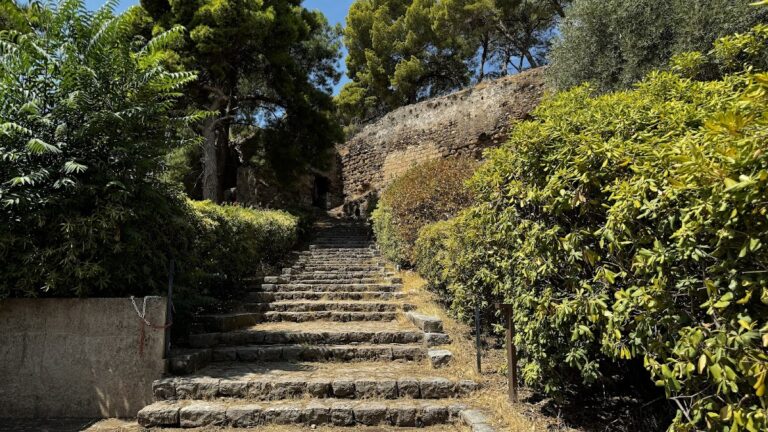
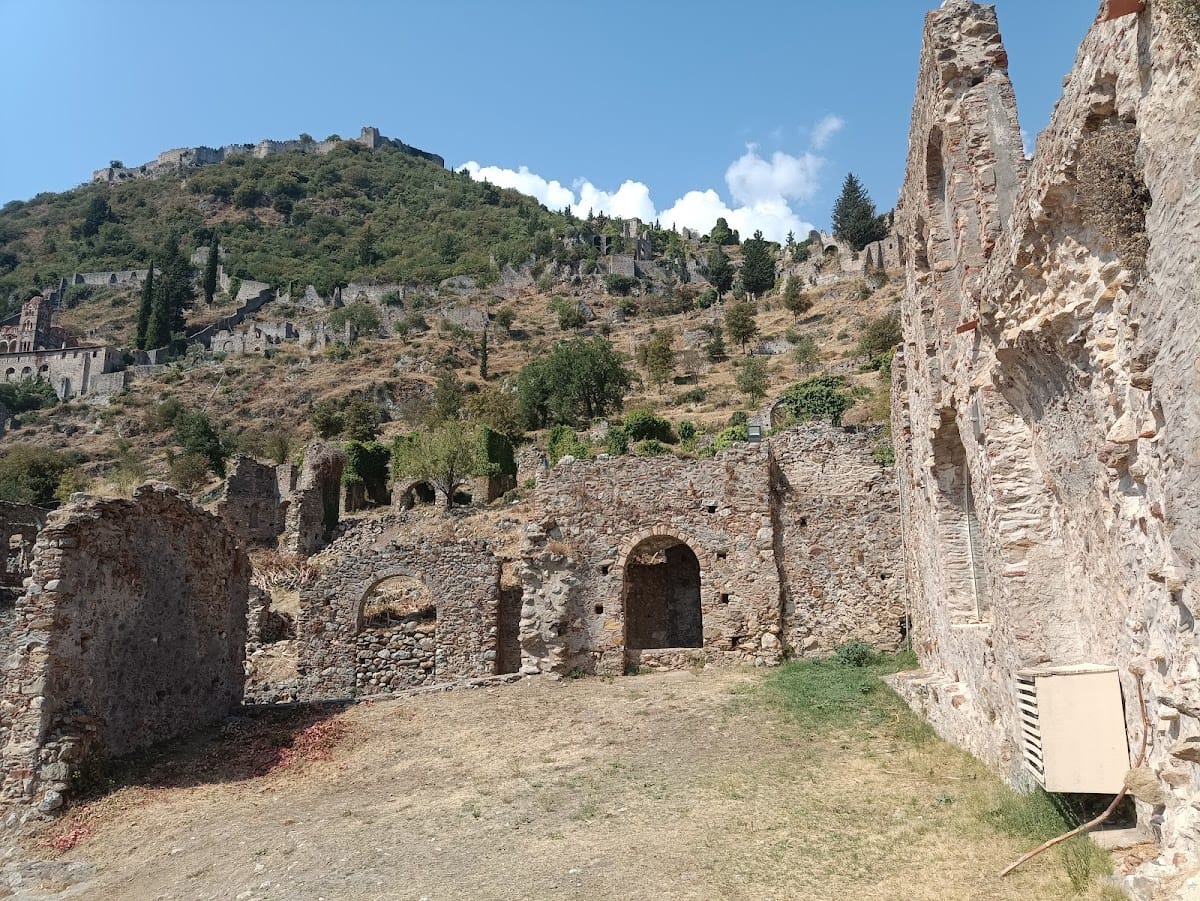
Mystras occupies a steep hillside with an urban layout carefully adapted to the rugged terrain. The settlement is enclosed by two concentric fortified walls, delineating the lower and upper city sectors. Construction predominantly dates from the thirteenth to fifteenth centuries, employing ashlar masonry combining stone and brick, often reusing materials from earlier structures. Buildings are typically multi-storied, supported by wide arches that stabilize them on the slopes. Roofs are pitched gable types, suited to local winter conditions. The urban fabric includes a citadel, palace complex, numerous churches and monasteries, and densely packed residential houses, many preserved as substantial ruins or partially restored.
The defensive system comprises a fortress and citadel at the summit, protected by two concentric walls, and city walls descending the hill’s western side. Fortifications include towers, gates, and watchtowers, some dating to the Frankish foundation and later modified by Byzantine and Ottoman occupants. Water supply and sanitation infrastructure incorporated cisterns and vaulted substructures for storage and drainage, with several cisterns documented within the palace and urban houses. The site preserves a complex archaeological landscape with visible remains of civic, military, religious, and domestic architecture.
Key Buildings and Structures
Fortress and Citadel
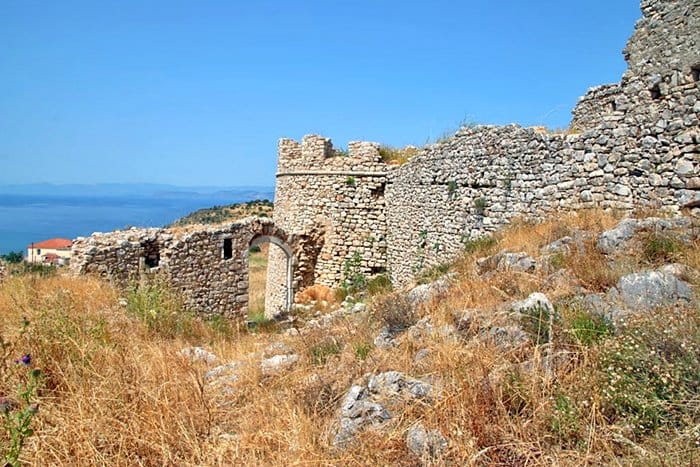
The fortress, constructed in 1249 by William II of Villehardouin, crowns a 620-meter-high hill overlooking Sparta. It forms the core defensive structure, featuring a single entrance gate guarded by a square tower. The citadel area is relatively flat and enclosed by two concentric walls: an outer enceinte surrounding the lower, broader part, and a thicker inner enceinte enclosing the northwestern donjon, the highest and most inaccessible section.
The outer wall contains ruins of Ottoman-period habitations and terminates at a watchtower on the southeast, which overlooks the Sparta plain and Taygetos slopes. The inner enceinte surrounds the donjon, which housed the governors’ residence and a chapel predating the Frankish arrival, possibly the oldest building on site. Another watchtower at the western extremity monitored the Taygetos slopes, guarding against attacks from the Melingoi tribe. The fortress walls extend into the city’s western walls, which are the strongest, featuring round and square towers and two heavily fortified gates. Byzantine and Ottoman modifications enhanced the fortifications, which served as observation posts and refuges during sieges.
Palace of the Despots
Located on a mid-hill plateau, the palace complex consists of two wings forming an L-shape along the east and west edges of the plateau. The courtyard, known as the phoros or Bojuk Bazar under Ottoman rule, functioned as a public square and market, oriented to maximize sunlight and shelter from wind.
The east wing, the oldest part, was built between 1249 and 1262 by William II of Villehardouin. It exhibits Gothic architectural features with few external openings, resembling Frankish buildings such as Chlemoutsi. Adjacent to it is a kitchen building with cisterns and hearths, likely contemporary. A connecting structure between these was added around 1350–1400. At the northeast end, a three-story building housed the despote’s apartments, with a chapel on the top floor.
The northwest wing, constructed in the early 15th century under the Palaiologos dynasty, has three levels: a semi-basement, a ground floor with eight separate apartments, and a first floor containing a large audience hall called the Chrysotriklinon or “Golden Throne Room.” This hall measures approximately 36.3 by 10.5 meters and features a continuous stone bench, two rows of windows (upper round and lower ogival), and eight fireplaces with chimneys resembling external buttresses. Architecturally, this wing resembles the Palace of the Porphyrogenitus in Constantinople but incorporates Italian Renaissance window designs. The northwest wing was likely destroyed in 1464 during a siege. Additional buildings west of the palace probably housed nobles and court officials.
Metropolis (Church of Hagios Demetrios)
The Metropolis church lies along the inner face of the lower city walls. Constructed around 1291–1292, it was dedicated to Saint Demetrios and restored by Nicéphore Moschopoulos, metropolitan of Lacedaemon. The building combines a basilical ground floor with a cross-in-square upper floor featuring five domes. The basilica has three naves separated by two rows of three columns, with a higher central nave. Two entrances exist: an older one leading to the women’s gallery (gynaikonitis) and another on the south facade street.
In the 15th century, Bishop Mathieu altered the church by removing the roof to add the upper floor and domes, damaging some frescoes. The exterior east facade shows a blend of older Helladic style (stone with brick bands) and later 15th-century Constantinopolitan influences. Sculptural elements are heterogeneous, including reused capitals and a frieze possibly from ancient Sparta. Frescoes dating from the late 13th to early 14th century depict the life and martyrdom of Saint Demetrios, reflecting Byzantine and Macedonian artistic schools.
Church of Saints Theodores
Situated north of the lower city, Saints Theodores is one of Mystras’s largest churches. Built circa 1290–1295, it follows a Greek cross plan with an octagonal dome supported on eight arches, a design originating in Constantinople. The dome contains sixteen windows and is visually softened by horizontal bands on the east facade and stepped roofs ascending to the dome.
The church remained well preserved until the late 19th century, when removal of columns around 1863 caused the dome and vaults to collapse. Restoration began in 1938 under Anastassios Orlandos. The ground floor is a basilica with three naves separated by two rows of three columns, while the upper floor is a cross-in-square church with five domes supported by four columns each. Saints Theodores was part of the Brontochion monastery complex, which included a refectory, monastic cells, and a watchtower. The church likely served as a cemetery church for monks, with funerary structures surrounding it.
Church of the Hodigitria (Aphendiko)
Also part of the Brontochion monastery complex, the Hodigitria church was built shortly after the Metropolis and Saints Theodores churches. It exhibits Constantinopolitan artistic influences and later influenced other Mystras churches. The church contains the tomb of Despot Theodore I, depicted in frescoes as both ruler and monk, as well as the tomb of Abbot Pacôme.
The interior is richly decorated with frescoes, including copies of imperial chrysobulls granting privileges to the monastery. The fresco style is unique, possibly influenced by Frankish art. The church’s architectural plan and decoration reflect a blend of Byzantine and Western elements.
Church of the Evangelistria
Dating from the late 14th to early 15th century, the Evangelistria church follows a cross plan similar to Peribleptos and Hagia Sophia but is smaller. Unlike other churches, it was apparently never converted into a mosque during Ottoman rule, as indicated by graffiti. The interior sculptures are stylistically unified, suggesting they were designed specifically for this church. The sculptural style points to a construction date at the end of the 14th or early 15th century.
Church of Hagia Sophia
Constructed between 1351 and 1365 by Manuel Kantakouzenos, the first Despot of Morea, Hagia Sophia was intended to recall the great church of the same name in Constantinople. Sometimes identified as the church of Christ Zoodotes, it was transformed into the catholicon of a monastery by a 1365 patriarchal decree. The church served as a burial place for at least two imperial family members, Theodora Tocco (d. 1429) and Cleopa Malatesta (d. c. 1433), likely interred outside the building.
Architecturally, it has a simple Greek cross plan with a low central dome, a large narthex, and narrow windows. The north and west facades feature colonnades; the north colonnade was rebuilt, while the west is in ruins. A partially surviving three-story tower on the north facade was converted into a minaret during Ottoman occupation. Sculptural decoration is sparse, with one column capital bearing floral motifs and Manuel’s monogram. Restoration by Anastassios Orlandos included reconstruction of the dome and north colonnade.
Monastery of Peribleptos
Located at the southeast corner of the outer city walls, the Peribleptos monastery was founded in the 14th century, likely by a noble couple. A later monogram mentions Leon Mavropapas, a notable Mystras family. The church is built on a cliff face, partially under a rock overhang, with an irregular plan shaped by the rock cavity. The apses protrude like balconies, with two small chapels beneath them. A narrow corridor leads from a western door directly into the church, enhancing interior light contrast.
The church follows a Greek cross plan with a dome supported by two rows of two columns. Exterior decoration is simpler than other churches, with heterogeneous sculptural elements, many reused. Interior frescoes date to the 14th century and depict the life of Christ, painted by at least four different artists or styles. A bas-relief with two lions flanking a monogram inscribed “Peribleptos” possibly represents the family emblem and includes fleur-de-lys motifs indicating Frankish influence.
Monastery of Pantanassa
Situated on the steep eastern slope of the hill, the Pantanassa monastery is the best-preserved building in Mystras and the only one still inhabited by Orthodox nuns. Founded in 1428 by John Frangopoulos, a minister under the last Palaiologoi despots, his name and title are inscribed on the west facade arches and a column capital.
The monastery’s architecture models the Hodigitria church, featuring a three-nave basilica on the ground floor and a five-domed cross-in-square church above. The apses are tall and richly decorated, divided into zones on the facade. Two rows of windows adorn the apses: wider on the upper level and narrower but more numerous below. Gothic influence appears in the arches surrounding the first-floor windows and the bell tower’s trilobed windows framed by Gothic arches, with four small towers flanking the dome. The Pantanassa exemplifies a fusion of local, Byzantine, and Frankish architectural traditions in early 15th-century Mystras.
Frangopoulos House
Dating to the early 15th century, the Frangopoulos House features a vaulted substructure used for cisterns and stables. The main living area includes a large room with a balcony and a rear fireplace. The building is attributed to John Frangopoulos, founder of the Pantanassa Monastery, based on a phi (φ) letter inscribed on the northeast corner stone.
Laskaris House
The Laskaris House, also from the early 15th century, has vaulted substructures for cisterns and stables. It comprises three levels, with the ground floor likely serving as stables. The house is named after the Laskaris family, prominent dignitaries in Mystras.
Small Palace (Palataki)
The Small Palace consists of two buildings from different periods: a southern tower built between 1250 and 1300, and a northern three-story building constructed in the 14th century. It is the oldest and largest surviving domestic structure in Mystras.
Urban Houses
Urban houses in Mystras are rectangular, elongated, and contiguous, built on steep slopes. They are typically multi-storied to economize space, with rear ground floors often partially underground or built against rock. Ground floors served as stables, storage, or kitchens, with small external openings for security. The main family living space is usually the first floor, often a large triklinon (reception room) with large windows and storage niches, sometimes occupying the entire floor. Buildings are supported by wide arches on each floor to provide stability on unstable slopes, with walls filling the arches made of lighter materials. Roofs are pitched gable types, adapted to winter weather; flat or vaulted roofs were unsuitable.
City Walls and Gates
The city is enclosed by two fortified walls: an outer wall encircling the lower city and an inner wall surrounding the upper city where the palace is located. The outer wall begins at the northernmost part of the city, curves east around the lower city, descends to the hill’s base, and ends at the southern site boundary. The inner wall starts at the Nauplia Gate and curves east around the upper city. Only two gates provide access to the upper city: the Monemvasia Gate and the Nauplia Gate. The western city walls are the strongest, featuring round and square towers and two heavily fortified gates. A square tower defends the citadel entrance. The citadel and city walls form a continuous defensive system.
Infrastructure: Water Supply and Sanitation
Mystras had abundant water sources on the slopes, with cisterns and vaulted substructures used for water storage. Some houses and the palace complex included cisterns integrated into vaulted substructures. Recent excavations uncovered parts of the water supply and drainage system, including canalization for water provision and waste evacuation. During Ottoman times, the city had three or four cisterns (Sarnitche) for water storage. The palace complex contained cisterns near the kitchen area, supporting domestic and administrative needs.
Other Religious Buildings
Additional churches at Mystras include Saint Nicholas, Saint Christopher, Saint Kyriaki, Saint George, the Taxiarchs, and Aï-Yannakis. These are less extensively described but are part of the religious landscape. The chapel of Saint George is a private chapel preserved intact since Byzantine times.
Other Civic and Military Structures
The citadel’s lower part contains ruins of Ottoman-period habitations. A watchtower at the southeast of the citadel overlooks the plain and Taygetos slopes. The donjon area housed the governor’s residence and a chapel. The palace courtyard served as a public square and market area during various periods.
Other Remains
Ruins of a long two-story building near the Hodigitria church likely served as a refectory. Two rows of monastic cells lie adjacent to the refectory. A watchtower north of the Hodigitria complex is also preserved. Scattered ruins of houses and other buildings are found on the hillside, some with balconies supported by large arches. Surface traces of walls and floor layers have been recorded in various parts of the site, indicating a dense urban fabric.
Preservation and Current Status
Many structures at Mystras survive as substantial ruins, with some buildings partially collapsed or fragmentary. The Pantanassa Monastery remains the only inhabited building, housing a small community of Orthodox nuns. Restoration efforts since the twentieth century have stabilized and conserved key monuments, including the Palace of the Despots, churches, and residences such as the Laskaris House. Some reconstructions use modern materials to support original fabric, while others are preserved in situ. Environmental factors and vegetation pose ongoing challenges, but the site benefits from active management by Greek heritage authorities. Conservation studies focus on mural, sculptural, and floor decorations. Infrastructure improvements have been implemented to support preservation. The site is protected as a UNESCO World Heritage Site since 1989, with continuous archaeological research and restoration projects underway.