Mainz Roman Theatre: An Ancient Cultural Landmark in Germany


Visitor Information
Google Rating: 4.3
Popularity: Low
Google Maps: View on Google Maps
Official Website: www.theatrum.de
Country: Germany
Civilization: Roman
Remains: Entertainment

History
The Roman Theatre in Mainz was built by the Romans in the ancient city of Mogontiacum, located at the meeting point of the Main and Rhine rivers. This strategic position made the city a key military and administrative center near the empire’s northern frontier, known as the Limes. Around 13 or 12 BCE, the Romans established a military camp here for two legions, which remained active for over three centuries.
By about 80 CE, Mogontiacum had grown beyond its military origins into a civilian settlement, becoming the capital of the Roman province Germania Superior. The theatre was likely constructed during this period, possibly linked to games honoring Drusus, a prominent Roman general. Military parades took place near a monument dedicated to Drusus as early as 19 CE, and the theatre hosted civil ceremonies where representatives from 60 Gallic communities gathered to pay tribute.
Historical records mention a theatre in Mogontiacum as early as 39 CE, suggesting an earlier wooden structure may have existed before the stone theatre was built. The stone theatre served the city for several centuries but fell out of use in the mid-4th century. At that time, the city walls were rebuilt, excluding the theatre from the protected area. Stones from the theatre’s seating were removed and reused elsewhere.
From the 6th century onward, the theatre’s vaulted underground spaces were repurposed as burial catacombs connected to nearby monasteries, especially the now-lost St. Nikomedes monastery. Archaeological excavations have uncovered burials from this period within the theatre’s remains. The theatre was last mentioned in the 11th century by Gozwin of Mainz, who described the ruins as evidence of Roman-style circus and theatrical events.
In the 17th century, the entire site was leveled during the construction of the Mainz citadel, causing the last visible masonry to disappear. The theatre was forgotten until the late 19th century when foundations were found during railway construction. However, these remains were initially not recognized as part of a theatre and were partly destroyed. It was not until 1914 that art historian Ernst Neeb identified the site as a Roman theatre, confirmed by a trench excavation in 1916. Due to World War I, no major excavations followed, and the remains were reburied.
Renewed archaeological work began in 1998, with increased efforts from 1999 supported by local volunteers and sponsors. The theatre area, near the Mainz South Station, has since been integrated into urban development plans, including discussions about expanding excavations and further reconstruction.
Remains
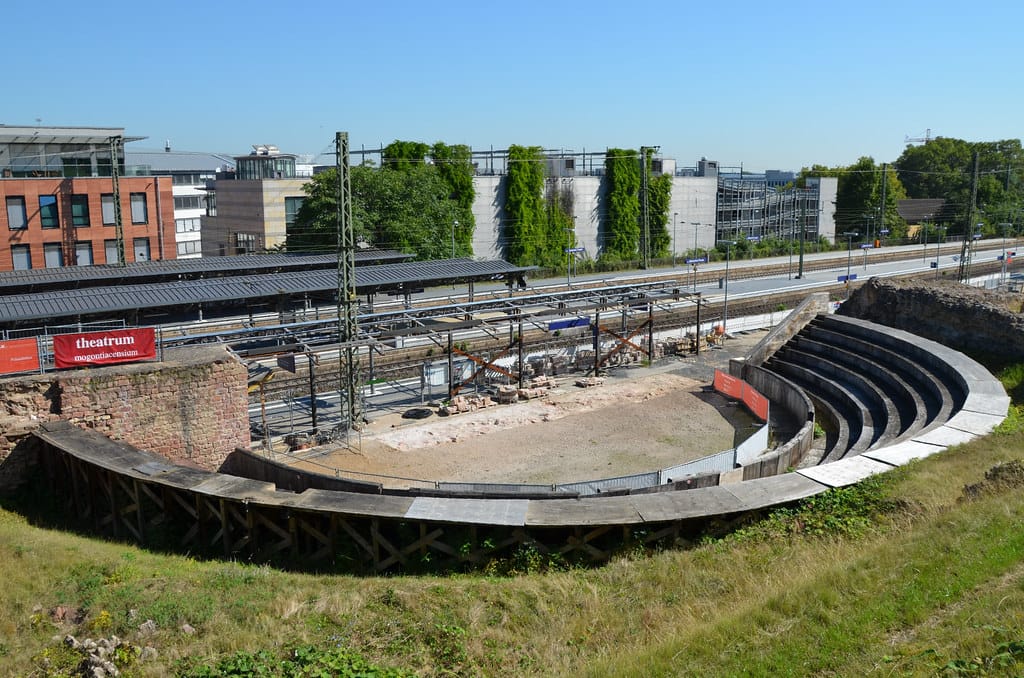
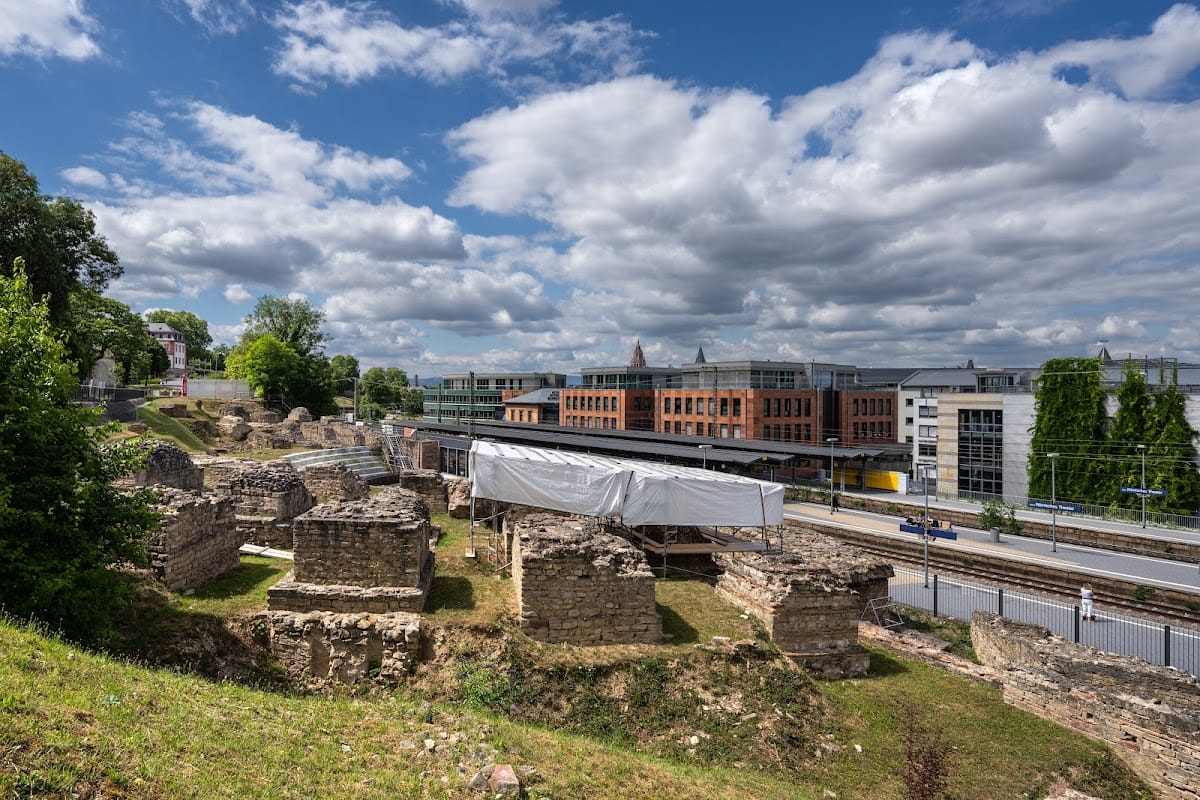
The Roman Theatre in Mainz was a large open-air structure with a seating area measuring 116 meters in diameter and a stage 42 meters wide. It was the largest Roman theatre north of the Alps, designed to hold around 10,000 spectators. The theatre was built using massive vaulted masonry, which allowed the structure to stand for centuries after it ceased operation.
Stone blocks from the seating tiers were gradually removed after the mid-4th century when the theatre was excluded from the city’s defensive walls. Foundations of the stage building were uncovered during 19th-century railway construction but were largely destroyed to make way for the station infrastructure.
Since 1998, excavations have uncovered pillar remains and other structural elements of the theatre. These finds have helped clarify the theatre’s layout and construction techniques.
The theatre’s remains lie adjacent to the Mainz South Station. The theatre is close to the Drusus monument, about 300 meters away.