Leibniz Center for Archaeology: A German Research Institution for Archaeology and Conservation
Site at a Glance
- Rating
- 5
- Popularity
- Very Low
- Country
- Germany
- Primary era
- Classical
- External website
- Open
- Eras represented
- Stone Age, Classical, Medieval
- Civilizations
- Roman
- Site type
- Museum
On this page13 sections
History
The Leibniz Center for Archaeology in Germany, formerly the Römisch-Germanisches Zentralmuseum, was founded in Mainz in 1852 as a scholarly institution for the study of Germanic and Roman antiquity. It developed from meetings in Dresden and Mainz that sought to unite German historical and antiquarian societies. A related museum in Nuremberg was intended to cover medieval antiquities, while the Mainz institution concentrated on classical antiquity and the prehistory of Germany.
Foundation and early collections
Ludwig Lindenschmit the Elder, a co-founder of Mainz’s Society for Research into Rhenish History and Antiquities, became the institution’s first director. He shaped it as a study collection made largely from copies, allowing scholars to examine important examples of classical and prehistoric material. The Mainz physician Carl Wenzel was another founding figure and a strong supporter of the project.
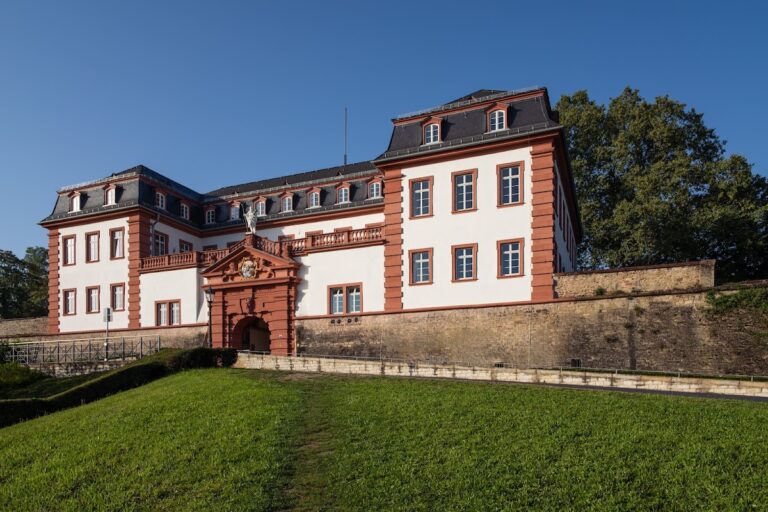
In 1853, the new museum moved into three rooms of Mainz’s Electoral Palace, a former residence of the prince-electors who governed the Electorate of Mainz within the Holy Roman Empire. Its first exhibition opened there in 1854 with 388 exhibits. The institution initially had no regular state funding and relied on small contributions from governments, princes, kings, and later the emperor, together with donations from Mainz residents and income from the sale of reproductions.
Lindenschmit rejected proposed mergers with the Nuremberg museum in 1855 and again in 1866 and 1867 because he feared that the Mainz department would be neglected. After the creation of the German Empire, the museum began receiving an annual subsidy in 1872. Following Lindenschmit’s death in 1893, Karl Schumacher became director in 1900, while Lindenschmit’s son, Ludwig Lindenschmit the Younger, became the second director. The collections then grew through additional casts and the purchase of original objects.
Expansion and wartime destruction
The museum’s premises expanded in 1910 with 22 newly arranged rooms. The Zeughaus, also known as the Sautanz building, was added for storage in 1930, and the Schirrmacherei became a workshop in 1934. Large parts of the exhibition areas, the storage building, and the workshop were destroyed during the Second World War. The Electoral Palace was subsequently occupied first by American forces and then by French forces.
The institution’s directors included Ludwig Lindenschmit the Elder from 1852 to 1893, Karl Schumacher from 1900 to 1926, Gustav Behrens from 1927 to 1952, Wolfgang Fritz Volbach from 1953 to 1958, Kurt Böhner from 1958 to 1981, Konrad Weidemann from 1982 to 2003, Falko Daim from 2003 to 2018, and Alexandra W. Busch from 2018.
Research institution and postwar development
The Society of Friends of the Römisch-Germanisches Zentralmuseum was founded in 1952. After the war, the museum continued to present itself chiefly as a study collection for specialists and informed non-specialists rather than as a general museum. Since 1977, it has been financed by the federal and state governments. In 2002, it joined the Leibniz Association, a publicly supported German network of independent research institutions in the sciences and humanities.
The institution investigated archaeology across the Old World and its contact zones, covering periods from the Paleolithic, or Old Stone Age, through the Middle Ages. Its work included human behavioral evolution, social and cultural change, cultural practices, contacts between societies, economy and technology, and the protection, authenticity, and reception of cultural heritage. Its specialist areas ranged from Pleistocene and Early Holocene archaeology to prehistory, Roman archaeology, early history, Byzantium, restoration and conservation, and materials analysis.
Projects examined prehistoric deposits, the formation of elites, the early Hungarians and the German Empire from the ninth to the eleventh century, cultural exchange in the medieval Crimea, Byzantine archaeology, the early Byzantine city of Caričin Grad, possibly Justiniana Prima, and environmental archaeology. Other work concerned the tomb of the Frankish king Childeric I, ancient and medieval organs, animal bones from an Avar cemetery in Vienna, and cooperation with Chinese partners on cultural-heritage preservation and research in Xi’an.
By 2016, cooperation with the universities of Reading and Leeds had produced the Samian Research online database. It links and supports analysis of approximately 250,000 entries for Terra Sigillata, fine Roman tableware whose forms, red surface, and makers’ marks help archaeologists study production and trade.
Relocation and the LEIZA name
A new archaeological center on the southern edge of Mainz’s city center, beside the Museum of Ancient Seafaring, was approved in December 2007. Construction was completed in September 2022, and the institution moved from October through the end of that year. The ceremonial handover of the keys to General Director Alexandra W. Busch took place on 28 September 2022.
On 1 January 2023, the institution adopted the name Leibniz Center for Archaeology, abbreviated LEIZA. It succeeded the Römisch-Germanisches Zentralmuseum and continued most of its research, presentation, and restoration work. The new buildings at the Ludwig-Lindenschmit Forum opened on 24 March 2023. The permanent exhibition in the Electoral Palace had closed to the public in June 2017 in preparation for the move, although limited viewing continued during special events and at the Museum of Ancient Seafaring. A separate archaeology museum with permanent exhibitions, including objects from the former collections, was planned for 2027.
LEIZA also maintained locations at the Vulkanpark, the Museum of Ancient Seafaring, and the MONREPOS Archaeological Research Center and Museum for Human Behavioral Evolution. It shared its work through lectures, special exhibitions, guided programs, excursions, and publications, including journals, monograph series, research volumes, catalogues, and guides to its displays.
Remains
The physical infrastructure of the Leibniz Center for Archaeology consists of historical museum premises, the new archaeological center at the Ludwig-Lindenschmit Forum, study and display collections, and specialized conservation facilities. Together, these spaces support archaeological research, object treatment, scientific analysis, documentation, and the faithful reproduction of important finds.
Historical museum premises
Electoral Palace rooms
The institution’s earliest exhibition and research space occupied three rooms in the Electoral Palace from 1853. The first exhibition displayed 388 exhibits when it opened in 1854. The premises were enlarged in 1910 by 22 newly arranged rooms, creating additional space for the growing collection and its scholarly use.
Zeughaus and Schirrmacherei
The Zeughaus, also called the Sautanz building, served as a storage facility from 1930. The Schirrmacherei, added in 1934, provided workshop space. Large parts of both buildings were destroyed during the Second World War, along with substantial sections of the exhibition areas.
New archaeological center
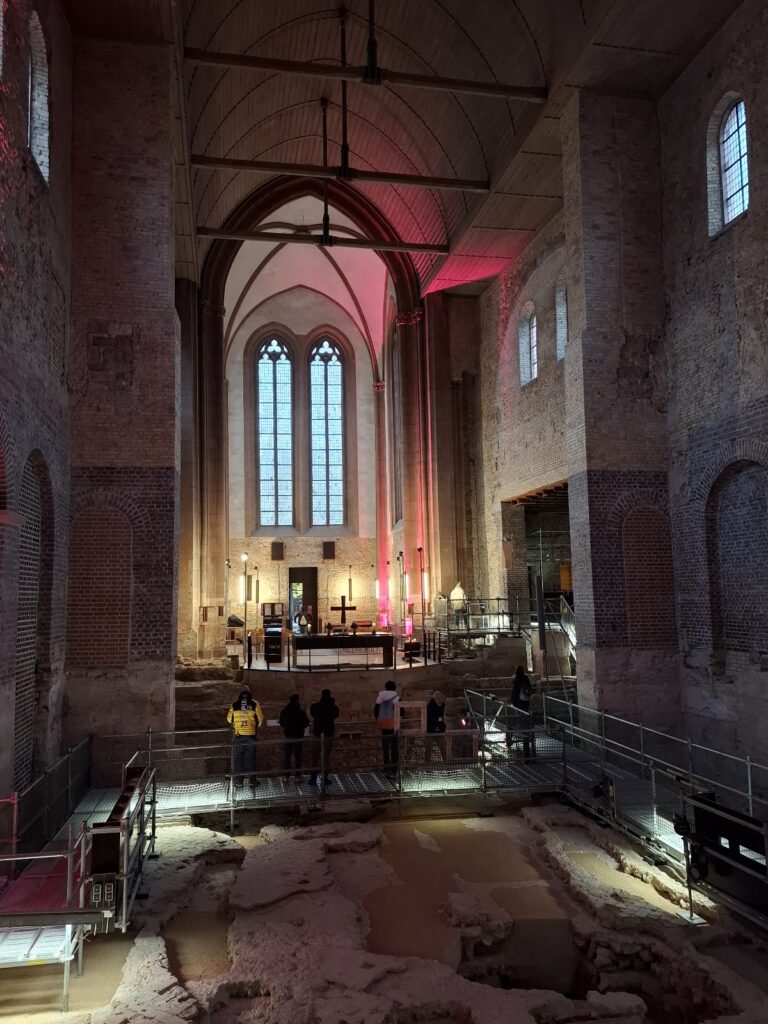
The present LEIZA complex forms part of an archaeological center at the Ludwig-Lindenschmit Forum on the southern edge of Mainz’s city center, beside the Museum of Ancient Seafaring. Its buildings were completed in September 2022 and occupied during the relocation later that year. The institution retains a permanent study and display collection, while a future archaeology museum in the complex was planned to include permanent exhibitions containing objects from the former Römisch-Germanisches Zentralmuseum collections.
Restoration and scientific facilities
Material-based workshops
The restoration facilities are organized by material and activity. They include workshops for ceramics, mould-making, coloring, and glass; two goldsmiths’ workshops for the technical study and reproduction of precious-metal objects; and three metal workshops for archaeological objects made from base metals. Additional facilities treat organic remains and small organic objects, while a wood-conservation department at the Museum of Ancient Seafaring handles large archaeological objects made of waterlogged wood.
Imaging and materials analysis
The workshops use microscopy, endoscopy, scanning electron microscopy, X-ray radiography, and computed tomography to examine objects. Their scientific analysis includes X-ray fluorescence, microprobe analysis, inductively coupled plasma mass spectrometry, and the identification of different chemical compounds. This work is part of archaeometry, the application of scientific methods to archaeological materials and objects.
Objects are selected chiefly for their scientific value, with particular attention to culturally important finds that require difficult conservation or specialized treatment. The workshops have investigated and treated archaeological material including the equipment of the glacier mummy Ötzi and a brass boar from Soulac-sur-Mer. Especially exceptional finds are reproduced faithfully for the collection. Restoration, conservation, documentation, scientific analysis, and the development of new treatment and reproduction methods are carried out through cooperation among conservators, natural scientists, and archaeologists, including specialists from Mainz University and Mainz University of Applied Sciences.