The Praetorium in Cologne: Roman Governor’s Palace of Lower Germania


Site at a Glance
- Rating
- 4.3
- Popularity
- Low
- Country
- Germany
- Primary era
- Classical
- External website
- Open
- Eras represented
- Classical, Medieval
- Civilizations
- Roman
- Site type
- Museum
On this page12 sections
History
The Praetorium in Cologne, Germany, was the official residence of the imperial governor of the Roman province of Lower Germania. Originating around the time of Christ’s birth, it became the political and administrative centre from which Roman authority was exercised along the Rhine and helped direct the systematic development and settlement of Cologne and its surrounding region.
Roman origins and development
The complex passed through several stages of construction. Archaeological investigation has identified four principal building periods, together with later alterations and extensions. These phases are represented by layered remains that preserve evidence of earlier Roman occupation as well as the palace’s subsequent development.
During the fourth century, the governor’s complex was transformed into a monumental palace. Its expansion reflected the continuing administrative role of Cologne within the Roman province. The palace and the earlier structures beneath it formed the central Roman component of what is now the Archaeological Zone, an archaeological area of approximately 6,000 square metres that preserves around 2,000 years of Cologne’s urban history.
Destruction and later urban phases
An earthquake at the end of the eighth century damaged or destroyed numerous buildings in Cologne and brought the historical development of the governor’s palace to an end. The effects of this earthquake remain an important subject of research, including investigations by the University of Cologne’s Seismological Institute and the Bensberg Seismological Station.
After the palace ceased to develop, the area acquired new roles during Cologne’s Frankish royal-seat and medieval urban phases. Excavations on and around Town Hall Square, including investigations begun in 2007 and continuing from 2012, revealed layers connected with the palace’s construction, its early medieval destruction, and the later resettlement of the area. Stratigraphic excavation, which studies the order of successive soil and building layers, allowed these phases and their associated finds to be dated more precisely.
Discovery and heritage setting
The foundations were found during post-war reconstruction excavations in 1953. Beneath the newly rebuilt Spanish Building of Cologne’s Town Hall, Otto Doppelfeld identified the palace remains and arranged for them to be conserved below the building and made accessible to the public. A further excavation led by Gundolf Precht in 1968 expanded knowledge of the complex’s building history.
The Praetorium is incorporated into the MiQua archaeological museum project and remains the central Roman element of the Archaeological Zone. Since 2021, it has also formed part of the UNESCO World Heritage property of the Lower Germanic Limes. This was the Roman frontier zone and associated military landscape along the lower Rhine, governed from Cologne. In 2025, a second-century lararium, a household shrine for protective deities and related religious observances, was discovered in the palace’s servants’ area. It has been described as the first lararium found north of the Alps.
Remains
The surviving archaeological area presents the Praetorium as a complex of monumental masonry, ceremonial and service spaces, later infrastructure, and associated urban remains. The fourth-century palace was organized around a central octagonal room flanked by two rectangular halls, with adjoining pillars and rounded apses, or semicircular-ended spaces. An east-facing gallery or portico, a covered architectural gallery or colonnade, stood before suites oriented toward the Rhine, while spacious courtyards extended westward beyond the present Archaeological Zone.
Palace architecture
Central palace rooms
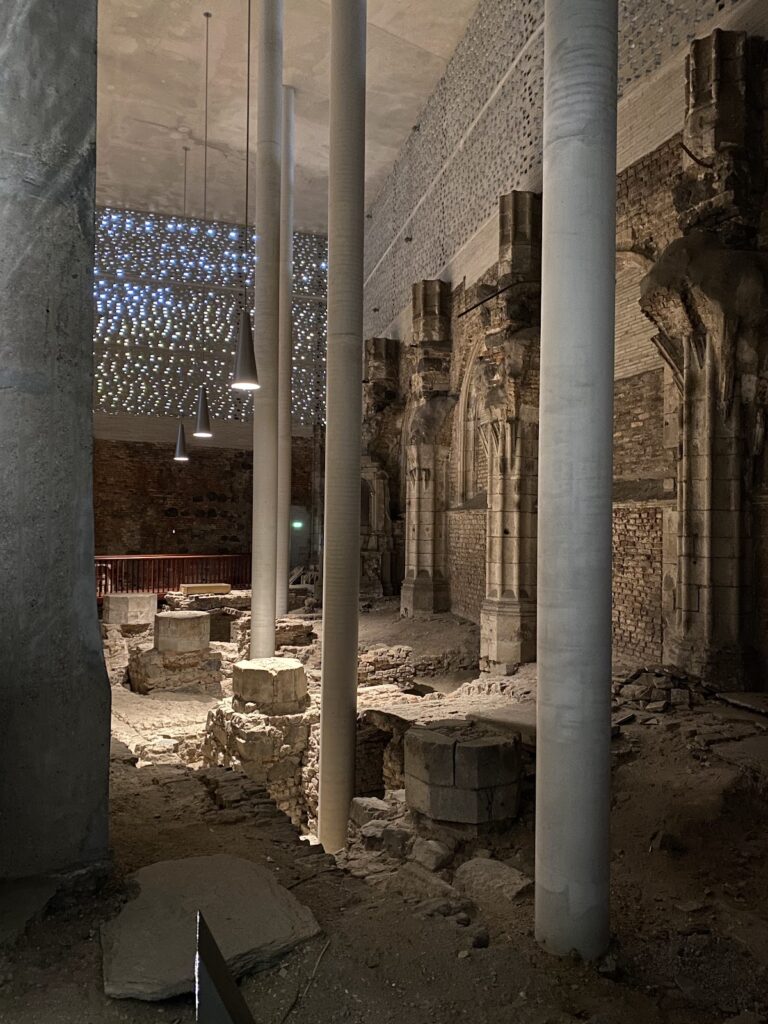
The monumental fourth-century walls survive in visible and accessible form beneath the Town Hall complex. Their masonry preserves cracks and displacements associated with the earthquake at the end of the eighth century. The exhibition area includes sections of wall, the octagonal room, and the eastern facade, allowing the principal elements of the palace plan to be understood through their surviving fabric.
Decorative and inscribed remains
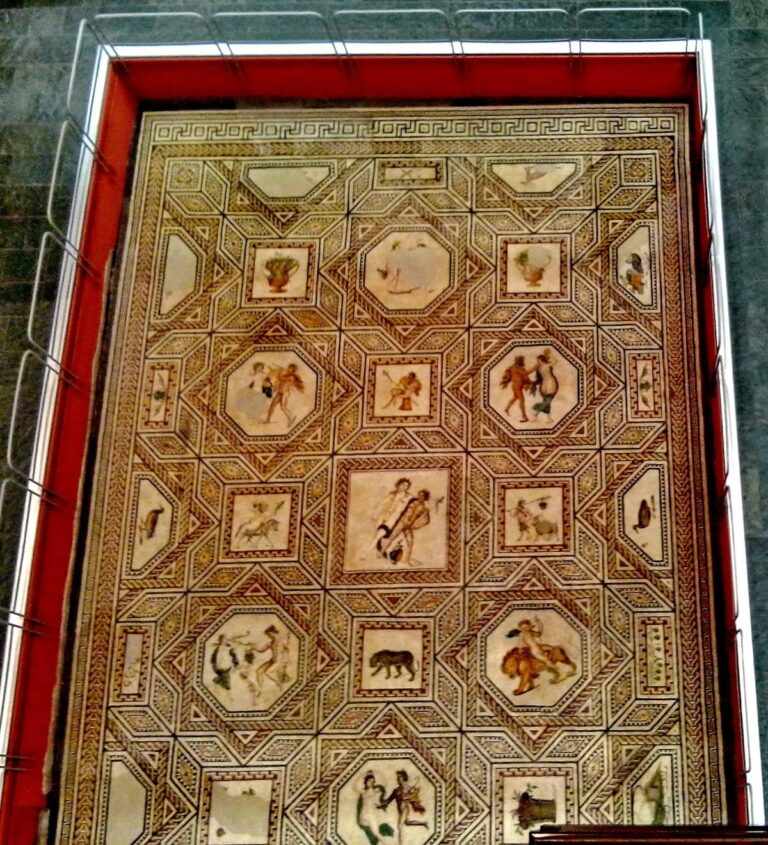
Excavated material from the palace includes pottery, glass, workshop fragments, lavish wall paintings, marble wall decoration, floors, mosaics, monumental sculpture fragments, and inscriptions on marble, limestone, and tufa. Finds specifically linked with the complex include a bust of the emperor Claudius, who ruled from AD 41 to 54, and a dedication stone recording a rebuilding of the Praetorium around AD 184 to 185.
Other associated objects include an epitaph for the Celtic soldier Catvnectvs, a gravestone belonging to Lucius Vicarinius, and an altar dedicated to Isis, an Egyptian goddess whose worship spread throughout the Roman Empire. A building inscription for the governor’s weapons chamber is connected with the emperor Trajan, who ruled from AD 98 to 117. Together, these remains illuminate the palace’s administration, personnel, religious practices, and imperial connections.
Roman drainage and adjoining structures
Great Budengasse sewer
One of Cologne’s principal Roman sewers ran beneath the Great Budengasse, crossed the Roman city wall, and continued toward the Rhine. It survives about eight metres below ground and can be followed for approximately 150 metres through an entrance tunnel from the Praetorium’s vestibule. Intact layers of fill were dated by accelerator mass spectrometry, a method that measures radiocarbon in archaeological material, placing the sewer’s abandonment in the third quarter of the fourth century.
Parallel sewer
A second sewer ran parallel to the main drainage route south of the principal archaeological area. It extends partly beneath the cellars along Obenmarspforten and is less completely preserved, although it contained abundant archaeological material. A gaming counter inscribed with the Latin word INVICTUS, meaning “unconquered,” was recovered from the sewer system.
Porticus and bath complex
A first-century Roman porticus was excavated beside the Historic Town Hall in 1969. The covered arcade or colonnade included a Roman portal. The same area also contained later remains of Cologne’s Jewish quarter and a hospital, showing how successive urban uses occupied the surroundings of the Roman complex.
Part of a warm bath was preserved in the former Jewish quarter above Roman remains of a bath complex thought probably to have belonged to the governor’s palace. The archaeological exhibition area brings these architectural remains together with the palace walls, eastern facade, octagonal room, and a Roman sewer or culvert, presenting the physical evidence of the complex and its infrastructure.