Kožlí Castle: A Medieval Noble Stronghold in the Czech Republic
Visitor Information
Google Rating: 4.5
Popularity: Low
Google Maps: View on Google Maps
Official Website: turistickamapa.cz
Country: Czechia
Civilization: Medieval European
Remains: Military

History
Kožlí castle is located in the municipality of Tisem-Neveklov in the Czech Republic. It was constructed during the medieval period by the local Bohemian nobility.
The earliest written mention of Kožlí dates to 1318, when it was associated with Ctibor of Kožlí. By the mid-14th century, brothers Konrád and Heřman, who previously held land near Chvojno, became its proprietors. During this era, the castle’s lords exercised the right to appoint clergy at the Church of St. James located in Chvojno, indicating their influence in both secular and religious matters.
Throughout the late 1300s, Kožlí remained in the possession of lesser noble families. Records from 1399 describe the castle as a hideout for bandits, reflecting a turbulent period in its history. Ownership shifted in the early 15th century to Petr of Pětichvost, an ally of King Václav IV, tying the site more closely to the royal political sphere.
From 1414 onward, the Libún family of Dubá emerged as prominent holders of Kožlí. Beneš (III.) Libún, an influential figure active in the Czech political scene, participated in significant military events such as the Battle of Lipany and the siege of Ostromeč. His son, Beneš (IV.) Libún, along with his wife Buzka of Makov, resided at Kožlí during a period when the castle gradually ceased to function as a noble residence.
In the early 1490s, control of Kožlí passed to the Sternberg family, who also owned the nearby Konopiště Castle. By 1495, Kožlí was described not as a full castle but as a fortified manor within the larger Konopiště estate. Over the course of the 16th century, the site fell into decline and was eventually deserted. By the end of that century, written sources referred to it as a ruined or abandoned chateau.
In the 19th century, the poet Karel Hynek Mácha visited the site during his travels in the Posázaví region in 1835. Although no surviving sketches from this visit are known, the location was recorded in a catalog under the name “Kožly,” illustrating a variation of the place name used over time.
Remains
Kožlí castle originally consisted of two main sections: an outer bailey and an inner castle, separated by a deep moat hewn directly into the rock. This moat created a protective barrier between the two parts, emphasizing the defensive nature of the stronghold. The passage connecting the outer and inner courtyards likely featured a drawbridge spanning the moat, positioned at a small gate tower that extended outward from the main curtain wall. This arrangement provided controlled access and enhanced security.
The inner castle showcased an architectural layout known as a two-palace design, considered among the earliest examples in Bohemia. At its core was a rectangular area with an entry gate leading into the first palace building. Beyond this lay a courtyard, which in turn gave access to a second palace located on the southeast side. These two palaces were linked by an inner curtain wall running along each side, enclosing the space and defining the castle’s heart.
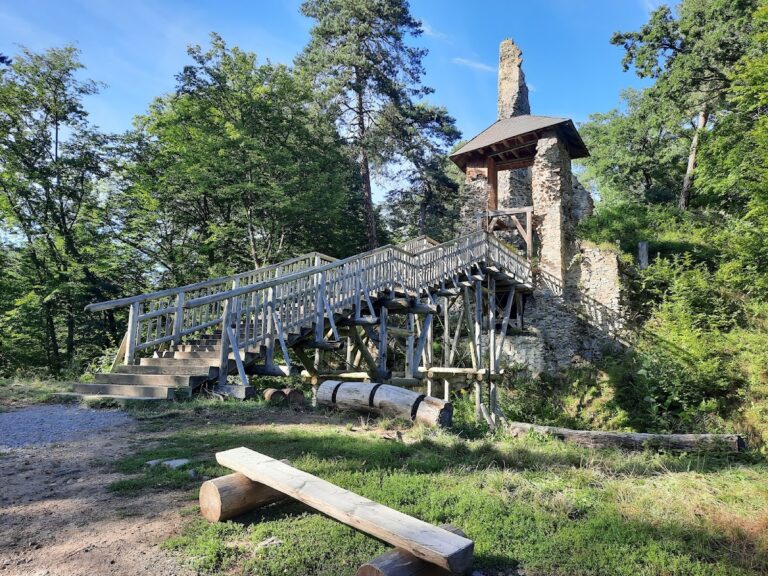
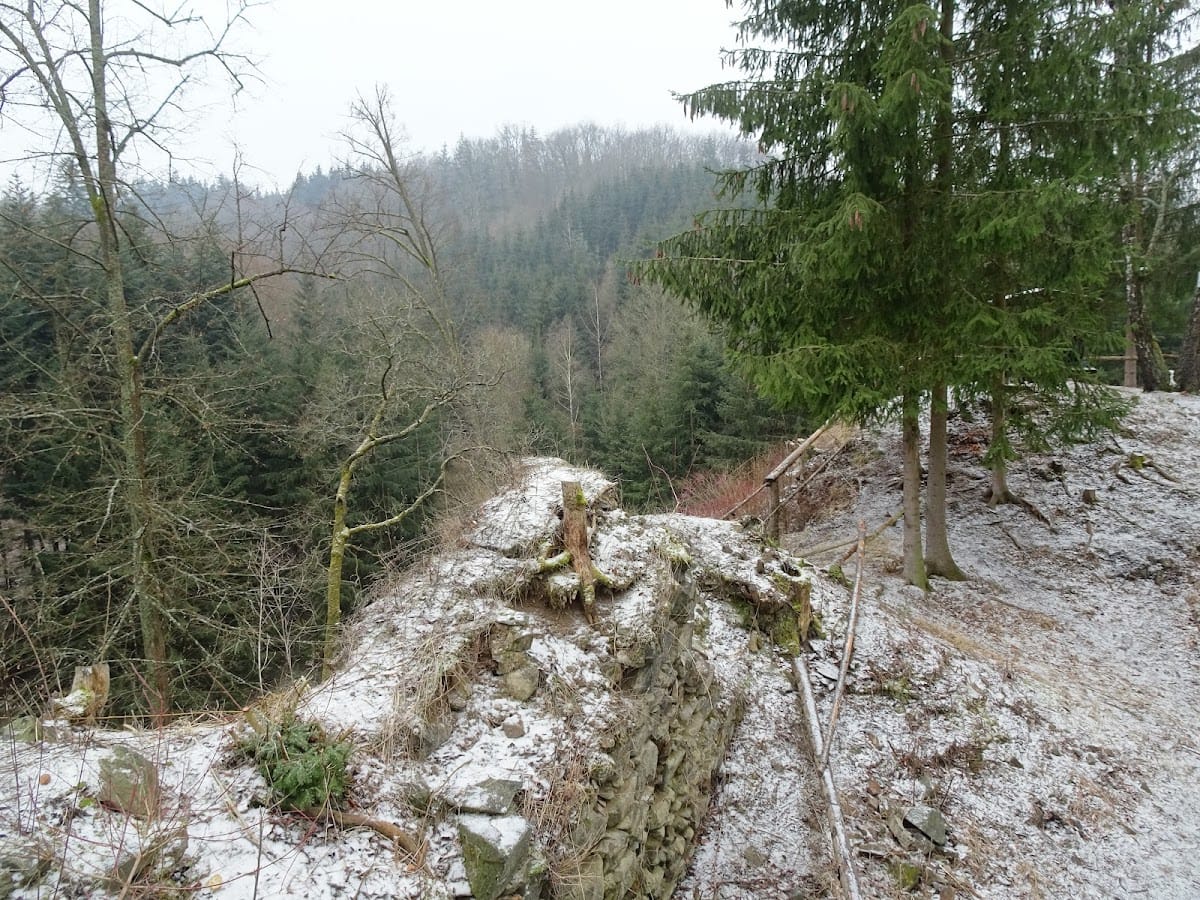
Surrounding the entire complex was an outer defensive wall, known as a parkán wall, forming a continuous enclosure that added an additional layer of protection. Among the castle’s surviving structures, the southeastern section of the parkán wall and a portion of the inner curtain wall on the same side are the best preserved to this day. Elsewhere, what remains mostly consists of uneven ground and traces of the former fortifications.
Recent clearing efforts have removed overgrown vegetation, revealing the fundamental layout of the castle site and facilitating study of its construction techniques. These archaeological features illustrate the castle’s role as a fortified noble residence from the medieval period until its decline and abandonment in the late 1500s.
Nearby sites