Zbořený Kostelec Castle: A Medieval Stronghold above the Sázava


Site at a Glance
- Rating
- 4.7
- Popularity
- Low
- Country
- Czechia
- Primary era
- Medieval
- Eras represented
- Medieval
- Civilizations
- Holy Roman Empire, Kingdom of Bohemia
- Site type
- Military
- Remains
- Castle
On this page11 sections
History
Zbořený Kostelec Castle is a medieval castle ruin in Czechia, near Týnec nad Sázavou. It was probably founded by Václav II, a Přemyslid king of Bohemia, in the late thirteenth century. The castle first appears in writing in 1342, when the Bohemian noble Oldřich Medek of Valdek held it as a pledge.
Royal pledges and noble ownership
Charles IV, king of Bohemia and Holy Roman Emperor, redeemed the castle in 1356. He soon pledged it again, beginning a succession of changes in ownership. The castle subsequently passed among several holders, including members of the Přemyslid dynasty and other Bohemian nobles.
The sieges of 1449 and 1450
Kuneš Rozkoš of Dubá became the castle’s last owner in 1443. His raids in the surrounding area led to a siege in 1449, which the castle resisted. A second siege began on 18 May 1450, and five days later an army commanded by Zdeněk Konopišťský of Šternberk captured the fortress. Zdeněk, a Bohemian noble, military commander, and political leader, then became its owner.
Fortification and destruction
In 1456, Zdeněk secured the abolition of the castle’s status as a fief, property held in return for service to a superior. He then newly fortified Zbořený Kostelec as one of his military strongholds. Zdeněk later became a leading opponent of King Jiří of Poděbrady. During the resulting conflict, a royal army captured and demolished the castle in 1467.
The ruin has been protected as a cultural monument of the Czech Republic since 1965.
Remains
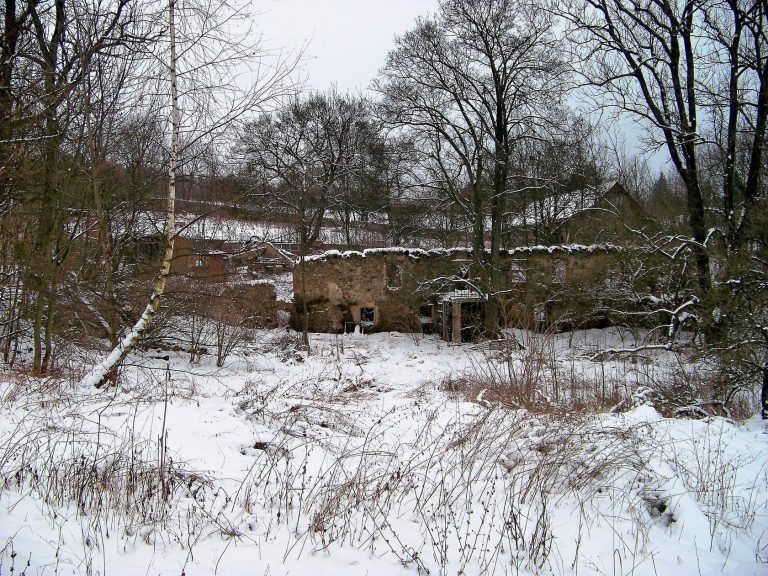
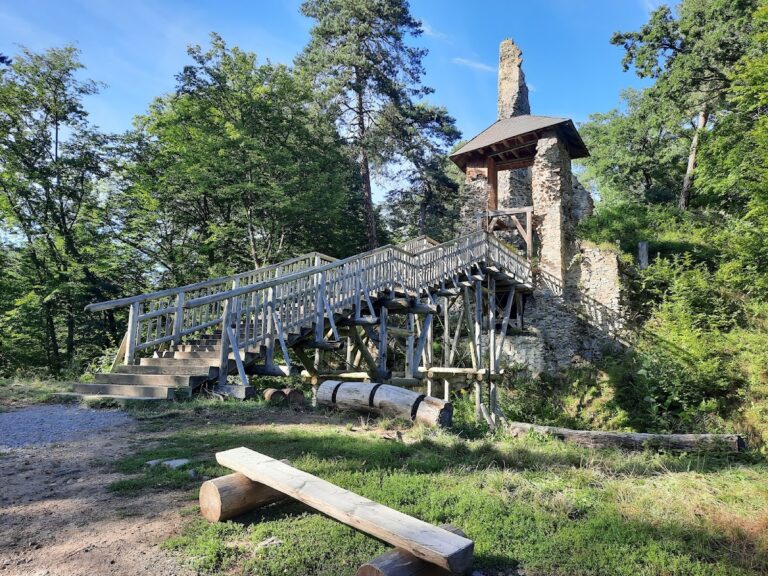
Zbořený Kostelec Castle occupies the highest part of a hill at approximately 300 metres above sea level, on a promontory above the right bank of the Sázava River near its confluence with the Kamenický Stream. It stands within the Čížov Nature Reserve, opposite the village of Zbořený Kostelec. The lower part of the site surrounded the castle core on three sides, while the core itself occupied the hilltop. The building history was complex, and its sequence cannot be reconstructed precisely without archaeological research.
Outer defenses
The surviving entrance gate belongs to the period of Kuneš Rozkoš of Dubá. It retains parts of the bridge’s pivot fittings and built-in stone seats. Kuneš also commissioned a round tower on the rock above the river and an outer rampart. A small additional gate and a bridge across the moat were later built to allow cannon to be hauled onto the outer rampart.
Castle core
The eastern curtain wall, a defensive wall enclosing the castle, is the only surviving element assigned to the earliest construction phase. The other parts of the core belong to later stages of development.
Southwestern palace
A tall palace supported by buttresses stood in the southwestern part of the core. Two further buildings were added there during Zdeněk Konopišťský’s alterations.
Northern palace
The best-preserved part of the castle is the two-room palace on the northern side of the core. Its surviving fabric forms one of the clearest elements of the hilltop complex.
River-side building
Above the river, on the opposite side of the courtyard, the surviving courtyard wall marks the position of another building.
Fortified encampment
Remains of a fortified encampment associated with the troops of Jiří of Poděbrady survive on the northern side of the castle. This feature preserves a physical trace of the military operations that shaped the site’s final history.